



We love seeing your favorite collections through your eyes. Thanks for sharing what makes them special with Signals.
These 5 collections had the most holders posting Signals this week: https://t.co/tT2a9jNRYZ


OpenSea is a peer-to-peer, self-custodial platform for discovering, buying, selling and minting NFTs, with token swaps across multiple blockchains. Founded in 2017, it has expanded from an NFT marketplace into a multi-chain trading platform supporting 25+ networks.
OpenSea was founded by Devin Finzer, its co-founder and CEO, and Alex Atallah, co-founder. The company entered Y Combinator in 2018. Its disclosed funding includes a $23 million Series A with participation from Andreessen Horowitz in March 2021, a $100 million Series B led by Andreessen Horowitz in July 2021, and a $300 million Series C led by Paradigm in January 2022. Total reported funding is $425.1 million. The company is headquartered in Miami, United States.
Users connect a self-custodial wallet to browse collection pages, make purchases, create listings and place offers. OpenSea does not hold user funds or take custody of tokens. Its supported chains include Ethereum, Solana, Base, Arbitrum, HyperEVM, Optimism, Abstract, Monad, Ink, Polygon, Avalanche and Zora, alongside other networks. Solana supports token swapping on the main platform, while Solana NFTs are available in OpenSea Mobile. OpenSea Studio lets creators deploy NFT contracts and mint items. It also supports NFT drops. Its developer API and Model Context Protocol server provide access to NFT and marketplace data.
Blockchain gas fees apply to transactions and attempted transactions, including unsuccessful mints. OpenSea does not control those network charges. OpenSea announced a 0% token-trading-fee period for 60 days from March 31, 2026. In September 2026, its mobile announcements described 0% platform trading fees and improved swap execution. The platform uses connected wallets rather than custodial accounts.
OpenSea launched in 2017 and introduced OS2 in 2025 as a rebuilt multi-chain trading platform. In October 2025, reported monthly activity reached $1.6 billion in cryptocurrency trading volume and $230 million in NFT trading volume. Trail of Bits reviewed the Seaport protocol. A 2022 phishing attack linked to an exploit in the Wyvern platform led to NFT theft from some users. In June 2022, an email vendor improperly shared about 1.8 million addresses. The SEC closed its investigation into OpenSea in February 2025 after issuing a Wells notice in August 2024. Creator-fee enforcement is documented, while the planned SEA token launch was delayed in March 2026.
OpenSea combines broad multi-chain access with self-custody, but buyers face gas costs, phishing and fake-collection risks, past security incidents and a delayed SEA token.
OpenSea is a self-custodial NFT marketplace that has expanded into token swaps across multiple supported networks, including Ethereum, Base, Arbitrum and Polygon. Solana currently supports token swapping on the main site, while Solana NFTs are available in OpenSea Mobile. The platform reported $230 million in NFT trading volume in October 2025, alongside $1.6 billion in cryptocurrency trading volume.
Its main strengths are breadth, creator tooling and wallet control. OpenSea Studio supports NFT mints and drops, while the developer API covers tokens, NFTs, swaps and marketplace events across supported chains. The marketplace does not hold user funds, so a connected self-custodial wallet remains responsible for assets and transaction approval. Gas applies to transactions and attempted transactions, including failed mints. The documented 0% token-trading period began on March 31, 2026 for 60 days.
OpenSea Studio includes drop configuration and presale stages. Creator-fee enforcement is documented. The SEA token was announced with community allocation and planned staking utility, then delayed in March 2026 from its planned launch.
The company has operated since 2017, was founded by Devin Finzer and Alex Atallah, entered Y Combinator, and raised $425.1 million across reported rounds including a $300 million Series C led by Paradigm. Its record includes a February 2022 phishing-related NFT theft, a June 2022 email-address disclosure affecting about 1.8 million addresses, and a Wells notice from the SEC in August 2024; the SEC closed that investigation in February 2025.
| Chains | Ethereum, Solana, Base, Polygon, Arbitrum, Avalanche, Other |
|---|---|
| Focus | Art, Collectibles, Gaming |
| Launchpad | Yes · unverified |
| Mobile app | Yes · unverified |
| Token | SEA · unverified |
| Points or rewards program | Yes · unverified |
Not disclosed by the provider: KYC required, Marketplace fee, Creator royalties, Aggregates other markets, Zero marketplace fee.
Data from the provider's website and public sources. Fees and availability change; confirm on the official site before you sign up.
Buy, sell and make offers on NFTs across Ethereum, Base and Arbitrum.
Swap tokens across supported chains through a connected self-custodial wallet. Solana currently supports token swaps.
OpenSea Studio supports NFT contract deployment, minting and primary drops, with gas fees charged by the underlying blockchain.
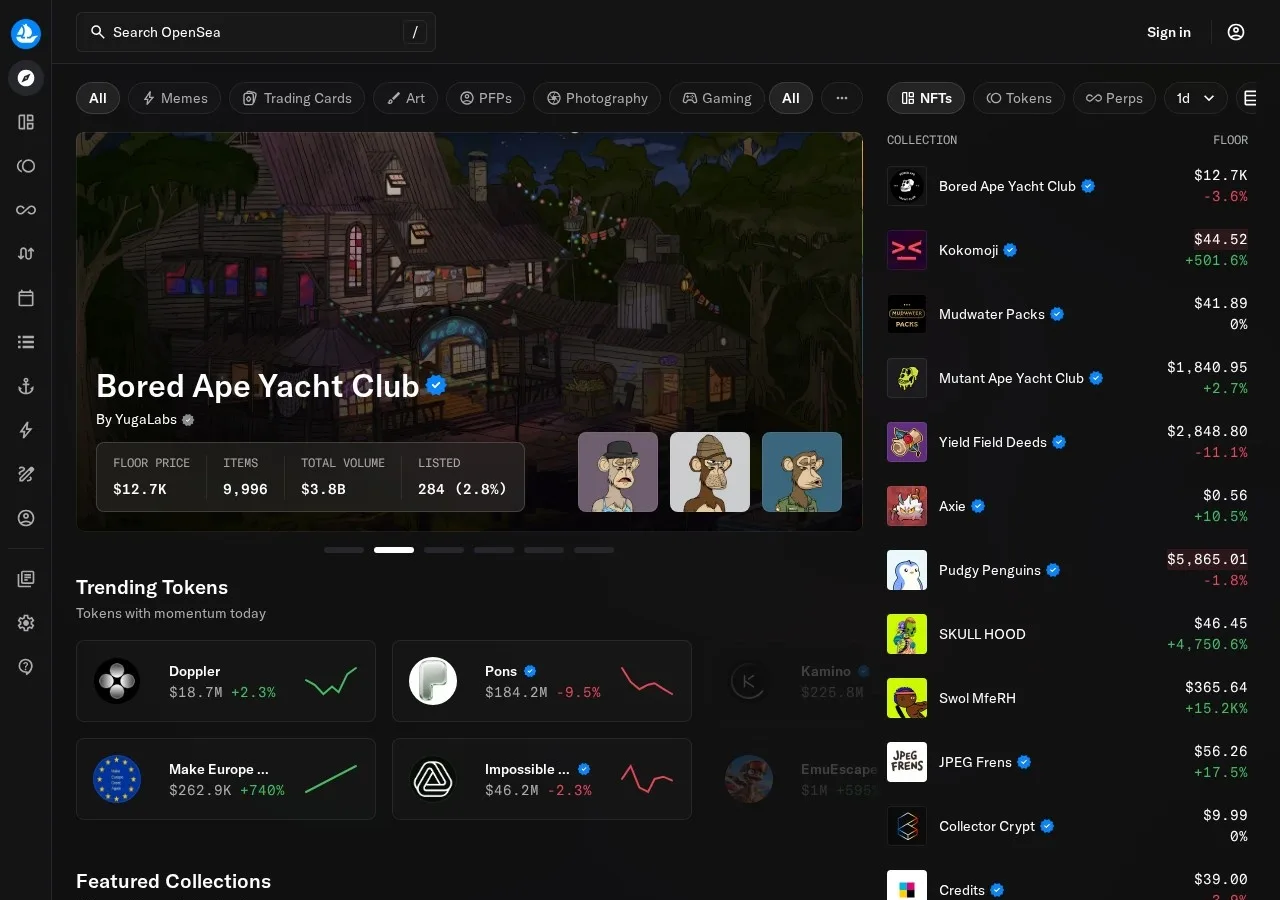
Collection and token pages provide real-time onchain data.
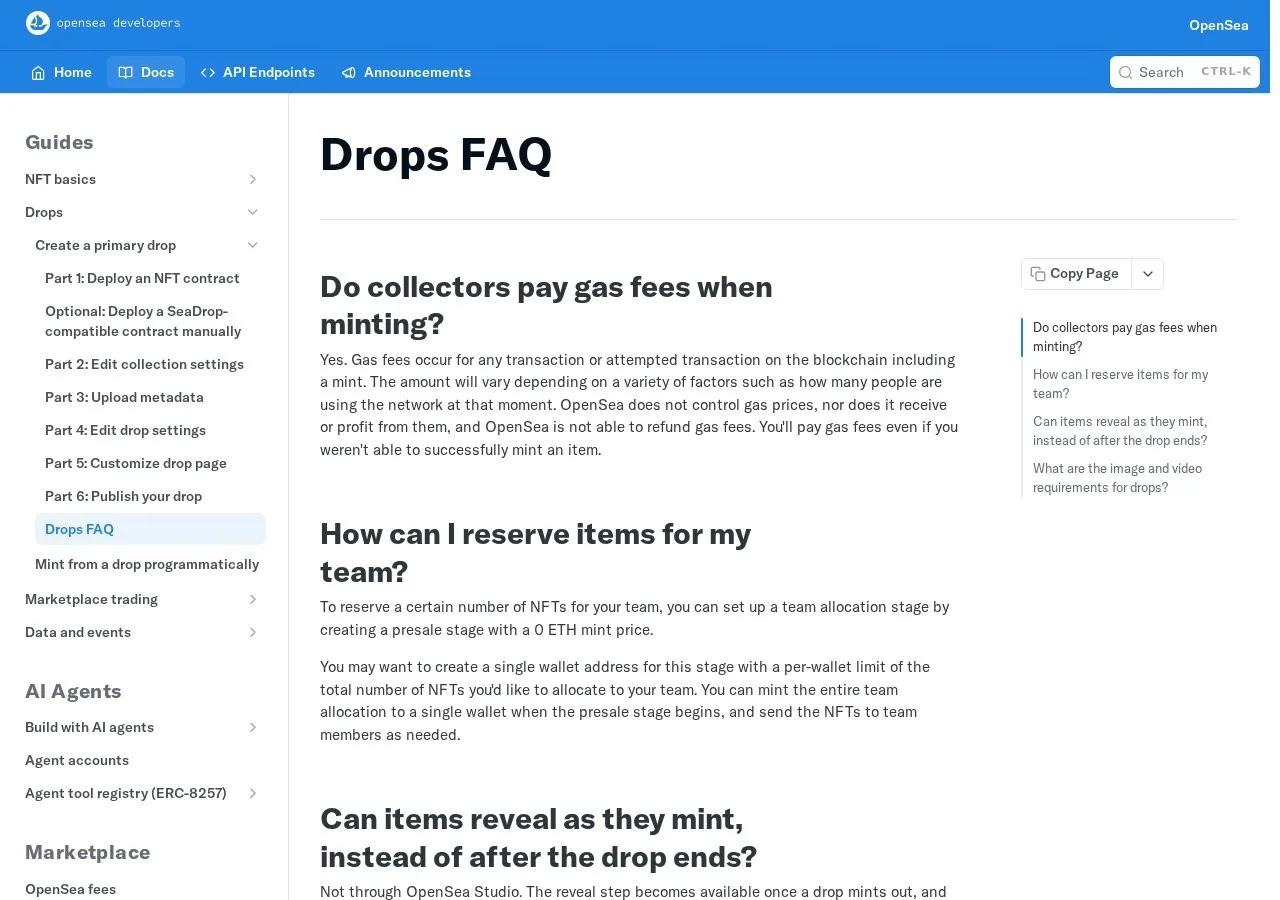
Creators can configure primary drops with presale stages, wallet limits, reveal settings and collection metadata.
The API covers tokens, NFTs, swaps, listings, offers, analytics and marketplace events across supported chains.
The Model Context Protocol server provides NFT, wallet and marketplace data, including collection verification and live offers.
OpenSea Mobile supports onchain trading and includes Solana NFTs, which went live on the app in September 2026.
The peer-to-peer marketplace lets users discover, buy, sell and mint NFTs and digital collectibles through connected self-custodial wallets. Collection pages include onchain listings and offers.
OpenSea supports token swaps across its listed networks through a connected wallet. Solana is supported for token swapping on the main platform, while Solana NFTs are available in OpenSea Mobile.
OpenSea Studio provides NFT minting and drop creation tools. Creators can configure presale stages, upload metadata and publish a drop page.
The developer API provides access to token, NFT and swap data, plus marketplace analytics and events across supported chains. Documentation also covers listings and offers.
OpenSea's Model Context Protocol server provides real-time NFT, wallet and marketplace data for developers and AI applications across multiple chains. Its data includes collection verification and live listings and offers.
Most discussion around OpenSea is self-promotion, collection links and referral-code requests, with little substantive product feedback. The clearest praise is for app speed and fixes after updates, while the main complaint is the need for ETH to cover gas fees.
“app used to take three coffees to load a collection. this is an improvement. speed does cut into the time i spend talking myself out of buying things, so mixed feelings.”
“Check the app update. I experienced the same thing, but after update the problem is gone”
“you have to send eth from another wallet to that wallet, so you can have eth to pay for network fees.”
“you need to put some eth in your wallet first, you cant pay gas fees with eurc so its stuck until you do”
Scam warning: Fake NFT airdrop emails and links ask users to connect wallets
Scam warning: Suspicious offers can request WETH spending approval
Based on 200 Reddit posts and comments from the last 12 months, checked Oct 17, 2026. These are posts by users on other sites, not reviews submitted on CryptoReview.
No user reviews yet. Have you used OpenSea? Share your experience below.
OpenSea was founded in 2017 by Devin Finzer and Alex Atallah. Finzer is the company's co-founder and CEO.
OpenSea's documented token-trading fee was 0% for 60 days starting March 31, 2026. Blockchain gas fees still apply to transactions and attempted transactions, including unsuccessful mints.
OpenSea supports Ethereum, Solana, Base, Arbitrum, HyperEVM, Optimism, Abstract, Monad, Ink, Polygon, ApeChain, MegaETH, Soneium, Somnia, AnimeChain, Avalanche, B3, Berachain, Blast, Flow, GUNZ, Robinhood Chain, Ronin, Sei, Shape, Unichain and Zora. Solana token swaps are available on the main platform, while Solana NFTs are available in OpenSea Mobile.
OpenSea is self-custodial and does not hold user funds. Its Seaport protocol has been reviewed by Trail of Bits. A phishing-related NFT theft affected some users in February 2022, and an email vendor incident exposed about 1.8 million addresses in June 2022.
OpenSea has a planned SEA token, but its launch was delayed in March 2026 from the planned March 30 kickoff. The announced plan included a community allocation and staking utility.
Yes. OpenSea Studio lets creators mint NFTs and create drops. Its tools include presale stages, collection settings, metadata uploads and custom drop pages.

Recent public posts from @opensea, shown as published. Not reviewed or endorsed by CryptoReview.
Recent posts from the official Telegram channel @officialopensea, shown as published. Not reviewed or endorsed by CryptoReview.
Creator-owned smart contracts and direct NFT minting across Ethereum, Base, and OP Mainnet
On-chain generative art marketplace and launchpad on Ethereum, Arbitrum, and Base
Multichain NFT minting and tokenization infrastructure supporting Cardano, Solana, and Aptos
Multi-chain gaming and collectibles NFT marketplace built on the AtomicAssets standard
Tezos digital art and NFT marketplace with 5% seller fees and royalty support
Solana NFT and real-world asset ecosystem featuring embedded licensing and the AART token
Type at least two characters. Press ↵ to see all results.