

Every interaction, support & partnership has been indispensable in our journey. These efforts have helped shape these tools to imagine a new future for decentralized finance, and they have our eternal gratitude. Here’s a detailed note about the closure https://t.co/0khneWn75E

Lendroid
Open-source decentralized lending protocol codebase originally built on Ethereum in 2017
2.0/ 5
Our score
Weak
Chains
Ethereum
Governance token
LST
What is Lendroid?
Lendroid was an open, non-custodial decentralized lending and margin trading protocol built on Ethereum. Operating as a non-rent-seeking network, the system coordinated borrowers, lenders, and margin traders without native platform commissions before the foundation concluded its research initiatives and ceased operations.
Team and background
The project was founded in Singapore in 2017 by Vignesh Sundaresan through the Lendroid Foundation. Sundaresan is a software architect and co-founder of BitAccess, a company that deployed Bitcoin ATMs across 18 countries. In February 2018, the foundation conducted a public token sale for the Lendroid Support Token (LST), establishing a hard cap of 5,000 ETH divided equally among 10,976 whitelisted registrants alongside earlier private sale stages.
Protocol mechanics and architecture
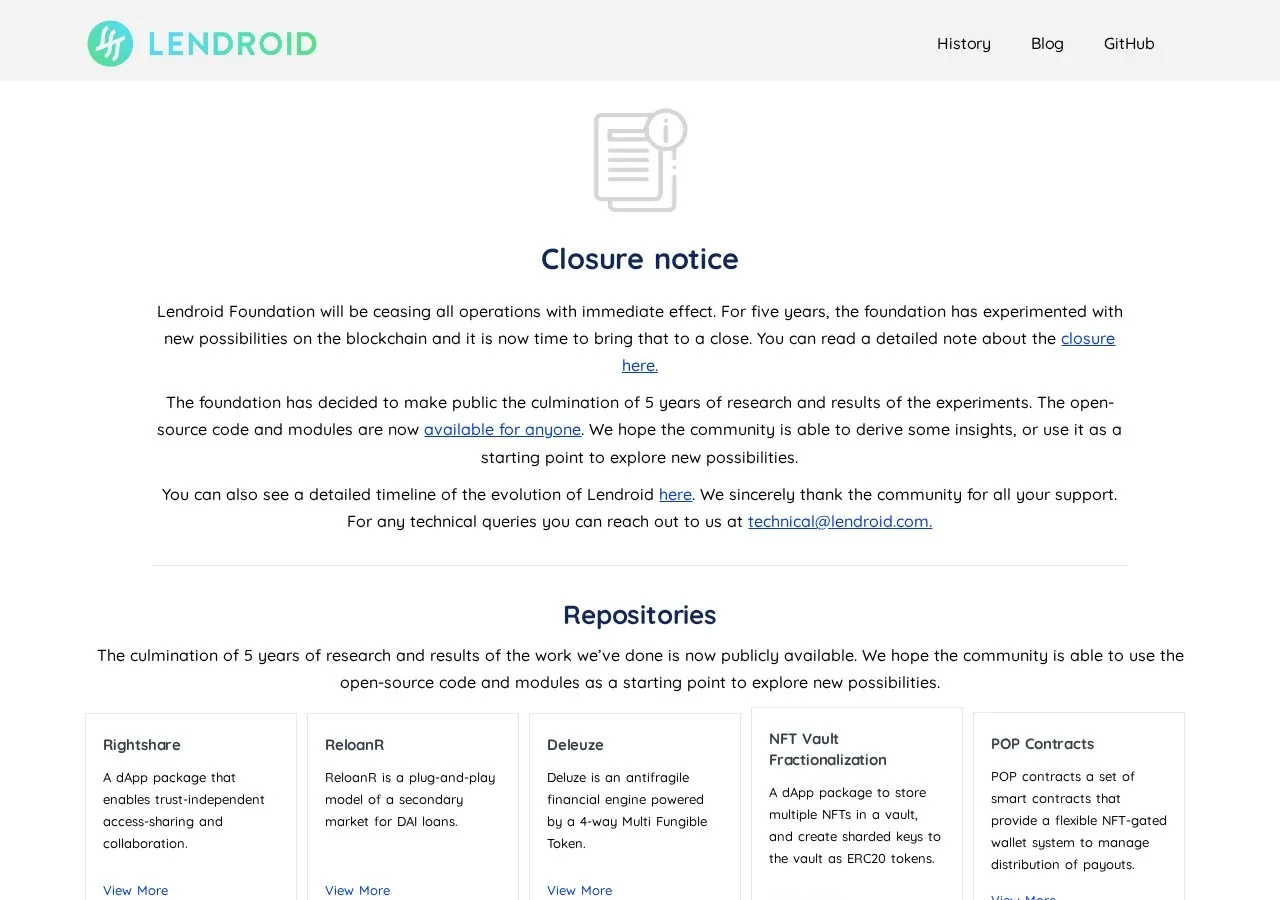
Lendroid was an on-chain settlement and off-chain order-coordination layer on Ethereum. The protocol relied on the native LST token to manage utility and handle decentralized governance. Alongside lending, the ecosystem developed supplementary financial and tokenization packages, including ReloanR for secondary DAI loan trading, Deleuze for multi-fungible asset engines, Rightshare for access sharing, and fractional NFT vault contracts with sharded ERC20 keys.
Fees and access
Smart contracts on Lendroid operated without native extraction or protocol fees, meaning interactions occurred directly peer-to-peer or pooled between trading participants who exchanged interest directly. Access was non-custodial.
Closure and risks
In December 2022, after five years of development and research, the Lendroid Foundation ceased all operations. The team made its codebases, including NFT-gated payout contracts, publicly available as open-source repositories for independent study or redeployment. Because official development and infrastructure support ended, anyone interacting with forks or unmaintained contracts faces typical DeFi risks such as smart contract vulnerabilities and liquidation failures.
Founders
Vignesh SundaresanFounder
Serial entrepreneur, software architect, Y Combinator alumnus, and co-founder of BitAccess.
Best for:Developers studying legacy DeFi architecturesResearchers analyzing open-source lending contractsTeams reviewing NFT fractionalization code
Pros and cons
Pros
- Smart contracts and modules are fully open source for community inspection
- Non-rent-seeking model operates without native commission fees
- Non-custodial architecture with no identity verification requirements
Cons
- Ceased all operations in December 2022 with no active maintenance
- No active hosted application or official operational liquidity pools
- Native LST token utility is obsolete following the shutdown
- Lacks ongoing security monitoring and bug bounty coverage
Our review
2.0/5
Weak
Lendroid provided non-rent-seeking decentralized lending frameworks on Ethereum, but the protocol ceased all operations in December 2022, leaving only open-source repositories for developers.
Lendroid was an open, non-custodial lending and margin trading protocol built on Ethereum by the Singapore-based Lendroid Foundation. Founded in 2017 by software architect and Y Combinator alumnus Vignesh Sundaresan, the protocol was designed to operate as a non-rent-seeking utility layer where lenders and off-chain relayers interacted without protocol-level cut fees. Operations were supported by its native Lendroid Support Token (LST), which raised 5,000 ETH during its February 2018 crowdsale.
Its research outputs included ReloanR, a secondary market concept for DAI debt, and specialized decentralized applications for sharding NFT ownership and managing access rights. Because smart contracts ran on Ethereum without native extraction fees, participating actors paid fees directly between themselves rather than paying platform commissions.
The central drawback is that Lendroid is no longer an active, running service. In December 2022, the Lendroid Foundation ceased all operations after five years of development and made its codebases publicly available. Lendroid is no longer an active, running service.
Lendroid suits developers and blockchain researchers seeking open-source smart contract modules for access sharing or secondary debt markets.
Sources (1)
Specs
| Chains | Ethereum · unverified |
|---|---|
| Governance token | LST · unverified |
| Own stablecoin | No · unverified |
Not disclosed by the provider: KYC required, Lending model, Main collateral assets, Flash loans, Permissionless markets, Audited, Bug bounty, Isolated markets, Real-world-asset collateral, Rates.
Data from the provider's website and public sources. Fees and availability change; confirm on the official site before you sign up.
Key features
Non-rent-seeking lending
Executes loans without platform-level protocol fees, transferring all interest directly between participants.
Secondary market trading via ReloanR
Provides a plug-and-play secondary market architecture specifically designed for trading active DAI loans.
Deleuze multi-fungible engine
Operates an antifragile financial engine powered by four-way Multi Fungible Tokens on Ethereum.
NFT vault fractionalization
Secures multiple non-fungible tokens in a smart contract vault and issues sharded ERC20 ownership tokens.
POP contract management
Supplies flexible NFT-gated wallet contracts to manage the distribution of protocol payouts.
Trust-independent Rightshare
Enables decentralized access-sharing and collaboration across connected decentralized applications.
Inside Lendroid
Rightshare
A decentralized application package built to facilitate trust-independent collaboration and access-sharing.
ReloanR
A plug-and-play secondary market architecture specifically designed for trading DAI debt positions.
Deleuze
A financial engine concept structured around a four-way Multi-Fungible Token design.
NFT Vault Fractionalization
A smart contract module that stores multiple NFTs in a vault and issues fractional ownership keys as ERC20 tokens.
POP Contracts
An NFT-gated smart contract system engineered to automate and manage payout distributions across wallets.
Lendroid screenshots
User reviews
No user reviews yet. Have you used Lendroid? Share your experience below.
FAQ
Is Lendroid still active?
No, Lendroid ceased all operations in December 2022. The Lendroid Foundation archived its platforms and made its code repositories publicly available for developers.
Who founded Lendroid?
Lendroid was founded in 2017 by Vignesh Sundaresan, a software architect, Y Combinator alumnus, and co-founder of BitAccess.
What blockchain did Lendroid operate on?
Lendroid was built and deployed on Ethereum.
Does Lendroid have a native token?
Yes, Lendroid introduced the Lendroid Support Token (LST), which was sold through a token crowdsale in February 2018 to coordinate off-chain network actors.
What fees did Lendroid charge?
Lendroid operated on a non-rent-seeking model with no native protocol fees. Lenders, borrowers, and relayers transacted directly with each other.
Latest from Lendroid on X
Throughout the foundation's existence, we've been fully compliant with stringent Singapore law, with diligent accounting and external audits, and we thank our consultants for their support. We've weathered extreme volatility while remaining ethically and financially prudent.
We have an announcement - After 5 years of working to build decentralized finance tools, the time has now come to bring it to a close. Lendroid foundation will cease operation with immediate effect. We want to thank the team, contributors and community for all their support.
We felt heard for the first time at ETH India. The vibe that Shakti created - welcoming, efficient, aspirational- inspired us to do better. He is sorely missed.
$hrimp supply at 36 mn. New NFTs. More functionality to look forward to.
Recent public posts from @lendroidproject, shown as published. Not reviewed or endorsed by CryptoReview.
Alternatives to Lendroid

Permissionless lending protocol and curated vaults securing over $11B across EVM chains
No KYCIsolated marketsEthereum · Base +2Permissionless markets

Pooled lending protocol founded in 2017, operating across 23 blockchain networks
No KYCPooledEthereum · Base +4Audited

Algorithmic money market lending single base assets across EVM networks since 2018
No KYCIsolated marketsEthereum · Arbitrum +1Audited

Solana money market protocol built by Jupiter with over $1B in total value locked
No KYCPooledSolanaAudited

Solana lending and liquidity protocol with over $1.3B in TVL and fixed-rate borrow markets
PooledSolanaAudited

Institutional onchain lending protocol managing over $4.6B across overcollateralized credit pools
KYC requiredPooledEthereumAudited