



Another big week on Kamino:
▫️ Kamino Fixed Rates crossed $75M in active loans
▫️ The Backpack Market launched, letting users borrow USDC against @Backpack Securities' 1:1-backed tokenized equities, including $MU, $SKHY, $SPCX and $SNDK
▫️ The @SentoraHQ Huma PST Market went live and grew to $10M, letting users borrow PYUSD against @humafinance's PST
▫️ Over $10M in fixed-rate loans are now active in the @onrefinance Market

Kamino
Solana lending and liquidity protocol with over $1.3B in TVL and fixed-rate borrow markets
4.0/ 5
Our score
Very good
Lending model
Pooled
Chains
Solana
Audited
Yes
Governance token
KMNO
What is Kamino?
Kamino is a decentralized credit and liquidity protocol built on Solana. It combines pooled collateral lending, automated liquidity vault strategies, fixed-rate loans, and real-world asset markets, holding over $1.3B in total value locked in October 2026.
Leadership and backing
Founded in 2022, Kamino raised venture funding from investors including ParaFi Capital and Alliance. In September 2026, the project named former Yieldstreet co-founder Michael Weisz as chief executive officer to lead its institutional credit push and oversee the establishment of an office in New York City. The leadership team expanded in October 2026 with the hiring of Matthew Klopfer to direct U.S. institutional markets alongside Blake Messer focusing on AI transaction systems.
Product architecture and mechanics
Kamino operates markets deployed on the Solana blockchain. Its flagship lending primitive, Kamino Lend, uses pooled peer-to-pool borrowing alongside segmented liquidity configurations such as the PRIME market, which held over $600M in deposits by late 2026. The platform also offers automated liquidity management vaults for concentrated liquidity positions, automated leveraged yield strategies, fixed-rate borrowing positions, and a decentralized exchange module designed for tokenized equity and real-world assets. Governance uses the KMNO token.
Track record and audits
Since its launch in 2022, Kamino has processed more than $650B in cumulative transaction volume. Active loan balances reached $909M in October 2026, generating $5.05M in protocol fees over a 30-day period and surpassing $51M in cumulative protocol revenue. The protocol smart contracts have undergone third-party security audits published via its dedicated security directory.
Risks and considerations
Collateralized positions face automated liquidation if asset prices drop, introducing bad debt risks during extreme market volatility or network latency. Lenders also remain exposed to smart contract bugs across core lending pools and connected automated market maker vaults, variable interest rate spikes, and collateral depeg events among tokenized assets.
Best for:Solana crypto asset borrowersDeFi liquidity providers seeking automated compoundingTraders using leveraged yield loopsLenders seeking fixed-rate credit terms
Pros and cons
Pros
- Over $1.3B in TVL and $909M in active loans on Solana in October 2026
- Processed more than $650B in cumulative volume across four years of operation
- Offers fixed-rate borrowing alongside variable pooled lending markets
Cons
- Operates exclusively on Solana with no native deployments on other chains
- Collateral is exposed to automated liquidations during high-volatility events
- Smart contracts carry exploit risks across multiple complex yield and vault primitives
- Variable borrowing rates can spike rapidly during liquidity contractions
Our review
4.0/5
Very good
Kamino provides deep liquidity and automated lending on Solana, though users take on variable borrowing costs and complete concentration risk on a single blockchain.
Kamino operates as a credit and liquidity protocol on Solana. Founded in 2022 and backed by Alliance and ParaFi Capital, the protocol managed roughly $1.38B in total value locked and more than $909M in active borrowings as of October 2026. Under CEO Michael Weisz, appointed in September 2026, the team is establishing a headquarters in New York City and focusing on institutional credit, tokenized equities, and fixed-rate products alongside its retail liquidity pools.
The protocol's primary lending engine, Kamino Lend, pairs automated pooled markets with specialized vaults and leveraged yield loops. Users can lend collateral or borrow against supported crypto assets through Solana wallets. Beyond variable rate borrowing, Kamino offers fixed-rate facilities, which crossed $55M in active loans in October 2026, alongside an RWA exchange and auto-rollover tools.
Kamino has several functional strengths:
- Deep lending liquidity on Solana, managing over $600M in its prime lending market alone.
- An integrated suite combining flexible lending facilities with automated yield vaults.
- Audited smart contracts with reports hosted openly on its security portal.
The trade-offs stem largely from asset design and network reliance. Kamino lives entirely on Solana, meaning downtime or performance issues on the network directly halt liquidations and position adjustments. Variable interest rates can spike unpredictably during high volatility, exposing leveraged borrowers to sudden liquidation cascades if oracles report rapid collateral depegs.
Specs
| Lending model | Pooled |
|---|---|
| Chains | Solana |
| Audited | Yes |
| Governance token | KMNO |
| Rates | Variable and fixed · unverified |
Not disclosed by the provider: KYC required, Main collateral assets, Flash loans, Permissionless markets, Bug bounty, Isolated markets, Real-world-asset collateral, Own stablecoin.
Data from the provider's website and public sources. Fees and availability change; confirm on the official site before you sign up.
Key features
Pooled peer-to-pool lending
Users supply assets to earn interest or borrow against supported Solana collateral across main and specialized pools like the PRIME market.
Fixed-rate borrowing
Lending contracts allow borrowers to lock in predictable borrowing costs, surpassing $55M in active fixed-rate loans in October 2026.
Automated liquidity vaults
Concentrated liquidity vaults automate liquidity management and compound yield on Solana decentralized exchanges.
Leveraged looping strategies
Built-in multiply strategies let borrowers loop yield-bearing collateral with automated roll-over capabilities.
RWA and tokenized equity markets
Dedicated credit and DEX facilities support tokenized equities and real-world assets, surpassing $50M in tokenized equity supply.
Inside Kamino
Kamino Lend
The main peer-to-pool borrowing primitive allowing users to deposit crypto collateral, earn yield, and draw variable-rate loans.
Kamino Liquidity
Automated market-maker vaults that auto-compound concentrated liquidity positions on Solana decentralized exchanges.
Fixed Rates
Fixed-term borrowing and lending pools that let users lock borrowing rates and automate leveraged positions with auto-rollover.
RWA DEX
A decentralized exchange product focused on real-world assets.
Kamino Institutional Yield
Institutional yield products tracked as part of Kamino's product set.
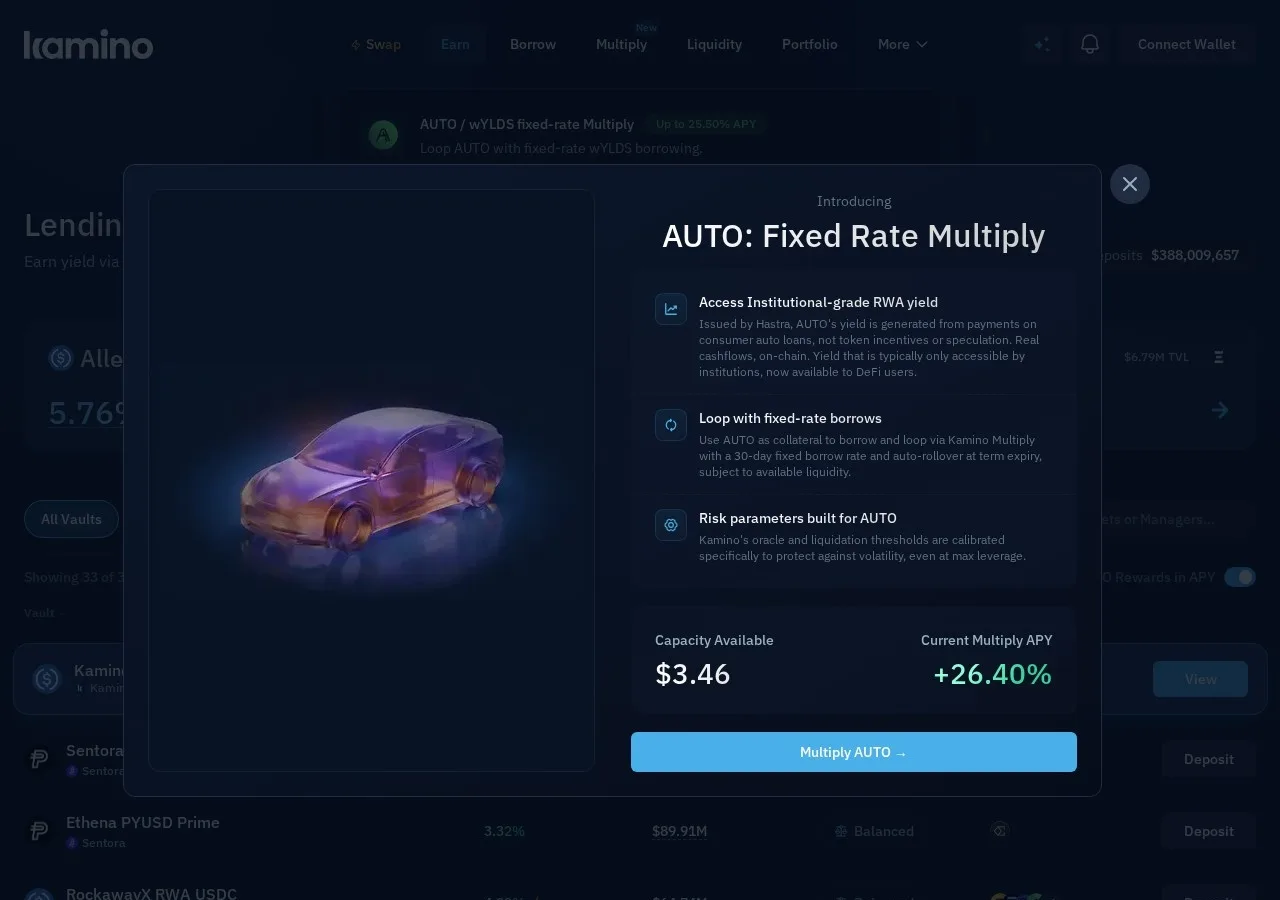
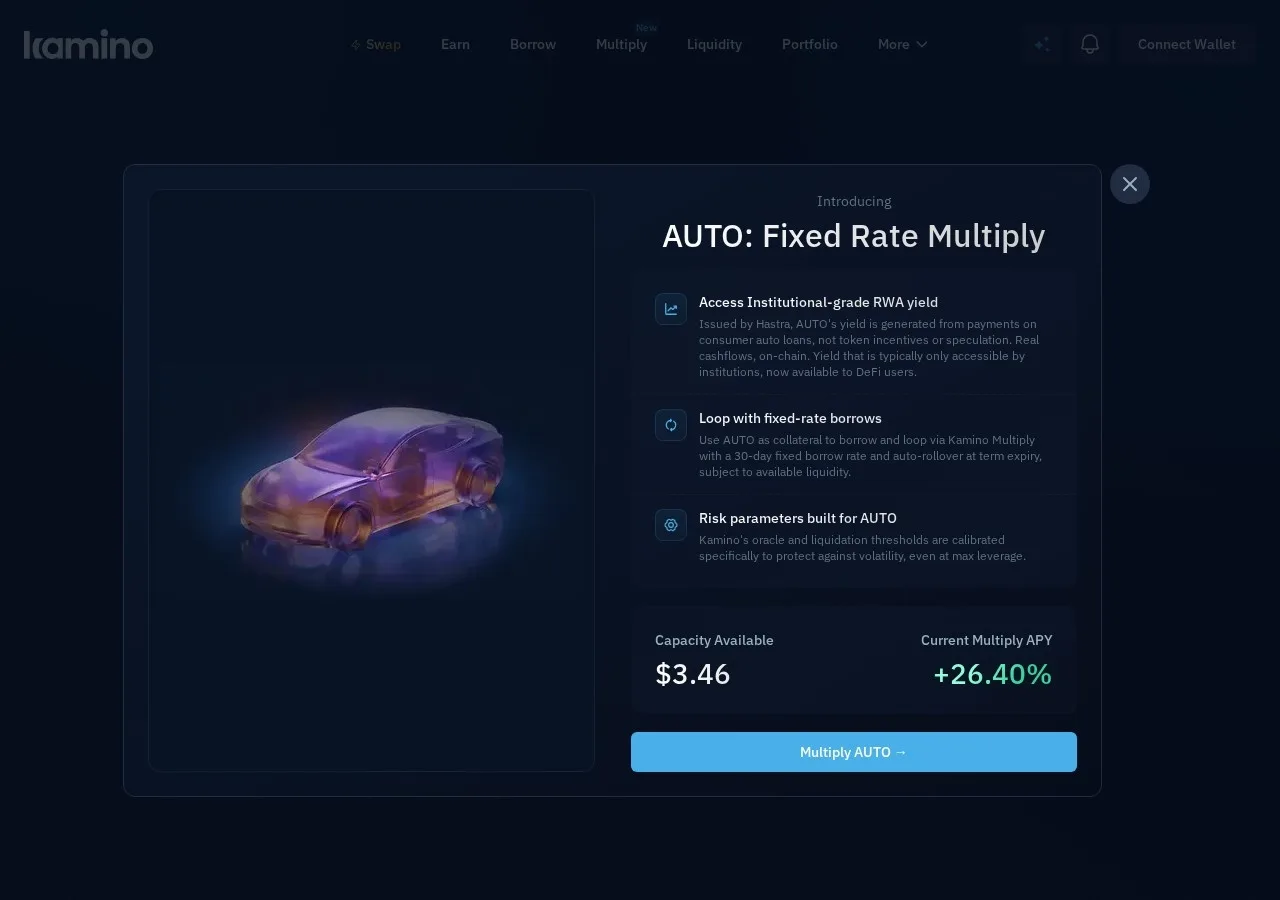
Kamino screenshots
What users say about Kamino
User feedback is limited, with mentions generally highlighting Kamino as a preferred platform for earning yields on liquidity pools and real-world asset vaults. There are no prominent recurring complaints.
Scam warning: Users warn to verify the official domain (kamino.com) to avoid phishing sites imitating the platform.
Based on 16 Reddit posts and comments from the last 12 months, checked Oct 20, 2026. These are posts by users on other sites, not reviews submitted on CryptoReview.
User reviews
No user reviews yet. Have you used Kamino? Share your experience below.
Funding and investors
1Round
2Investors
-
Funding round Amount undisclosed
FAQ
Who leads Kamino?
Kamino is led by CEO Michael Weisz, formerly the co-founder of Yieldstreet, who joined in September 2026 to direct institutional operations from New York.
Which blockchains does Kamino support?
Kamino operates exclusively on Solana. All lending markets and deposits remain on the Solana network.
Does Kamino have a governance token?
Yes, Kamino uses KMNO as its governance and protocol token.
Has Kamino been audited?
Yes, Kamino's protocol contracts are audited, with audit reports published directly on its security documentation page.
How does Kamino handle fixed-rate lending?
Kamino offers dedicated fixed-rate lending facilities alongside its pooled markets. Borrowers can lock in financing terms with automated roll-over capabilities.
Latest from Kamino on X
Kamino Fixed Rates just crossed $75M in active loans, making it the fastest-growing fixed-rate lending protocol onchain.
The future of credit is fixed. https://t.co/toHHRPUY2C
The future of credit is fixed. https://t.co/toHHRPUY2C
Following continued monitoring of the ongoing Binance situation, borrowing has resumed in the SOL/BTC Market.
While borrows were paused, the team monitored onchain activity to assess any risk to the market or users. We found no immediate risk, and Kamino remained unaffected throughout.
Deposits, withdrawals and repayments continued to process normally.
While borrows were paused, the team monitored onchain activity to assess any risk to the market or users. We found no immediate risk, and Kamino remained unaffected throughout.
Deposits, withdrawals and repayments continued to process normally.
Kamino can confirm that it is currently unaffected by the ongoing Binance situation
Out of an abundance of caution, we have temporarily paused borrowing in the SOL/BTC Market
We are actively monitoring the situation and are in communication with various partners. Any further updates will be communicated solely here on Kamino’s official Twitter account
Out of an abundance of caution, we have temporarily paused borrowing in the SOL/BTC Market
We are actively monitoring the situation and are in communication with various partners. Any further updates will be communicated solely here on Kamino’s official Twitter account
Over $10M in fixed-rate loans are now active in the @onrefinance Market on Kamino.
Fixed Rates bring a known cost of capital to reinsurance-backed strategies through rolling 30-day terms.
A new standard for fixed-rate credit. https://t.co/0ijv9t041q
Fixed Rates bring a known cost of capital to reinsurance-backed strategies through rolling 30-day terms.
A new standard for fixed-rate credit. https://t.co/0ijv9t041q
Recent public posts from @Kamino, shown as published. Not reviewed or endorsed by CryptoReview.
Alternatives to Kamino

Permissionless lending protocol and curated vaults securing over $11B across EVM chains
No KYCIsolated marketsEthereum · Base +2Permissionless markets

Pooled lending protocol founded in 2017, operating across 23 blockchain networks
No KYCPooledEthereum · Base +4Audited

Algorithmic money market lending single base assets across EVM networks since 2018
No KYCIsolated marketsEthereum · Arbitrum +1Audited

Solana money market protocol built by Jupiter with over $1B in total value locked
No KYCPooledSolanaAudited

Institutional onchain lending protocol managing over $4.6B across overcollateralized credit pools
KYC requiredPooledEthereumAudited

Non-custodial lending and isolated liquidity markets on the Sui network
No KYCPooledSuiAudited