



As a routine, proactive step following @TheTNetwork’s maintenance update on tBTC, we’ve restricted new tBTC deposits and new borrows against tBTC on Aave.
Aave’s contracts are not affected, existing positions remain unchanged, and users can continue to repay and withdraw as normal.
Once maintenance is complete, new tBTC deposits and borrows will be available again.

Aave
Pooled lending protocol founded in 2017, operating across 23 blockchain networks
4.0/ 5
Our score
Very good
Lending model
Pooled
Chains
EthereumBaseArbitrumAvalanche+2
Main collateral assets
USDCUSDTWETHwBTC+6
Audited
Yes
Governance token
AAVE
Flash loans
Yes
What is Aave?
Aave is a decentralised, non-custodial liquidity protocol for supplying crypto assets, earning interest, borrowing against collateral and swapping positions. It operates across 23 blockchain networks and reported $18.006B in combined TVL in October 2026, with Aave V3 accounting for $16.969B.
Who is behind Aave
Aave was founded in 2017 by Stani Kulechov, a Finnish lawyer who started the project under the name ETHLend. The protocol is governed through onchain proposals and the AAVE token. Aave Labs develops the protocol and related products, including Aave Kit, the Aave App and the GHO stablecoin. Aave's headquarters country is Finland.
How the protocol works
Users connect a compatible crypto wallet rather than opening a custodial account. Suppliers deposit assets into pooled markets and receive interest-bearing aTokens. Borrowers provide collateral exceeding the value of their loans, then borrow supported assets at variable rates set by market utilisation and governance-approved risk parameters.
Aave V3 includes Efficiency Mode for correlated assets and Isolation Mode, which limits the debt that can be created against certain volatile collateral. The protocol also supports flash loans. Supported networks include Ethereum, Polygon, Avalanche, Base, Arbitrum, Plasma, Monad, BSC, Gnosis, Mantle, Optimism, Linea, MegaETH, Sonic, Celo, Scroll, ZKsync Era, Aptos, Metis, Soneium, Fantom, X Layer and Arc. GHO is Aave's native collateral-backed stablecoin.
Costs and access
Aave does not require KYC for direct wallet access to its permissionless protocol. Transactions incur blockchain gas fees, with costs varying by network. Borrowers pay variable interest determined by each market, while suppliers earn interest from borrowing activity. Liquidation can occur when collateral falls below the required threshold.
Track record and risks
Aave reports 2.5M+ users, $32.2B in net deposits, $3.46T in lifetime deposits and $1T in lifetime borrowing. Aave V4 was deployed on Ethereum in March 2026 with a Hub and Spoke design. The protocol says its contracts have undergone independent audits and formal verification, and it runs an ongoing bug bounty.
Risks include oracle manipulation and variable rates. A $27M liquidation event followed oracle mispricing in March 2026. In April 2026, an upstream KelpDAO bridge exploit created unbacked rsETH that was used as collateral on Aave V3 to borrow roughly $193M in ETH-correlated liquidity. Reports attributed the root cause to the bridge, after which Aave reviewed V3 asset-listing standards.
Founders
Stani KulechovFounder
Finnish lawyer who founded Aave in 2017 under the name ETHLend.
Best for:Multi-chain DeFi borrowersCollateralised crypto lendingStablecoin liquidity strategiesDeFi developers integrating lending
Pros and cons
Pros
- $18.006B combined TVL in October 2026
- Operates across 23 blockchain networks
- Non-custodial wallet-based access
- V3 includes Isolation Mode and Efficiency Mode
- Independent audits and an ongoing bug bounty
Cons
- Variable borrowing rates can rise with market utilisation
- Liquidation can sell collateral after health-factor deterioration
- Smart contract and oracle risks remain
- Collateral depends on external bridges and asset issuers
- March 2026 oracle event caused a $27M liquidation
Our review
4.0/5
Very good
Aave offers deep pooled liquidity across many networks, but variable rates, oracle exposure and recent market incidents keep smart-contract risk material.
TVL was about $16.97 billion on October 17, 2026, while Aave reports $32.2 billion in net deposits and more than 2.5 million users. It operates across 23 blockchain networks, including Ethereum, Polygon, Avalanche, Base and Arbitrum.
Aave V3 includes Efficiency Mode for correlated assets and Isolation Mode for volatile collateral with debt ceilings. The site lists general-purpose, collateral-isolated and strategy-isolated markets. Borrowing is overcollateralized, and supplied assets can also become collateral. Rates are variable and respond to market borrowing demand, so borrowing costs can rise quickly when liquidity tightens. The protocol also supports flash loans and GHO, its native collateral-backed stablecoin.
Access is permissionless through a connected wallet, with no account custody by Aave Labs and no stated KYC step. Users pay network gas, with Ethereum transactions typically costing more than those on other supported networks.
Security has documented strengths: the contracts are publicly auditable, have undergone third-party audits and formal verification, and the protocol runs an ongoing bug bounty. Governance uses the AAVE token and onchain proposals. The record is not clean, however. An oracle mispricing led to a $27 million liquidation event in March 2026. In April, a KelpDAO bridge failure created unbacked rsETH that was deposited into Aave V3 and used to borrow roughly $193 million, although reports attributed the root cause to the bridge rather than Aave code. Aave later reviewed V3 asset-listing standards. These events expose oracle and bridge risks even when the core contracts are not the direct cause.
Aave was founded in 2017 by Stani Kulechov. Aave V4 was deployed on Ethereum in March 2026.
Specs
| KYC required ⓘ | No · unverified |
|---|---|
| Lending model | Pooled |
| Chains | Ethereum, Base, Arbitrum, Avalanche, BNB Chain, Other |
| Main collateral assets | USDC, USDT, WETH, wBTC, LINK, wstETH, cbBTC, GHO, AAVE, ETH-correlated assets · unverified |
| Flash loans | Yes |
| Permissionless markets | No |
| Audited | Yes |
| Bug bounty | Yes |
| Governance token | AAVE |
| Isolated markets | Yes · unverified |
| Real-world-asset collateral | Yes · unverified |
| Own stablecoin | Yes · unverified |
| Rates | Variable · unverified |
Data from the provider's website and public sources. Fees and availability change; confirm on the official site before you sign up.
Key features
Pooled money markets
Suppliers add assets to shared liquidity pools, while borrowers take overcollateralized loans against supported collateral.
Multi-chain lending
Aave operates across 23 networks, including Ethereum, Base, Arbitrum, Polygon and Avalanche.
Isolated collateral
Isolation Mode limits debt ceilings for selected volatile assets, separating their risk from broader markets.
Efficiency Mode
E-Mode supports higher capital efficiency when borrowing between correlated assets, subject to market parameters.
Flash loans
Flash loans allow assets to be borrowed and repaid within one transaction without conventional collateral.
GHO stablecoin
GHO is Aave's native stablecoin, backed by collateral deposited within the protocol.
Onchain governance
AAVE holders vote on Aave Improvement Proposals and protocol parameters through onchain governance.
Inside Aave
Aave App
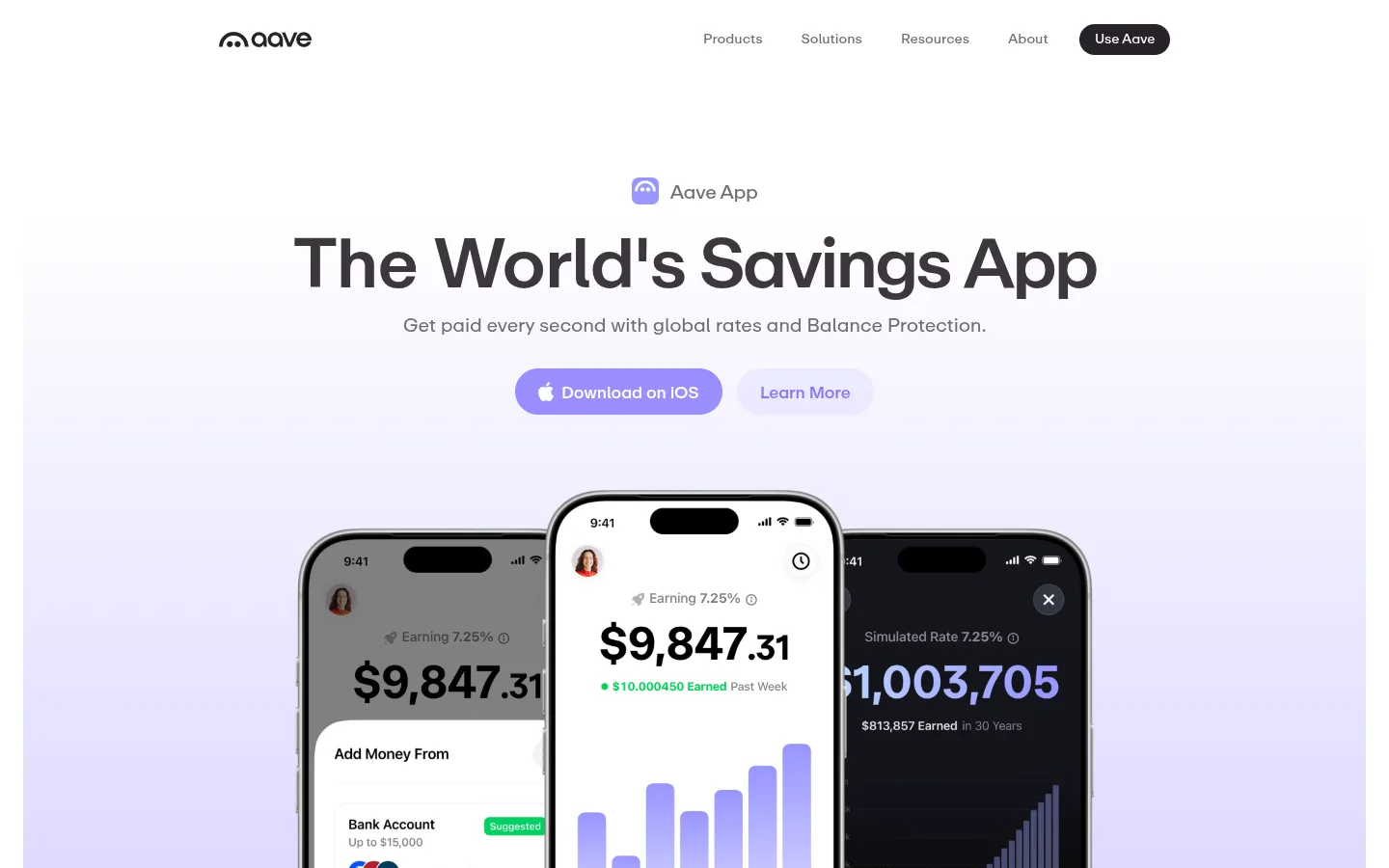
The wallet-connected app lets users supply assets, borrow, swap and manage positions across supported markets. It also offers mobile access. USDC and USDT deposits from Hyperliquid's HyperEVM were announced as live on October 15, 2026.
Aave Pro
Aave Pro is the interface for Aave V4 and offers lending, borrowing and swaps. Aave V4 uses a Hub and Spoke architecture to consolidate liquidity while isolating risk in modular spokes.
General purpose
This is Aave's broad market for supplying and borrowing across a wider range of collateral. The site lists AAVE, USDC, wETH and wBTC among its assets, with additional collateral available.
Collateral-isolated
These markets let users deposit selected collateral and borrow stablecoins against it. The listed examples include wETH, wstETH, wBTC and cbBTC.
Strategy-isolated
This market groups correlated assets for borrowing USDe against Ethena-related collateral. Listed assets include PT-sUSDe, PT-USDe, sUSDe and USDe.
GHO
GHO is Aave's native decentralized stablecoin, backed by collateral deposited in the protocol. Users can access GHO through supported Aave markets.
Aave Kit
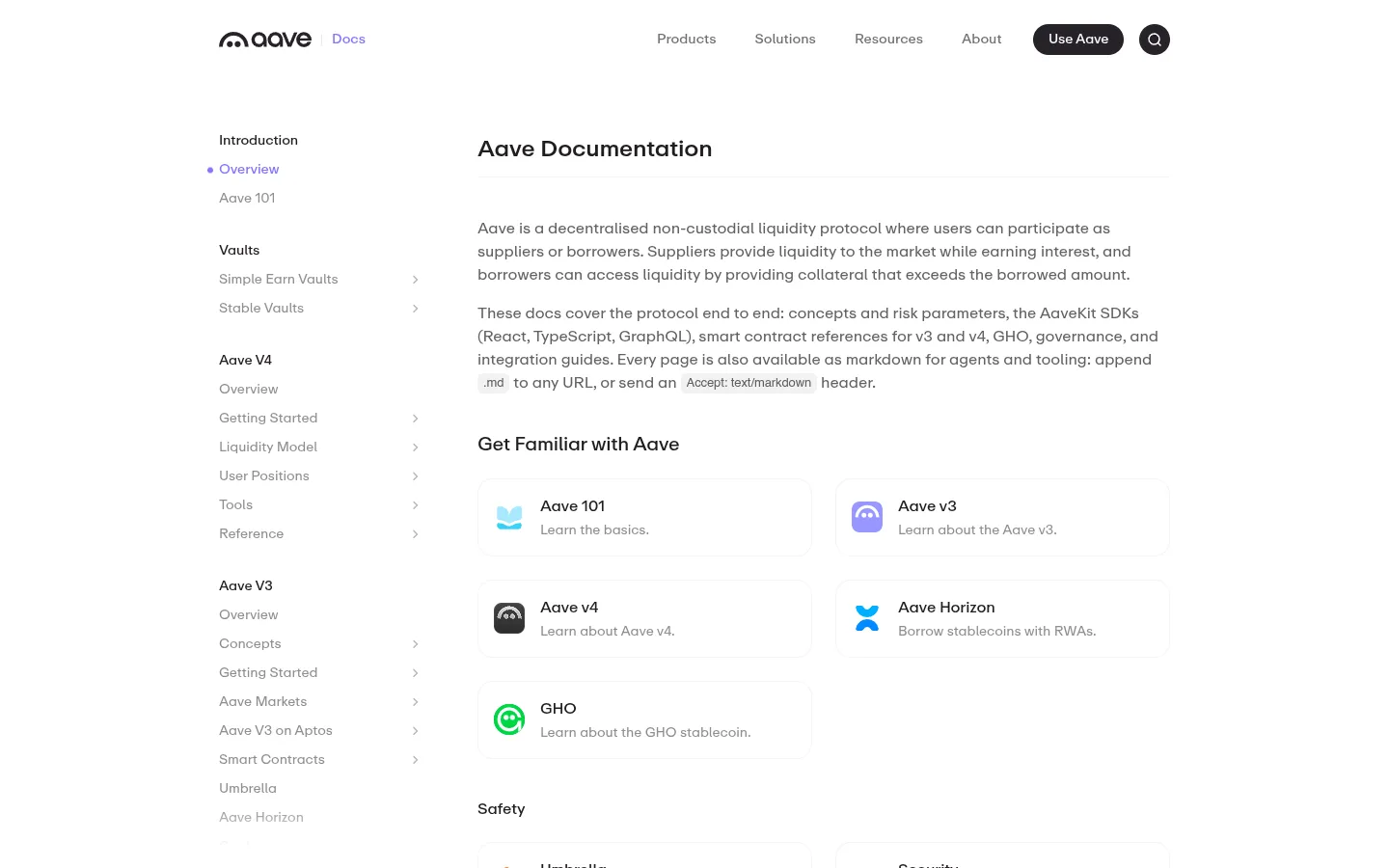
Aave Kit is the integration stack for building lending, yield and onchain finance products. Its resources include React, TypeScript and GraphQL tools for integrating Aave operations and market data.
Aave screenshots
What users say about Aave
Aave offers native Bitcoin collateral that avoids wrapping, stablecoin savings yield in its app, and a mobile app that simplifies deposits and integrations. Complaints are fewer and more technical, centered on unclear liquidation rules for native BTC and on added cross-chain and issuer risk.
Top goods
In their own words
“My experience moving part of my savings into USDC for the yield 0.6%. That was what my savings account was paying while inflation did what it's been doing, and after a while watching the balance quietly shrink in real terms got old enough that I did something about it.”
“Native BTC as Aave collateral via Babylon vaults is the interesting bit. You lock BTC on Bitcoin itself, then borrow against it, instead of wrapping first. Still a proposal, not live, but if it passes, that's a cleaner path from self-custody into DeFi.”
“AAVE.com Deposit your tokens, then you can borrow against your deposit. They accept all the major tokens - BTH/ETH/USDC - and many others. I recommend playing around with small amounts to get used to how the app works.”
“Trustless custody is the hard part — the borrow side is solved. Curious how Babylon's vault handles the oracle: does native BTC price still route through a feed, or is settlement designed differently?”
“Native BTC as collateral on V4 puts a Bitcoin-side vault inside an Aave position, so the borrower's risk now spans two chains.”
“Behind every tokenized stock used as collateral sits an issuer holding the real share, so these loans also depend on that issuer keeping the token fully backed.”
Scam warning: Fake lookalike domains such as app-aave.com and aave-app.com impersonate the real Aave site
Scam warning: Scammers posing as Aave support ask users for their 24-word recovery phrase
Based on 56 X replies, 71 Reddit posts and comments from the last 12 months, checked Oct 17, 2026. These are posts by users on other sites, not reviews submitted on CryptoReview.
User reviews
No user reviews yet. Have you used Aave? Share your experience below.
Funding and investors
1Round
3Investors
-
Funding round Amount undisclosed
FAQ
Who founded Aave?
Stani Kulechov founded Aave in 2017 under the name ETHLend. The protocol is governed through the AAVE token and onchain governance.
Does Aave require KYC?
Aave is permissionless and can be accessed by connecting a compatible crypto wallet. Users pay blockchain gas fees when they transact, with Ethereum generally costing more than other supported networks.
Is Aave safe?
Aave uses non-custodial smart contracts that have undergone third-party audits and formal verification, with an ongoing bug bounty. An oracle mispricing caused a $27 million liquidation event in March 2026, and an April 2026 bridge exploit affected markets through unbacked rsETH collateral.
Which chains does Aave support?
Aave operates across 23 blockchain networks, including Ethereum, Polygon, Avalanche, Base and Arbitrum. The broader network list includes Plasma, Monad, BSC, Gnosis, Mantle, OP Mainnet, Linea, MegaETH, Sonic, Celo, Scroll, ZKsync Era, Aptos, Metis, Soneium, Fantom, X Layer and Arc.
Does Aave have a token?
AAVE is Aave's governance token and is used to vote on Aave Improvement Proposals. It can also be staked through the protocol's safety mechanism.
How does borrowing on Aave work?
Aave uses pooled, overcollateralized markets, so borrowers deposit collateral before borrowing supported assets. V3 includes Efficiency Mode for correlated assets and Isolation Mode, which places debt ceilings on selected volatile collateral.
Latest from Aave on X
Update following the Binance incident:
All markets are now unfrozen across Aave V3 and V4.
They were frozen as a precaution after initial reports, which paused new deposits and borrows while withdrawals and repayments continued as normal.
Aave contracts were unaffected by the incident and positions remained fully collateralized.
All markets are now unfrozen across Aave V3 and V4.
They were frozen as a precaution after initial reports, which paused new deposits and borrows while withdrawals and repayments continued as normal.
Aave contracts were unaffected by the incident and positions remained fully collateralized.
We’re aware of reports of a potential incident affecting Binance-affiliated wallets.
Aave’s contracts are unaffected, and positions remain overcollateralized. As a precaution, all DAO-operated markets across V3 and V4 have been frozen.
The freeze pauses new deposits and borrows, and users can still withdraw and repay their existing positions.
Aave’s contracts are unaffected, and positions remain overcollateralized. As a precaution, all DAO-operated markets across V3 and V4 have been frozen.
The freeze pauses new deposits and borrows, and users can still withdraw and repay their existing positions.
Introducing @chainlink 24/7, coming soon to stock-backed loans on Aave.
It delivers continuous pricing for stocks and other RWAs through weekends and holidays, strengthening DeFi’s ability to onboard the $150 trillion equities market and beyond.
It delivers continuous pricing for stocks and other RWAs through weekends and holidays, strengthening DeFi’s ability to onboard the $150 trillion equities market and beyond.
USDC and USDT deposits from @Optimism are now live in the Aave mobile app. https://t.co/FbsttnH9An

Recent public posts from @aave, shown as published. Not reviewed or endorsed by CryptoReview.
Alternatives to Aave

Permissionless lending protocol and curated vaults securing over $11B across EVM chains
No KYCIsolated marketsEthereum · Base +2Permissionless markets

Algorithmic money market lending single base assets across EVM networks since 2018
No KYCIsolated marketsEthereum · Arbitrum +1Audited

Solana money market protocol built by Jupiter with over $1B in total value locked
No KYCPooledSolanaAudited

Solana lending and liquidity protocol with over $1.3B in TVL and fixed-rate borrow markets
PooledSolanaAudited

Institutional onchain lending protocol managing over $4.6B across overcollateralized credit pools
KYC requiredPooledEthereumAudited

Non-custodial lending and isolated liquidity markets on the Sui network
No KYCPooledSuiAudited