



Great to see
@KeyringNetwork Unwind uses Euler lending vaults to support tokenised asset positions, coordinating borrowing and repayment around the asset’s settlement cycle.

3.9/ 5
Our score
Good
Lending model
Isolated markets
Chains
EthereumBaseAvalancheOther
Main collateral assets
USDCWETHcbBTCwstETH+3
Audited
Yes
Governance token
EUL
Flash loans
Yes
What is Euler?
Euler is a modular DeFi lending protocol built on the Ethereum Vault Connector (EVC). Users can lend, borrow, and launch credit vaults across EVM networks, supporting crypto assets and tokenized real-world assets.
Team and development
The protocol is developed by a team based in London. Governance is coordinated through the protocol's native token, EUL, which gives token holders voting power over core protocol parameters and treasury management.
How lending and borrowing work
Euler uses an isolated lending architecture rather than a single pooled liquidity model. Market curators can create custom markets using the Euler Toolbox by configuring collateral tiers and oracles. Users can supply assets such as USDC and WETH to earn yield, or post collateral to borrow paired assets. The protocol also supports flash loans and enables permissioned markets designed for tokenized assets like treasuries and equities without requiring changes to core contracts.
Availability and fees
The core protocol is permissionless and non-custodial, requiring no KYC verification or account onboarding beyond connecting an EVM-compatible Web3 wallet. Network availability spans Ethereum, Base, Monad, Arbitrum, BNB Chain, and Avalanche. Variable borrowing rates are governed algorithmically by market supply and demand within each independent vault.
Track record and protocol risks
By October 2026, total value locked across Euler V2 stood at approximately $289M. Security measures include formal verification by Certora across the core contracts and EulerEarn, over 60 independent security engagements, and an active bug bounty program offering up to $7.5M for reported vulnerabilities. Primary operational risks include oracle pricing manipulation on newly configured markets, smart contract vulnerabilities in external custom vaults, liquidation delays during severe market volatility, and collateral depegging events.
Founders
Michael BentleyCo-founder and CEO
Former postdoctoral researcher in evolutionary biology at Oxford and former macroeconomic analyst.
Best for:DeFi liquidity providers seeking yieldsBorrowers using exotic collateralCurators launching custom credit marketsDevelopers embedding lending via SDK
Pros and cons
Pros
- Supports permissionless deployment of custom vaults and lending markets
- Non-custodial and requires no KYC verification to lend or borrow
- Formally verified contracts and a bug bounty program of up to $7.5M
- Handles both standard crypto tokens and tokenized real-world assets
Cons
- Isolated vaults mean liquidity is fragmented across separate markets
- Custom vaults introduce variable counterparty and oracle configuration risks
- Variable interest rates can fluctuate sharply based on vault utilization
Our review
3.9/5
Good
Euler delivers highly flexible, modular lending and permissionless market deployment, but users must evaluate oracle choices and collateral parameters for each isolated vault individually.
Euler operates as modular lending infrastructure organized around the Ethereum Vault Connector. Lenders and borrowers interact through isolated credit vaults. Rather than relying entirely on a monolithic liquidity pool, the architecture permits curators and developers to launch custom markets with designated collateral assets and pricing oracles. In October 2026, total value locked on Euler V2 stood at $289.36M across supported networks including Ethereum, Base, Monad, and Arbitrum.
The system focuses on market flexibility and risk containment. Because lending vaults are isolated, an exploit tied to an exotic collateral asset does not automatically contaminate unrelated lending pools. Supported collateral spans mainstream assets like USDC and WETH alongside yield-bearing tokens and real-world assets such as Paxos Gold (PAXG) and tokenized funds. Lenders can deposit into curated vaults to earn yield, while borrowers supply collateral to draw liquidity across verified borrowing pairs. Developers can also integrate protocol liquidity into external applications through the Euler SDK.
However, the modular architecture introduces distinct trade-offs for users:
- Vault-by-vault risk variations mean lenders must manually verify the specific oracle integrations and liquidation parameters of every market they enter.
- Liquidity is fragmented across independent vaults and multiple network deployments rather than concentrated in a unified deposit pool.
- Governance decisions around parameters and governor roles vary across individual markets created through the Euler Toolbox.
Euler addresses technical security through more than 60 independent security engagements, formal verification by Certora for Euler V2 core and EulerEarn, and a bug bounty pool offering up to $7.5 million. The protocol suits decentralized finance builders and liquidity providers who want fine-grained control over market parameters or access to niche collateral. Users seeking a simple, unified liquidity pool with single-click deposits may prefer traditional pooled lending protocols.
Specs
| KYC required ⓘ | No · unverified |
|---|---|
| Lending model | Isolated markets |
| Chains | Ethereum, Base, Avalanche, Other |
| Main collateral assets | USDC, WETH, cbBTC, wstETH, PAXG, sUSDe, VBILL · unverified |
| Flash loans | Yes |
| Permissionless markets | Yes |
| Audited | Yes |
| Bug bounty | Yes |
| Governance token | EUL |
| Isolated markets | Yes · unverified |
| Real-world-asset collateral | Yes · unverified |
| Own stablecoin | No · unverified |
| Rates | Variable · unverified |
Data from the provider's website and public sources. Fees and availability change; confirm on the official site before you sign up.
Key features
Custom vault deployment
Curators can use the Euler Toolbox to launch independent lending vaults with chosen collateral rules, borrowing limits, and oracle sources.
Permissioned institutional markets
Supports tokenized real-world assets, including funds and bonds, with access rules governing deposits and liquidations.
Cross-chain availability
Deploys non-custodial lending pools across Ethereum, Base, Monad, Arbitrum, BNB Chain, and Avalanche.
Flash loan integration
Enables uncollateralized single-transaction borrowing directly against available vault liquidity.
Formally verified core
Undergoes formal verification through Certora for core contracts alongside a bug bounty program offering up to $7.5M.
Inside Euler
Euler Lending & Borrowing App
The main user interface where lenders supply crypto, stablecoins, or tokenized assets to earn yields and borrowers take out loans against deposited collateral.
Euler Toolbox
A market deployment suite that allows risk curators and managers to configure custom vaults, oracles, collateral rules, and governors.
EulerEarn
A specialized yield-generating component built on Euler V2 core with verified smart contract properties.
Euler SDK
A developer integration toolkit designed for fintech applications to embed Euler lending and borrowing infrastructure into their own interfaces.
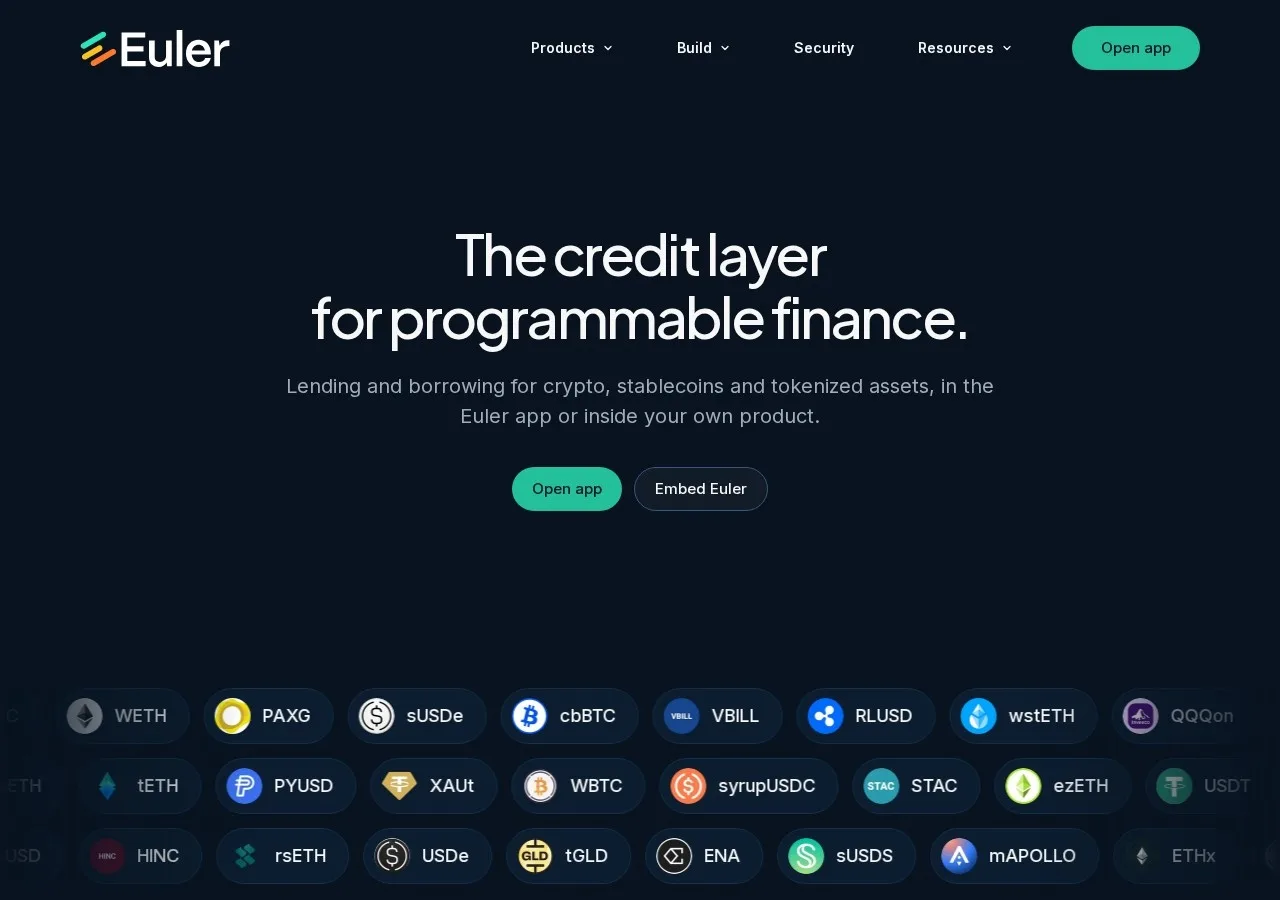
Euler screenshots
User reviews
No user reviews yet. Have you used Euler? Share your experience below.
Funding and investors
$40MTotal raised
2Rounds
5Investors
-
Series A Jun 2022 $32M
-
Seed Aug 2021 $8M
FAQ
What is Euler?
Euler is a modular DeFi lending protocol that allows users to supply collateral, borrow assets, and deploy custom credit vaults across multiple blockchains.
Does Euler require KYC?
No, Euler is non-custodial and operates permissionlessly for core crypto lending, although custom permissioned vaults can be deployed for institutional assets.
What is the Euler governance token?
The protocol uses EUL as its native governance token to manage system-level decisions and upgrades.
How does Euler handle protocol security?
Euler V2 core and EulerEarn are formally verified by Certora, backed by more than 60 security engagements, and covered by a bug bounty of up to $7.5 million.
Which networks does Euler support?
Euler is active on Ethereum, Base, Monad, Arbitrum, HyperEVM, and BNB Chain, among other EVM-compatible chains.
How does lending on Euler differ from traditional pooled lending?
Euler uses isolated credit vaults linked by the Ethereum Vault Connector, preventing bad debt in one riskier market from affecting unrelated vaults.
Latest from Euler on X
🤝
A closer look at how Euler vaults are configured.
Open Vault checks to inspect individual results, grouped by category, including oracles and collateral. Each finding names the relevant assets and contracts. https://t.co/vDrUWKdOAe
Open Vault checks to inspect individual results, grouped by category, including oracles and collateral. Each finding names the relevant assets and contracts. https://t.co/vDrUWKdOAe
Euler is thrilled to announce it is a member of @TACoalition
We’re looking forward to contributing to the coalition, and working together to set the standards the industry is built on.
We’re looking forward to contributing to the coalition, and working together to set the standards the industry is built on.
Gondor, your margin account for Polymarket
Built on Euler
Built on Euler
Recent public posts from @eulerfinance, shown as published. Not reviewed or endorsed by CryptoReview.
Alternatives to Euler

Permissionless lending protocol and curated vaults securing over $11B across EVM chains
No KYCIsolated marketsEthereum · Base +2Permissionless markets

Pooled lending protocol founded in 2017, operating across 23 blockchain networks
No KYCPooledEthereum · Base +4Audited

Algorithmic money market lending single base assets across EVM networks since 2018
No KYCIsolated marketsEthereum · Arbitrum +1Audited

Solana money market protocol built by Jupiter with over $1B in total value locked
No KYCPooledSolanaAudited

Solana lending and liquidity protocol with over $1.3B in TVL and fixed-rate borrow markets
PooledSolanaAudited

Institutional onchain lending protocol managing over $4.6B across overcollateralized credit pools
KYC requiredPooledEthereumAudited