

We've made the difficult decision to enter Maintenance Mode until June 2028, after which we will wind down.
Thank you for being a Sablier user 🙏
You can learn more about what this means here:
https://t.co/aEAGg2fhuy

Sablier Labs
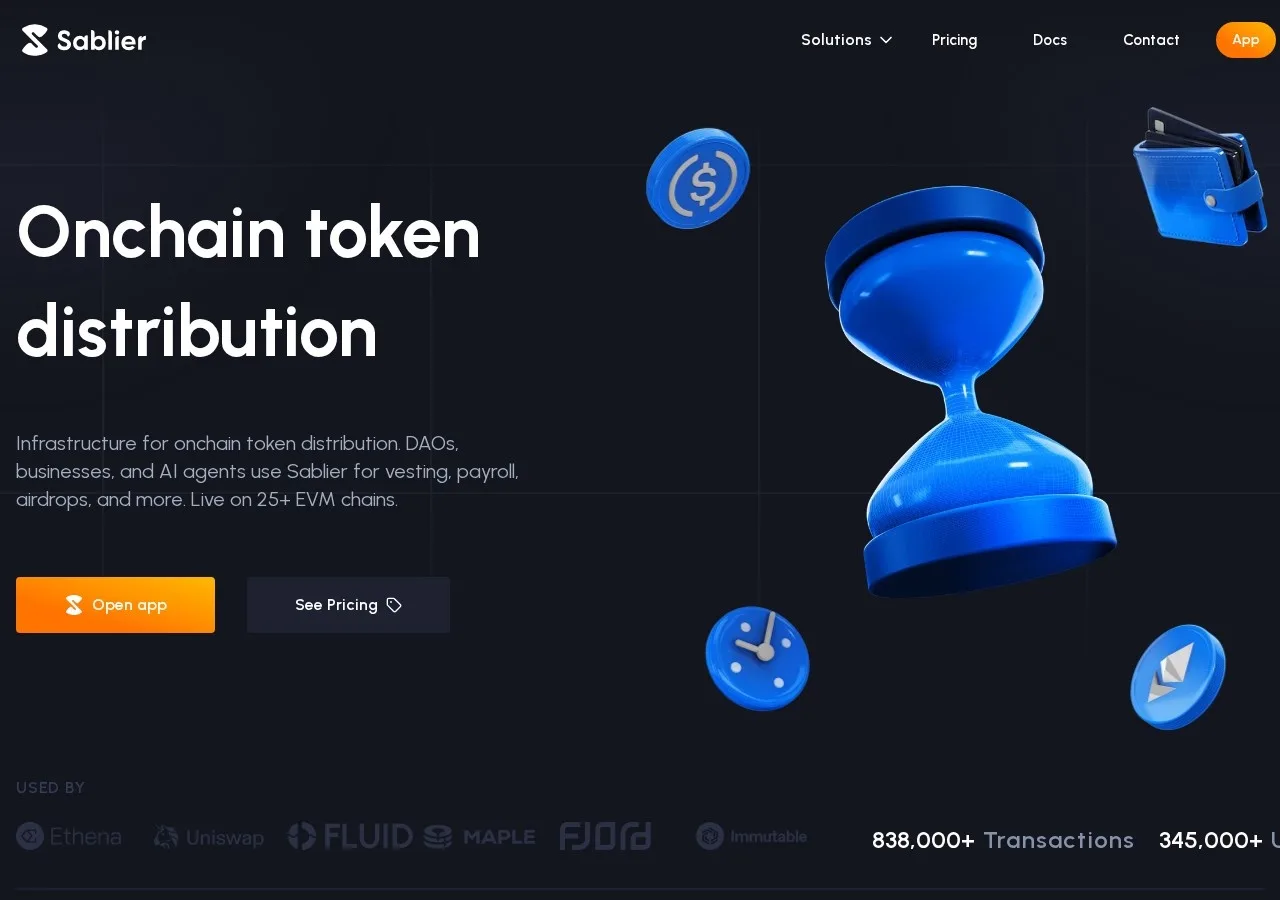
Onchain token distribution infrastructure for streaming vesting, payroll, and airdrops across 25+ EVM chains
3.7/ 5
Our score
Good
Services
Developer tooling
Chains supported
25
Free tier
No
Pricing from
$0.99 per stream withdrawal
What is Sablier Labs?
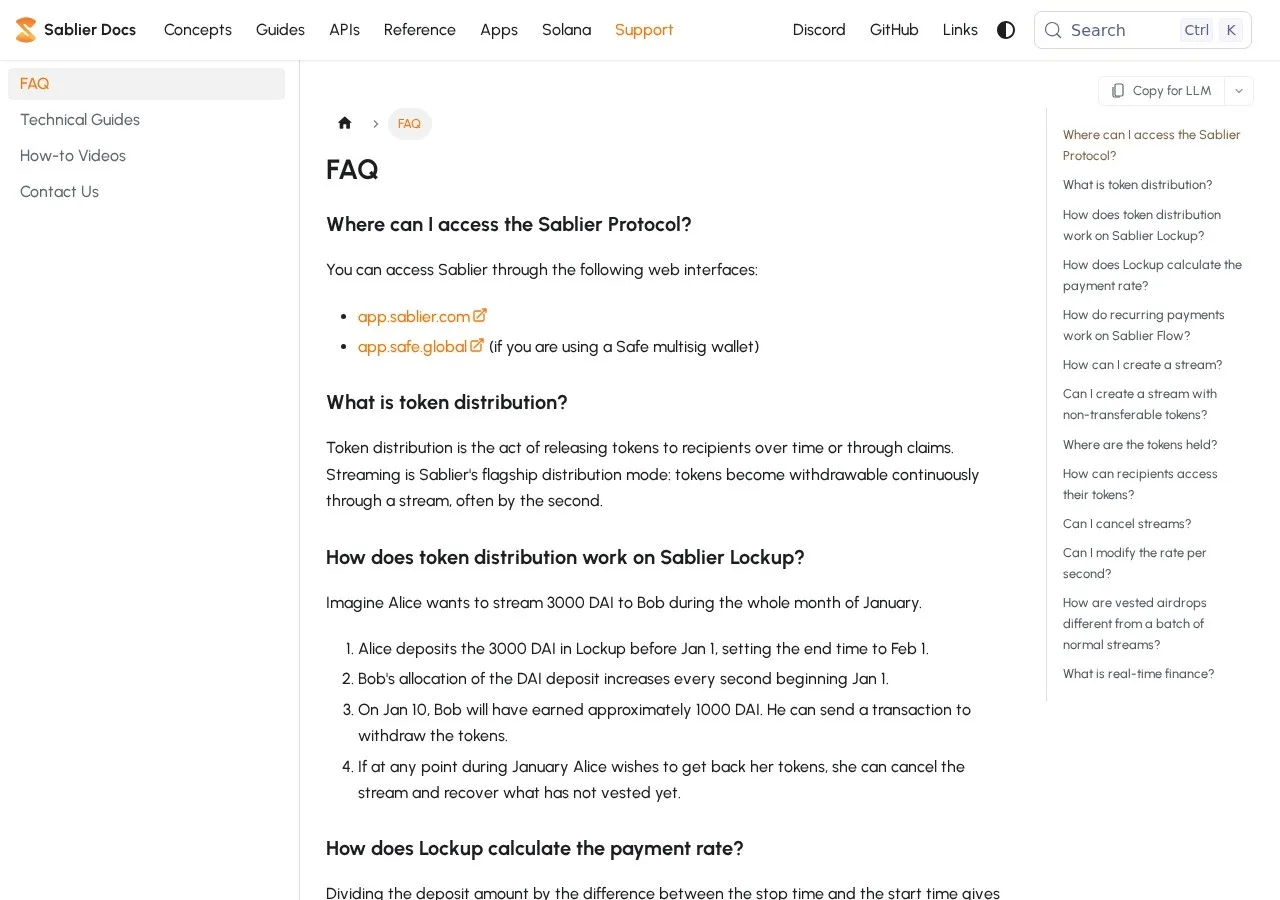
Sablier is an onchain token distribution protocol for continuous streaming, vesting schedules, payroll, and token airdrops. Launched in 2019, it lets senders deposit ERC-20 assets into smart contracts that release funds to recipients by the second. More than 345,000 users have completed over 838,000 transactions across its contracts.
Organization and backing
Sablier Labs develops the protocol. Backers include Fenbushi Capital, Evan Van Ness, Lito Coen, and Daniel Bar. After expanding across multiple blockchain ecosystems, the team announced in July 2026 that Sablier had entered maintenance mode until June 2028, after which the project plans to wind down operations.
How the protocol works
Sablier runs non-custodial smart contracts on more than 25 EVM mainnets, including Ethereum, Arbitrum, Base, Optimism, and Polygon. Senders deposit supported ERC-20 tokens into contracts such as Sablier Lockup, which distributes tokens dynamically, linearly, or in tranches according to predetermined cliffs and schedules. Sablier Flow provides open-ended payment streams for continuous payroll. The Sablier Airdrops tool executes batch distributions using Merkle trees, and users can claim instantly or enter linear vesting streams. Recipients can withdraw vested amounts directly at any point without manual intervention from the sender.
Fees and access
Interacting with Sablier requires network gas fees alongside interface fees for specific contract interactions. The web interface applies a flat $0.99 fee, paid in the network's native gas token, per stream withdrawal on Lockup v2.0+ and Flow v1.1+. For Merkle airdrops, creators can sponsor claims starting at $1.99 per recipient, or recipients can pay variable claiming fees directly. Anyone with an EVM-compatible wallet or Safe multisig can use the open-source contracts and public interface.
Audits and operational limitations
Sablier's smart contract suites have undergone multiple independent security audits and public audit contests. Sablier shut down its Solana web interface in June 2026, leaving only the underlying onchain programs active. With the protocol operating in maintenance mode until an eventual June 2028 shutdown, teams building long-term distribution workflows face planned end-of-life constraints.
Best for:DAOs executing continuous token vestingWeb3 organizations managing crypto payrollProjects deploying Merkle-based token airdrops
Pros and cons
Pros
- Supports continuous, second-by-second token unlocks across 25 EVM networks
- Open-source smart contracts audited across multiple security reviews and contests
- Non-custodial infrastructure with over 838,000 transactions processed since 2019
- Direct integration into Safe multisig wallets for DAO treasury streaming
Cons
- Entered maintenance mode in July 2026, targeting a full wind-down by June 2028
- Interface withdrawal fee of $0.99 applied on modern Lockup and Flow streams
- Official Solana web interface was decommissioned in June 2026
Our review
3.7/5
Good
Sablier offers continuous vesting and token distribution across 25 EVM chains, but its web interface has entered maintenance mode ahead of a scheduled June 2028 wind-down.
Sablier Labs has provided onchain token streaming and distribution infrastructure since 2019. Its smart contracts manage continuous vesting, payroll, and token distributions, handling more than 838,000 transactions across 345,000 users. Deployments span 25 EVM mainnets including Ethereum, Arbitrum, Base, and Polygon, alongside smart contract programs on Solana. The protocol supports linear or dynamic lockup schedules, as well as open-ended streaming flows and Merkle-based airdrop campaigns.
The protocol offers flexible architectures for automated distributions. Senders can stream tokens per second or add cliffs without managing recurring manual transactions. For developers and automated systems, Sablier maintains agent skill toolkits and CLI packages like npx skills that let AI agents and scripts deploy distributions directly. Interface pricing is transparent: streams built on Lockup v2.0 and Flow v1.1 incur a flat $0.99 withdrawal fee paid in native gas tokens, while Merkle airdrops charge volume-tiered fees starting at $1.99 per claim, which creators can sponsor upfront.
Operational longevity is the primary consideration for potential users. In July 2026, Sablier announced it entered maintenance mode and will wind down in June 2028. The Solana web interface shut down in June 2026, and the official Discord was shifted to read-only mode in May 2026 due to moderation overhead. While the underlying smart contracts remain deployed and verifiable onchain on block explorers, teams must account for the shrinking operational footprint.
Backed by investors including Fenbushi Capital, Evan Van Ness, Lito Coen, and Daniel Bar, Sablier offers a proven track record dating back to 2019 for organizations seeking automated per-second vesting schedules on EVM networks.
Specs
| Services | Developer tooling · unverified |
|---|---|
| Chains supported | 25 · unverified |
| Free tier | No · unverified |
| Pricing from | $0.99 per stream withdrawal · unverified |
| Open source | Yes · unverified |
Not disclosed by the provider: Enterprise SLA, Token, Uptime SLA, Free tier limits, Server regions.
Data from the provider's website and public sources. Fees and availability change; confirm on the official site before you sign up.
Key features
Sablier Lockup streaming
Distributes ERC-20 tokens continuously per second or through custom tranches, cliff schedules, and dynamic vesting curves.
Sablier Flow payroll
Maintains open-ended, continuous payment streams that run indefinitely until paused or voided by either party.
Merkle airdrop distribution
Executes gas-efficient batch token airdrops that support instant claims or automatic streaming schedules.
Multichain contract deployment
Operates across 25 EVM mainnet networks, including Ethereum, Arbitrum, Base, Polygon, and Optimism.
AI agent integrations
Offers protocol-aware skill kits allowing automated AI agents to configure vesting streams and Merkle distributions.
Safe multisig integration
Integrates directly inside Safe app environments for multisig treasury token distributions.
Inside Sablier Labs
Sablier Lockup
Executes predetermined token streaming and vesting campaigns. Senders can configure linear, dynamic, or tranched schedules with cliff dates.
Sablier Flow
Manages continuous, open-ended payment streams tailored for payroll and ongoing contractor billing. Senders deposit funds as needed, and either party can pause or void the stream.
Sablier Airdrops
Distributes tokens at scale via Merkle tree verification. Campaigns can distribute assets instantly or stream them over custom vesting schedules.
Sablier Bob
Provides price-gated token lockups on Ethereum. Tokens held in Bob unlock only when an underlying asset achieves a predefined price target.
Sablier Skills
Offers protocol-aware packages for automated AI agents and developer workflows. Integrations enable agent prompts to draft Merkle drops and vesting streams.
Sablier Labs screenshots
What users say about Sablier Labs
There is insufficient user feedback to evaluate Sablier Labs, with no clear trends of praise or complaints identified.
Based on 1 Reddit posts and comments from the last 12 months, checked Oct 21, 2026. These are posts by users on other sites, not reviews submitted on CryptoReview.
User reviews
No user reviews yet. Have you used Sablier Labs? Share your experience below.
Funding and investors
1Round
4Investors
-
Funding round Amount undisclosedDB Daniel BarVenture capital EV Evan Van NessVenture capitalSource
 Fenbushi CapitalVenture capital
LC Lito CoenVenture capital
FAQ
What is Sablier?
Sablier is an onchain token distribution protocol used for vesting, payroll, continuous grants, and airdrops. It distributes tokens by the second via smart contracts across EVM networks and Solana.
What fees does Sablier charge?
The Sablier interface charges a flat $0.99 fee in the native gas token for stream withdrawals on Lockup v2.0 and Flow v1.1 contracts. Airdrop claim fees start at $1.99 per claim, which campaign creators can sponsor upfront.
Which chains does Sablier support?
Sablier contracts are deployed on 25 EVM mainnets, including Ethereum, Arbitrum, Base, Polygon, Linea, and Avalanche, as well as Solana. Certain chains are accessible directly onchain rather than through the primary web interface.
Where are tokens held during a Sablier stream?
Tokens are held non-custodially inside Sablier smart contracts deployed on each respective network. Recipients can withdraw vested portions directly through the interface or via contract calls on block explorers.
Does Sablier have an official token?
No, Sablier does not have its own native token. Protocol operations and interface fees are settled using the native gas token of the corresponding chain or the streamed ERC-20 assets.
Can senders cancel a Sablier stream?
Yes, creators can cancel eligible streams in Sablier Lockup or void streams in Sablier Flow. When a stream is canceled, unvested tokens are refunded to the sender while the recipient retains already vested tokens.
Latest from Sablier Labs on X
1/ We've made the difficult decision to fully shut down the official Sablier UI on Solana.
https://t.co/8xS79VOay3 goes offline on June 30, 2026.
The SolSab programs will remain deployed onchain. Here's what you need to do before then. 🧵
https://t.co/TW2cBG7dyA
https://t.co/8xS79VOay3 goes offline on June 30, 2026.
The SolSab programs will remain deployed onchain. Here's what you need to do before then. 🧵
https://t.co/TW2cBG7dyA
PSA: our Discord will be entering read-only mode on May 1.
The primary reason for this decision is the overwhelming number of scammers we've had to deal with on the server.
Despite our moderation efforts, it has become increasingly difficult to keep the community safe from bad actors impersonating our team and targeting our users.
Going forward, you can still reach us through the following channels:
- Email: for direct support inquiries ([email protected])
- GitHub: for technical issues, bug reports, and feature requests (http://github .com/sablier-labs)
Sablier on Solana is entering maintenance mode.
Starting today, it will no longer be possible to create new streams and airdrops on https://t.co/8xS79VNCIv
Existing streams and airdrop campaigns remain fully functional — recipients can still withdraw and claim as normal.
Starting today, it will no longer be possible to create new streams and airdrops on https://t.co/8xS79VNCIv
Existing streams and airdrop campaigns remain fully functional — recipients can still withdraw and claim as normal.
We just launched a new Bob pool with a $10,000 target price 🚀
As a reminder, Bob is our product that allows for price-gated lockups: tokens unlock only when a specified price target is reached.
Jump in now and be part of the action:
https://t.co/UgVgsQEWca
As a reminder, Bob is our product that allows for price-gated lockups: tokens unlock only when a specified price target is reached.
Jump in now and be part of the action:
https://t.co/UgVgsQEWca
Recent public posts from @Sablier, shown as published. Not reviewed or endorsed by CryptoReview.
Alternatives to Sablier Labs

Open-source smart contract libraries and enterprise security tooling backing over $38T in transfers
Developer toolingFree tier10 chains supported

Blockchain infrastructure platform supporting 100+ chains with a free 30M-compute-unit tier
RPC / nodes · Data APIs +3Free tier100 chains supported

Managed blockchain infrastructure across 70+ chains with a free 3M-request monthly tier
RPC / nodes · IndexingFree tier70 chains supported

EVM development and simulation platform supporting transaction debugging and testing across 50+ chains
Developer toolingFree tier50 chains supported
Open-source distributed ledger foundation hosting Fabric, Besu, and Cacti under the Linux Foundation
RPC / nodes · Developer toolingFree tier2 chains supported

Blockchain infrastructure platform providing RPC nodes and data streams across 76 networks
RPC / nodes · Data APIsFree tier76 chains supported