

Hello world!

Push Protocol
Shared-state Layer 1 blockchain and web3 communication network with 1-second block times
3.6/ 5
Our score
Good
Services
Developer toolingWallet APIs
Token
PUSH
What is Push Protocol?
Push Protocol is a decentralized infrastructure network and Layer 1 blockchain that provides cross-chain notifications, messaging, and shared-state execution. Originally launched as Ethereum Push Notification Service (EPNS), the protocol expanded to build Push Chain, an EVM-compatible proof-of-stake blockchain designed to eliminate multi-chain fragmentation. Push Chain targets a 1-second native block time and 4,200 transactions per second. Developers can deploy decentralized applications once and serve users across multiple ecosystems without manual asset bridges.
Founding and financial backing
Harsh Rajat and Richa Joshi founded the protocol in 2020. Rajat is the founder and project lead, bringing an entrepreneurial background in SaaS, mobile development, and web services, while Joshi is co-founder and chief marketing officer. Headquartered in Singapore, the organization raised over $12.26 million in venture backing across multiple rounds. Investors include LD Capital, Momentum 6, Zebpay, True Ventures, Sandeep Nailwal, and Jump Crypto, with its Series A funding closing at $10.10 million in April 2022.
Architecture and core mechanics
Push operates both its legacy decentralized communication layer and Push Chain. The communication suite supports push notifications and token-gated messaging across networks such as Ethereum, Polygon, and BNB Chain. Push Chain introduces universal account abstraction using Universal Origin Accounts, which represent native wallets on home chains like MetaMask on Ethereum or Phantom on Solana. These map to deterministic Universal Executor Accounts on Push Chain. Through fee abstraction, users can pay transaction gas in their home chain's native tokens rather than holding a separate gas asset.
Security and trade-offs
The network relies on the native PUSH token for protocol governance and ecosystem utility, alongside an architectural design for PUSD, a 1:1 backed universal stablecoin. Push Chain completed a smart contract security audit by Hacken. Because Push Chain operates in a testnet phase via its Donut Testnet, the Layer 1 environment has not yet accumulated extensive production mainnet history. Reliance on universal validator networks and cross-chain execution gateways introduces architectural complexity and execution counterparty risk, which can create centralization points or potential transaction delays if validator consensus stalls.
Founders
Harsh RajatFounder
Richa JoshiCo-Founder
Best for:Cross-chain dApp developersWeb3 notification integrationsProjects requiring fee abstraction
Pros and cons
Pros
- Supports cross-chain execution without requiring token bridging
- Users can settle transaction gas in their home chain's native tokens
- Smart contracts audited by Hacken
- Over $12.26 million in verified institutional funding
Cons
- Push Chain mainnet remains unlaunched while operating on testnet
- Universal execution introduces protocol reliance on custom validator relayers
- Complex multi-chain smart account derivation increases smart contract attack surfaces
Our review
3.6/5
Good
Push Protocol offers cross-chain communication and universal execution across ecosystems, though Push Chain remains on testnet with its core infrastructure still expanding.
Founded in 2020 as Ethereum Push Notification Service (EPNS) by Harsh Rajat and Richa Joshi, Push Protocol has expanded from wallet notifications into a Layer 1 universal execution network called Push Chain. The organization raised $12.26M across funding rounds, backed by investors including LD Capital, Momentum 6, and Zebpay. Its primary products span decentralized push alerts, direct messaging through Push Chat, and the shared-state Push Chain.
Push Chain is built to solve fragmented cross-chain deployments. As a 100% EVM-compatible Proof of Stake chain, it introduces Universal Origin Accounts and Universal Executor Accounts. Users on chains like Ethereum or Solana can trigger smart contracts on Push Chain using their native wallets without switching networks. Through universal fee abstraction, users can pay transaction costs in any supported token without manual bridging. The network targets 4,200 transactions per second with 1-second block times, and smart contracts have undergone security auditing by Hacken.
The system presents several infrastructure trade-offs:
- Mainnet for Push Chain has not yet launched; active developer development remains on the Donut Testnet.
- Interoperability features, such as reading state directly from external chains, remain in development.
- Decentralized communication still relies on developer adoption within individual dApps to generate reach.
Push Protocol suits teams seeking cross-chain notification rails or developers building unified decentralized apps that interact with multi-chain users through a single contract interface. Teams looking for battle-tested mainnet Layer 1 execution environments or standalone oracle networks should consider mature standalone networks until Push Chain completes its mainnet rollout.
Specs
| Services | Developer tooling, Wallet APIs · unverified |
|---|---|
| Open source | Yes · unverified |
| Token | PUSH · unverified |
Not disclosed by the provider: Chains supported, Free tier, Pricing from, Enterprise SLA, Uptime SLA, Free tier limits, Server regions.
Data from the provider's website and public sources. Fees and availability change; confirm on the official site before you sign up.
Key features
Universal wallet abstraction
Maps user wallets from external networks like Ethereum and Solana into deterministic Universal Executor Accounts on Push Chain.
Universal fee abstraction
Permits users to pay transaction gas fees in any supported native token without manual bridging.
Push notifications and chat
Delivers native on-chain alerts, token-gated group chats, and decentralized direct messaging to wallet addresses.
EVM-compatible execution
Executes standard Solidity smart contracts without modifying underlying contract code.
Fast block finality
Delivers a 1-second native block time with network throughput reaching up to 4,200 TPS.
Inside Push Protocol
Push Chain
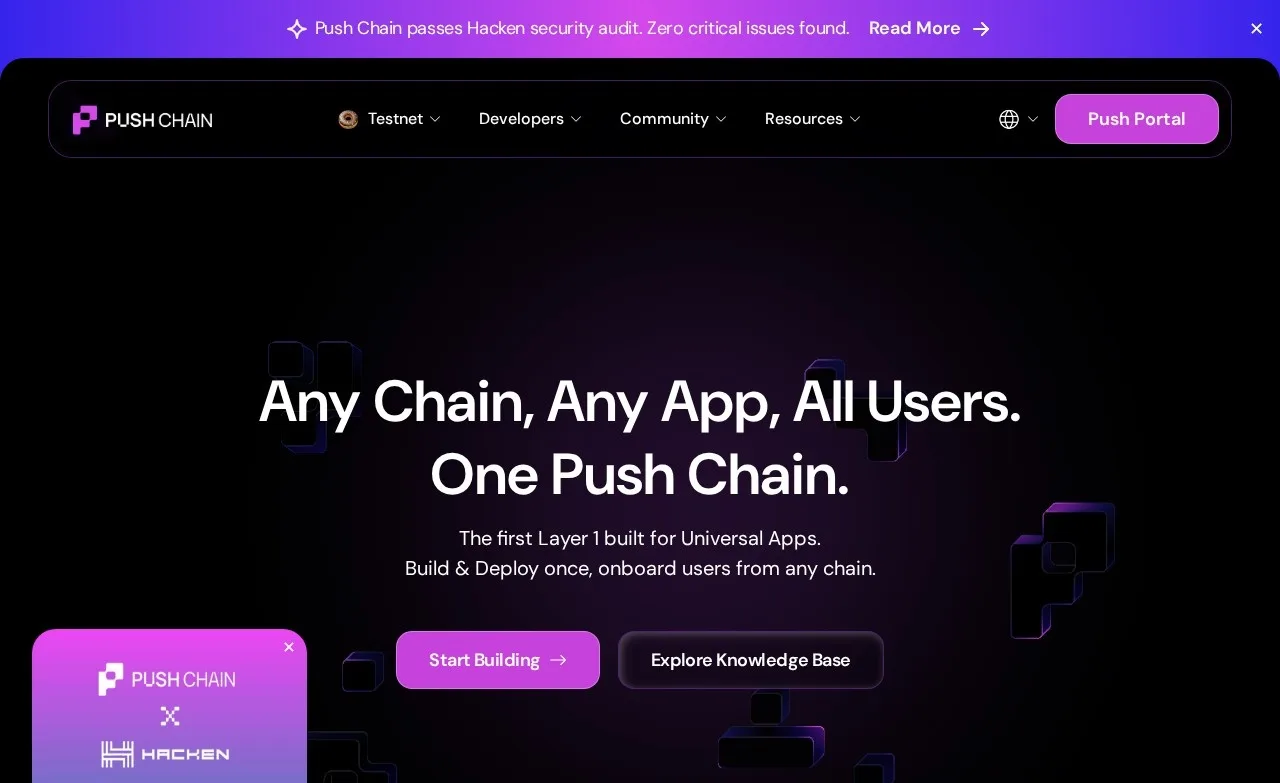
A shared-state Layer 1 blockchain that provides universal execution, fee abstraction, and wallet abstraction across EVM and non-EVM ecosystems.
Push Notifications
A decentralized communication protocol that delivers on-chain alert notifications directly to wallet addresses.
Push Chat
A web3-native messaging layer that supports encrypted direct chats and token-gated community group conversations.
Push Video & Spaces
Decentralized audio and video infrastructure that enables real-time peer-to-peer calling and broadcast spaces between wallet addresses.
PUSD
A 1:1 backed universal stablecoin designed to unify cross-chain liquidity and facilitate bridgeless settlements on Push Chain.
Push Protocol screenshots
What users say about Push Protocol
Independent user feedback is extremely sparse, with discussion primarily focused on conceptual praise for cross-chain abstraction and unified signing.
In their own words
“this is actually a really clean explanation of why atomicity matters more than people realize. most user frustration in defi comes from partial states approvals without execution or funds stuck mid flow and multicall fixes that at the root. the cross chain angle is the interesting part.”
“Super interesting write-up and honestly, you’re spot on that identity is the *real* mess in cross-chain UX. Right now every wallet basically fragments you into 10 different “yous,” and devs end up duct-taping signer logic just to make basic flows work.”
“This is one of those problems everyone complains about but nobody actually solves cleanly, so seeing real fee abstraction get pushed forward is pretty exciting.”
Based on 113 Reddit posts and comments from the last 12 months, checked Oct 21, 2026. These are posts by users on other sites, not reviews submitted on CryptoReview.
User reviews
No user reviews yet. Have you used Push Protocol? Share your experience below.
Funding and investors
$12.3MTotal raised
3Rounds
3Investors
-
Series A Apr 2022 $10.1M
-
Seed Mar 2021 $1.4M
-
Seed Dec 2020 $750K
FAQ
Who founded Push Protocol?
Push Protocol was founded in 2020 by Harsh Rajat and Richa Joshi, initially operating under the name Ethereum Push Notification Service (EPNS).
Does Push Protocol have a native token?
Yes, Push Protocol operates the PUSH utility and governance token.
Has Push Protocol been audited for security?
Push Chain completed a security audit conducted by Hacken and maintains an ongoing bug bounty program.
Which blockchains does Push Protocol support?
Push Protocol supports networks including Ethereum, Polygon, and BNB Chain, while Push Chain is built to bridge execution across EVM chains and Solana.
What is Push Chain?
Push Chain is an EVM-compatible, shared-state Layer 1 blockchain that lets developers deploy an application once and onboard users from any supported blockchain using their existing native wallets.
Latest from Push Protocol on X
Recent public posts from @pushprotocol, shown as published. Not reviewed or endorsed by CryptoReview.
Alternatives to Push Protocol

Open-source smart contract libraries and enterprise security tooling backing over $38T in transfers
Developer toolingFree tier10 chains supported

Blockchain infrastructure platform supporting 100+ chains with a free 30M-compute-unit tier
RPC / nodes · Data APIs +3Free tier100 chains supported

Managed blockchain infrastructure across 70+ chains with a free 3M-request monthly tier
RPC / nodes · IndexingFree tier70 chains supported

EVM development and simulation platform supporting transaction debugging and testing across 50+ chains
Developer toolingFree tier50 chains supported

Open-source distributed ledger foundation hosting Fabric, Besu, and Cacti under the Linux Foundation
RPC / nodes · Developer toolingFree tier2 chains supported

Blockchain infrastructure platform providing RPC nodes and data streams across 76 networks
RPC / nodes · Data APIsFree tier76 chains supported