

Our project @DINBuild is growing up so quickly. Exciting announcements and big things coming to DevConnect! Catch them at the @AgenticZero conference in Buenos Aires!

Infura
Consensys-owned RPC node infrastructure provider powering MetaMask across 40+ blockchain networks
4.1/ 5
Our score
Very good
Services
RPC / nodesData APIs
Chains supported
40
Free tier
Yes
Pricing from
$50/month
Enterprise SLA
Yes
What is Infura?
Infura is a managed blockchain infrastructure service that provides remote procedure call (RPC) endpoints and APIs for Web3 developers. Operated as a business unit within Consensys, the platform serves as the default network provider for MetaMask and routes requests across major Layer 1 and Layer 2 ecosystems.
Company background
Infura was founded in 2016 and announced publicly at Devcon2 in Shanghai before being integrated into Consensys, based in New York.
Platform architecture and supported networks
Developers access networks using JSON-RPC over HTTPS and WebSocket connections. Infura supports more than 40 networks, including Ethereum, Arbitrum, Optimism, Polygon, Linea, Starknet, Avalanche, and Palm. Alongside core EVM-compatible node access, the platform includes decentralized storage connectivity through an IPFS API and dedicated IPFS gateway. Infrastructure health is monitored via public status feeds with alert notifications distributed through webhooks, email, text message, and Slack.
Subscription tiers and pricing
Infura uses a credit-based billing system across multiple service tiers. The Core plan is free and provides 6 million credits per day with a throughput rate limit of 2,000 credits per second. Paid tiers include the Developer plan at $50 per month and the Team plan at $225 per month. Extra capacity can be added for $200 per month per 55 million credits. High-volume teams can negotiate Enterprise contracts that include custom request ceilings, dedicated account managers, 24/7 engineering support, and formal service level agreements.
Track record and infrastructure trade-offs
Operating since 2016, Infura maintains a target uptime SLA of 99.99% for its paid infrastructure. However, reliance on centralized node providers introduces systemic operational trade-offs for decentralized applications. If an upstream cloud outage or provider incident occurs, client applications and wallets routing exclusively through Infura can experience transaction processing halts and localized interface downtime unless automatic fallback RPCs are configured.
Best for:Developers building on Ethereum and LineaMetaMask SDK and Snaps integrationsTeams needing managed multi-chain RPC endpoints
Pros and cons
Pros
- Free Core tier provides 6 million credits daily
- Direct native integration with MetaMask and Consensys tooling
- Supports over 40 blockchain networks and Layer 2s
- Target 99.99% uptime SLA on enterprise accounts
Cons
- Centralized RPC architecture creates single-point-of-failure risks
- Paid subscriptions start at $50 per month
- Strict rate limits apply on free tier throughput
Our review
4.1/5
Very good
Infura provides reliable, deeply integrated node infrastructure for the Consensys ecosystem, but users face centralized architecture dependencies and steep monthly price jumps across paid tiers.
Infura has operated since 2016 as a remote procedure call (RPC) and API node provider within Consensys. Headquartered in New York, it serves as the default node provider for the MetaMask wallet. The platform provides HTTPS and WebSocket JSON-RPC access across more than 40 networks, including Ethereum, Arbitrum, Optimism, Polygon, Starknet, Avalanche, and Linea.
The service provides reliable infrastructure with an advertised 99.99% uptime guarantee. Its incident notification system supports webhooks, email, SMS, and Slack alerts. The free Core tier grants up to 6 million credits per day, with a 2,000 credit per second throughput limit. Infura also integrates directly with the MetaMask SDK and MetaMask Snaps.
Infura has several practical trade-offs:
- Centralization risk remains a consideration. Systemic outages or service interruptions directly affect downstream applications that rely solely on its default endpoints.
- Pricing scales abruptly between tiers, jumping from free to $50 monthly for the Developer plan and $225 monthly for the Team plan.
- High-throughput custom SLAs and 24/7 dedicated engineering support require custom Enterprise agreements.
Infura suits teams deploying Web3 applications, dApps, or MetaMask Snaps that need connectivity to Ethereum and major Layer 2 networks without maintaining self-hosted hardware. Teams requiring fully decentralized infrastructure pipelines or strictly open-source node stacks may instead self-host execution and consensus clients.
Specs
| Services | RPC / nodes, Data APIs |
|---|---|
| Chains supported | 40 · unverified |
| Free tier | Yes |
| Pricing from | $50/month · unverified |
| Enterprise SLA | Yes · unverified |
| Uptime SLA | 99.99% · unverified |
| Free tier limits | 6 million credits/day, 2,000 credits/second · unverified |
Not disclosed by the provider: Open source, Token, Server regions.
Data from the provider's website and public sources. Fees and availability change; confirm on the official site before you sign up.
Key features
Multi-chain RPC access
Supports JSON-RPC over HTTPS and WebSocket connections across more than 40 networks, including Ethereum, Arbitrum, Optimism, Polygon, and Linea.
Free Core allocation
Provides 6 million credits each day at a throughput cap of 2,000 credits per second on the free tier.
IPFS gateway integration
Includes dedicated APIs and gateway infrastructure to store and serve files over decentralized IPFS storage.
MetaMask developer alignment
Integrates directly with the MetaMask SDK and MetaMask Snaps, serving as the core infrastructure backend for the wallet.
Automated incident alerts
Sends real-time infrastructure status notifications via Slack, webhooks, SMS, and email whenever service incidents occur.
Enterprise SLAs
Guarantees up to 99.99% uptime with 24/7 engineering support and custom throughput limits on negotiated tiers.
Inside Infura
Infura Core Blockchain APIs
Provides JSON-RPC endpoints over HTTPS and WebSocket connections for Ethereum, Layer 2 networks, and alternative chains with up to 99.99% uptime.
IPFS Service
Delivers programmatic access to decentralized file storage through a scalable API and a dedicated IPFS gateway.
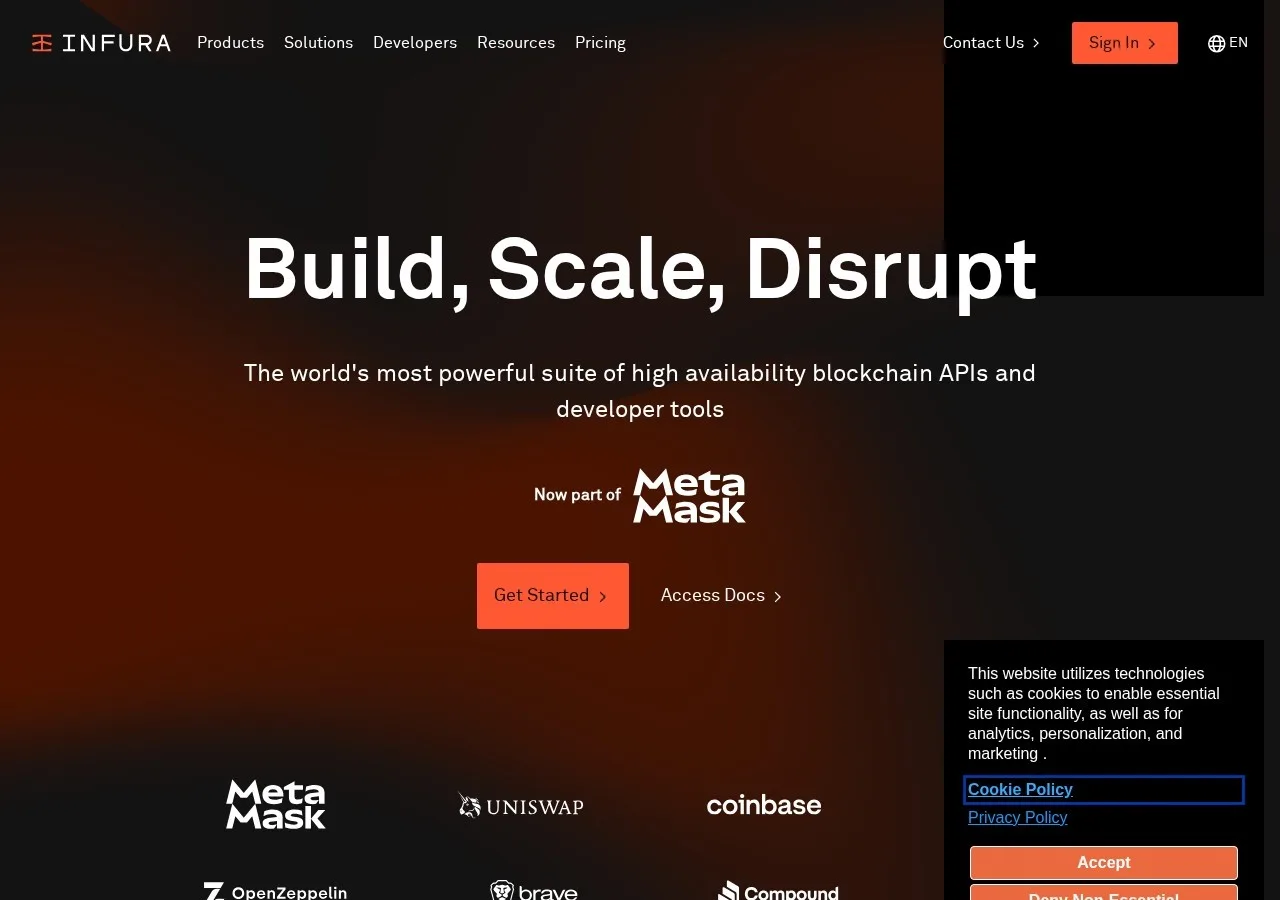
Infura screenshots
What users say about Infura
User feedback for Infura contains minimal substantive discussion. One user reported positive results using the service, while other mentions consist of unrelated technical snippets.
Based on 3 Reddit posts and comments from the last 12 months, checked Oct 20, 2026. These are posts by users on other sites, not reviews submitted on CryptoReview.
User reviews
No user reviews yet. Have you used Infura? Share your experience below.
FAQ
Who owns and operates Infura?
Infura is part of Consensys and was launched publicly at Devcon2 in 2016.
How much does Infura cost?
Infura offers a free Core plan providing 6 million credits daily, a Developer plan for $50 per month, a Team plan for $225 per month, and custom-priced Enterprise tiers. Additional credits can be purchased at $200 per month for 55 million credits.
Which blockchain networks does Infura support?
Infura supports more than 40 networks, including Ethereum, Arbitrum, Optimism, Polygon, Starknet, Avalanche, Palm, and Linea.
Does Infura have a native token?
Infura operates as an API service with subscription tiers and custom enterprise billing.
What is the uptime guarantee for Infura?
Infura provides an advertised 99.99% uptime guarantee across its core blockchain node services.
What free tier limits does Infura impose?
The free Core plan provides 6 million request credits per day with a rate limit of 2,000 credits per second.
Latest from Infura on X
ICYMI: @MetaMaskDev dashboard now supports @hemi_xyz network, decentralized by @DINBuild
Start building today! https://t.co/2Nj9eB8gL4
Start building today! https://t.co/2Nj9eB8gL4

Excited to see @DINBuild move forward and take decentralization to the next stage. Looking forward to the DIN AVS Mainnet launch in partnership with @eigencloud !
Recent public posts from @infura_io, shown as published. Not reviewed or endorsed by CryptoReview.
Alternatives to Infura

Open-source smart contract libraries and enterprise security tooling backing over $38T in transfers
Developer toolingFree tier10 chains supported

Blockchain infrastructure platform supporting 100+ chains with a free 30M-compute-unit tier
RPC / nodes · Data APIs +3Free tier100 chains supported

Managed blockchain infrastructure across 70+ chains with a free 3M-request monthly tier
RPC / nodes · IndexingFree tier70 chains supported

EVM development and simulation platform supporting transaction debugging and testing across 50+ chains
Developer toolingFree tier50 chains supported

Open-source distributed ledger foundation hosting Fabric, Besu, and Cacti under the Linux Foundation
RPC / nodes · Developer toolingFree tier2 chains supported

Blockchain infrastructure platform providing RPC nodes and data streams across 76 networks
RPC / nodes · Data APIsFree tier76 chains supported