Institutional interoperability with CLIP. Institutions keep their own ledgers and settle across them in one atomic transaction.
📍 Mumbai, Booth 08
🗓️ 04 Nov - 12:00 IST https://t.co/25q08DTv35

Ethereum software and infrastructure provider powering Infura, MetaMask, Linea, and Besu
Consensys is an Ethereum software engineering company building core web3 infrastructure, developer tooling, and enterprise blockchain deployments. Established before the Ethereum genesis block, its portfolio includes developer gateway Infura, the non-custodial wallet MetaMask, the Linea zero-knowledge rollup, and production clients such as Besu and Teku.
Ethereum co-founder Joseph Lubin founded Consensys in 2014 and is its chief executive officer. Lubin holds an electrical engineering and computer science degree from Princeton University and previously worked on the Identrus project before operating a hedge fund. The global organization operates with a headcount of over 700 technologists, delivering client code, institutional staking, and managed infrastructure.
The company provides developer access to EVM networks through Infura, which launched in 2016 to deliver hosted JSON-RPC and WebSocket endpoints without requiring local node operations. Infura is the primary RPC backend for MetaMask and connects to public networks including Ethereum and Linea, as well as testnets. For node operators, Consensys maintains Besu, an open-source execution client designed for public and private enterprise networks, alongside Teku, a consensus client tailored for institutional proof-of-stake validators. The company also developed Web3Signer for remote key management and the Lineth open-source rollup architecture powering Linea.
Infura uses a credit-based consumption model for blockchain queries. Methods are metered according to computational intensity: executing an eth_call RPC request consumes 80 credits, while an eth_getLogs request consumes 255 credits. Enterprise client deployments and custom managed network agreements operate under scoped institutional contracts.
Consensys infrastructure underpins substantial Ethereum activity; its MetaMask wallet generated over $198 million in cumulative protocol revenue through June 2026. The SEC dismissed its lawsuit against the company in February 2026. However, heavy reliance on Infura exposes applications to centralization risks when major dApps share a single hosted RPC gateway. Multi-chain coverage remains narrower than some competitors, with Infura limiting direct access to 25 chains. WebSocket support across non-Ethereum chains such as Arbitrum, Avalanche, and BNB remained in beta as of April 2026, while Solana access has stayed restricted to select enterprise users.

Consensys provides standard Ethereum infrastructure across MetaMask, Infura, and client software, but non-EVM coverage is limited and developers face centralized RPC dependencies.
Consensys is an Ethereum software and infrastructure company. Founded in 2014 by Ethereum co-founder Joseph Lubin, the firm maintains components including Infura for hosted RPC APIs, the MetaMask non-custodial wallet, the Linea ZK-rollup, and core client implementations such as Besu and Teku. With a team exceeding 700 technologists, Consensys operates across developer tooling and managed infrastructure.
For developers, Infura integrates with several parts of the Ethereum stack. As the default RPC backend for MetaMask, Infura handles high daily transaction volumes and supports both HTTPS and WebSocket connections for Ethereum mainnet and testnets. Pricing operates on a credit consumption model, charging 80 credits for an eth_call and 255 credits for an eth_getLogs request. The firm offers SOC 2 Type II-certified institutional staking infrastructure with built-in slashing protection and remote key signing through Web3Signer.
The trade-offs center on multi-chain flexibility and centralization risks. Infura enforces a 25-chain cap, while some multi-chain alternatives support more networks. WebSocket support for non-Ethereum networks like Arbitrum, Avalanche, BNB Chain, and Optimism remained in beta as of April 2026, while Solana connectivity is restricted to select enterprise partners. Reliance on Infura across the Web3 ecosystem has drawn criticism over node centralization, prompting the team to develop the Decentralized Infrastructure Network (DIN) initiative to distribute traffic across external node runners.
Consensys fits enterprise teams and dApp builders committed exclusively to Ethereum and EVM rollups that require Ethereum client software and high-throughput RPC endpoints. Teams requiring native non-EVM indexing or Solana performance will need to integrate supplementary infrastructure vendors.
| Services | RPC / nodes, Developer tooling, Staking infrastructure, Wallet APIs · unverified |
|---|---|
| Chains supported | 25 · unverified |
| Free tier | Yes · unverified |
| Enterprise SLA | Yes · unverified |
| Open source | Yes · unverified |
Not disclosed by the provider: Pricing from, Token, Uptime SLA, Free tier limits, Server regions.
Data from the provider's website and public sources. Fees and availability change; confirm on the official site before you sign up.
Provides scalable HTTPS and WebSocket connections for Ethereum, Linea, and testnets with metered credit consumption.
An open-source Ethereum execution client built in Java, supporting public networks and permissioned consortium deployments.
Institutional-grade Ethereum consensus client offering distributed validator setups and slashing protection.
A remote signing service separating private keys from validator clients to secure institutional signing operations.
A zero-knowledge rollup scaling Ethereum execution using the open-source Lineth architecture.
Self-custodial Ethereum staking APIs and dedicated validator nodes with built-in anti-slashing architecture.
A blockchain API infrastructure suite providing developers with high-availability RPC and WebSocket access to Ethereum and EVM-compatible networks.
A non-custodial Web3 wallet and developer SDK platform that allows end users to manage digital assets and interact with decentralized applications.
A zero-knowledge rollup (zkEVM) Layer 2 network designed to scale Ethereum transaction throughput while lowering gas costs.
An open-source Ethereum execution client written in Java, engineered for enterprise deployments on both public and permissioned networks.
An institutional-grade Ethereum consensus client built to meet enterprise staking and validator requirements.
A secure remote signing service designed to isolate private keys and protect Ethereum validator signing workflows.
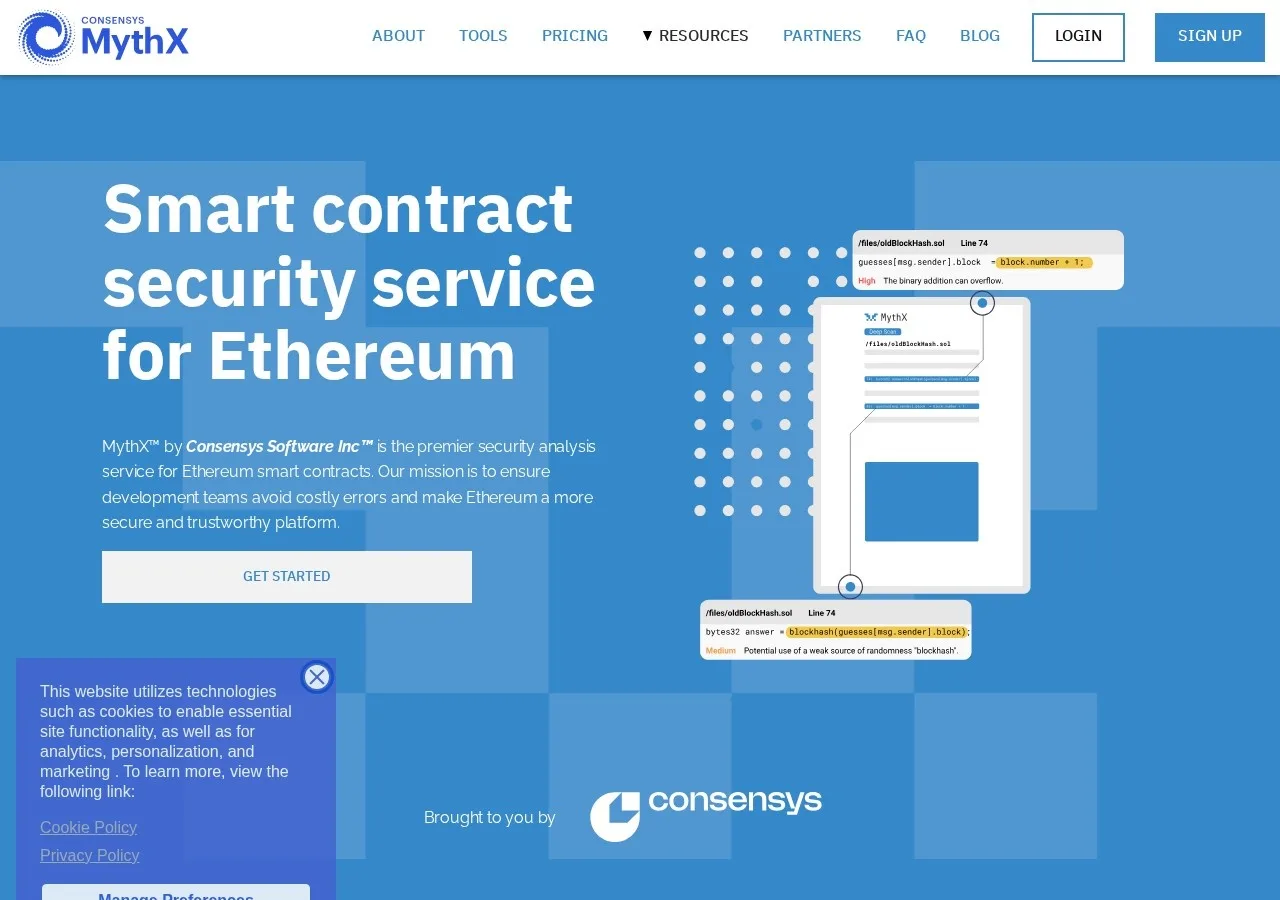
A smart contract security analysis tool that scans EVM code for vulnerabilities using static analysis, symbolic execution, and fuzzing.
No user reviews yet. Have you used Consensys? Share your experience below.
Consensys was founded in 2014 by Ethereum co-founder Joseph Lubin, who is the company's CEO. Lubin previously studied electrical engineering and computer science at Princeton University.
Consensys provides Infura for hosted RPC APIs, the Linea Layer 2 network, Besu and Teku node clients, Web3Signer key management, and institutional validator staking. It also develops the MetaMask wallet and the MythX smart contract security suite.
Infura meters developer usage with API credits based on the method called. An eth_call query consumes 80 credits, whereas an eth_getLogs request consumes 255 credits.
Consensys infrastructure focuses primarily on Ethereum and EVM-compatible networks, including Linea, Arbitrum, Optimism, Avalanche, and BNB Chain up to a 25-chain ceiling. Non-EVM networks like Solana remain restricted to select partners.
No, Consensys is a private software corporation and does not have an official corporate token. Individual protocols within its ecosystem, like the Linea rollup, operate on their own distinct network architectures.
In February 2026, the US Securities and Exchange Commission dismissed its lawsuit against Consensys. The legal challenge had previously scrutinized Ethereum software services including MetaMask Swaps and staking features.


Recent public posts from @consensys, shown as published. Not reviewed or endorsed by CryptoReview.
Open-source smart contract libraries and enterprise security tooling backing over $38T in transfers
Blockchain infrastructure platform supporting 100+ chains with a free 30M-compute-unit tier
Managed blockchain infrastructure across 70+ chains with a free 3M-request monthly tier
EVM development and simulation platform supporting transaction debugging and testing across 50+ chains
Open-source distributed ledger foundation hosting Fabric, Besu, and Cacti under the Linux Foundation
Blockchain infrastructure platform providing RPC nodes and data streams across 76 networks
Type at least two characters. Press ↵ to see all results.