ARPA is a decentralized secure computation network built around threshold BLS signatures. Its first major product, Randcast, supplies on-chain verifiable randomness for games, lotteries and decentralized applications. ARPA says its mainnet has completed more than 224,000 computation tasks.
Who is behind it
The project began in 2018 as ARPA Chain, a privacy-preserving Multi-party Computation network. Felix Xu is listed as co-founder and CEO. A strategic funding round announced in May 2024 raised $6 million from Laser Digital and DeFiance Capital, with participation from Animoca Brands, Metrics Ventures, ArkStream Capital and Trinito.
How the network works
Nodes take part in distributed key generation and produce partial BLS signatures. A group aggregates those signatures, while ARPA smart contracts verify the result on-chain before a request is fulfilled. The NodeRegistry handles node registration, activation, exit and slashing. The Controller and Coordinator manage groups and key-generation phases, while the Adapter manages subscriptions, payments, task assignment and callbacks.
Developers can use the Randcast SDK, Solidity contracts, Foundry tools or a web portal. The portal creates and funds subscriptions, adds consumer contracts, and displays pending and historical requests. Documentation covers Ethereum, BNB Chain and ARPA Chain. The wider network is designed for secure wallets, cross-chain bridges and decentralized custody, although those uses require separate integrations.
Fees and participation
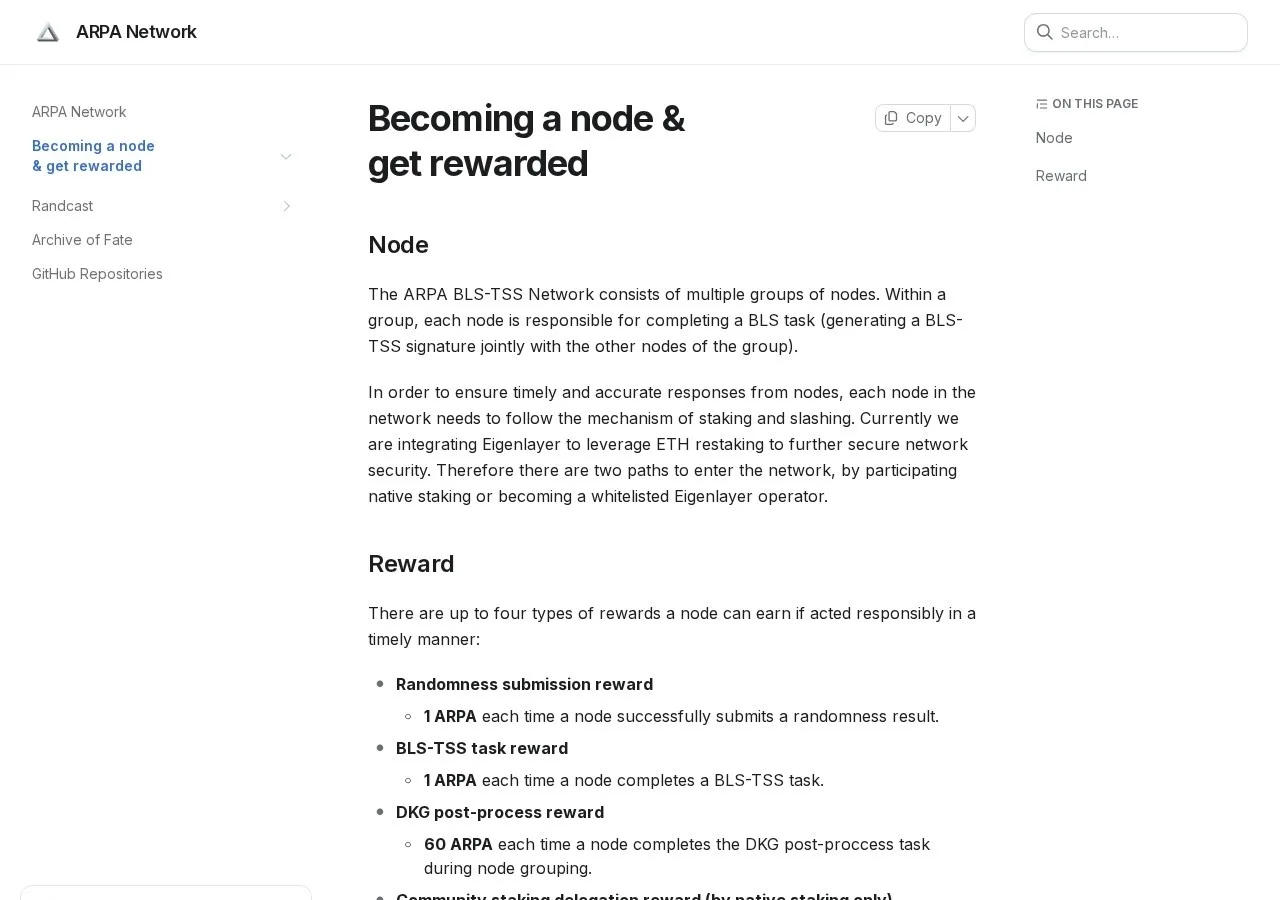
Randcast lists a flat fee of 0.000002 ETH per request on Ethereum Mainnet and 0.000006 BNB per request on BSC Mainnet. Requests also require funds for the underlying blockchain transaction. ARPA token holders can stake through native staking or a community pool. Node operators face slashing for malicious activity, and staking rewards depend on network participation and token economics.
Track record and limitations
ARPA dates its project origin to 2018. The threshold-signature network is operated by nodes across different regions. An audit report is linked for ARPA Staking. The network’s security depends on node participation, group formation and smart-contract operation. A node outage or coordination failure can delay randomness requests, while a compromised threshold of participants could affect outputs.
Applications require correctly configured contracts and funded subscriptions goals. Staking introduces exposure to ARPA token economics, while bridges and custody applications add smart-contract and counterparty risks.