

The official Twitter handle for $ANYONE, operated by The Foundation for Anyone, is @AnyoneFDN
This is the same account that has been historically used and will maintain the gold check for authenticity after an interim period.
Be careful of outdated links and phishing scams.

Anyone Protocol
Decentralized onion-routing privacy network with over 7,500 independent relay nodes
3.1/ 5
Our score
Fair
Services
Developer tooling
Chains supported
1
Free tier
Yes
Token
ANYONE
What is Anyone Protocol?
Anyone Protocol is a decentralized physical infrastructure network (DePIN) that routes internet traffic through a distributed set of independent relays using multi-hop layered encryption. Founded in 2023 as a rebrand from ATOR Protocol, the project replaces centralized VPN and proxy services with a peer-to-peer network where node operators receive cryptographic rewards for contributing bandwidth.
Team and operational background
The network operates under The Foundation for Anyone, maintaining development across open-source code repositories. Founding contributors include executives with backgrounds across Forte Group, Helium Systems, and Bloxroute. The project shifted its public presence to the Foundation structure following the migration from the original ATOR token architecture to the current ANYONE utility token.
Network architecture and hardware
The core infrastructure anonymizes web and application traffic by passing packets through three distinct encrypted relay hops, meaning no single relay possesses visibility into both the origin and destination of a request. Users connect to the network via mobile and desktop applications or through the dedicated Anyone Router, a physical hardware device designed to route local network traffic automatically. Developers integrate network routing directly into applications using the Anyone SDK, which records more than 66,000 package installs.
Tokenomics and relay requirements
Relay operators earn payouts in ANYONE tokens based on bandwidth consensus weight and verified uptime. Operating a virtual, non-hardware relay requires locking 100 ANYONE tokens per relay fingerprint on Ethereum. Dedicated Anyone Router hardware devices operate without token locking requirements. To receive weekly reward emissions, virtual operators must maintain their locked token balance throughout the distribution cycle or forfeit their earned payouts.
Network scale and trade-offs
The network reports over 7,500 active relay nodes, 4,000 distinct IP locations, and cumulative throughput exceeding 80 GB/s. Because relay rewards and staking economics depend on the ANYONE token, compensation volatility directly influences node operator retention and aggregate routing capacity. Setting up self-hosted relays also introduces technical overhead, requiring operators to configure virtualization environments and manual router port forwarding on port 9001.
Best for:Privacy-focused developers routing app trafficHardware operators earning relay bandwidth rewardsUsers avoiding centralized commercial VPN services
Pros and cons
Pros
- Open-source infrastructure with more than 7,500 active nodes globally
- Hardware routers do not require locked ANYONE tokens to operate
- Layered 3-hop encryption avoids centralized VPN points of failure
- Over 80 GB/s in aggregate decentralized routing bandwidth
Cons
- Virtual relays require locking 100 ANYONE tokens to claim rewards
- Operator earnings depend directly on ANYONE token market volatility
- Relay setup requires manual router port forwarding on port 9001
- Weekly reward claims are forfeited if eligibility conditions lapse
Our review
3.1/5
Fair
Anyone Protocol offers decentralized, encrypted routing powered by thousands of independent relays, but operators face token-locking requirements and developers lack traditional enterprise uptime service agreements.
Founded in 2023 as a rebrand of ATOR Protocol, Anyone Protocol builds decentralized physical infrastructure (DePIN) designed for private internet routing. Rather than running standard RPC nodes or centralized indexing services, the protocol operates an onion-routed communication overlay. User data passes across three independent relays, stripping metadata without storing server logs or browsing activity.
The network reports over 7,500 active network nodes across 4,000 distinct IP locations, delivering more than 80 GB/s in aggregate bandwidth. Developers can integrate this transit layer directly into applications using the open-source SDK, which has logged more than 66,000 NPM installs. Users access the routing layer either through client software or dedicated hardware, while relay providers receive incentives denominated in the ANYONE utility token.
The protocol presents trade-offs compared to traditional Web3 node and infrastructure providers:
- Relay operators running virtual machines or commodity hardware must lock 100 mainnet ANYONE tokens per fingerprint to claim rewards, while hardware router owners are exempt.
- Reward allocation depends on consensus bandwidth weight, geographic location, and Proof of Uptime tiers, with 20% of rewards reserved for high-uptime nodes.
- The network acts as an isolated transport overlay on Ethereum and Arweave rather than an EVM-compatible RPC pipeline across diverse blockchains.
- There are no formal enterprise uptime service-level agreements (SLAs) or round-the-clock commercial support lines.
Anyone Protocol suits decentralized application builders and AI agent developers seeking anonymous communication channels without centralized VPN bottlenecks. Teams requiring standard EVM JSON-RPC infrastructure or binding corporate enterprise SLAs should choose dedicated Web3 node providers instead.
Specs
| Services | Developer tooling · unverified |
|---|---|
| Chains supported | 1 · unverified |
| Free tier | Yes · unverified |
| Open source | Yes · unverified |
| Token | ANYONE · unverified |
Not disclosed by the provider: Pricing from, Enterprise SLA, Uptime SLA, Free tier limits, Server regions.
Data from the provider's website and public sources. Fees and availability change; confirm on the official site before you sign up.
Key features
Three-hop onion routing
Encrypts application and browser traffic across three successive relays so no individual node can link origin IP addresses to final destinations.
Anyone Router hardware
Physical hardware unit that secures an entire home network connection and acts as a relay node without requiring locked tokens.
Software relay staking
Virtual and server-based relay operators must hold and lock 100 ANYONE tokens per fingerprint to qualify for weekly reward distributions.
Anyone SDK
Developer library with over 66,000 installs designed to embed anonymous routing directly into decentralized applications and automated bots.
Proof of Uptime incentives
Allocates 20% of protocol rewards specifically to nodes meeting high-uptime performance tiers alongside bandwidth weight metrics.
Inside Anyone Protocol
Anyone Network
A decentralized DePIN communication network that routes traffic through three hops of layered encryption across independent relays.
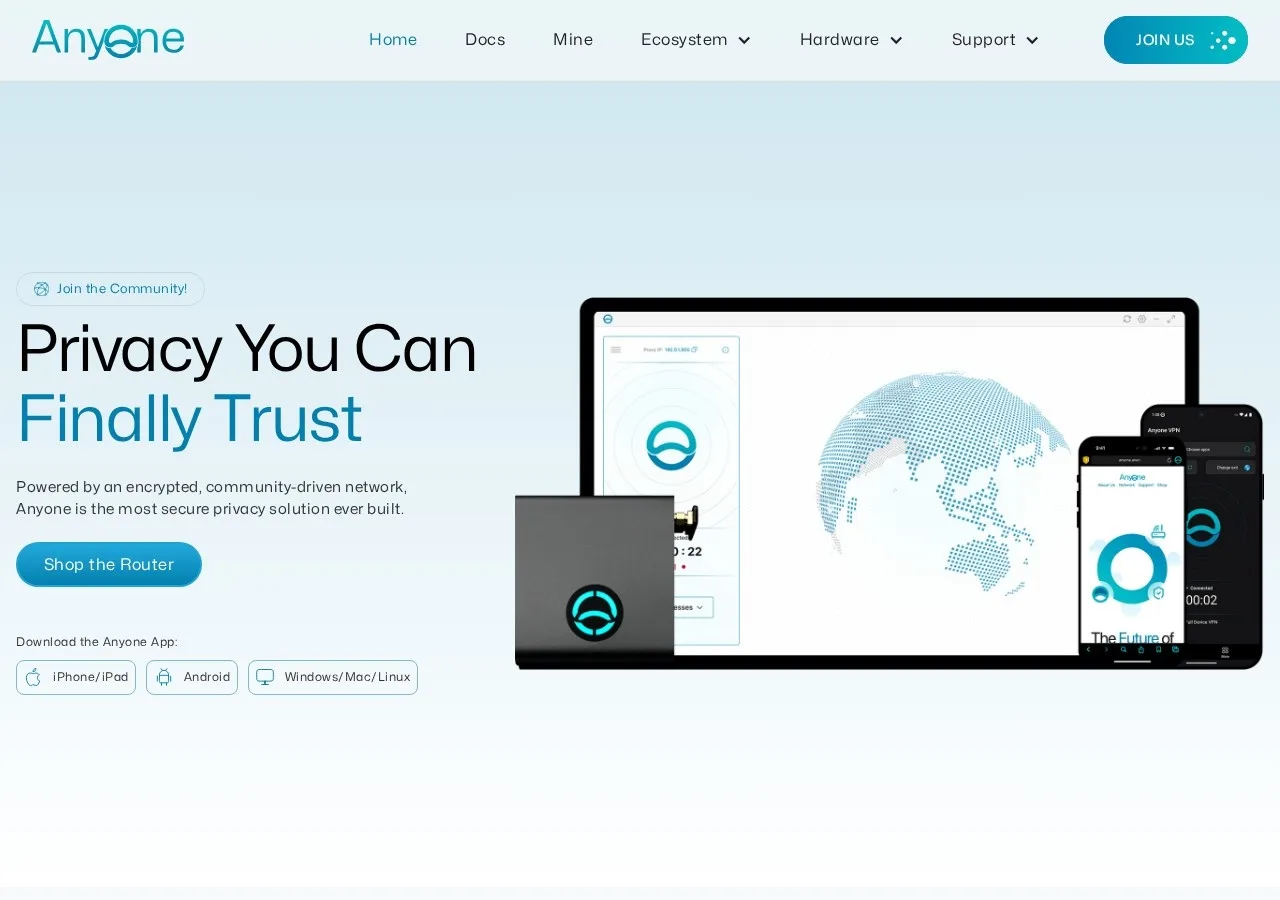
Anyone Router
Dedicated physical hardware that encrypts home network traffic and operates as an incentivized relay without requiring locked tokens.
Anyone App
A client application and browser for mobile and desktop devices that routes personal traffic directly through the encrypted network without storing logs.
Anyone SDK
A developer toolkit and NPM package designed to integrate onion-routed privacy layers into external applications and automated agents.
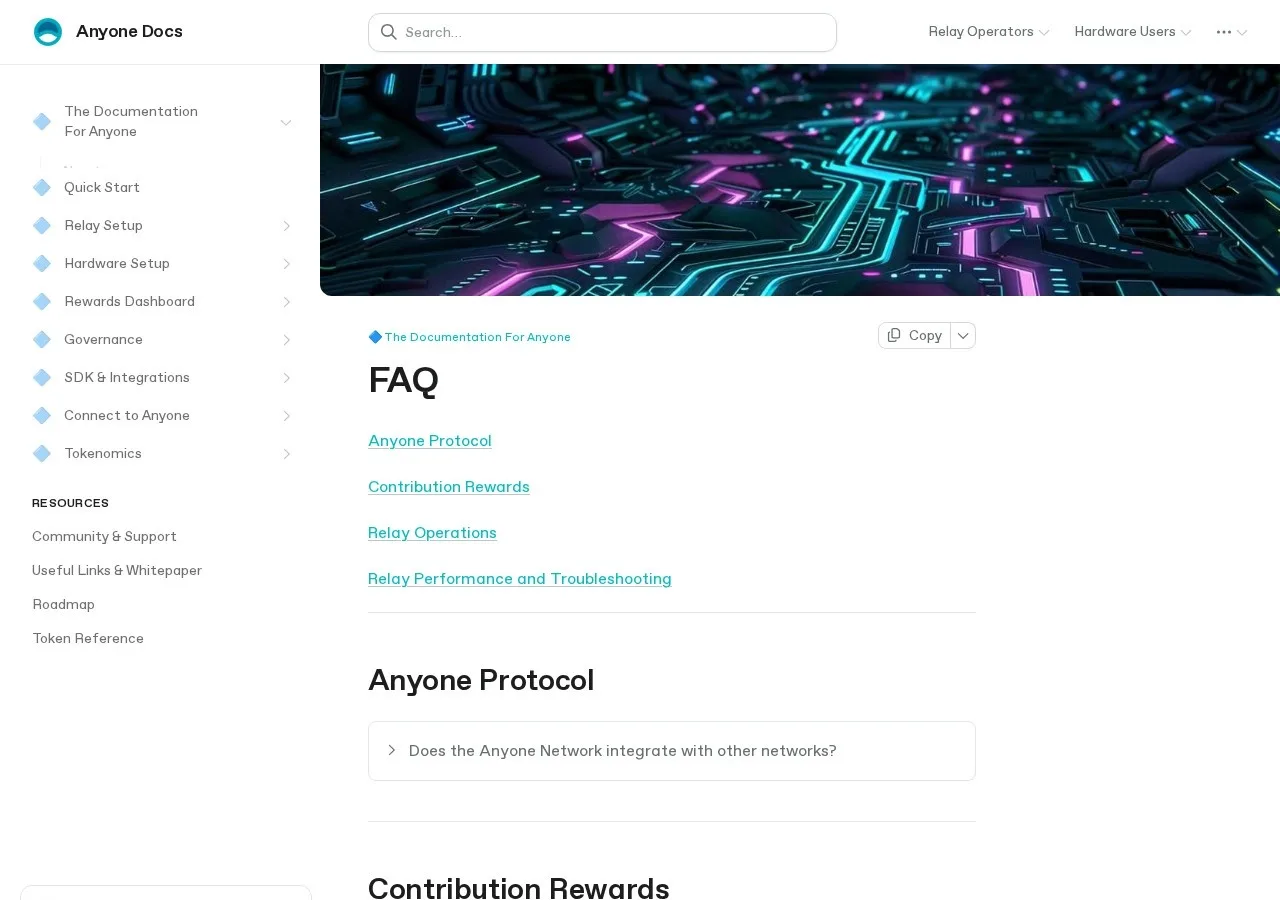
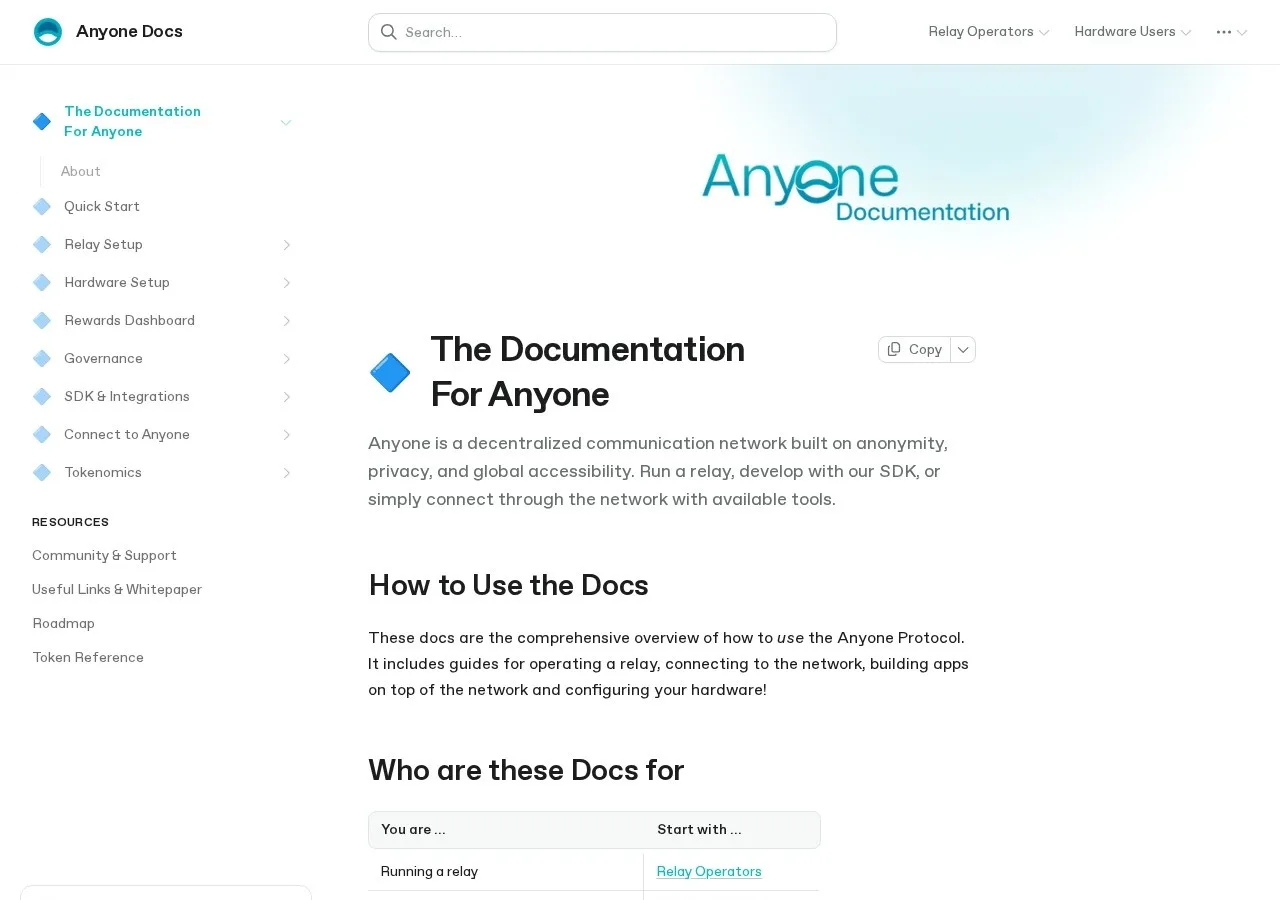
Anyone Protocol screenshots
What users say about Anyone Protocol
User feedback is overwhelmingly positive, with reviews praising the network and browser for strong privacy, anonymity, and free decentralized access.
In their own words
“I've been to both China and UAE in the last 3 months. What worked for me was anyone.io, both on phone and PC. The speeds ranged from good to bad, but still useable. They haven't implemented "paid circuits" yet, so for a currently free product, it does pretty decent.”
“If this happens, use anyone.io which is free and decentralized. I have proton VPN since it's in the proton pack that I'm using mostly for drive and mail, but anyone was even better since it doesn't require any account”
“Real privacy Finally real privacy - no data is collected union built in great browser”
Based on 6 Reddit posts and comments, 10 App Store reviews from the last 12 months, checked Oct 20, 2026. These are posts by users on other sites, not reviews submitted on CryptoReview.
User reviews
No user reviews yet. Have you used Anyone Protocol? Share your experience below.
FAQ
When was Anyone Protocol founded?
Anyone Protocol was established in 2023. The project was previously known as ATOR Protocol before rebranding.
Does Anyone Protocol have a token?
Yes, the protocol uses the ANYONE token, an ERC-20 utility asset deployed on Ethereum mainnet with a total supply of 100 million tokens. It is wrapped on Arweave to manage network consensus and reward relay operators.
Do relay operators need to lock tokens to earn rewards?
Operators running non-hardware relays must hold 100 mainnet ANYONE tokens for each registered relay fingerprint. Operators using the dedicated Anyone Router hardware are not required to lock tokens.
What security model does Anyone Protocol use for data routing?
Anyone routes traffic through a decentralized three-hop onion relay network. The protocol enforces layered encryption without storing activity logs or tracking user data.
What chains does Anyone Protocol support?
Anyone operates its own specialized privacy communication network rather than a multichain node system. Its token and incentive layers run on Ethereum and Arweave.
What developer tools does Anyone Protocol provide?
The project publishes an open-source SDK available on NPM to let developers route application and AI agent traffic through the Anyone network.
Latest from Anyone Protocol on X

Alternatives to Anyone Protocol

Open-source smart contract libraries and enterprise security tooling backing over $38T in transfers
Developer toolingFree tier10 chains supported

Blockchain infrastructure platform supporting 100+ chains with a free 30M-compute-unit tier
RPC / nodes · Data APIs +3Free tier100 chains supported

Managed blockchain infrastructure across 70+ chains with a free 3M-request monthly tier
RPC / nodes · IndexingFree tier70 chains supported

EVM development and simulation platform supporting transaction debugging and testing across 50+ chains
Developer toolingFree tier50 chains supported

Open-source distributed ledger foundation hosting Fabric, Besu, and Cacti under the Linux Foundation
RPC / nodes · Developer toolingFree tier2 chains supported

Blockchain infrastructure platform providing RPC nodes and data streams across 76 networks
RPC / nodes · Data APIsFree tier76 chains supported