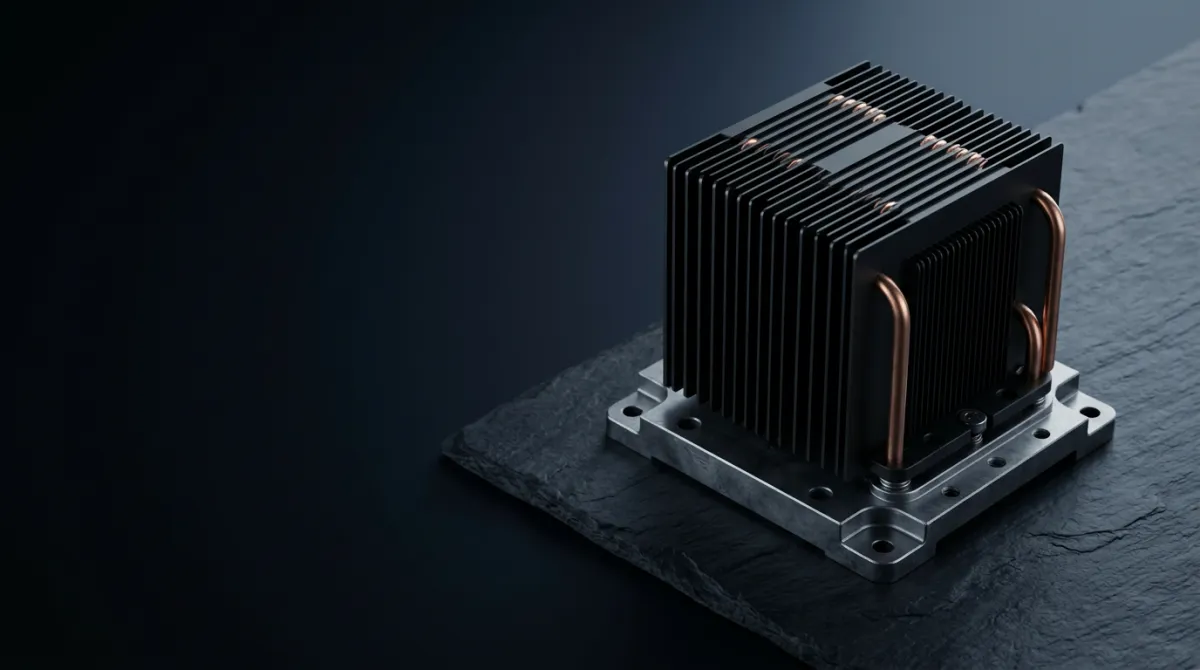





Buying GPUs is the easy part. Getting a cluster live on the date a customer was promised is the real job.
That's what Aethir is built around: compute that actually shows up, ready for training and inference.

Aethir
Distributed enterprise GPU compute network for AI and gaming backed by over 435,000 GPUs
3.5/ 5
Our score
Good
Chains supported
2
Pricing from
Dynamic demand-based bidding system
Token
ATH
What is Aethir?
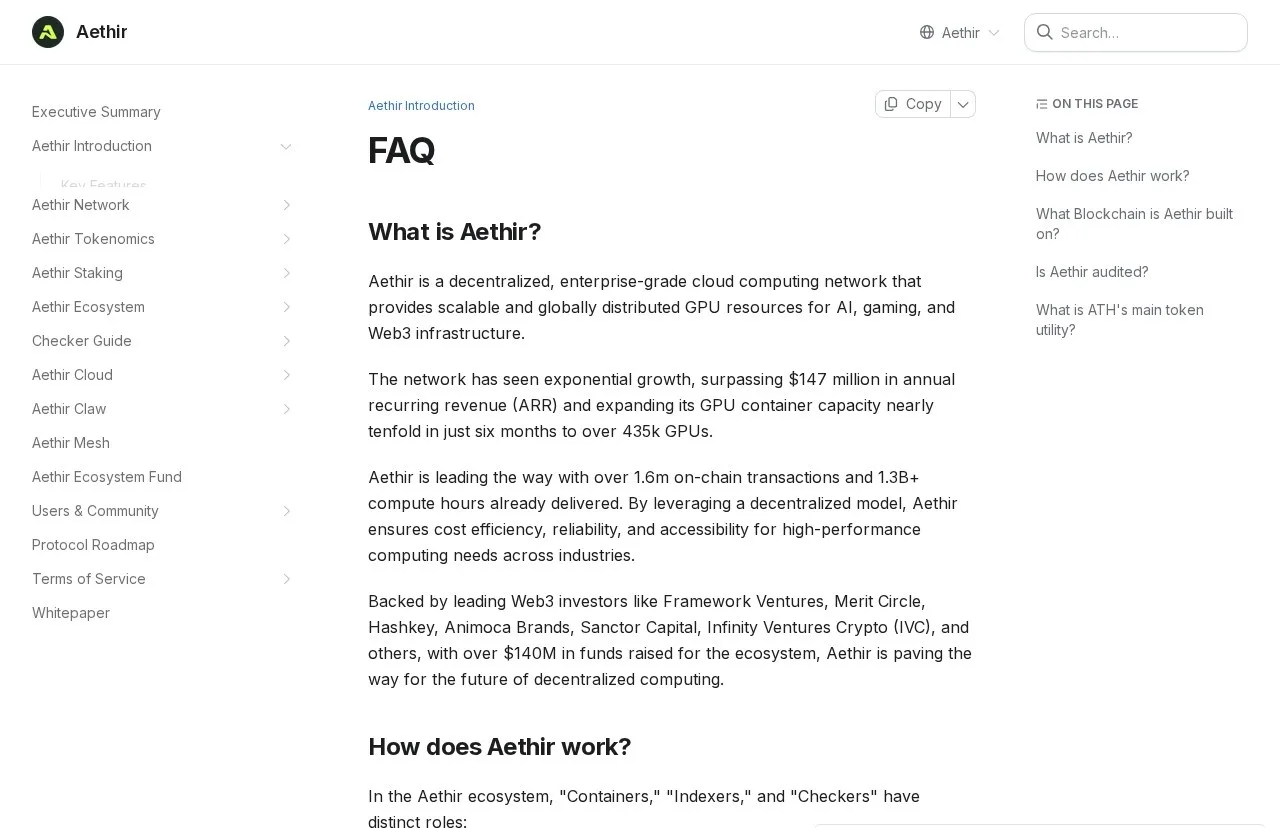
Aethir is a decentralized cloud compute infrastructure network designed to supply enterprise-grade GPU power for artificial intelligence, machine learning, and cloud gaming workloads. Operating across more than 93 countries, the network aggregates over 435,000 GPU containers to provide raw compute without centralized cloud overhead.
Team and funding
Founded in August 2021, Aethir was started by Daniel Wang and Mark Rydon. Daniel Wang serves as Chief Executive Officer, having previously worked as Chief Investment Officer at YGG SEA, Head of International Publishing at Riot Games, and General Partner at Mythos Venture Partners. Mark Rydon serves as Chief Strategy Officer following prior roles at NOTA Platform and Bechtel Corporation. The company employs over 150 team members and has raised more than $140 million in ecosystem funding from investors including Framework Ventures, Merit Circle, HashKey, Animoca Brands, Sanctor Capital, and Infinity Ventures Crypto.
Architecture and core mechanics
The network splits compute tasks across three functional layers: Containers, Indexers, and Checkers. Containers are virtualized endpoints where enterprise workloads execute directly on bare-metal hardware. Indexers act as matching coordinators, routing user requests to optimal Containers based on latency, hardware quality, and pricing. Checkers verify hardware specifications and continuous rendering quality. Node operators stake the ATH utility token to register capacity, facing slashing penalties if they fail to meet performance thresholds. The ATH token launched on Ethereum as an ERC-20 token, while network distribution, rewards, and Checker activities operate on Arbitrum.
Pricing and track record
Aethir does not charge a fixed software license fee; instead, developers pay dynamic compute service fees determined by a demand-based bidding system between clients and Container hosts. By late 2025, Aethir reported over 1.3 billion delivered compute hours and $166 million in annual recurring revenue. The network's smart contracts have undergone audits by CertiK.
Operational risks and bridge exploit
Using distributed infrastructure involves counterparty risks tied to token volatility and hardware reliability. In April 2026, an access-control vulnerability in the AethirOFTAdapter cross-chain bridge was exploited, draining roughly $400,000 in assets. The attack was contained with user losses limited to under $90,000, and the core Ethereum ATH contract was not affected. Node stakers also face liquidity constraints, such as one-year lock-up terms on EigenLayer staking pools.
Founders
Mark RydonCo-founder & CEO
Best for:AI teams training custom modelsCloud gaming studios needing low-latency streamingGPU owners monetizing enterprise hardware
Pros and cons
Pros
- Over 435,000 enterprise-grade GPU containers distributed worldwide
- Smart contracts audited by CertiK
- More than 1.3 billion delivered compute hours recorded
- Dynamic bidding market allows cost-based workload allocation
Cons
- Cross-chain bridge exploit in April 2026 caused $400,000 in contract losses
- EigenLayer ATH staking requires a one-year lock-up period
- Container operators face token slashing for hardware downtime or poor QoS
- Pricing relies on bidding fluctuations rather than fixed flat tiers
Our review
3.5/5
Good
Aethir delivers massive, cost-effective enterprise GPU compute for AI and gaming, but relies on variable bidding fees and suffered an access-control exploit on its bridge.
Aethir provides decentralized compute infrastructure focused on high-performance GPUs for artificial intelligence workloads and cloud gaming streaming. Founded in 2021 by Daniel Wang and Mark Rydon, the network has built out significant physical supply, scaling past 435,000 GPU containers and generating $166 million in annual recurring revenue by September 2025.
The platform separates delivery into distinct lines: Aethir Earth provides bare-metal GPU clusters without virtualization overhead for model training and inference, while Aethir Atmosphere handles low-latency graphics streaming for cloud gaming. Infrastructure coordination relies on three node types: Containers deliver compute, Indexers match tasks according to fee and latency requirements, and Checker Nodes verify quality of service and container specifications. Over $140 million in ecosystem funding from investors such as Framework Ventures, Merit Circle, HashKey, and Animoca Brands has helped bootstrap enterprise adoption.
Operational trade-offs center on security track record, pricing stability, and token integration. Compute pricing uses a dynamic bidding system where service costs fluctuate with network demand rather than following predictable flat tiers. Developers must also navigate native token economics: the ATH token functions as the core medium of exchange and staking asset across Ethereum and Arbitrum. In April 2026, an access-control vulnerability in the AethirOFTAdapter cross-chain bridge drained an estimated $400,000, though the core Ethereum token contract remained secure and user-side losses stayed below $90,000. Smart contracts carry a CertiK audit.
Aethir suits machine learning engineering teams and gaming studios that need scalable enterprise GPU capacity without centralized cloud markups. Organizations requiring standard, fixed-rate monthly invoicing, rigid traditional service-level guarantees, or simple fiat accounting should opt for centralized cloud vendors instead.
Specs
| Chains supported | 2 · unverified |
|---|---|
| Pricing from | Dynamic demand-based bidding system · unverified |
| Token | ATH · unverified |
Not disclosed by the provider: Services, Free tier, Enterprise SLA, Open source, Uptime SLA, Free tier limits, Server regions.
Data from the provider's website and public sources. Fees and availability change; confirm on the official site before you sign up.
Key features
Aethir Earth bare-metal compute
Provides raw enterprise GPU capacity without virtualization overhead for AI model training, fine-tuning, and inference workloads.
Aethir Atmosphere gaming cloud
Delivers low-latency distributed GPU streaming designed for real-time cloud gaming platforms.
Checker Node verification
Validates Container hardware metrics and operational quality across the network, distributing rewards and applying slashing penalties on Arbitrum.
Dynamic bidding fees
Lets developers acquire compute resources through a demand-based bidding system settled with Container hosts.
eATH liquid staking
Enables ATH token holders to stake through EigenLayer pools to earn host fees with non-custodial eATH representations.
Inside Aethir
Aethir Earth
A bare-metal GPU cloud providing raw compute power without virtualization overhead, built for AI model training, fine-tuning, and inference workloads.
Aethir Atmosphere
A distributed network of low-latency enterprise GPUs designed for real-time, interactive cloud gaming delivery.
Checker Nodes
Validation nodes operated via NFT licenses that verify container hardware specifications and monitor quality of service across the network.
Aethir Staking
A portal allowing token holders to stake ATH, including through an EigenLayer vault to receive eATH liquid staking tokens and earn a share of cloud host fees.
Aethir screenshots

What users say about Aethir
Community sentiment around Aethir is polarized, with users valuing its strong compute fundamentals and reported revenue while expressing frustration over falling staking and mining rewards. Additional complaints highlight aggressive Discord moderation and token value disconnection from enterprise performance.
In their own words
“The AI Infrastructure Play That Could Be Seriously Undervalued I’ve been looking more closely at Aethir, and honestly, I think the market may be overlooking what is actually being built here. The main reason I’m bullish on $ATH isn’t hype, partnerships or short-term price action.”
“I bought mine brand new. After a few months the amount of Aethir tokens go down drastically and they also keep around 30 percent of the amount of tokens that you earn locked up for a few months”
“Looking for a serious answer With all the ARR and all that going on. If you dig deep enough you’d realise there’s actually no promise on proper usage of the revenue? Or did i miss it? So ATH making massive returns wouldn’t actually reflect on the coin price?”
Based on 200 Reddit posts and comments from the last 12 months, checked Oct 20, 2026. These are posts by users on other sites, not reviews submitted on CryptoReview.
User reviews
No user reviews yet. Have you used Aethir? Share your experience below.
Funding and investors
$140MTotal raised
2Rounds
9Investors
-
Pre-Series A Jul 2023 Amount undisclosed
-
Funding round Amount undisclosedSource
FAQ
Who founded Aethir?
Aethir was co-founded in August 2021 by Daniel Wang, who serves as CEO, and Mark Rydon, who serves as Chief Strategy Officer. Wang previously held leadership roles at Riot Games and YGG SEA, while Rydon led the project as its initial CEO.
Does Aethir have a native token?
Yes, Aethir uses the ATH token. It serves as an ERC-20 token on Ethereum with reward distribution on Arbitrum, functioning as the payment medium for compute fees, governance, and node staking.
Has Aethir experienced any security exploits?
Yes, an access-control exploit on the AethirOFTAdapter bridge drained roughly $400,000 in April 2026. User-side losses were contained under $90,000, and the primary Ethereum token contract was not impacted.
How are compute fees determined on Aethir?
Compute service fees operate on a dynamic bidding model paid by developers to compute containers. Pricing rises and falls based on real-time network supply and workload demand.
Which blockchains does Aethir support?
Aethir issues its ATH token on Ethereum and distributes Checker, IDC, and Edge network rewards on Arbitrum.
What is the difference between Aethir Earth and Aethir Atmosphere?
Aethir Earth offers bare-metal GPU clusters without virtualization overhead for AI model training and inference. Aethir Atmosphere distributes low-latency enterprise GPUs tailored for cloud gaming streaming.
Latest from Aethir on X
What is a neocloud?
A cloud built only for AI.
Neocloud sector revenue passed $25B in 2025 and could near $400B by 2031.
Here's the neocloud meaning, the operating model behind it, and where Aethir fits👇 https://t.co/NJRe3C9n58
A cloud built only for AI.
Neocloud sector revenue passed $25B in 2025 and could near $400B by 2031.
Here's the neocloud meaning, the operating model behind it, and where Aethir fits👇 https://t.co/NJRe3C9n58

Gartner sized the AI-optimized IaaS market at $42.2 billion for 2026, up 96.4% from $21.5 billion in 2025.
Inside that number, inference accounts for $23 billion against $19 billion for training, and inference share climbs to 59% in 2027.
The industry spent three years building for training and is now spending on serving.
Inference is continuous, latency-sensitive, and geographically distributed by nature.
Aethir's network was designed around exactly those three properties.

A measurement study published in March put a number on something practitioners have felt for a while.
Chain-of-thought prompting lifted accuracy sharply on hard tasks, and raised energy per answer by 120 to 150 times.
Majority voting added 72% to 177% for much smaller gains. Same deployment, same question, two orders of magnitude apart in compute consumed.
Any capacity plan that assumes a fixed cost per query is now wrong by default, sometimes by a hundredfold. The variance is in how the model thinks.

SpaceX just financed about $40B of GPUs on 5-year leases. Lenders don't take a 5-year payback unless they expect the chips to keep earning that long.
AI compute is now financeable infrastructure, and that's the market Aethir is building for.
AI compute is now financeable infrastructure, and that's the market Aethir is building for.
Recent public posts from @AethirCloud, shown as published. Not reviewed or endorsed by CryptoReview.
Latest from Aethir on Telegram

Aethir Announcements
Join
@Aethir_Official · 126K subscribers
Axe Compute ($AGPU) now trades on @binance
as a 20x perpetual and as AGPUB, a 1:1 backed tokenized stock.
Two routes, 24/7, in USDT to tokenized GPU compute.
AGPU has also been listed across multiple exchanges in various forms, including @Gate, @Aster_DEX , @HTX_Global, @bitget, @okx, and @Bybit_Official.
@AxeCompute's stock is now reachable from crypto exchange accounts, in USDT, outside New York trading hours.
What it means for AI compute tokenization and why it’s important👇
https://x.com/AethirCloud/status/2115491046889230401

986 View on Telegram
Neocloud capacity has 3 numbers:
Contracted power → deployed megawatts → available GPU hours
The largest listed providers:
~4.2GW contracted, ~1.5GW active.
Aethir: 2B+ compute hours already delivered
On top of our readily available decentralized cloud, we plan to add more compute capacity through mid-sized data center buildouts across the US and Europe via our ACCELERATE program.
This means targeted GB300 and B300 deployments for already existing compute demand.
Learn more in our new blog👇
https://x.com/AethirCloud/status/2115072368410259745

1.1K View on Telegram
190 GW of AI compute capacity has been announced since 2024.
~16 GW scheduled for 2026.
~5 GW under construction.
Announced, financed, permitted, energized, commissioned and rentable are six different states, and the industry uses one word for all of them.
Explore our new blog to learn how to read an AI capacity announcement👇
https://x.com/AethirCloud/status/2113241974136258969

1.6K View on Telegram
Aethir Announcements pinned a photo
Recent posts from the official Telegram channel @Aethir_Official, shown as published. Not reviewed or endorsed by CryptoReview.
Alternatives to Aethir

Open-source smart contract libraries and enterprise security tooling backing over $38T in transfers
Developer toolingFree tier10 chains supported

Blockchain infrastructure platform supporting 100+ chains with a free 30M-compute-unit tier
RPC / nodes · Data APIs +3Free tier100 chains supported

Managed blockchain infrastructure across 70+ chains with a free 3M-request monthly tier
RPC / nodes · IndexingFree tier70 chains supported

EVM development and simulation platform supporting transaction debugging and testing across 50+ chains
Developer toolingFree tier50 chains supported

Open-source distributed ledger foundation hosting Fabric, Besu, and Cacti under the Linux Foundation
RPC / nodes · Developer toolingFree tier2 chains supported

Blockchain infrastructure platform providing RPC nodes and data streams across 76 networks
RPC / nodes · Data APIsFree tier76 chains supported