

Checking your backup shouldn't mean typing your words into a computer.
Verify Seed checks your paper against your KeepKey without wiping it. Each word goes through a cipher scrambled on the device screen, so your computer sees only scrambled letters.
Get it in KeepKey Desktop. https://t.co/oRSvXsWJVe

KeepKey
Open-source USB hardware wallet with an OLED display and no-KYC swaps across 11 native chains
3.6/ 5
Our score
Good
Secure element
No
Firmware
Fully open source
Connectivity
USB-C
Supported assets
7,000
Bitcoin-only
No
What is KeepKey?
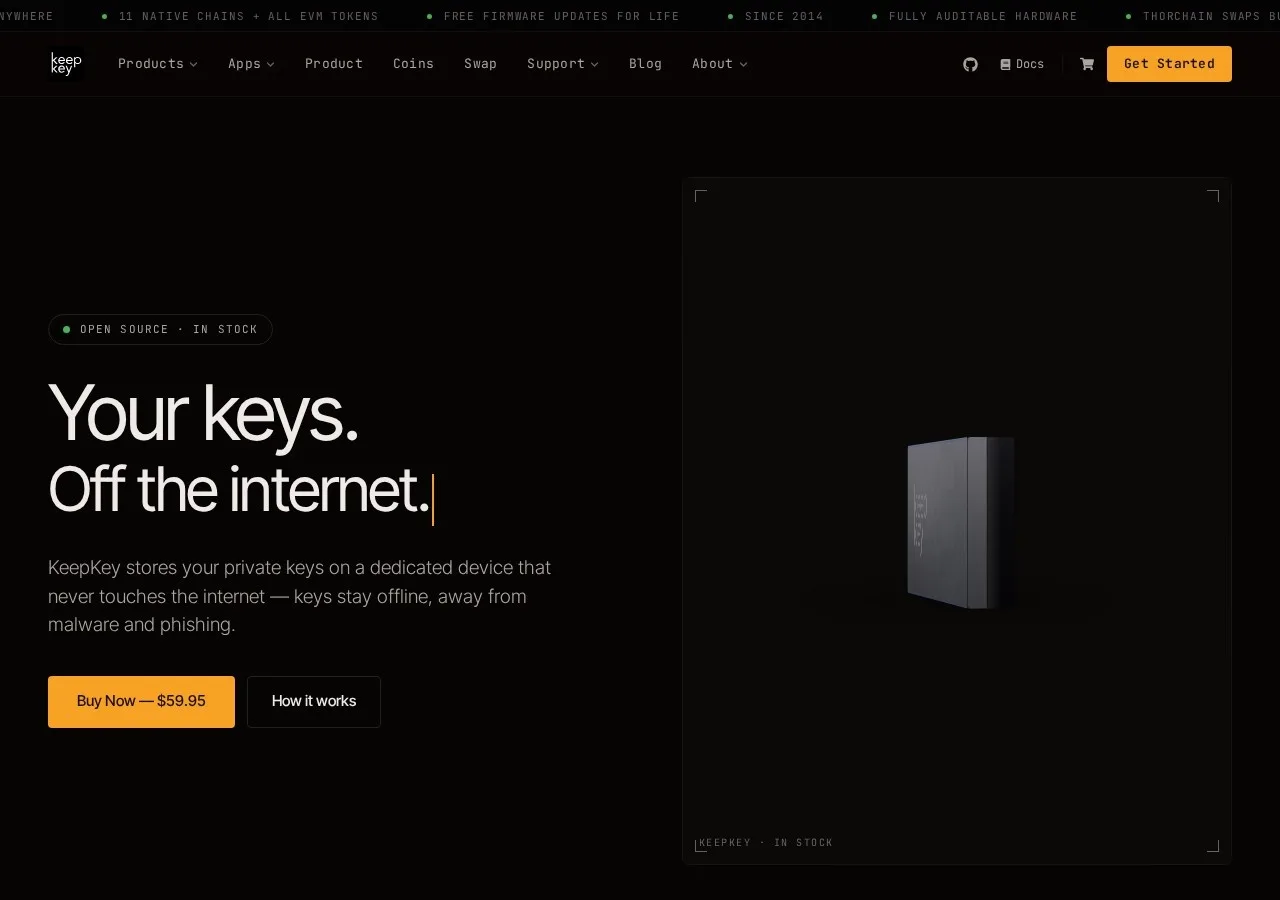
KeepKey is an open-source cryptocurrency hardware wallet built inside an anodized aluminum casing with a large OLED display. It stores cryptographic keys in an isolated offline environment, requiring physical confirmation on the device before any transaction can be broadcast.
Team and corporate history
KeepKey was founded in 2014 by Darin Stanchfield and Ken Hodler in the United States following the collapse of Mt. Gox. In August 2017, cryptocurrency trading platform ShapeShift, founded by Erik Voorhees, acquired KeepKey to integrate direct on-device swapping. When ShapeShift restructured into a decentralized autonomous organization in 2021, KeepKey transitioned into an independent, community-governed open-source initiative led by long-time contributors Matt Highlander and Nick Marrow.
Architecture and operation
Private keys are generated entirely offline on the unit, displaying a 12-word or 24-word recovery phrase on the internal screen alongside BIP39 passphrase support. The wallet pairs via USB cable with KeepKey Desktop for Windows, macOS, and Linux, as well as a Web3 Chrome extension and an iOS companion app. KeepKey natively signs for 11 blockchains, including Bitcoin, Ethereum, Litecoin, Dogecoin, THORChain, and Solana, while supporting all EVM tokens. Cross-chain trading runs directly through KeepKey Desktop by pulling quotes from decentralized liquidity venues such as THORChain, Maya Protocol, Chainflip, 0x, and Relay without requiring KYC verification or user accounts.
Pricing and availability
The device ships internationally from the United States with no mandatory account creation, personal identity verification, or subscription tiers. Firmware updates remain free for life and are distributed through the desktop companion application. Hardware units include a standard one-year manufacturer limited warranty.
Security track record and trade-offs
KeepKey uses an open-source architecture built on standard general-purpose microcontrollers rather than a certified, proprietary Secure Element chip. In 2020, security researchers at Ledger Donjon disclosed a physical side-channel power-analysis vulnerability against the device PIN verification routine, which KeepKey patched in firmware 6.4.1. Because standard microcontrollers remain susceptible to physical fault injection or voltage-glitching attacks if an attacker gains physical custody of the hardware, users rely heavily on an unstored BIP39 passphrase to safeguard funds against physical extraction. The device lacks air-gapped signing via QR codes or microSD cards, and it requires a continuous wired USB connection.
Founders
Erik VoorheesCEO, ShapeShift AG
Best for:Long-term Bitcoin and EVM cold storageDeFi users trading without KYCDesk-bound self-custody setups
Pros and cons
Pros
- Full hardware schematics and device firmware published on GitHub
- Large OLED screen clearly displays full receiving addresses and transaction amounts
- Direct on-chain cross-chain swaps without custodial exchange accounts or KYC
- Includes BIP39 passphrase support for secondary hidden wallet partitions
Cons
- Lacks a certified Secure Element chip to resist physical hardware glitching
- Requires a wired USB connection with no air-gapped QR or microSD signing
- Hardware design targeted by physical side-channel vulnerabilities disclosed in 2020
- Companion browser extension operates exclusively on Google Chrome
Our review
3.6/5
Good
KeepKey pairs transparent open-source code and native cross-chain swaps with a large display, but its microcontroller design lacks a dedicated secure element.
KeepKey has operated since 2014 as one of the longest-standing self-custody brands in the sector. Founded by Darin Stanchfield and Ken Hodler, the project was acquired by ShapeShift in 2017 before transitioning into an independent, open-source initiative when ShapeShift restructured into a DAO in 2021. Its primary hardware design centers on a 3.12-inch OLED display housed in an anodized aluminum casing. Users verify complete transaction parameters on the physical screen before approving them with a single button press.
The device's core architectural trade-off lies in its silicon. KeepKey uses an open architecture built around standard microcontrollers rather than a dedicated, certified secure element chip. While this structure enables fully auditable, open-source firmware without closed-source vendor blobs, it exposes the device to physical side-channel and glitching attacks if an attacker gains physical possession. Ledger Donjon demonstrated power analysis vulnerabilities against KeepKey's PIN mechanism in 2020, which the team resolved in firmware 6.4.1. Users who face direct device theft rely heavily on an optional BIP39 passphrase to safeguard their funds from seed extraction.
Software integration is a distinct operational strength. The companion KeepKey Desktop runs locally on Windows, macOS, and Linux without mandatory accounts or KYC, connecting directly to decentralized protocols including THORChain, Mayachain, ChainFlip, and 0x for cross-chain swaps. The ecosystem also includes a Chrome browser extension with EIP-6968 compatibility, bridging on-device signing to EVM DApps and Web3 interfaces. KeepKey supports 11 native blockchains alongside all EVM networks and over 7,000 digital assets.
KeepKey suits desktop cryptocurrency users who focus on transparent code and non-custodial swaps rather than compact mobility. Buyers needing an air-gapped camera setup or certified secure elements for hostile physical environments should consider alternative models.
Specs
| KYC required ⓘ | No · unverified |
|---|---|
| Connectivity | USB-C · unverified |
| Secure element | No · unverified |
| Firmware | Fully open source · unverified |
| Display | Screen + buttons · unverified |
| Air-gapped signing | No · unverified |
| Bitcoin-only | No · unverified |
| Supported assets | 7,000 · unverified |
| Battery | No · unverified |
| BIP39 passphrase | Yes · unverified |
| Companion app | KeepKey Desktop · unverified |
| Touchscreen | No · unverified |
| Backup options | 12-word seed phrase, 24-word seed phrase, BIP39 passphrase · unverified |
| NFC | No · unverified |
Not disclosed by the provider: Price from, Multisig support.
Data from the provider's website and public sources. Fees and availability change; confirm on the official site before you sign up.
Key features
On-device OLED verification
Full transaction details, recipient addresses, and network fees display on the built-in screen for physical confirmation before signing.
Decentralized cross-chain swaps
KeepKey Desktop aggregates swap routes across THORChain, Maya Protocol, Chainflip, and 0x without account sign-ups or identity verification.
Multi-chain asset support
Signs transactions natively for 11 blockchains, including Bitcoin, Ethereum, Dogecoin, and Solana, plus thousands of ERC-20 and EVM tokens.
BIP39 passphrase defense
Supports optional hidden wallets through user-defined passphrases that are never saved to the physical unit.
Open-source desktop and extension
Pairs with KeepKey Desktop on Windows, macOS, and Linux, and connects to Web3 applications through an official Chrome extension.
Inside KeepKey
KeepKey Hardware Wallet
The physical USB cold-storage device featuring an anodized aluminum body, single physical button, and a large OLED display for on-device confirmation.
KeepKey Desktop
An open-source desktop management tool for Windows, macOS, and Linux that handles portfolio tracking and decentralized cross-chain swaps.
KeepKey Browser Extension
A Chrome connector that routes transaction approval requests from Web3 decentralized applications directly to the physical KeepKey screen.
KeepKey Mobile App
An iOS companion application designed for monitoring cryptocurrency portfolio balances and coordinating approvals remotely.
KeepKey screenshots
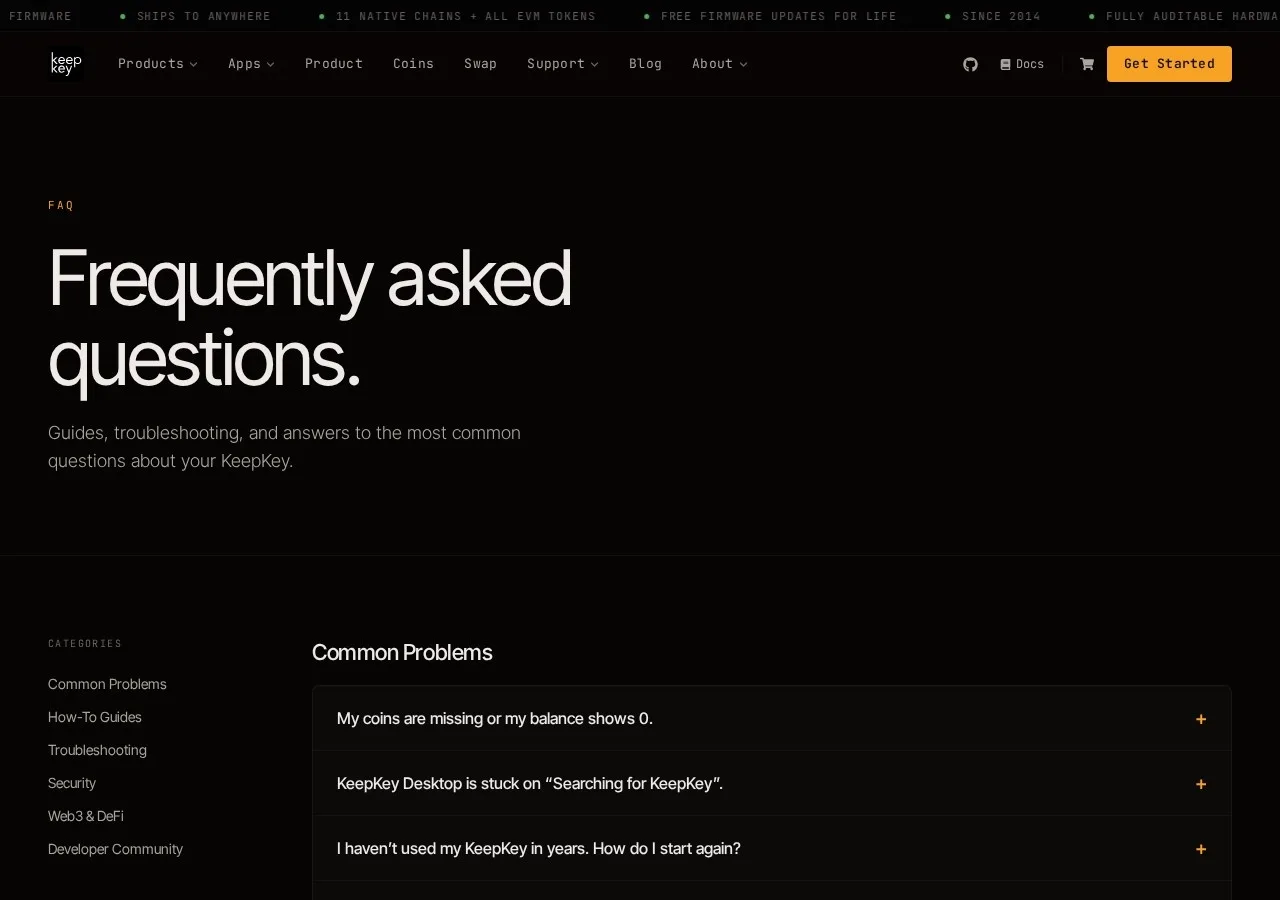
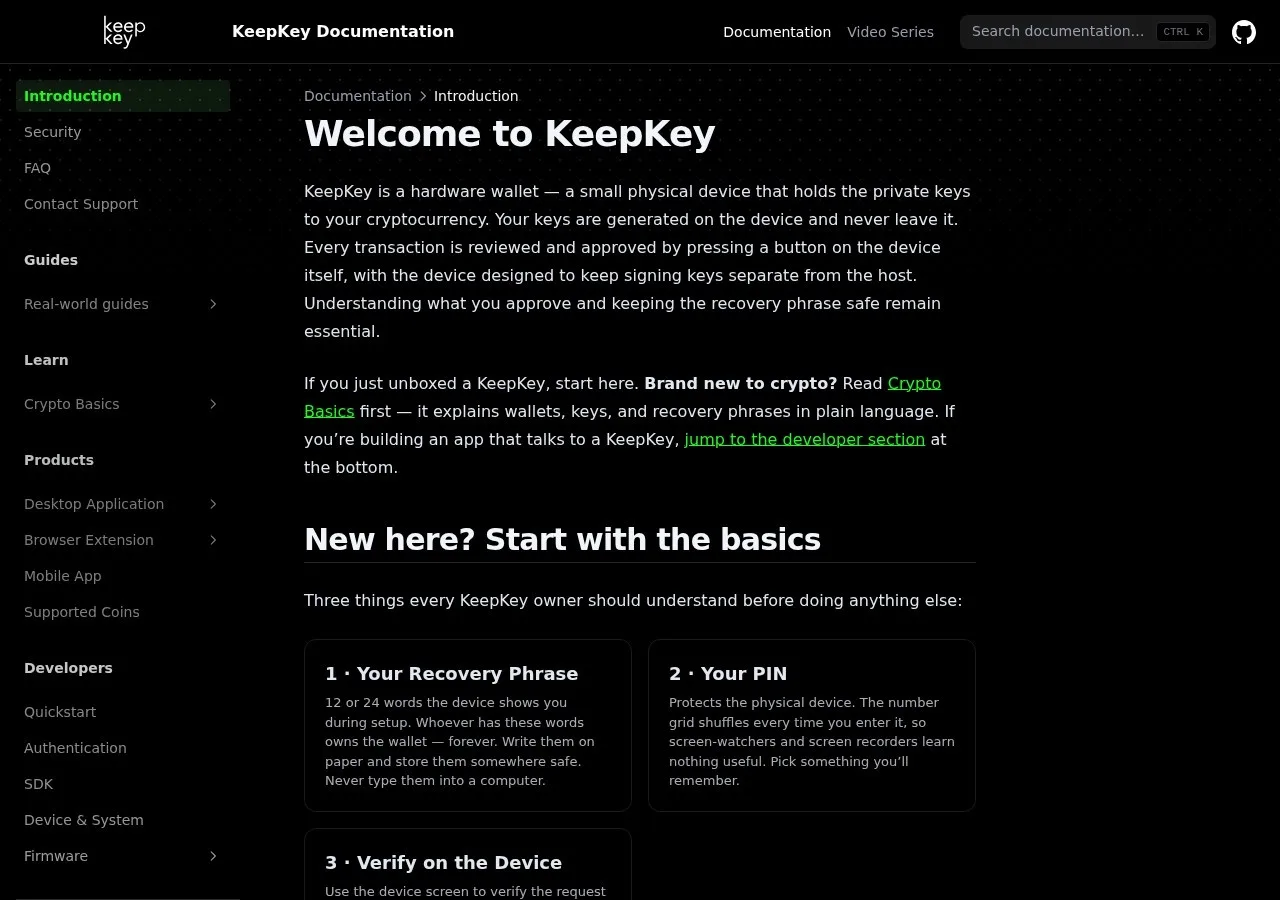
What users say about KeepKey
Recent discussions regarding KeepKey consist of official development announcements and support updates rather than user feedback, leaving no distinct user-reported strengths or complaints.
Scam warning: Scammers operate fake support channels on Discord, Telegram, and other social media platforms pretending to be KeepKey support.
Based on 5 Reddit posts and comments from the last 12 months, checked Oct 21, 2026. These are posts by users on other sites, not reviews submitted on CryptoReview.
User reviews
No user reviews yet. Have you used KeepKey? Share your experience below.
FAQ
Who founded KeepKey?
KeepKey was founded in 2014 by Darin Stanchfield and Ken Hodler. The company was acquired by ShapeShift in 2017 and later became an independent open-source project managed by core contributors.
Does KeepKey require KYC or an account?
No, KeepKey does not require account creation, identity verification, or an email address. All signing operations and desktop swaps run locally without user registration.
What assets does KeepKey support?
KeepKey supports 11 native blockchains, including Bitcoin, Ethereum, Litecoin, Dogecoin, THORChain, and Solana, along with all EVM chains and over 7,000 tokens.
Has KeepKey suffered any security incidents?
In 2020, Ledger Donjon disclosed a physical side-channel vulnerability in KeepKey's PIN verification process. KeepKey patched the issue in firmware version 6.4.1.
Does KeepKey have a native token?
No, KeepKey does not issue or operate a proprietary cryptocurrency token.
Is KeepKey firmware open source?
Yes, KeepKey publishes its firmware, smart contracts, and user interface repositories openly on GitHub under open-source licenses.
Latest from KeepKey on X
Get KeepKey Desktop: https://t.co/SyQIoTx2qN
$68 million in WBTC went to a lookalike address planted in the victim's own transaction history.
Don't copy recipients from history. Save verified addresses to KeepKey Desktop's Address Book, and read the full address on the KeepKey before you sign.
Get it in KeepKey Desktop. https://t.co/5ZVZiTjvTM
Don't copy recipients from history. Save verified addresses to KeepKey Desktop's Address Book, and read the full address on the KeepKey before you sign.
Get it in KeepKey Desktop. https://t.co/5ZVZiTjvTM
Swapping shouldn't mean depositing your coins on an exchange first.
KeepKey Desktop quotes six routes, including THORChain, Mayachain and ChainFlip, with no account and no KYC. Your coins move only after you approve on the KeepKey.
Get it in KeepKey Desktop. https://t.co/FlnSw3urtD
KeepKey Desktop quotes six routes, including THORChain, Mayachain and ChainFlip, with no account and no KYC. Your coins move only after you approve on the KeepKey.
Get it in KeepKey Desktop. https://t.co/FlnSw3urtD
Only hold bitcoin? Run firmware that only knows bitcoin.
KeepKey's Bitcoin-only build leaves the code for every other chain off the device entirely. Less code on the device means less to attack.
Get it in KeepKey Desktop. https://t.co/KKFXQdwy5D
KeepKey's Bitcoin-only build leaves the code for every other chain off the device entirely. Less code on the device means less to attack.
Get it in KeepKey Desktop. https://t.co/KKFXQdwy5D
Recent public posts from @cryptokeepkey, shown as published. Not reviewed or endorsed by CryptoReview.
Alternatives to KeepKey
NFC hardware wallet with 14,100+ assets across 90+ blockchains
NFCSecure elementPartially open source
Air-gapped hardware wallet with QR signing, a CC EAL5+ chip and 10,000+ assets
QR code (air-gapped) · microSDSecure elementClosed source

Open-source hardware wallets supporting 100+ chains and 30,000+ coins and tokens
No KYCUSB-C · BluetoothSecure elementFully open source

Swiss-made open-source hardware wallet line launched in 2015 by Shift Crypto
Secure elementFully open sourceBitcoin-only

Air-gapped hardware wallet with three secure-element chips and QR signing
QR code (air-gapped) · microSDSecure elementFully open source

Hardware wallets with Secure Element chips, 100+ chains and 15,000+ supported assets
No KYCSecure elementPartially open sourcePrice from: $59