

OCEAN is in Helsinki this week!
Join @markartymko, @NachoPauls and @leo_haf as they visit the Nordics!
Wednesday is the European Mining Summit:
One day of discussions on mining, grid stability and what to do with surplus power.
Friday and Saturday the main event @btchelevent:
The Nordic Bitcoin Conference.
Catch Mark and Nacho on the Main stage Friday and find the team at booths #1/#2 both days.
See you in Helsinki.

OCEAN
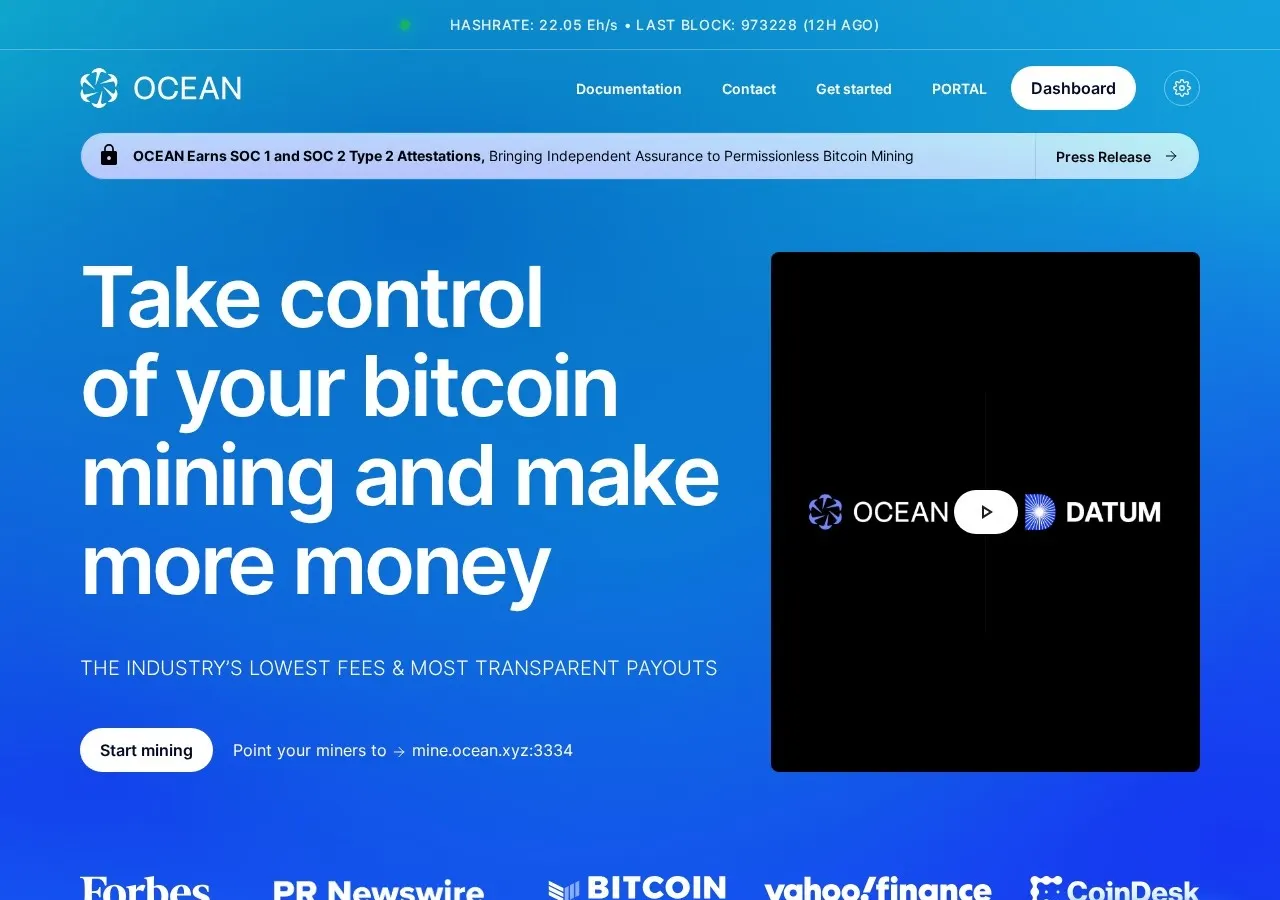
Non-custodial Bitcoin mining pool with direct coinbase payouts and decentralised DATUM block templates
3.9/ 5
Our score
Good
Type
Mining pool
Pool fee
1% (DATUM) to 2%
Payout schemes
TIDES
Hashrate
22.15 EH/s
Coins
BTC
What is OCEAN?
OCEAN is a non-custodial Bitcoin mining pool that routes block rewards and transaction fees directly from the Bitcoin network's coinbase transactions to participating miners. Operated by Mummolin, the pool removes custodial intermediaries by using an auditable reward scheme called TIDES and lets miners construct their own block templates through the DATUM protocol.
Leadership and backing
The pool was co-founded by trial lawyer Ian Northon and longtime Bitcoin developer Luke Dashjr, who departed in August 2026. Barefoot Mining founder Bob Burnett serves as Chairman, Mark Artymko serves as President, and Jason Hughes leads technical development as Chief Technology Officer. Rapha Zagury and Giacomo Zucco serve on the Board of Directors. In November 2023, OCEAN announced a $6.2 million seed funding round led by Jack Dorsey.
How the pool works
Miners connect their hardware to the pool endpoint at mine.ocean.xyz:3334 using their Bitcoin payout address as the worker username. No registration or personal documentation is required. Block rewards are distributed via the TIDES scheme, which calculates exact pro-rata shares across a multi-day window rather than estimating payouts through hashrate-rental models. Miners running their own full nodes can deploy the DATUM protocol to select transactions independently, preventing pool operators from filtering block content. Payouts settle directly on-chain or over the Lightning Network using BOLT12 offers.
Fees and payout thresholds
Standard pool mining carries a 2% fee, while miners who construct their own block templates using DATUM pay a discounted 1% fee. On-chain payouts to active mining addresses require an accumulated balance of at least 0.01048576 BTC, with a lower discretionary threshold of 0.00065536 BTC applied to inactive addresses. Lightning Network payouts provide instant settlement without waiting for the on-chain threshold.
Track record and risks
As of October 2026, OCEAN reported a pool hashrate of 22.15 EH/s across 2,611 active miners, with 1,636 total blocks mined since launch, including 1,395 generated with DATUM templates. The operation has completed SOC 1 Type 2 and SOC 2 Type 2 security attestations. Because the TIDES mechanism only distributes rewards when the pool finds actual blocks, miners take on income variance compared to custodial FPPS pools that offer fixed daily returns regardless of luck.
Founders
Luke DashjrFounder
Best for:Miners seeking non-custodial payoutsOperators running independent Bitcoin nodesSmall miners using Lightning payouts
Pros and cons
Pros
- Non-custodial payouts sent straight from block coinbase transactions
- No user accounts or identity verification required to connect
- Fee drops to 1% when building block templates using DATUM
- SOC 1 Type 2 and SOC 2 Type 2 compliance attestations completed
- Instant payouts available through the Lightning Network using BOLT12
Cons
- Subject to block variance since rewards only pay out when blocks are found
- Standard 2% pool fee is higher than many custodial competitors
- Minimum on-chain payout threshold requires 0.01048576 BTC for active miners
- DATUM block construction requires running and maintaining a personal Bitcoin node
Our review
3.9/5
Good
OCEAN offers non-custodial payouts and miner block construction via DATUM, but its reliance on TIDES exposes miners to block variance without guaranteed FPPS income.
OCEAN is a non-custodial Bitcoin mining pool founded in 2023 by Ian Northon and Luke Dashjr, backed by a $6.2 million seed round led by Jack Dorsey. Instead of holding user balances on internal pool ledgers, the pool sends block rewards directly to miners from the coinbase transaction using its proprietary TIDES payout scheme. Standard pool fees sit at 2%, which drops to 1% for miners who construct their own block templates using the DATUM protocol. Setup requires no account registration or KYC identity verification; miners connect directly by providing a Bitcoin address at mine.ocean.xyz:3334.
Unlike custodial pools that control transaction selection, OCEAN miners running DATUM can pick mempool transactions locally, reducing pool operator censorship risks. Miners also receive granular payout accounting on-chain, alongside Lightning Network payouts using BOLT12 for immediate, low-threshold settlements. On the institutional front, the pool holds SOC 1 Type 2 and SOC 2 Type 2 attestations examining its operational control environment.
However, the pool carries clear trade-offs tied to its payout model and size:
- TIDES distributes rewards based only on blocks actually mined, meaning miners absorb full block variance rather than receiving steady, predictable returns common to FPPS pools.
- On-chain payouts require reaching a minimum payout threshold of 0.01048576 BTC for active addresses, which can lead to delayed settlements for small-scale miners.
- With 22.15 EH/s in hashrate recorded in October 2026 across 2,611 active miners, the pool controls a modest portion of total global Bitcoin mining power compared to market leaders.
OCEAN suits independent Bitcoin miners who run full nodes, want direct on-chain or Lightning custody of their earnings, and prefer building their own block templates. Industrial operators requiring fixed revenue streams without variance risk should look toward traditional FPPS mining pools.
Specs
| Type | Mining pool · unverified |
|---|---|
| Coins | BTC · unverified |
| Pool fee | 1% (DATUM) to 2% · unverified |
| Payout schemes | TIDES · unverified |
| Minimum payout | 0.01048576 BTC (on-chain) · unverified |
| Hashrate | 22.15 EH/s · unverified |
Not disclosed by the provider: Stock ticker, Locations, Energy sources, Hardware models.
Data from the provider's website and public sources. Fees and availability change; confirm on the official site before you sign up.
Key features
Direct coinbase payouts
Rewards distribute straight from newly mined Bitcoin blocks to individual miner addresses without touching a pool-controlled custodial wallet.
DATUM template construction
Miners can run their own Bitcoin node to build custom block templates and select transactions, dropping the pool fee from 2% to 1%.
TIDES payout system
Contributed shares receive an exact pro-rata split of block subsidies and transaction fees across an auditable multi-day accounting window.
Lightning BOLT12 settlement
Miners can configure Lightning Network payouts to receive immediate reward distributions without meeting on-chain balance thresholds.
Permissionless worker connection
ASIC hardware connects directly to mine.ocean.xyz:3334 using an on-chain Bitcoin address without account signups or identity verification.
Inside OCEAN
OCEAN Mining Pool
A non-custodial Bitcoin mining pool using the TIDES payout system to distribute rewards directly to miner addresses via coinbase transactions without pool custody.
DATUM Protocol
An alternative template construction protocol that allows individual miners to run nodes and build custom block templates for a discounted 1% pool fee.
Lightning Network Payouts
A payout integration using BOLT12 offers that lets miners collect earnings over the Lightning Network without waiting to meet standard on-chain balance thresholds.
OCEAN screenshots
What users say about OCEAN
Miners appreciate OCEAN for its decentralization, lack of KYC, and custom block template construction via DATUM. However, users express frustration over controversial template signaling like BIP110, delayed payouts, and dashboard tracking confusion.
In their own words
“BTC Pool Mining - Who Are You Using and Why? I have been using Oceanxyz and I have actually been pretty happy with it so far. What I like most is the transparency and the ability to build your own block templates. You do not really get that with other pools.”
“Not really that bad. The ocean.xyz site outlines it very well. I looked into it last year; and plan to implement it this next week. Previous years, Ive mined the "Core+Anitspam" pool from Ocean's alternative template pools. All pools share the same reward, across all their pools.”
“Well I know on Ocean.xyz you dont get paid right at the 0.01 payout, sometimes it was a few days later and paid out around 0.0105 on chain. Not sure on Braiins, Im testing them out now because of the whole forced BIP110 on Ocean/Knots.”
“Currently running Knots with Ocean.xyz pool - however I'm starting to feel I will need to spin up Core and possibly find another pool. Will see how this plays out, but not looking great for Knots BIP110 unless im missing something.”
Based on 35 Reddit posts and comments from the last 12 months, checked Oct 26, 2026. These are posts by users on other sites, not reviews submitted on CryptoReview.
User reviews
No user reviews yet. Have you used OCEAN? Share your experience below.
Funding and investors
$6.2MTotal raised
1Round
1Investor
-
Seed Nov 2023 $6.2MSource
FAQ
Who founded OCEAN?
OCEAN was co-founded in 2023 by trial lawyer Ian Northon and Bitcoin Core developer Luke Dashjr. In August 2026, Dashjr stepped down from his executive and board roles by mutual agreement.
What are the mining fees on OCEAN?
OCEAN charges a standard pool fee of 2%. Miners who construct their own block templates using the DATUM protocol receive a discounted fee of 1%.
Does OCEAN require KYC or an account?
No, OCEAN does not require an account or KYC identity verification. Miners connect directly by setting their payout Bitcoin address as their worker username.
How does OCEAN pay out mining rewards?
OCEAN uses the non-custodial TIDES payout scheme, which writes reward distributions directly into the block's coinbase transaction without the pool holding custody. It also supports threshold-free payouts via the Lightning Network using BOLT12.
What is the DATUM protocol on OCEAN?
DATUM stands for Decentralized Alternative Templates for Universal Mining. It is a protocol that allows individual miners to build their own block templates and select transactions rather than relying on the pool operator.
Does OCEAN have its own crypto token?
No, OCEAN does not have a native cryptocurrency token. It is solely a Bitcoin mining pool and is distinct from the unrelated Ocean Protocol project.
Latest from OCEAN on X
OCEAN earns SOC 1 Type 2 and SOC 2 Type 2 Attestations
The reports reinforce OCEAN’s commitment to transparent, dependable Bitcoin mining through independent examination of control design and operating effectiveness of OCEAN’s internal systems over the reporting periods.
Link to the release:
https://t.co/RAXy21fBeG
The reports reinforce OCEAN’s commitment to transparent, dependable Bitcoin mining through independent examination of control design and operating effectiveness of OCEAN’s internal systems over the reporting periods.
Link to the release:
https://t.co/RAXy21fBeG

OCEAN has promoted Jason Hughes (@wk057) to Chief Technology Officer.
Jason has spent nearly fifteen years writing software that Bitcoin miners depend on. At OCEAN, he wrote much of what makes this company worth choosing.
He developed TIDES, our transparent and auditable reward system, and architected and built DATUM, which lets pooled miners construct block templates using their own Bitcoin nodes. OCEAN’s commitment to giving miners more control rests on engineering that Jason delivered.
He came to that work with years of experience running Eligius, one of Bitcoin’s earliest major mining pools. After taking over its operation in 2012, he developed and maintained much of the software behind it while also operating a mining farm of his own. He understood the problems miners faced because they were his problems, too.
Tesla got its own introduction to Jason’s abilities once. An investigation that began with his dissatisfaction with the car’s infotainment system eventually uncovered vulnerabilities reaching its worldwide vehicle fleet. During a demonstration for Tesla, he remotely moved a car in California from North Carolina after being given its VIN. He helped the company address the vulnerabilities and earned what was then its largest-ever bug bounty.
We’d put Jason’s engineering record alongside anyone’s in Bitcoin. Having him lead OCEAN’s technology operations is an asset that will help us realize our mission of decentralization.
Congratulations, Jason. Continually stoked to have you here.
🌊

Giacomo Zucco (@giacomozucco) has rejoined OCEAN’s Board of Directors.
Giacomo has been part of OCEAN since the beginning, but his history with Bitcoin goes back much further.
Since 2013, he has made a career out of pulling Bitcoin apart, explaining why it matters, and building the ecosystem around it. He has helped develop and advance open technical standards including BOLT, OpenTimestamps, RGB, and BDK; taught Bitcoin everywhere from university programs to Lugano’s Summer School and Cubo+; and advised major financial and infrastructure companies trying to understand what Bitcoin means for their businesses.
Today, he leads Bitcoin education as VP of the Plan ₿ Foundation in Lugano and CEO of Plan ₿ Network, while continuing to invest in and advise Bitcoin companies across the ecosystem. He’s also a physicist and honorary consul. Because, as with Bitcoiners, of course he is.
Giacomo has spent more than a decade approaching Bitcoin from just about every direction possible. He asks hard questions, holds strong views, and cares deeply about keeping Bitcoin decentralized, permissionless, and resistant to capture.
This perspective has been part of OCEAN’s DNA from the start.
We’re glad to have it back around the table.
Welcome back, Giacomo.
🌊

⚡⚡ Lightning payouts are back at OCEAN. ⚡⚡
Lightning was paused over the last month due to incompatibility with the chain split. Now that this has been resolved, payments have resumed.
What this means for you:
• Accumulated Rewards:
If you were previously set up for Lightning payouts, your accumulated rewards will be processed in upcoming batches through normal channels. If your rewards reach the natural threshold, they will be paid out on-chain.
• Lower On-Chain Payout Threshold (Coming Soon):
We’ve heard feedback from smaller miners that our on-chain threshold was too high. We are reducing that threshold from ~1 million sats to 500,000 sats to make frequent on-chain payouts easier for smaller miners who aren’t using Lightning. Note: This threshold change will take effect with an upcoming TIDES system update.
Lightning is back, and a lower threshold is on the way.
Keep building. 🚀
Recent public posts from @ocean_mining, shown as published. Not reviewed or endorsed by CryptoReview.
Alternatives to OCEAN

Institutional digital asset mining infrastructure operating the largest Bitcoin mining pool
Mining pool · Firmware & softwareBTC · ZEC0%

Public Bitcoin miner operating 50 EH/s across self-managed data centers
Public minerBTC50 EH/s

Bitcoin mining pool, LuxOS firmware, and compute derivatives with over 40 EH/s in hashrate
Mining pool · Firmware & softwareFPPS · Fixed +1>40 EH/s

Publicly traded clean-energy Bitcoin miner and HPC provider operating 440 MW of data center capacity
Public miner · HostingBTC25.1 EH/s

Publicly traded digital infrastructure enterprise and Bitcoin miner with 1.9 GW of energized power capacity
Public miner · Mining pool +1BTCNASDAQ: MARA

ADX-listed digital infrastructure operator running over 550 MW of power across six markets
Public miner · HostingBTC15.9 EH/s