
EMURGO & Yoroi DRep Update: Upcoming Changes to Our DReps
As we continue to support affected users of the @secondfiapp security incident and make further progress towards the recovery phase, we want to give notice of two governance decisions: our immediate resignation from the @IntersectMBO board and our intention to de-register our DRep role in Cardano governance in due course.
Both decisions reflect our focus on directing our full attention and resources toward the recovery effort and ensuring affected users are properly supported through this process. We recognize that our seat on the Intersect board and our DRep role each represent meaningful responsibilities within the Cardano governance ecosystem and we do not take the decision to step back from either lightly.
When you migrate your wallet, it will be automatically undelegated from both your stake pool and your DRep. You will then be free to choose a new DRep that best represents you.
We will share full guidance, including timing, as the migration tool launches.
Yoroi Wallet
Cardano light wallet by EMURGO permanently shut down in 2026 after a signing exploit
2.1/ 5
Our score
Weak
Custody
Self-custodial
Chains
Other
Platforms
ChromeFirefoxEdgeiOS+1
Open source
Yes
In-app swaps
Yes
Hardware wallet support
Yes
What is Yoroi Wallet?
Yoroi Wallet was an open-source, self-custodial light wallet built specifically for the Cardano blockchain. Created by EMURGO, the product was available as a browser extension and mobile application that allowed users to send, receive, and stake ADA without running a full node.
Team and corporate background
EMURGO launched the wallet in 2018 as one of the three founding entities of the Cardano ecosystem alongside IOG and the Cardano Foundation. EMURGO was founded by CEO Ken Kodama, alongside executives Florian Bohnert and Shunsuke Murasaki. In 2026, EMURGO operated under CEO Phillip Phan. In April 2026, EMURGO rebranded the Yoroi application to SecondFi at the Money20/20 conference in Bangkok before retiring the platform later that year.
Wallet mechanics and features
As a light client, the software bypassed the need to download the full Cardano blockchain history, connecting directly to remote nodes. The application provided self-custodial key management, where users held their own seed phrases locally. It offered native ADA delegation to stake pools, support for Cardano native tokens, and direct integration with hardware wallets including Ledger and Trezor to sign transactions offline.
Exploit, track record, and shutdown
Between June 21 and June 23, 2026, a signing vulnerability compromised 374 wallets, draining approximately 16.1 million ADA, valued at about $2.6 million. Blockchain analytics firm Groom Lake assisted EMURGO in investigating the incident. On July 6, 2026, EMURGO announced that neither Yoroi nor its rebranded SecondFi application would resume operations. EMURGO funded a recovery wallet accessible through a zero-knowledge claim portal in September 2026 to reimburse affected balances, while resigning its seat from the Intersect board.
Risks and current status
Yoroi Wallet is completely discontinued. The software operates strictly in a restricted mode to let existing holders view balances, verify whether their addresses were among the 374 compromised accounts, and export private keys or seed phrases to alternative Cardano wallets such as Lace or Eternl. Transactions and token swaps are no longer supported.
Founders
Ken KodamaCEO & Founder
Florian BohnertChief Marketing Officer, Japan Director
Shunsuke MurasakiCEO of EMURGO Indonesia
Best for:Former users migrating seed phrasesChecking affected exploit address statusAuditing historical Cardano transaction balances
Pros and cons
Pros
- Open-source codebase backed by Cardano founding entity EMURGO
- Direct hardware wallet support via Trezor and Ledger
- Self-custodial design where users retain control of seed phrases
- Lightweight client that skips full node blockchain syncing
Cons
- Permanently shut down in July 2026 following a 16.1 million ADA exploit
- No longer supports active transfers, dApp connections, or new account creation
- Limited historically to the Cardano and Ergo ecosystems
- Affected by a signing flaw that compromised 374 user wallets
Our review
2.1/5
Weak
Yoroi Wallet was an early self-custodial Cardano light wallet, but EMURGO permanently shut it down in July 2026 after a signing exploit drained 16.1 million ADA.
Launched in 2018 by founding Cardano entity EMURGO, Yoroi Wallet was a light client for the Cardano ecosystem. As a non-custodial browser extension and mobile wallet, it bypassed the need to download full ledger history while letting users store ADA, participate in Shelley-era proof-of-stake delegation, and connect to hardware devices like Ledger and Trezor. In April 2026, EMURGO rebranded the software as SecondFi.
Operations ceased permanently in July 2026 following a catastrophic cryptographic compromise. Between June 21 and June 23, 2026, attackers exploited a signing vulnerability in the software, draining approximately 16.1 million ADA worth around $2.6 million from 374 wallets. Following an investigation assisted by analytics firm Groom Lake, EMURGO confirmed that neither Yoroi nor SecondFi would resume regular operations, restricting the client to an isolation mode solely for balance viewing and migration.
The incident demonstrated the inherent risks of browser-based key handling and client-side signing flaws, even within software backed by founding core organizations. While EMURGO funded a recovery process via zero-knowledge proofs to reimburse affected balances, the software's active lifecycle has ended.
Sources (1)
Specs
| KYC required ⓘ | No · unverified |
|---|---|
| Wallet type | Browser extension, Mobile · unverified |
| Custody | Self-custodial · unverified |
| Chains | Other · unverified |
| Platforms | Chrome, Firefox, Edge, iOS, Android · unverified |
| Open source | Yes · unverified |
| Hardware wallet support | Yes · unverified |
| In-app swaps | Yes · unverified |
| Staking | Yes · unverified |
| Security features | Hardware wallet integration, Local key storage, Seed phrase backup · unverified |
| Recovery without a seed phrase | No · unverified |
| Perpetuals trading | No · unverified |
Not disclosed by the provider: NFT support, Buy crypto in app, WalletConnect, Passkey login, Multisig, Built-in dApp browser, Swap fee.
Data from the provider's website and public sources. Fees and availability change; confirm on the official site before you sign up.
Key features
Light node architecture
Connects to remote Cardano nodes without requiring local downloads of the full ledger history.
Cardano staking delegation
Allows direct delegation of ADA to decentralized stake pools without locking funds or forfeiting custody.
Hardware wallet integration
Supports hardware signing keys using Trezor and Ledger devices.
Native asset storage
Holds and transfers Cardano native tokens and NFTs alongside ADA on a single address structure.
Quarantine status checker
Displays an in-app banner confirming whether an address was among the 374 accounts impacted by the 2026 signing exploit.
Inside Yoroi Wallet
Staking Dashboard
Allowed Cardano holders to browse stake pools and delegate ADA to earn Shelley-era protocol rewards without locking tokens.
Hardware Wallet Integration
Enabled connections to Ledger and Trezor hardware devices to sign Cardano transactions while keeping private keys offline.
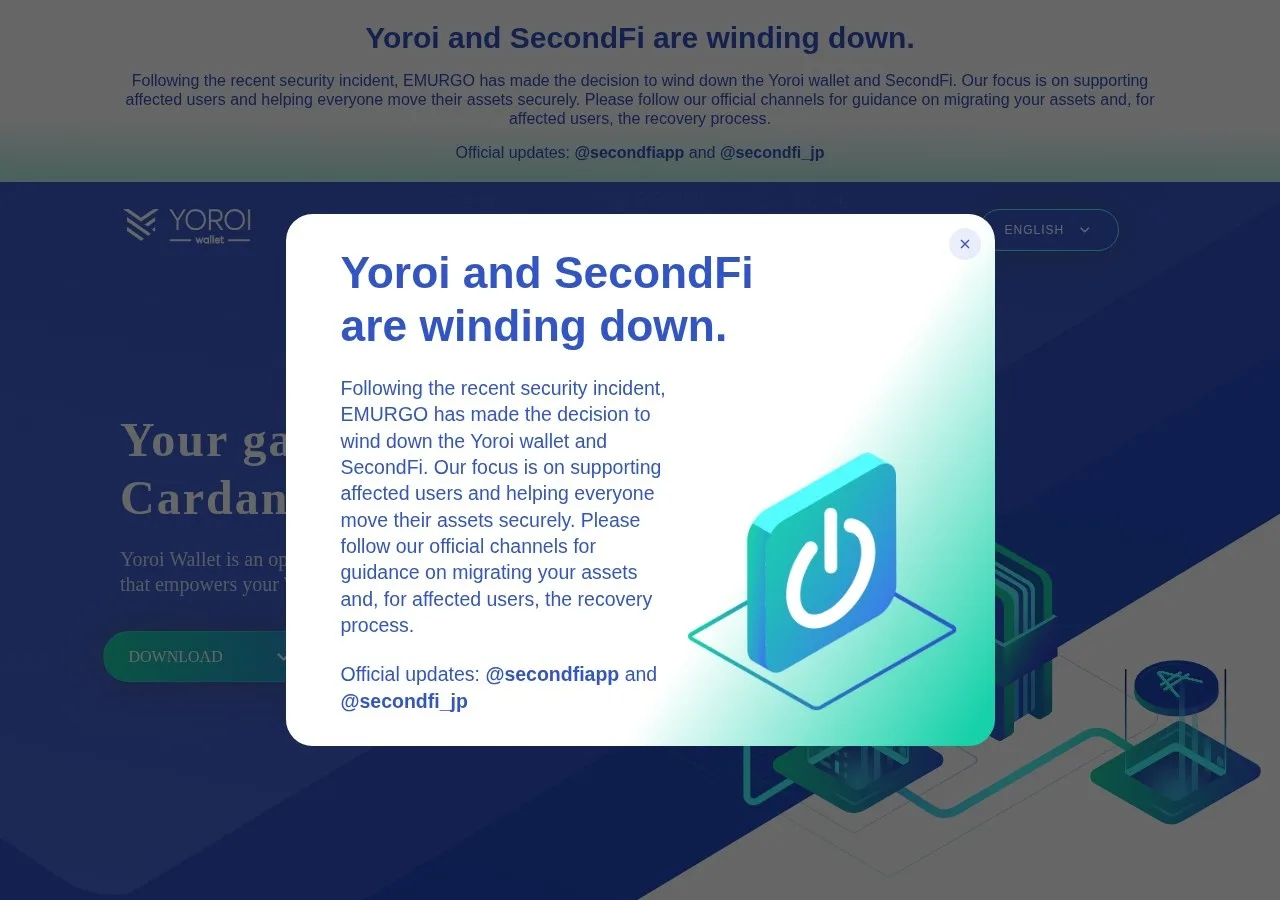
Quarantine Mode
A restricted interface introduced following the 2026 exploit that allows users to verify whether their address was compromised and export balances to safe wallets.
Yoroi Wallet screenshots
User reviews
No user reviews yet. Have you used Yoroi Wallet? Share your experience below.
FAQ
Is Yoroi Wallet still safe to use?
No, Yoroi Wallet is no longer operational. EMURGO permanently retired the software in July 2026 after an exploit drained 16.1 million ADA, leaving the application in isolation mode only for balance checks and fund migration.
Who founded Yoroi Wallet?
Yoroi Wallet was created in 2018 by EMURGO, a founding entity of the Cardano blockchain founded by CEO Ken Kodama. EMURGO's executive team also included Florian Bohnert and Shunsuke Murasaki.
What security incident affected Yoroi Wallet?
A cryptographic signing flaw between June 21 and June 23, 2026, compromised 374 wallet addresses. Attackers stole 16.1 million ADA, valued at about $2.6 million, prompting EMURGO to close the product permanently.
Which blockchains did Yoroi Wallet support?
Yoroi Wallet supported the Cardano network alongside Ergo. It did not support EVM networks like Ethereum or non-UTXO chains like Solana.
Did Yoroi Wallet require KYC verification?
No, Yoroi Wallet was a self-custodial client that required no account registration or identity verification. Users held their own private keys via a recovery seed phrase.
Latest from Yoroi Wallet on X
How to check if your SecondFi / Yoroi Wallet was affected and submit a support ticket
Step 1: With quarantine mode now live, you can view your balance and check whether your wallet address was affected in the recent incident.
If your wallets are potentially impacted, a warning banner will appear on your Home screen in the SecondFi app. Tap it to view your wallet status.
Please note that statuses are based on preliminary, non-final data from our review of the incident and remain subject to further review.
SecondFi / Yoroi Wallet Guidance Sessions in Tokyo and Osaka
We are hosting dedicated in-person guidance sessions during for SecondFi and Yoroi Wallet users affected by the security incident.
Each session will include:
- A SecondFi / Yoroi update from our CEO
- A live Q&A with our specialists
- Migration guidance slides
Our team will answer your questions and walk you through best practices for securing your wallet, or safely migrating it using the secure wallet export functionality, which will be released soon.
Please note the guidance slides are informative only. We will not conduct 1:1 or hands-on wallet troubleshooting.
EVENT DETAILS:
📍 Tokyo: Melody Line Hall, 1F, WebX Venue
(The Prince Park Tower Tokyo, Minato City)
📅 Tuesday, 14 July 2026, 12:00 to 18:45 JST
Register here: https://t.co/VICwKDgTUP
📍 Osaka: TKP Garden City Umeda Osaka
📅 Saturday, 18 July 2026, 12:00 to 17:45 JST
Register here: https://t.co/lPD9n1JEbf
Sessions are held in English and Japanese. Registration via Luma is required for both, and support is first-come, first-served.
Recent public posts from @YoroiWallet, shown as published. Not reviewed or endorsed by CryptoReview.
Alternatives to Yoroi Wallet

Open-source, self-custodial mobile wallet supporting over 100 blockchains and built-in cross-chain swaps
No KYCMobileSelf-custodialEthereum · Bitcoin +13
Self-custodial mobile wallet with built-in DEX routing across more than 18 blockchains
No KYCMobileSelf-custodialEthereum · BNB Chain +7

Open-source, non-custodial multi-chain wallet with built-in Tor and privacy-preserving assets
No KYCMobile · DesktopSelf-custodialBitcoin · Ethereum +7
Non-custodial DeFi wallet and multichain aggregator covering 10,000+ assets across 48+ networks
No KYCMobile · WebSelf-custodialEthereum · Bitcoin +9
Self-custodial Cosmos wallet launched in 2021, now supporting almost 350 networks
Mobile · Browser extension +1Self-custodialEthereum · Bitcoin +4
Self-custodial multichain wallet from Kraken with passkey support and zero platform swap fees
No KYCMobile · WebSelf-custodialBitcoin · Ethereum +7