

Reminder to enter to win tickets to UFC in NYC!
Details below:

4.0/ 5
Our score
Very good
Custody
Self-custodial
Chains
BitcoinEthereumSolanaOther
Platforms
WindowsmacOSLinuxiOS+2
In-app swaps
Yes
Hardware wallet support
Yes
What is Exodus?
Exodus is a self-custodial cryptocurrency wallet for desktop and mobile devices. Founded in 2015, it supports 1,000,000+ assets and is operated by Exodus Movement, Inc., a publicly traded company on NYSE American under EXOD. The wallet combines asset storage with swaps, crypto purchases, staking and hardware-wallet integrations.
Company and team
Exodus was co-founded by Jon Paul Richardson and Daniel Castagnoli. Richardson is Chief Executive Officer and Chairman of the Board. He is a self-taught developer who has published more than 200 open-source libraries and holds a Bachelor of Science in Electrical and Computer Engineering from the University of Nebraska-Lincoln. Castagnoli is Chief Creative Officer and leads the product’s visual design, including its interface, sounds and animations. Exodus has approximately 220 full-time equivalents as of March 31, 2026.
The company completed a $60 million crypto-only public equity offering in April 2021. It completed the acquisition of Monavate Holdings Limited, Baanx US Corp. and Baanx.com Ltd. on May 1, 2026. Those businesses support its payments infrastructure. Exodus is headquartered in Omaha, United States.
How the wallet works
Exodus is self-custodial. Private keys remain under the user’s control, and the wallet can be restored with a recovery phrase. It is available on Windows, macOS, Linux, iOS and Android, with a Chrome version also listed. Supported assets include Bitcoin, Ethereum, Litecoin, USDT and Solana, alongside a wider asset catalogue. Ledger and Trezor integrations let users manage assets with compatible hardware devices.
Built-in services cover crypto purchases with a card, bank account, Apple Pay or Google Pay, asset swaps, and staking for supported cryptocurrencies. Exodus says its swaps cover thousands of assets and swapping pairs. Exodus Pay adds payments, the Exodus Card and rewards through third-party providers.
Fees and availability
Exodus says swap rates start at 0.5%. The wallet itself does not charge transaction fees, although blockchain network fees apply, and fee settings can be adjusted. Swap and card services use third-party providers, whose terms and pricing apply. The wallet can be used without providing personal data; purchase and payment services may have separate requirements.
Track record and risks
Exodus says it has served millions of customers since 2015. It reported $22.7 million in revenue for the three months ended March 31, 2026, and $26.2 million for the three months ended June 30, 2026. Its exchange providers processed $1.18 billion during the quarter ended March 31, 2026. A self-custodial wallet leaves seed-phrase storage and transaction approval with the user. Phishing or seed-phrase loss can result in permanent loss. Swaps add a stated rate from 0.5% on top of applicable network costs. Third-party purchase and card providers add counterparty and service-dependency risks.
Founders
Jon Paul RichardsonCo-founder, Chief Executive Officer and Director
He is a self-taught developer who has published more than 200 open-source libraries.
Daniel CastagnoliCo-founder and Chief Creative Officer
He leads Exodus design, including interface details, sounds and animations.
Best for:Multi-device crypto holdersHardware-wallet usersUsers swapping multiple assetsUsers staking supported tokens
Pros and cons
Pros
- Self-custodial control across desktop and mobile devices
- Supports 1,000,000+ assets
- Ledger and Trezor hardware-wallet support
- Swap rates start at 0.5%
- Staking is available for supported cryptocurrencies
- Publicly traded operator with millions of customers
Cons
- Users bear responsibility for recovery-phrase security
- Swap rates start at 0.5%, before blockchain network fees
- Card and payment services depend on third-party providers
- Staking rewards vary by supported cryptocurrency
- A lost recovery phrase can prevent wallet restoration
Our review
4.0/5
Very good
Exodus combines a multi-device self-custodial wallet with desktop, mobile, and hardware support, but in-app swaps add fees and custody remains seed-phrase based.
Exodus is a self-custodial wallet for desktop and mobile, with Ledger and Trezor integrations. This custody model gives holders control of their private keys, while recovery depends on protecting a seed phrase. Passkey protection adds a device-based option, but it does not remove the risks of phishing, malware, or poor backup practices.
Its main strength is coverage. The wallet supports Windows, macOS, Linux, iOS, and Android, and the company lists more than 1,000,000 assets, including Bitcoin, Ethereum, USDT, and Solana. Staking, in-app purchases, and hardware-wallet management are available in the same product.
Users can swap across thousands of assets, buy through cards, bank accounts, Apple Pay, or Google Pay, and stake supported cryptocurrencies. Exodus says swap rates start at 0.5%. Network fees can still apply to transactions, and third-party providers handle card and purchase services.
Security features include passkeys, device-held private keys, and Ledger or Trezor support. Exodus provides 24-hour support and reported an average customer response time of less than 60 minutes in March 2026. The product remains software-wallet infrastructure. Browser-extension and endpoint risks still apply.
The company was founded in 2015 by Jon Paul Richardson and Daniel Castagnoli. Richardson is CEO and Chairman, and Exodus Movement became publicly traded on NYSE American under EXOD after a $60 million crypto-only public equity offering in 2021. It completed the acquisition of Monavate Holdings Limited, Baanx US Corp., and Baanx.com Ltd. on May 1, 2026.
Exodus suits holders who want a self-custodial wallet with desktop, mobile, swaps, staking, and payment tools in one interface.
Specs
| KYC required ⓘ | No · unverified |
|---|---|
| Wallet type | Mobile, Desktop, Browser extension · unverified |
| Custody | Self-custodial |
| Chains | Bitcoin, Ethereum, Solana, Other · unverified |
| Platforms | Windows, macOS, Linux, iOS, Android, Chrome |
| Hardware wallet support | Yes · unverified |
| In-app swaps | Yes · unverified |
| Staking | Yes · unverified |
| Buy crypto in app | Yes · unverified |
| Security features | Device-based passkeys, Wallet encryption, Recovery phrase, Ledger support, Trezor support · unverified |
| Recovery without a seed phrase | No · unverified |
| Passkey login | Yes · unverified |
| Swap fee | 0.5% · unverified |
Not disclosed by the provider: Open source, NFT support, WalletConnect, Multisig, Built-in dApp browser, Perpetuals trading.
Data from the provider's website and public sources. Fees and availability change; confirm on the official site before you sign up.
Key features
Multi-device wallet
Exodus runs on Windows, macOS, Linux, iOS and Android, with a Chrome version also listed.
In-app swaps
The wallet supports swaps across thousands of assets and swapping pairs, with rates starting at 0.5%.
Crypto purchases
Users can buy and sell crypto with cards, bank accounts, Apple Pay or Google Pay, with assets delivered to the wallet.
Staking support
Supported cryptocurrencies can be staked from the wallet to earn network-based rewards.
Hardware integration
Exodus works with Ledger and Trezor hardware wallets for compatible asset management.
Recovery phrase
A recovery phrase restores the wallet on a compatible device if the original device is lost.
Passkey protection
Device-based passkeys provide an alternative protection method that does not require a password.
Exodus Pay
Exodus Pay supports payments, the Exodus Card and rewards through third-party payment providers.
Inside Exodus
Swaps
Swaps let users exchange crypto across thousands of assets and swapping pairs inside the wallet. Exodus says rates start as low as 0.5%.
Purchase crypto
Users can buy and sell crypto with a credit or debit card, bank account, Apple Pay or Google Pay, with purchased assets delivered to the wallet.
Stake and earn
This section lets users stake supported cryptocurrencies from the wallet interface and receive rewards from eligible networks.
Exodus Pay
Exodus Pay supports payments to friends, spending with the Exodus Card and rewards. The service launched across all 50 U.S. states and various global markets in April 2026.
Hardware wallets
Exodus supports Ledger and Trezor integrations for managing digital assets with a hardware wallet alongside the software interface.
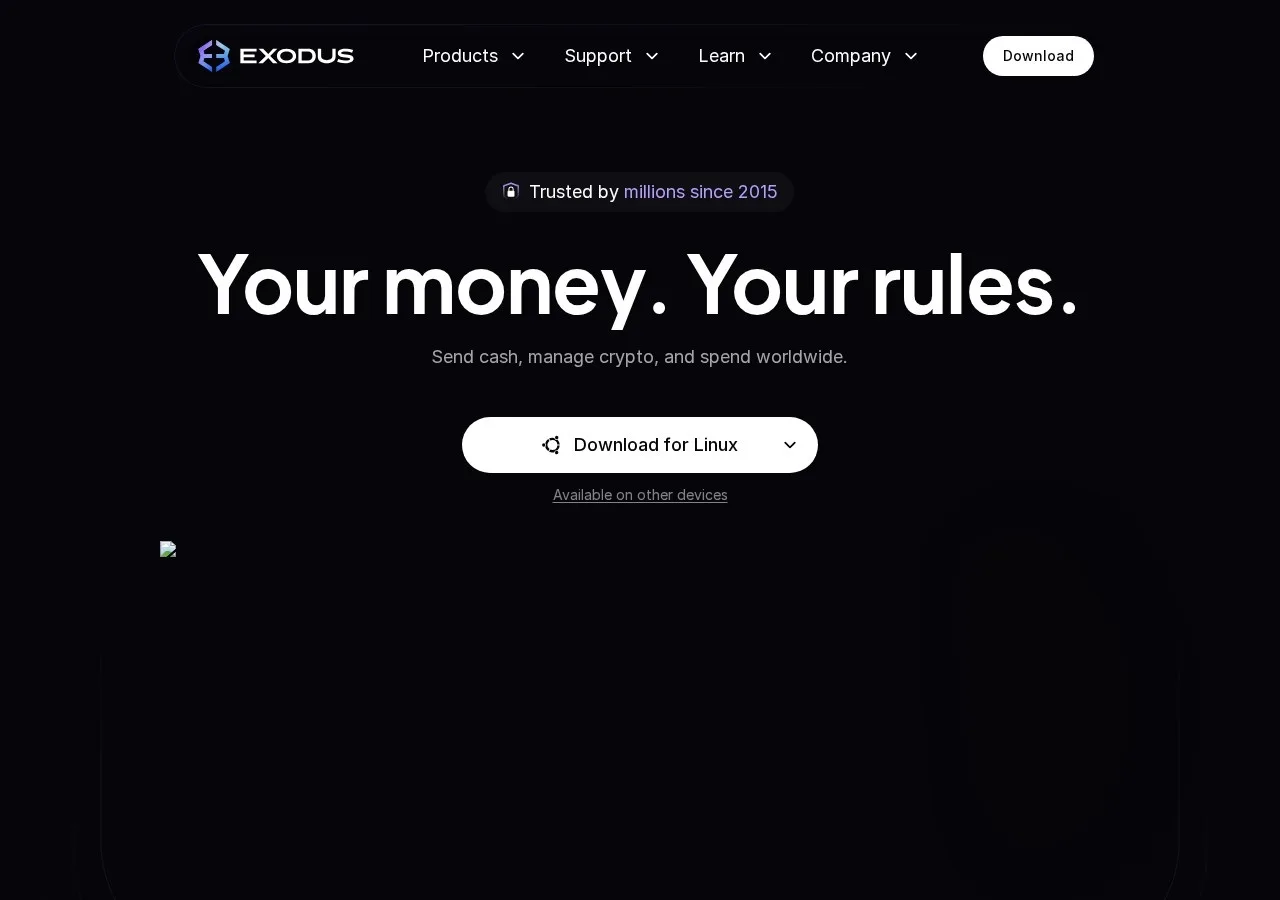
Exodus screenshots
What users say about Exodus
Users often praise Exodus for being easy to use, simple, and fast. Complaints are more serious, centered on reported drained wallets, stuck or failed transactions, and slow support, alongside recurring app and feature problems.
Top goods
In their own words
“Easy to use app!! Super easy app to use -‘thought it’d be hard”
“All good so far! Looks good. Seems easy to use, so far. Easily withdrew from exchange, and it showed up within a few seconds.”
“Very easy app for newbies I like the aesthetic of the app and I like what the app is about and I’m super excited to start using it full-time”
“2 separate withdrawals of $51.3 to my friends wallet but the money was never sent Normally when I withdraw money it shows a second icon in my activity showing it sent the money out but it never showed that and I don't have my money anymore. How do I get it back.”
“Worst Customer service. Starting out the application was great. I like the app. Eventually due to software bugs or faulty updates your app will inherently have issues. When that happens you are completely out of luck. I requested assistance several times with XO Ramp issues.”
“Swap Pending Bug 2 days ago I sent over $1500 to my exodus wallet from cake wallet (xmr) after I received the funds from there I wanted to swap to eth to invest and let it sit.”
Scam warning: Phishing emails, fake websites, and malicious links have been used to trick Exodus users into entering sensitive information or connecting wallets.
Scam warning: Fake support contacts and malware links have been associated with reported wallet losses.
Based on 100 Reddit posts and comments, 31 App Store reviews from the last 12 months, checked Oct 18, 2026. These are posts by users on other sites, not reviews submitted on CryptoReview.
User reviews
No user reviews yet. Have you used Exodus? Share your experience below.
Funding and investors
$60MTotal raised
1Round
1Investor
-
Crypto-only public equity offering Apr 2021 $60MPE Public equity investorsSource
FAQ
Who founded Exodus?
Exodus was founded in 2015 by Jon Paul Richardson and Daniel Castagnoli. Richardson is the CEO and Chairman, while Castagnoli is Chief Creative Officer.
What fees does Exodus charge?
Exodus says wallet transactions do not carry an Exodus fee, though blockchain network fees may apply. Swap rates start at 0.5%, and card or payment services use third-party providers.
Is KYC required to use Exodus?
Exodus says personal data is not required to use the wallet. Buying crypto and payment services are provided through third parties, so their terms can apply.
Is Exodus safe?
Exodus is self-custodial, stores private keys on the device and supports passkeys plus Ledger and Trezor hardware wallets. Recovery uses a seed phrase, so phishing, malware and seed-phrase loss remain risks.
What assets does Exodus support?
Exodus lists more than 1,000,000 supported assets, including Bitcoin, Ethereum, USDT and Solana. It also supports swapping across thousands of assets and pairs.
Can Exodus stake cryptocurrency?
Yes. Exodus supports staking for selected cryptocurrencies through its wallet interface, with rewards set by the relevant blockchain or service.
Latest from Exodus on X
Enter for a chance to win 2 tickets to UFC 334 at Madison Square Garden.
November 14. New York City.
Enter: https://t.co/tHmi8eXMaH https://t.co/9tSCVitRiQ
November 14. New York City.
Enter: https://t.co/tHmi8eXMaH https://t.co/9tSCVitRiQ

there are 66 days left in 2026.
act accordingly.
act accordingly.
if you have to hand over your crypto before you can use it, we haven’t finished the job.
what's spookier than bitcoin not reaching 100k by EOY?
wrong answers only.
wrong answers only.
Recent public posts from @exodus, shown as published. Not reviewed or endorsed by CryptoReview.
Alternatives to Exodus

Open-source, self-custodial mobile wallet supporting over 100 blockchains and built-in cross-chain swaps
No KYCMobileSelf-custodialEthereum · Bitcoin +13

Self-custodial mobile wallet with built-in DEX routing across more than 18 blockchains
No KYCMobileSelf-custodialEthereum · BNB Chain +7

Open-source, non-custodial multi-chain wallet with built-in Tor and privacy-preserving assets
No KYCMobile · DesktopSelf-custodialBitcoin · Ethereum +7

Non-custodial DeFi wallet and multichain aggregator covering 10,000+ assets across 48+ networks
No KYCMobile · WebSelf-custodialEthereum · Bitcoin +9

Self-custodial Cosmos wallet launched in 2021, now supporting almost 350 networks
Mobile · Browser extension +1Self-custodialEthereum · Bitcoin +4
Self-custodial multichain wallet from Kraken with passkey support and zero platform swap fees
No KYCMobile · WebSelf-custodialBitcoin · Ethereum +7