

mStable Stacked Yield has more than doubled its ethereum:0x7cf9dec92ca9fd46f8d86e7798b72624bc116c05 allocation, from $1M to ~$2.3M in the latest rebalance.
@ApolloCryptoFM runs market-neutral stablecoin strategies across chains and venues, packaged into ethereum:0x7cf9dec92ca9fd46f8d86e7798b72624bc116c05 by @MidasRWA
mAPOLLO is now the vault’s largest yield source 🏆

mStable
Automated stablecoin yield vault combining Pendle, Ethena, and Aave on Ethereum
3.2/ 5
Our score
Fair
Lending model
Pooled
Chains
Ethereum
Main collateral assets
sUSDeUSDemAPOLLO
Audited
Yes
Governance token
MTA
What is mStable?
mStable is an automated yield and vault protocol operating on Ethereum mainnet that pools stablecoins into automated earning strategies. Originally launched in 2020 by Stability Labs, the protocol underwent a full architectural rebuild in late 2025. It now focuses on tokenized, stacked yield strategies that compound returns without requiring depositors to manually roll over derivative positions or manage collateral debt.
Protocol architecture and team background
The protocol was originally founded by Stability Labs and later transitioned governance through its DAO structure. Following a strategic restructuring, the execution infrastructure supporting mStable was aligned with dHEDGE, which rebranded to Chamber in April 2026. Chamber provides the underlying onchain asset management tooling and smart contract layer that powers mStable's current vault deployments.
How stacked vaults work
mStable operates non-custodial smart contract vaults on Ethereum, accessible by connecting a Web3 wallet without identity verification. Its primary product is the mStable Stacked Yield vault, exemplified by strategies such as mPT-sUSDe. The vault combines multiple decentralized finance protocols into a single automated token. It purchases Pendle Principal Tokens (PT-USDe) to capture fixed-rate maturity discounts, loops Ethena USDe and sUSDe collateral through Aave lending markets, and deploys capital into market-neutral real-world asset yields like Midas mAPOLLO, which expanded to a $2.3M allocation in October 2026.
Audits and track record
mStable smart contracts have undergone security audits by Sherlock, iosiro, and Trust Security. Across its history, the protocol held nearly $200M in all-time high deposits before pivoting its core design. In October 2026, total value locked stood at about $4.8M. The vault team actively manages depeg and credit risks; on June 2, 2026, mStable Stacked Yield executed an emergency exit from its apxUSD PT position following an apxUSD market depeg, mitigating further exposure.
Risks and considerations
Depositors face multi-layer composability risks. Because mStable combines Pendle, Ethena, and Aave, any smart contract failure, bad debt accumulation, or liquidation failure within those external protocols directly impacts the vault. Users also carry collateral depeg risk linked to synthetic dollars such as USDe, as well as counterparty risks stemming from third-party yield providers.
Best for:Passive stablecoin yield earnersEthereum mainnet DeFi usersInvestors seeking hands-off Pendle PT compounding
Pros and cons
Pros
- Audited by Sherlock, iosiro, and Trust Security
- Automates complex multi-protocol yield loops without manual rollovers
- Requires no KYC or account registration to deposit
- Rapidly cut exposure during the June 2026 apxUSD depeg incident
Cons
- Restricted solely to Ethereum mainnet with no layer-2 support
- Exposure to cascading smart contract risks across Ethena, Aave, and Pendle
- Vulnerable to synthetic dollar and stablecoin depeg events
- Total value locked is modest at about $4.8M in October 2026
Our review
3.2/5
Fair
mStable delivers automated, stacked stablecoin yields through composable DeFi protocols, but depositors carry multi-layered smart contract risk and exposure to underlying token depegs across Ethereum.
Originally launched in 2020 by Stability Labs, mStable underwent a rebuild and protocol relaunch in late 2025. It now operates as an automated vault layer built on top of Chamber infrastructure (formerly dHEDGE) on Ethereum mainnet. The protocol aggregates stablecoin yields by stacking positions across external primitives rather than managing standalone peer-to-peer or pooled lending markets.
The system operates primarily through tokenized vaults such as mStable Stacked Yield (including mPT-sUSDe and mPT-USDe). Instead of requiring depositors to execute manual rollovers, mStable automatically compounds returns by combining Pendle Principal Tokens, Ethena's synthetic dollar (USDe and sUSDe), Aave borrowing loops, and institutional market-neutral yield tokens like Midas's mAPOLLO. In October 2026, the vault held around $4.8M in total value locked, with mAPOLLO representing its single largest allocation after expanding to approximately $2.3M.
Depositors benefit from automated leverage management, programmatic rollover of maturing fixed-yield tokens, and independent audits conducted by Sherlock, iosiro, and Trust Security. However, stacking yield creates nested counterparty risk. A failure, oracle malfunction, or liquidation cascade in any underlying protocol directly impacts mStable vault depositors. For example, mStable had to execute an emergency exit from its apxUSD position on June 2, 2026, following the apxUSD token depeg.
mStable suits hands-off Ethereum stablecoin depositors seeking double-digit yields who prefer not to manage recursive Aave debt or Pendle maturity dates manually. Risk-averse users who prefer isolated lending pools or non-custodial markets without composite derivative risks should look toward standalone lending platforms like Aave.
Specs
| KYC required ⓘ | No · unverified |
|---|---|
| Lending model | Pooled · unverified |
| Chains | Ethereum |
| Main collateral assets | sUSDe, USDe, mAPOLLO · unverified |
| Permissionless markets | No · unverified |
| Audited | Yes · unverified |
| Governance token | MTA · unverified |
| Isolated markets | No · unverified |
| Real-world-asset collateral | Yes · unverified |
| Own stablecoin | No · unverified |
| Rates | Variable · unverified |
Not disclosed by the provider: Flash loans, Bug bounty.
Data from the provider's website and public sources. Fees and availability change; confirm on the official site before you sign up.
Key features
Automated yield stacking
Combines Pendle Principal Tokens, Ethena sUSDe, and Aave money market loops into an automated, single-token vault.
RWA yield integration
Allocates capital to tokenized, market-neutral debt vehicles including Midas mAPOLLO alongside onchain strategies.
Principal token roll management
Automates the rollover of expiring Pendle PT positions into new maturities to avoid idle funds.
Chamber infrastructure
Executes trades and rebalances through the Chamber vault architecture on Ethereum mainnet.
Independent security audits
Features audited smart contract architecture reviewed by Sherlock, iosiro, and Trust Security.
Inside mStable
mStable Stacked Yield
The core automated vault strategy combining Pendle PTs, Ethena synthetic dollar yield, Aave looping, and mAPOLLO into a single auto-compounding token.
Deposit
The protocol interface allowing users to allocate stablecoins into active yield vaults.
Withdrawal
The portal where depositors redeem vault share tokens back into underlying stable assets.
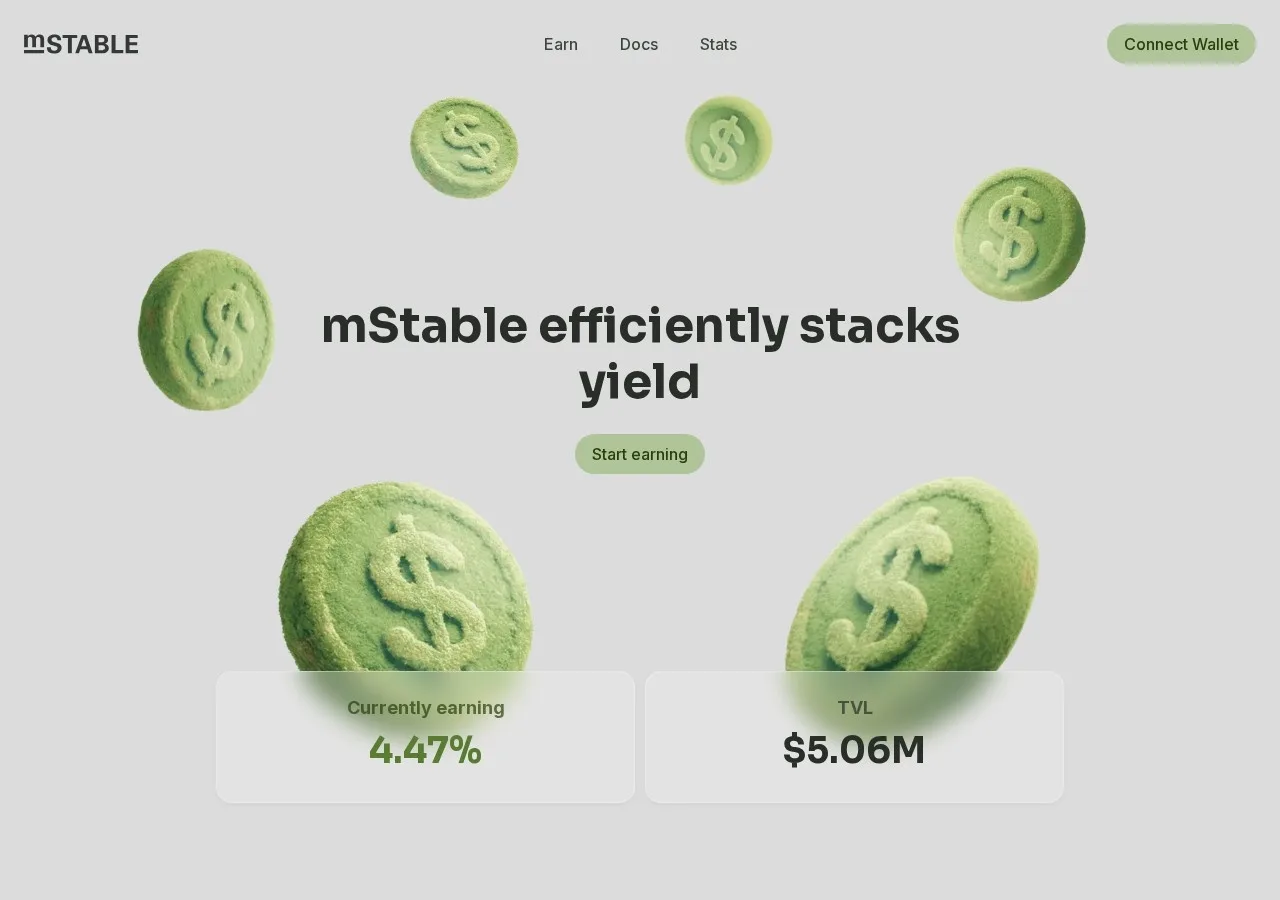
mStable screenshots
User reviews
No user reviews yet. Have you used mStable? Share your experience below.
FAQ
What is mStable?
mStable is a decentralized finance vault protocol on Ethereum that automates and stacks stablecoin yield strategies using protocols like Pendle, Ethena, Aave, and Midas.
Does mStable require KYC?
No, mStable is a non-custodial protocol accessed directly via an Ethereum Web3 wallet without identity verification.
Which networks does mStable support?
mStable operates on the Ethereum mainnet.
Has mStable been audited?
Yes, mStable contracts have been audited by Sherlock, iosiro, and Trust Security.
Does mStable have a governance token?
Yes, mStable uses the Meta token (MTA) for protocol governance, while the underlying infrastructure provider Chamber uses DHT.
Has mStable experienced collateral depegs?
Yes, mStable Stacked Yield was forced to exit its apxUSD Principal Token position on June 2, 2026, following the depeg of apxUSD.
Latest from mStable on X
mStable Stacked Yield turned one this month
$1,000 at launch is $1,130 today https://t.co/psE9YKSOr7
$1,000 at launch is $1,130 today https://t.co/psE9YKSOr7

That demand includes us
mStable Stacked Yield moved $500k out of sUSDe and into the @pendle_fi November PT on Friday
mStable Stacked Yield moved $500k out of sUSDe and into the @pendle_fi November PT on Friday
Good stablecoin yield is boring
It shows up whether you watch it or not https://t.co/9fnCBMs02u
It shows up whether you watch it or not https://t.co/9fnCBMs02u

mStable Stacked Yield is earning 14.24%
70% sUSDe. 30% mAPOLLO. That is the whole vault https://t.co/EPdkyvYOLo
70% sUSDe. 30% mAPOLLO. That is the whole vault https://t.co/EPdkyvYOLo

Recent public posts from @mstable_, shown as published. Not reviewed or endorsed by CryptoReview.
Alternatives to mStable

Permissionless lending protocol and curated vaults securing over $11B across EVM chains
No KYCIsolated marketsEthereum · Base +2Permissionless markets

Pooled lending protocol founded in 2017, operating across 23 blockchain networks
No KYCPooledEthereum · Base +4Audited

Algorithmic money market lending single base assets across EVM networks since 2018
No KYCIsolated marketsEthereum · Arbitrum +1Audited

Solana money market protocol built by Jupiter with over $1B in total value locked
No KYCPooledSolanaAudited

Solana lending and liquidity protocol with over $1.3B in TVL and fixed-rate borrow markets
PooledSolanaAudited

Institutional onchain lending protocol managing over $4.6B across overcollateralized credit pools
KYC requiredPooledEthereumAudited