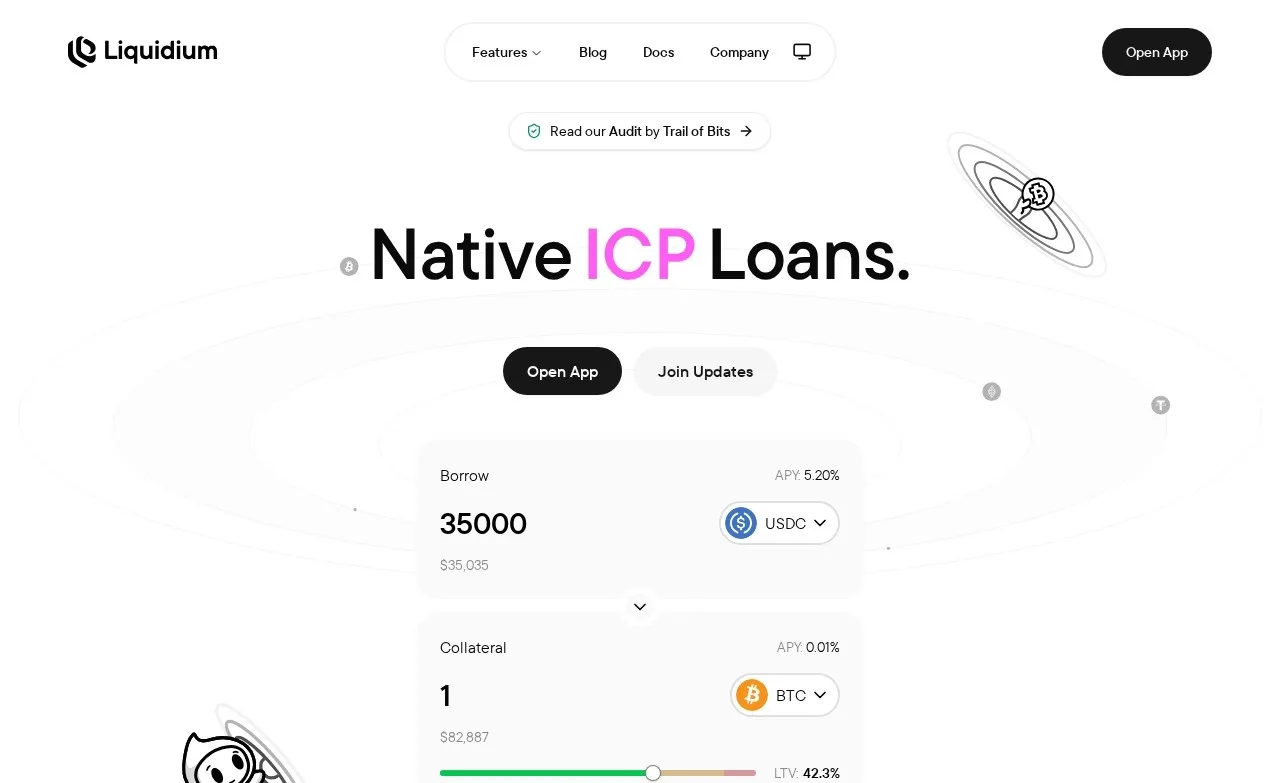
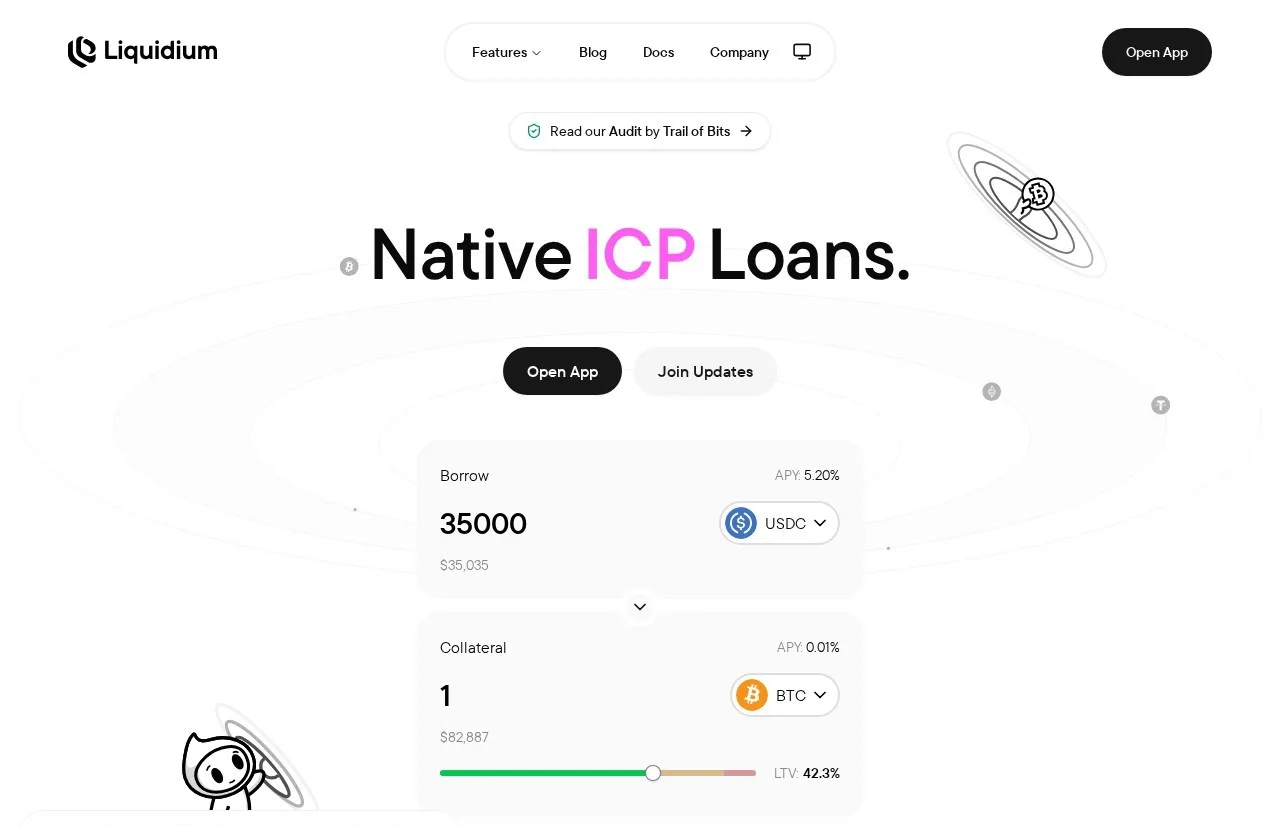
We run automated security checks daily, alongside multi-human reviews.
If you're curious to learn more, you can read about our security practices below 👇 https://t.co/HQMxQBWNbK

Cross-chain lending protocol borrowing stablecoins against native Bitcoin via ICP Chain Key infrastructure
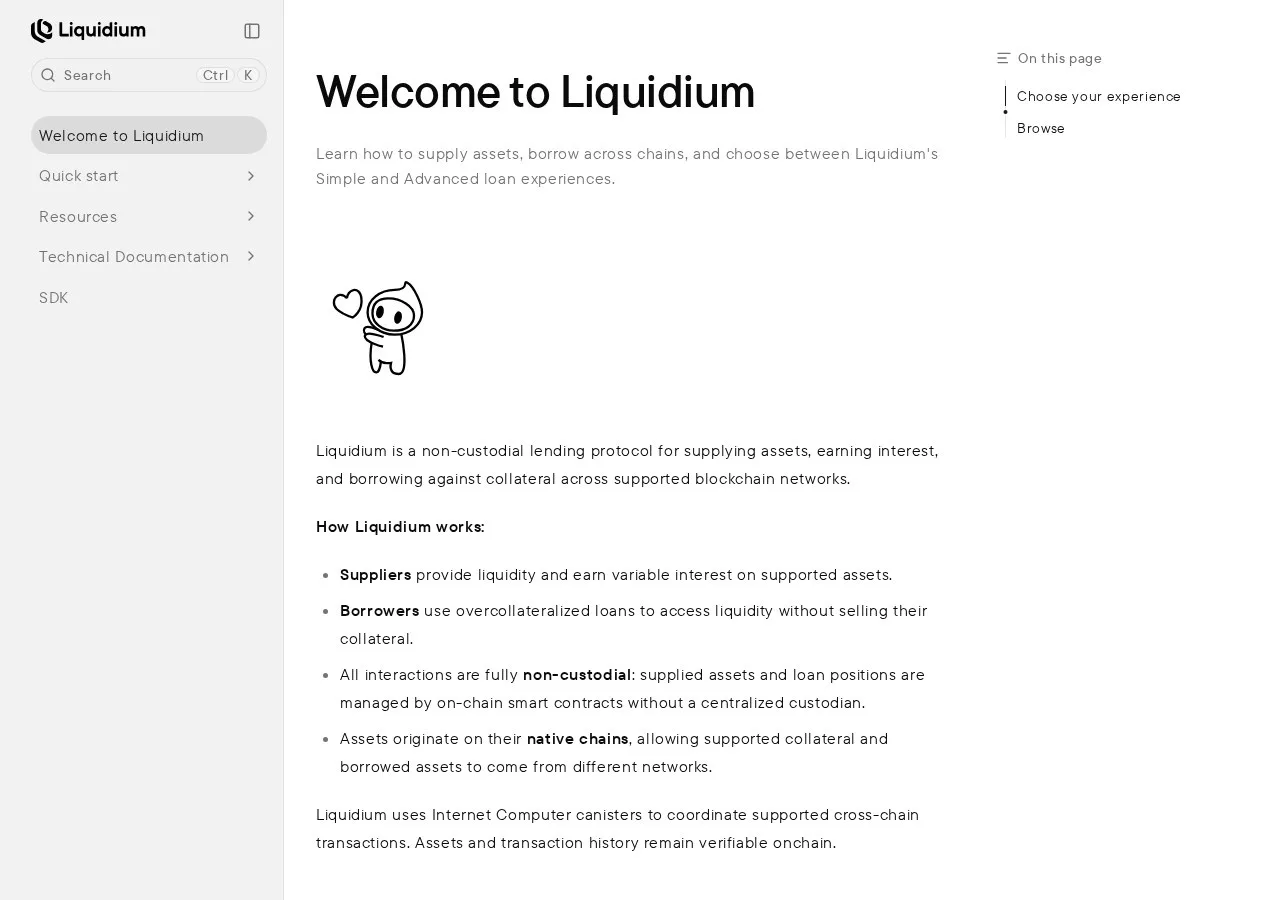
Liquidium is a decentralized, non-custodial cross-chain lending protocol that allows users to borrow stablecoins against native Bitcoin, Ethereum, and ICP assets. Built using Internet Computer's Chain Key technology, the platform bypasses conventional centralized bridges and manual wrapped-token mechanics by minting 1:1 backed ckAssets under threshold cryptography.
The protocol was co-founded by Chief Executive Officer Robin Obermaier alongside co-founder Peter Giammanco. Liquidium originally operated as a peer-to-peer Ordinals lending venue before expanding into cross-chain pooled lending. The project has raised $4.0 million across two funding rounds, including a $1.25 million pre-seed round in December 2023 backed by Bitcoin Frontier Fund and Side Door Ventures, followed by a $2.75 million seed round in July 2024 featuring Portal Ventures, Wise3 Ventures, CMS Holdings, and NGC Ventures.
Liquidium allows users to deposit native BTC or ETH to protocol-assigned addresses, where ICP threshold signatures custody the base assets and issue corresponding ckAssets (such as ckBTC or ckETH) into unified liquidity pools. Users can borrow native USDT or USDC delivered directly to Ethereum addresses, or interact via ICP ICRC-1 accounts. Two modes exist: Simple Loans, which provide a one-step borrowing route with no wallet connection or account required, and Liquidium Advanced, which uses Internet Identity or Web3 wallets for multi-collateral management, portfolio health monitoring, and custom repayments. Borrow rates follow a two-slope kink model anchored to pool utilization.
Each newly opened loan incurs a 0.5% activation fee calculated on the principal and added directly to the total debt balance in the borrowed asset. Variable borrow rates apply depending on market utilization, with an optimal kink target set around 92% utilization. Maximum loan-to-value limits sit at 65% for BTC, ETH, USDC, and USDT, with a liquidation threshold of 74% and a 5% liquidation bonus. For ICP collateral, the maximum LTV is 50% with a 70% threshold and a 7.5% liquidation bonus.
Originally launching Ordinals lending on its Liquidium.wtf platform, the team launched the cross-chain Liquidium.fi lending protocol in February 2026. The wider platform has processed over 119,000 loans and handled more than $400 million in cumulative borrowing volume, recording about $4.45 million in total value locked in October 2026. Key risks include exposure to threshold cryptographic canisters underpinning ICP Chain Key tech, oracle latency during rapid market drops, variable rate spikes above the 92% utilization kink, and fast 15-second liquidation cycles that leave borrowers little room to adjust collateral.

Liquidium enables bridge-free cross-chain loans against native Bitcoin and Ethereum assets, though its total liquidity pool remains modest.
Liquidium operates a cross-chain pooled lending protocol that connects Bitcoin, Ethereum, and the Internet Computer without relying on traditional wrapped-asset bridges. Using ICP Chain Key threshold signatures and ckAssets (ckBTC, ckETH, ckUSDT, ckUSDC), the protocol lets borrowers deposit native layer-1 Bitcoin and borrow ERC-20 stablecoins like USDT or USDC directly to an Ethereum address.
The system runs on two distinct tracks. Simple Loans allow one-step borrowing where users generate a dedicated deposit address and take out debt without registering an account. Liquidium Advanced provides a multi-asset dashboard for managing broader collateral pools, tracking portfolio health, and withdrawing assets. Borrowing rates follow a standard two-slope kink model targeting 92% optimal pool utilization, accompanied by an upfront 0.5% activation fee added directly to the loan principal.
Key structural parameters include:
Originally known for its peer-to-peer Ordinals lending protocol at Liquidium.wtf, the company expanded in February 2026 into cross-chain pooled liquidity under co-founders Robin Obermaier and Peter Giammanco. The firm raised $4.0M across seed and pre-seed rounds backed by investors including Portal Ventures, Bitcoin Frontier Fund, and Wise3 Ventures. As of October 2026, Liquidium holds about $4.45M in total value locked.
Liquidium suits Bitcoin holders seeking liquidity in dollar stablecoins without selling spot assets or navigating manual third-party bridges. However, borrowers must tolerate the protocol trust assumptions embedded in ICP Chain Key canister infrastructure, along with network wait times such as four Bitcoin confirmations (about 40 minutes) or 64 Ethereum confirmations for cross-chain settlements.
| KYC required ⓘ | No · unverified |
|---|---|
| Lending model | Pooled · unverified |
| Chains | Other |
| Main collateral assets | BTC, ETH, USDT, USDC, ICP · unverified |
| Governance token | LIQ · unverified |
| Isolated markets | No · unverified |
| Real-world-asset collateral | No · unverified |
| Own stablecoin | No · unverified |
| Rates | Variable · unverified |
Not disclosed by the provider: Flash loans, Permissionless markets, Audited, Bug bounty.
Data from the provider's website and public sources. Fees and availability change; confirm on the official site before you sign up.
Deposit native Bitcoin or Ethereum and receive native USDT or USDC on Ethereum without manually handling bridge tokens.
Borrow stablecoins against Bitcoin or ICP in a single step with a dedicated deposit address and no account registration.
Connect via Internet Identity or Web3 wallets to manage cross-collateral positions, portfolio health, and multi-asset borrowing.
Borrow and supply interest rates scale linearly up to an optimal 92% utilization kink before accelerating up a 300% second slope.
Liquidity pools run on 1:1 backed ckBTC, ckETH, ckUSDT, and ckUSDC canisters validated through threshold cryptography on ICP.
Liquidations execute on 15-second settlement cycles on ICP with liquidation thresholds between 70% and 74%.
A streamlined borrowing interface that lets users deposit collateral and receive borrowed stablecoins in a single flow without creating an account or linking a profile.
A full-featured portfolio dashboard where authenticated users supply assets to earn variable interest, borrow against multi-asset collateral, and manage health factors.
A dedicated Bitcoin-native lending platform that facilitates peer-to-peer loans against Ordinals and Runes using Discreet Log Contracts and Partially Signed Bitcoin Transactions.
User sentiment is generally positive, with discussions focusing on the ability to take loans against Bitcoin natively without bridging or wrapping assets.
“Not if you use protocols like no wrapping”
“If Liquidium.fi really keeps everything on-chain native, that’s a big UX + security win.”
Based on 9 Reddit posts and comments from the last 12 months, checked Oct 21, 2026. These are posts by users on other sites, not reviews submitted on CryptoReview.
No user reviews yet. Have you used Liquidium? Share your experience below.
Liquidium was founded by CEO Robin Obermaier and co-founder Peter Giammanco. The team originally launched the peer-to-peer Bitcoin Ordinals platform Liquidium.wtf before deploying the cross-chain lending protocol Liquidium.fi in 2026.
Liquidium charges an activation fee of 0.5% calculated on the borrowed principal, which is added directly to the total debt balance. Ongoing borrowing costs follow a variable interest rate determined by pool utilization.
No, Liquidium does not require identity verification or KYC. Users can complete Simple Loans without an account, or connect via Internet Identity and supported Web3 wallets for Advanced positions.
Liquidium supports Bitcoin, Ethereum, and the Internet Computer. Available pool assets for lending and borrowing include native BTC, ETH, USDT, USDC, and ICP.
Yes, Liquidium has a native token under the ticker symbol LIQ, initially issued in the Bitcoin Runes ecosystem.
Liquidity canisters monitor loan health on the Internet Computer with 15-second evaluation cycles. If a position drops below the liquidation threshold (74% for BTC and ETH, 70% for ICP), liquidators repay debt to claim collateral with a bonus between 5% and 7.5%.


Recent public posts from @LiquidiumFi, shown as published. Not reviewed or endorsed by CryptoReview.
Permissionless lending protocol and curated vaults securing over $11B across EVM chains
Pooled lending protocol founded in 2017, operating across 23 blockchain networks
Algorithmic money market lending single base assets across EVM networks since 2018
Solana money market protocol built by Jupiter with over $1B in total value locked
Solana lending and liquidity protocol with over $1.3B in TVL and fixed-rate borrow markets
Institutional onchain lending protocol managing over $4.6B across overcollateralized credit pools
Type at least two characters. Press ↵ to see all results.