

Over 2 million oracle requests and counting.
UMA’s Optimistic Oracle passed its 2 millionth request on August 17.
The second million took just 69 days.
Nice. https://t.co/whFopFHaNa


Optimistic oracle protocol securing arbitrary data across Ethereum, Base, Arbitrum, and Polygon
UMA is a decentralized optimistic oracle protocol that brings arbitrary real-world data and verifiable statements onto blockchains. Built to handle complex natural-language queries that standard price feeds cannot resolve, the protocol provides data settlement for decentralized applications including Polymarket, Across, Story Protocol, and Sherlock. By August 2026, the network passed 2 million oracle requests, recording its second million requests within 69 days.
The protocol is developed by Risk Labs. The team operates out of the United States with a headcount between 11 and 50 employees, led by Chief Operating Officer Melissa Quinn and Chief Technology Officer Matthew Rice. Risk Labs maintains the core smart contracts, developer tooling, and governance architecture supporting the oracle ecosystem.
UMA operates through a multi-stage verification framework consisting of its Optimistic Oracle and the Data Verification Mechanism (DVM). To propose an answer or settle a condition, a user submits a natural-language statement accompanied by an ERC-20 token bond. The statement enters a challenge period where it is accepted as true if no counterparty contests it. Because honest proposals risk losing their bond if challenged, disputes are infrequent, with approximately 1.5% of proposals contested as of February 2025. If a dispute occurs, UMA tokenholders vote on the outcome through the DVM, using Schelling-point consensus where majority voters receive token emissions while incorrect or inactive voters forfeit relative network share. The system is deployed across Ethereum, Base, Arbitrum, and Polygon.
The protocol's codebase is audited by OpenZeppelin, which has completed multiple reviews spanning 2020 through 2026. These assessments covered core protocol updates, including an audit of the Managed Optimistic Oracle contract in August 2025 and the Dispute Router module in March 2026. In May 2026, amid security inquiries involving connected markets, UMA verified that its core contracts and dispute resolution systems functioned normally without any exploit.
The optimistic model relies on delayed finality because every assertion must wait out a challenge window before smart contracts can consume the result. Data disputes require human intervention via tokenholder voting, exposing resolution accuracy to voter participation and token governance distribution.
UMA provides flexible optimistic verification for arbitrary onchain assertions, but dispute resolution depends on tokenholder voting latency rather than millisecond price feeds.
UMA operates an optimistic oracle framework that verifies arbitrary, real-world data and natural-language statements onchain. Supported by the Risk Labs Foundation, the protocol relies on economic incentives: proposers post a bond when asserting a data point, and if no challenge occurs during a set challenge window, the assertion is finalized automatically. When challenged, disputes escalate to the Data Verification Mechanism (DVM), where UMA tokenholders vote to establish consensus.
This design fits specialized use cases that traditional push or pull price oracles struggle to serve. Applications like Polymarket use UMA to resolve subjective or complex prediction market questions, while Across relies on it for cross-chain intent settlements. Other integrators include Story Protocol and Sherlock. With roughly 1.5% of proposals contested as of February 2025, the optimistic model handles most transactions cheaply without incurring full consensus costs. By August 2026, the protocol had handled over 2 million total oracle requests.
The system has specific limitations developers must evaluate:
Security is supported by repeated smart contract audits conducted by OpenZeppelin between 2020 and 2026, including assessments for its Managed Optimistic Oracle and Dispute Router modules. Deployments span Ethereum, Base, Arbitrum, and Polygon.
| Services | Oracle |
|---|---|
| Chains supported | 4 · unverified |
| Open source | Yes |
| Token | UMA |
Not disclosed by the provider: Free tier, Pricing from, Enterprise SLA, Uptime SLA, Free tier limits, Server regions.
Data from the provider's website and public sources. Fees and availability change; confirm on the official site before you sign up.
Validates arbitrary real-world queries such as election outcomes, sports scores, and cross-chain transfers without relying on standardized numeric price feeds.
Accepts proposed data assertions automatically if no counterparty posts a bond to challenge the statement during the designated dispute window.
Routes contested proposals to UMA tokenholders, who vote to resolve disputes using Schelling-point economic incentives.
Runs natively across Ethereum mainnet, Arbitrum, Base, and Polygon, alongside Sepolia testnet support.
Permits UMA tokenholders to stake assets and earn up to 16% APR for voting consistently with the consensus majority on disputes.
Provides preconfigured smart contract frameworks allowing applications like prediction markets to integrate custom resolution rules.
Validates arbitrary and natural-language statements using economic bonds and challenge periods, accepting proposals as true if no dispute occurs.
Acts as the dispute resolution backstop where UMA tokenholders vote on contested assertions using Schelling-point consensus.
Provides a configurable smart contract framework for decentralized applications implementing automated oracle integrations.
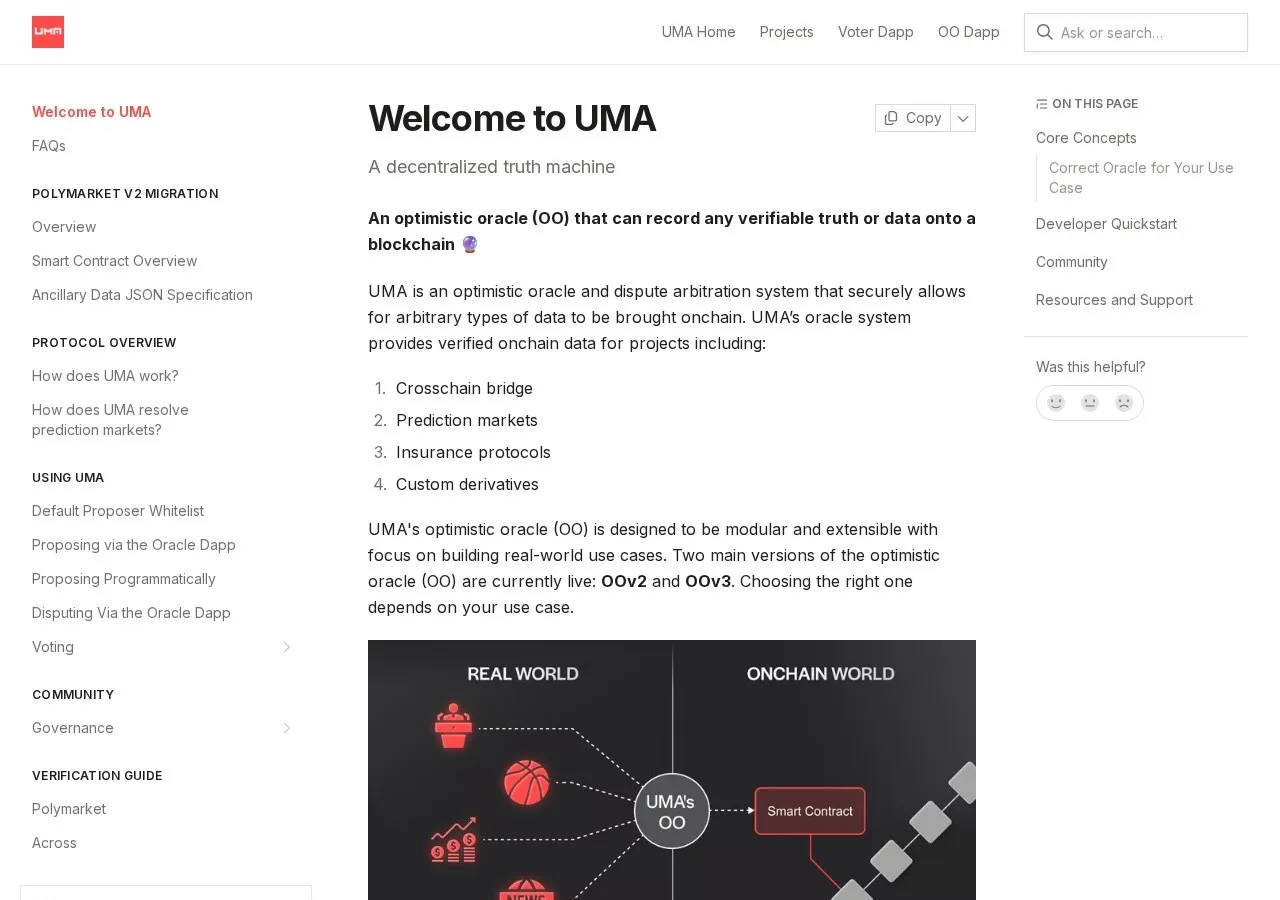
User discussions mention UMA's oracle and dispute resolution mechanism in prediction markets, alongside difficulties connecting mobile wallets.
“Hi, I already have the Base app installed, and my wallet connected respectively. The purpose was to connect my wallet to uma.xyz on desktop and scanning using my apple phone. I exhausted all possible options and functions throughout the app and found no more solution to amend this problem.”
Based on 3 Reddit posts and comments from the last 12 months, checked Oct 20, 2026. These are posts by users on other sites, not reviews submitted on CryptoReview.
No user reviews yet. Have you used UMA? Share your experience below.
UMA was developed under Risk Labs Foundation, with chief operating officer Melissa Quinn and chief technology officer Matthew Rice running operations.
Yes, UMA uses the UMA token. Stakers vote on contested data queries and earn staking returns of up to 16% APR for voting with the majority.
UMA's Optimistic Oracle is deployed on Ethereum, Base, Arbitrum, and Polygon, alongside the Sepolia testnet.
OpenZeppelin has conducted multiple audits on UMA's contracts from 2020 through 2026, including reviews of its Managed Optimistic Oracle and Dispute Router modules.
If someone disputes an asserted proposal during the challenge window, the assertion is sent to the Data Verification Mechanism. UMA tokenholders then vote on the resolution, and the winning side receives a reward.
Recent public posts from @UMAprotocol, shown as published. Not reviewed or endorsed by CryptoReview.
Open-source smart contract libraries and enterprise security tooling backing over $38T in transfers
Blockchain infrastructure platform supporting 100+ chains with a free 30M-compute-unit tier
Managed blockchain infrastructure across 70+ chains with a free 3M-request monthly tier
EVM development and simulation platform supporting transaction debugging and testing across 50+ chains
Open-source distributed ledger foundation hosting Fabric, Besu, and Cacti under the Linux Foundation
Blockchain infrastructure platform providing RPC nodes and data streams across 76 networks
Type at least two characters. Press ↵ to see all results.