

Introducing the definitive guide to ZK in 2026.
The year’s biggest questions pointed to ZK: Can we trust AI? Will quantum break encryption? Can private money live on public rails? How do we know what’s real online?
Read how in the 2026 ZK Industry Report with @zeroknowledgefm. https://t.co/1xAIkkzkMO
Succinct
Open-source zkVM and decentralized proving network securing over $13 billion in value
4.0/ 5
Our score
Very good
Services
Developer tooling
Chains supported
1
Free tier
Yes
Token
PROVE
What is Succinct?
Succinct provides zero-knowledge infrastructure designed to generate cryptographic proofs for standard software at production scale. Its core system combines the open-source SP1 zero-knowledge virtual machine (zkVM) with a decentralized prover network deployed on Ethereum. By October 2026, the network had fulfilled over 7.7 million proofs, securing more than $13.5 billion in value across partner integrations.
Team and funding
Succinct was founded in 2022 by Uma Roy, who serves as Chief Executive Officer, alongside co-founder John Guibas. In March 2024, the project raised $55 million across combined Seed and Series A financing rounds led by Paradigm. The round included participation from Robot Ventures, Bankless Ventures, Geometry, and ZK Validator, as well as individual angels from EigenLayer and Polygon.
How SP1 and the proving network operate
The system lets developers write programs in standard Rust rather than custom circuit languages. SP1 compiles this code into zero-knowledge proofs that attest to program execution without replaying every transaction onchain. For production deployments, proof generation requests can be routed to the Succinct Prover Network on Ethereum. This protocol acts as a two-sided marketplace where distributed provers bid in auctions to complete computational workloads, coordinating activity with the native PROVE token. Verification on Ethereum takes approximately 200,000 gas, with proof aggregation reducing this cost further for workloads that are not latency sensitive.
Track record and integrations
Succinct's infrastructure is integrated across major ecosystems. Base uses SP1 to prove $7.4 billion in bridge deposits, and OP Stack rollups deploy OP Succinct for trustless state settlement. In May 2025, Succinct demonstrated real-time proving of 93% of Ethereum blocks in under 12 seconds across 200 GPUs. Beyond rollups, Chainlink CCIP 2.0 uses Succinct for cross-chain transfer verification, and Google Quantum AI deployed SP1 in March 2026 to verify elliptic curve security research. Security audits have been completed by KALOS, Cantina, and Zellic.
Risks and past incidents
Proving systems carry mathematical complexity and implementation risks. On January 27, 2025, external researchers identified critical vulnerabilities in SP1 V3 alongside an upstream Plonky3 flaw. Succinct temporarily froze verifier routers on mainnet contracts while deploying fixes in its SP1 Turbo update. Relying on an external proving network also introduces market exposure to token economics, prover liveness, and hardware availability during periods of elevated network load.
Founders
Uma RoyCo-Founder and CEO
John GuibasCo-Founder
Best for:Rollup teams implementing ZK validity proofsDevelopers writing Rust verifiable computing applicationsBridges requiring trustless cross-chain state verification
Pros and cons
Pros
- Compiles native Rust programs into ZK proofs without custom circuit logic
- Secures over $13.5B across rollups and bridges including Base and Chainlink
- Audited by firms including KALOS, Cantina, and Zellic
- Aggregated verification reduces onchain gas requirements below 200K gas
Cons
- Frozen mainnet verifier routers were required to patch January 2025 vulnerabilities
- On-demand proving market depends on decentralized prover node liveness and the PROVE token
- Complex multi-GPU setups are required for self-hosted real-time block proving
Our review
4.0/5
Very good
Succinct simplifies zero-knowledge proving by compiling standard Rust code into verifiable proofs across major rollups, though users depend on active prover network liquidity and complex cryptographic architectures.
Succinct builds cryptographic proving infrastructure centered on SP1, an open-source zero-knowledge virtual machine (zkVM) that lets engineers write standard Rust instead of building custom cryptographic circuits. By coupling SP1 with a decentralized Ethereum-based prover network, Succinct coordinates on-demand proof generation across a two-sided marketplace. Major ecosystems rely on this pipeline: Coinbase uses it to prove $7.4B in deposits on Base Azul, while Chainlink CCIP 2.0 integrates it for cross-chain transfer verification. In total, the system secures $13.5B across 35 or more partners, with over 7.7M proofs completed.
The company was founded in 2022 by Uma Roy and John Guibas, backed by $55M in Seed and Series A capital led by Paradigm. Development has moved rapidly, including integrations like NVIDIA cuPQC acceleration and specialized architectures such as Flock for batch hash proving. However, running zkVM systems brings software-level trade-offs. In January 2025, security researchers from Aligned, LambdaClass, and 3MI Labs uncovered vulnerabilities in SP1 V3 alongside an upstream Plonky3 bug. Succinct froze onchain verifier routers while shipping fixes in SP1 Turbo, which underscored the operational risks of emerging zero-knowledge primitives.
Cost efficiency remains an upside for rollups and decentralized applications. Verifying an unaggregated proof on Ethereum costs around 200,000 gas, with recursive aggregation available to lower amortized costs further. On the other hand, the prover network relies on the PROVE token economic model, meaning proving availability and pricing depend on third-party prover hardware markets rather than predictable fixed-rate cloud pricing.
Succinct suits development teams deploying zk-rollups, cross-chain bridges, and coprocessors that need fast proving pipelines without dedicated cryptographers. Teams looking for simple managed RPC nodes or turnkey data indexers should look toward standard infrastructure providers instead.
Specs
| Services | Developer tooling · unverified |
|---|---|
| Chains supported | 1 · unverified |
| Free tier | Yes · unverified |
| Open source | Yes · unverified |
| Token | PROVE · unverified |
Not disclosed by the provider: Pricing from, Enterprise SLA, Uptime SLA, Free tier limits, Server regions.
Data from the provider's website and public sources. Fees and availability change; confirm on the official site before you sign up.
Key features
SP1 zkVM
Compiles standard Rust code directly into zero-knowledge proofs without requiring developers to write custom cryptographic circuits.
Decentralized prover network
Coordinates proof generation via an Ethereum-based auction marketplace where distributed provers bid to fulfill offchain computation.
Onchain verification
Verifies proofs on Ethereum mainnet at roughly 200,000 gas, with batch aggregation available for non-latency-sensitive workloads.
OP Succinct rollup integration
Supplies zero-knowledge state transition proofs for OP Stack chains while settling state updates directly to Ethereum.
Flock batch proving
Specialized SNARK system designed to reduce the computational overhead when proving batches of standard cryptographic hash functions.
Hardware acceleration
Integrates NVIDIA cuPQC to speed up zero-knowledge proof generation across high-performance GPU clusters.
Inside Succinct
SP1
An open-source general-purpose zero-knowledge virtual machine that compiles normal Rust code into zero-knowledge proofs for developers.
Succinct Prover Network
A decentralized protocol and two-sided auction marketplace on Ethereum coordinating hardware provers to fulfill ZK proof requests on demand.
OP Succinct
A specialized proving layer tailored for OP Stack chains that enables data confidentiality and proof settlement to Ethereum.
Flock
A SNARK system designed to reduce computation costs when generating zero-knowledge proofs for large batches of standard hash functions.
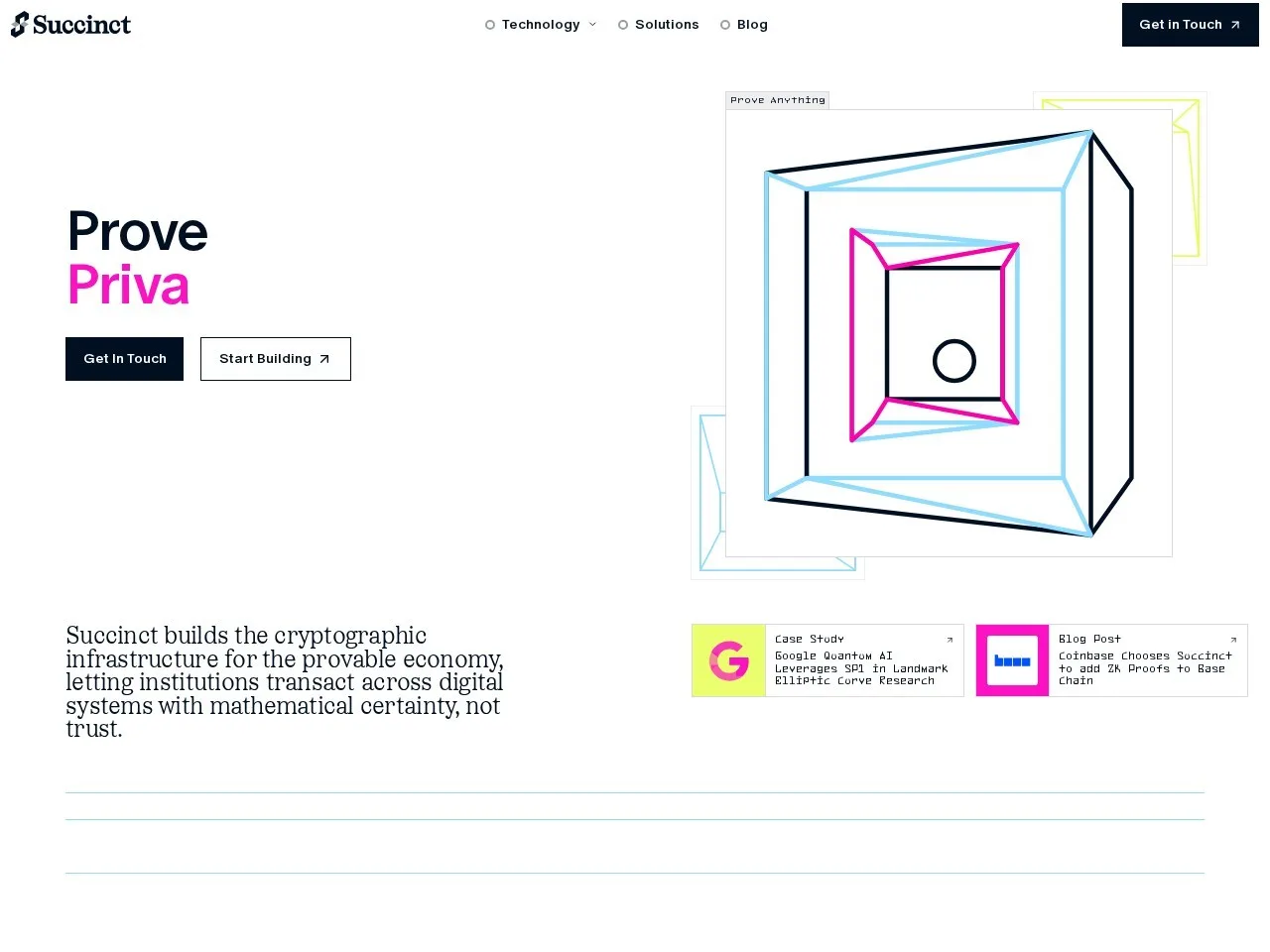
Succinct screenshots
User reviews
No user reviews yet. Have you used Succinct? Share your experience below.
Funding and investors
$55MTotal raised
2Rounds
5Investors
-
Seed and Series A Mar 2024 $55MSource
-
Series A Mar 2024 Amount undisclosedBV Bankless VenturesVenture capital GE GeometryVenture capitalSource
 Robot VenturesVenture capital
ZV ZK ValidatorVenture capital
FAQ
Who founded Succinct?
Succinct was founded in 2022 by Uma Roy and John Guibas. The company has raised $55 million in funding led by Paradigm.
Does Succinct have a token?
Yes, the protocol utilizes the PROVE token. It powers the Ethereum-based decentralized prover network marketplace.
Has Succinct undergone security audits or experienced incidents?
Succinct has audits from firms including KALOS, Cantina, and Zellic. In January 2025, vulnerabilities discovered in SP1 V3 and Plonky3 required a verifier router freeze and a security upgrade to SP1 Turbo.
What chains does Succinct support?
The Succinct Prover Network operates on Ethereum and provides proving integrations across ecosystems such as Base, Arbitrum, and Polygon.
How much does proof verification cost on Succinct?
Onchain verification costs approximately 200,000 gas on Ethereum. Non-latency-sensitive workloads can aggregate multiple proofs to reduce individual verification costs further.
What is SP1?
SP1 is an open-source general-purpose zkVM built by Succinct. It enables developers to generate zero-knowledge proofs using standard Rust code without designing custom circuits.
Latest from Succinct on X
This Wednesday, we're publishing the first-ever ZK Industry Report.
A full snapshot of ZK in 2026 between proving, research, adoption, and forces accelerating all of it.
DM us or @zeroknowledgefm to get notified when it's live. https://t.co/4m8cjrzPWG
A full snapshot of ZK in 2026 between proving, research, adoption, and forces accelerating all of it.
DM us or @zeroknowledgefm to get notified when it's live. https://t.co/4m8cjrzPWG

.@apolynya is back with updated thoughts on ZK.
One line stood out: “The potential impact of ZKPs supercedes that of all blockchains.”
Early signs say he’s right. Our upcoming 2026 ZK Industry Report with @zeroknowledgefm surveys adoption across categories beyond blockchains.
One line stood out: “The potential impact of ZKPs supercedes that of all blockchains.”
Early signs say he’s right. Our upcoming 2026 ZK Industry Report with @zeroknowledgefm surveys adoption across categories beyond blockchains.

The next phase of digital assets should be built on verifiable guarantees, not just trust between counterparties.
Zero-knowledge turns trust into something institutions can P.R.O.V.E across their entire stack:
Privacy
Reporting
Ownership
Verification
Execution
Zero-knowledge turns trust into something institutions can P.R.O.V.E across their entire stack:
Privacy
Reporting
Ownership
Verification
Execution
Derive rebuilt its options exchange using a zkVM.
zkVMs have been around for a few years. What changed is performance. Proving is now fast and cheap enough to run an options exchange’s margin and settlement.
Hear from @josh_pwrk on why they upgraded to Succinct's SP1. https://t.co/3NgLIeQINm
zkVMs have been around for a few years. What changed is performance. Proving is now fast and cheap enough to run an options exchange’s margin and settlement.
Hear from @josh_pwrk on why they upgraded to Succinct's SP1. https://t.co/3NgLIeQINm
Recent public posts from @succinctlabs, shown as published. Not reviewed or endorsed by CryptoReview.
Alternatives to Succinct

Open-source smart contract libraries and enterprise security tooling backing over $38T in transfers
Developer toolingFree tier10 chains supported

Blockchain infrastructure platform supporting 100+ chains with a free 30M-compute-unit tier
RPC / nodes · Data APIs +3Free tier100 chains supported

Managed blockchain infrastructure across 70+ chains with a free 3M-request monthly tier
RPC / nodes · IndexingFree tier70 chains supported
EVM development and simulation platform supporting transaction debugging and testing across 50+ chains
Developer toolingFree tier50 chains supported
Open-source distributed ledger foundation hosting Fabric, Besu, and Cacti under the Linux Foundation
RPC / nodes · Developer toolingFree tier2 chains supported
Blockchain infrastructure platform providing RPC nodes and data streams across 76 networks
RPC / nodes · Data APIsFree tier76 chains supported