

All the new Copilot features and experiences we announced at #GitHubUniverse 🚀 https://t.co/TfTyzCmkpN
Ordinals
Open-source Bitcoin indexing client, block explorer, and wallet for tracking satoshis
3.5/ 5
Our score
Good
Services
IndexingDeveloper tooling
Chains supported
1
Free tier
Yes
Pricing from
0
Enterprise SLA
No
What is Ordinals?
Ordinals is an open-source indexing client, block explorer, and command-line wallet implementation for tracking individual satoshis on the Bitcoin blockchain. Built in Rust under the name ord, the software applies ordinal theory to assign serial numbers to satoshis in the order they are mined, enabling them to be tracked across transactions and inscribed with arbitrary data.
Development and governance
The Ordinals protocol was created by Casey Rodarmor, with ongoing development led by maintainer raphjaph alongside community contributors. Protocol stewardship and infrastructure funding are supported by the Open Ordinals Institute, a California nonprofit corporation established to back developers and cover operational costs for services such as the ordinals.com explorer. Development operations are funded via donations through a 2-of-4 multisig wallet held by key contributors.
Technical mechanics and integration
The software functions as local infrastructure that communicates directly with a fully synchronized Bitcoin Core node (bitcoind) via RPC. Running an index requires bitcoind with the transaction index flag enabled (-txindex). The ord client reads satoshi movements sequentially from local block data to maintain an accurate internal map of satoshi locations. For wallet functions and transaction construction, ord relies on Bitcoin Core for underlying key management, loading a dedicated wallet instance through the command line.
Pricing and licensing
The ord client software is distributed free of charge under the CC0-1.0 public domain dedication. The core ord client has no software subscription fee. Operators must run a synced bitcoind node with -txindex.
Risks and operational trade-offs
Running the ord client introduces specific operational risks. The integrated wallet mechanism relies on Bitcoin Core, which lacks native awareness of inscriptions and satoshi-level accounting; spending funds from the same wallet via standard Bitcoin Core commands can unintentionally destroy or transfer inscribed satoshis. Additionally, the built-in web explorer renders user-submitted HTML and JavaScript directly, exposing host environments to potential cross-site scripting vulnerabilities if web services are made public without security controls.
Founders
Casey RodarmorCreator / Contributor
raphjaphLead Maintainer
Best for:Bitcoin node operatorsDevelopers indexing Bitcoin digital artifactsEngineers running self-hosted blockchain explorers
Pros and cons
Pros
- Fully open source under the CC0-1.0 public domain license
- Direct indexing from local Bitcoin Core nodes without reliance on third-party APIs
- Free self-hosted software with no vendor licensing costs
Cons
- Requires a fully synced Bitcoin Core node with txindex enabled to run
- Inscriptions can be accidentally spent if cardinal and ordinal wallets are mixed
- Self-hosted explorer runs untrusted HTML and JavaScript, creating script execution risks
- No commercial enterprise SLA
Our review
3.5/5
Good
Ordinals provides open-source indexing and command-line tooling for Bitcoin inscriptions, but it requires running a fully indexed Bitcoin Core node without enterprise SLA guarantees.
Ordinals, implemented through the Rust client ord, is an indexer, block explorer, and command-line wallet for tracking satoshis and inscriptions on the Bitcoin blockchain. Casey Rodarmor created the software, which is maintained by lead maintainer raphjaph. It is open source under the CC0-1.0 universal public domain dedication. The Open Ordinals Institute, a California nonprofit corporation funded by community donations, provides organizational backing.
As an infrastructure component, ord tracks satoshis according to ordinal theory without requiring sidechains or off-chain state coordination. Developers can query inscription metadata, run local explorer servers, and build Bitcoin-native digital artifacts against Bitcoin Core. The core ord client has no software subscription fee.
The self-hosted architecture has operational trade-offs:
- It requires an operational bitcoind instance running with -txindex.
- It does not provide a commercial enterprise SLA.
- Standard bitcoind RPC commands can cause accidental inscription spending if satoshis are not segregated with inscription awareness.
- Serving untrusted inscription content through the built-in server explorer can expose users to web vulnerabilities such as cross-site scripting.
Ord suits developers and node operators building inscription services, wallets, or Bitcoin indexers that require protocol compatibility and local data verification. It supports Bitcoin and runs as self-hosted software.
Specs
| Services | Indexing, Developer tooling · unverified |
|---|---|
| Chains supported | 1 · unverified |
| Free tier | Yes · unverified |
| Pricing from | 0 · unverified |
| Enterprise SLA | No · unverified |
| Open source | Yes · unverified |
| Free tier limits | Unlimited open-source self-hosted access · unverified |
Not disclosed by the provider: Token, Uptime SLA, Server regions.
Data from the provider's website and public sources. Fees and availability change; confirm on the official site before you sign up.
Key features
Satoshi indexing
Indexes individual satoshis sequentially across Bitcoin blocks by connecting directly to a bitcoind node running with transaction indexing enabled.
Local block explorer
Hosts a local web server to inspect blocks, query specific satoshi serial numbers, and view digital inscriptions in a browser.
Command-line wallet
Provides dedicated wallet commands that coordinate with Bitcoin Core to segregate inscribed satoshis from cardinal balances.
Self-hosted RPC connectivity
Communicates with Bitcoin Core over local RPC using cookie authentication, manual credentials, or environment variables.
Data inscription tooling
Enables writing arbitrary data directly into Bitcoin transaction witness scripts according to ordinal theory.
Inside Ordinals
ord
The core command-line utility and Rust indexing engine that tracks satoshis, creates inscriptions, and handles ordinal wallet management through bitcoind.
server
A built-in HTTP server and block explorer that visualizes blocks, satoshi numbers, and raw inscription content directly from the local ord index.
wallet
A dedicated sub-command suite that interfaces with Bitcoin Core for creating inscription transactions and managing ordinal-aware satoshi transfers.
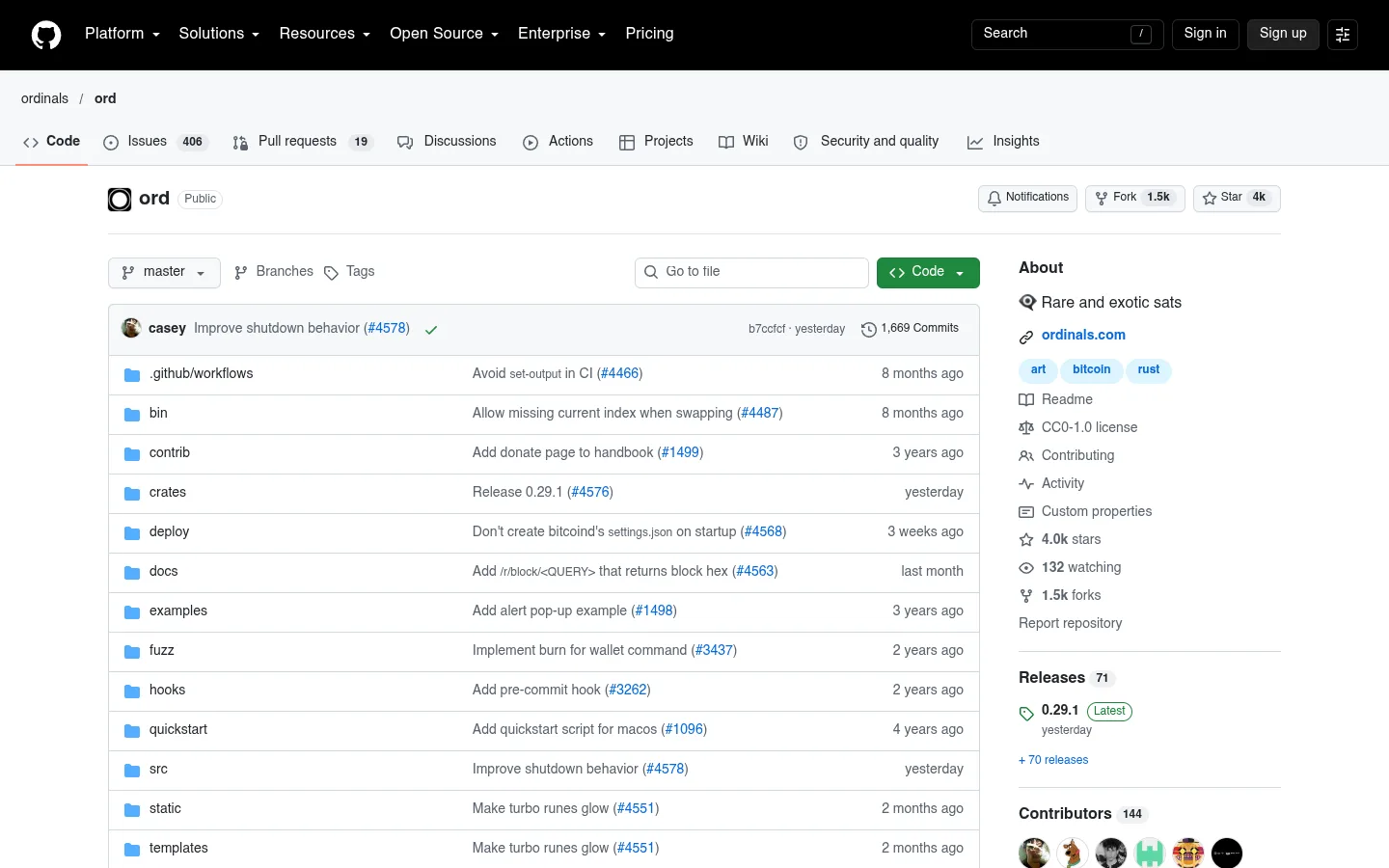
Ordinals screenshots
What users say about Ordinals
The provided posts do not discuss Ordinals or describe users’ experiences with the product. No product-specific praise or complaints can be identified.
Based on 200 Reddit posts and comments from the last 12 months, checked Oct 21, 2026. These are posts by users on other sites, not reviews submitted on CryptoReview.
User reviews
No user reviews yet. Have you used Ordinals? Share your experience below.
FAQ
Who founded Ordinals?
Ordinals was created by Casey Rodarmor, and the reference software client ord is led by maintainer raphjaph with backing from the Open Ordinals Institute.
How much does it cost to use the ord software?
The ord software is free and open source under the CC0-1.0 license. Users only pay the standard Bitcoin network transaction fees required for mining inscriptions or transfers.
Does Ordinals have an official token?
The protocol tracks and inscribes data directly onto native Bitcoin satoshis. The protocol tracks and inscribes data directly onto native Bitcoin satoshis.
Which blockchains does Ordinals support?
Ordinals exclusively supports the Bitcoin blockchain and requires a Bitcoin Core node configured with transaction indexing.
What security precautions are required when using the ord wallet?
Users must isolate wallets holding inscriptions from standard Bitcoin Core wallets because default bitcoind commands lack satoshi control and may accidentally spend inscriptions as regular fees.
Latest from Ordinals on X
Mondays, right? 🥱 https://t.co/k7zTco0Kpj

It’s time to make SHIFT happen. 🕹️
The theme for GitHub Game Off 2026 is SHIFT.
Shift gears. Shift perspectives. Shift reality. Or make a game controlled by the Shift keys. Your call.
You’ve got November to make something weird and wonderful.
https://t.co/jR269OD4JR
The theme for GitHub Game Off 2026 is SHIFT.
Shift gears. Shift perspectives. Shift reality. Or make a game controlled by the Shift keys. Your call.
You’ve got November to make something weird and wonderful.
https://t.co/jR269OD4JR
What are you adding to your #GitHubUniverse badge?
Add 3D Maze app and more here: https://t.co/6yvxhn2YBj https://t.co/42G69plnQk
Add 3D Maze app and more here: https://t.co/6yvxhn2YBj https://t.co/42G69plnQk
Halloween mode https://t.co/r9SpeJEaxu

Recent public posts from @github, shown as published. Not reviewed or endorsed by CryptoReview.
Alternatives to Ordinals

Open-source smart contract libraries and enterprise security tooling backing over $38T in transfers
Developer toolingFree tier10 chains supported

Blockchain infrastructure platform supporting 100+ chains with a free 30M-compute-unit tier
RPC / nodes · Data APIs +3Free tier100 chains supported

Managed blockchain infrastructure across 70+ chains with a free 3M-request monthly tier
RPC / nodes · IndexingFree tier70 chains supported

EVM development and simulation platform supporting transaction debugging and testing across 50+ chains
Developer toolingFree tier50 chains supported
Open-source distributed ledger foundation hosting Fabric, Besu, and Cacti under the Linux Foundation
RPC / nodes · Developer toolingFree tier2 chains supported
Blockchain infrastructure platform providing RPC nodes and data streams across 76 networks
RPC / nodes · Data APIsFree tier76 chains supported