

EY ramps up #blockchain offering with #procurement and visualisation tools.
https://t.co/tFrmxzK30t

Openledger
Embedded accounting API and financial ledger infrastructure acquired by Collective
3.0/ 5
Our score
Fair
What is Openledger?
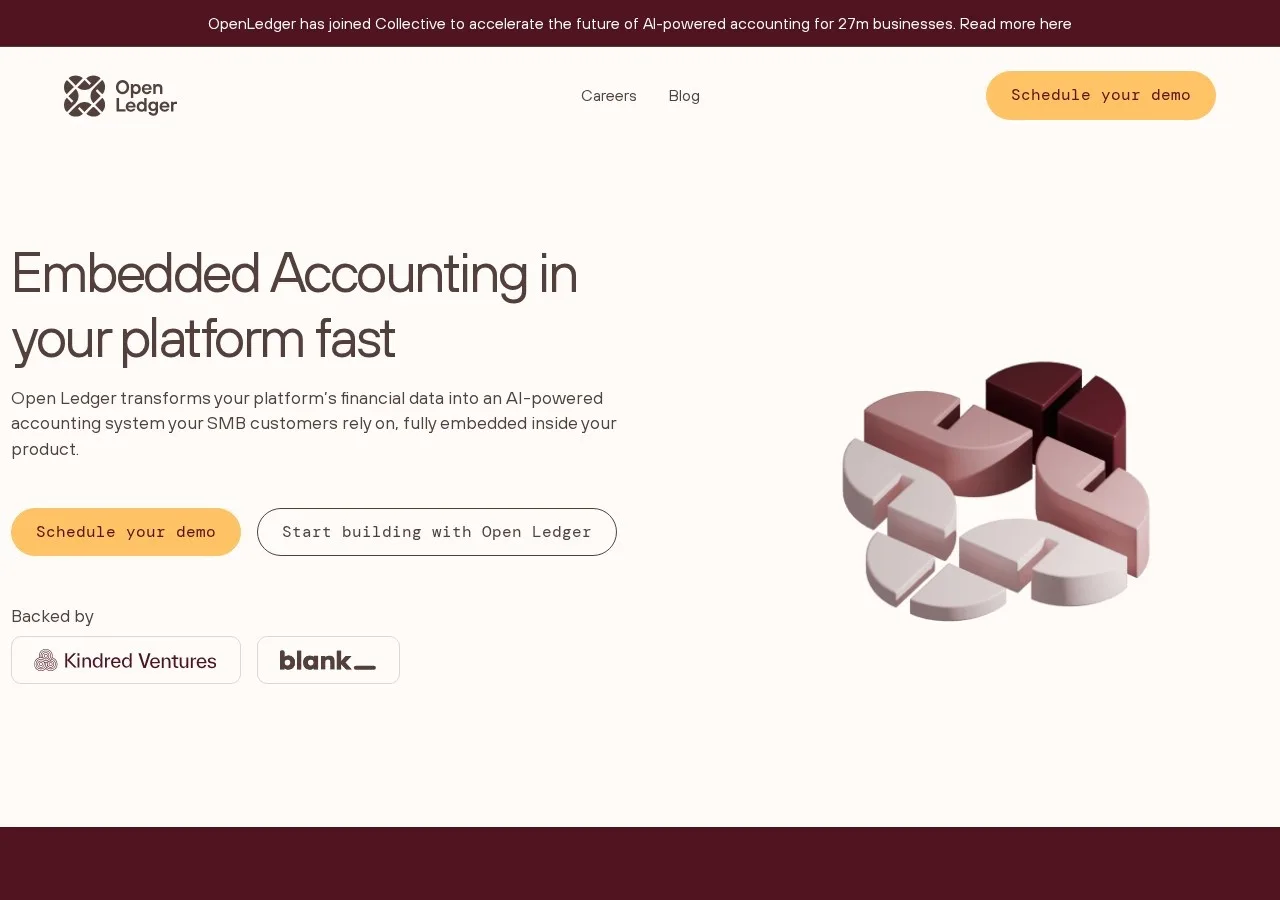
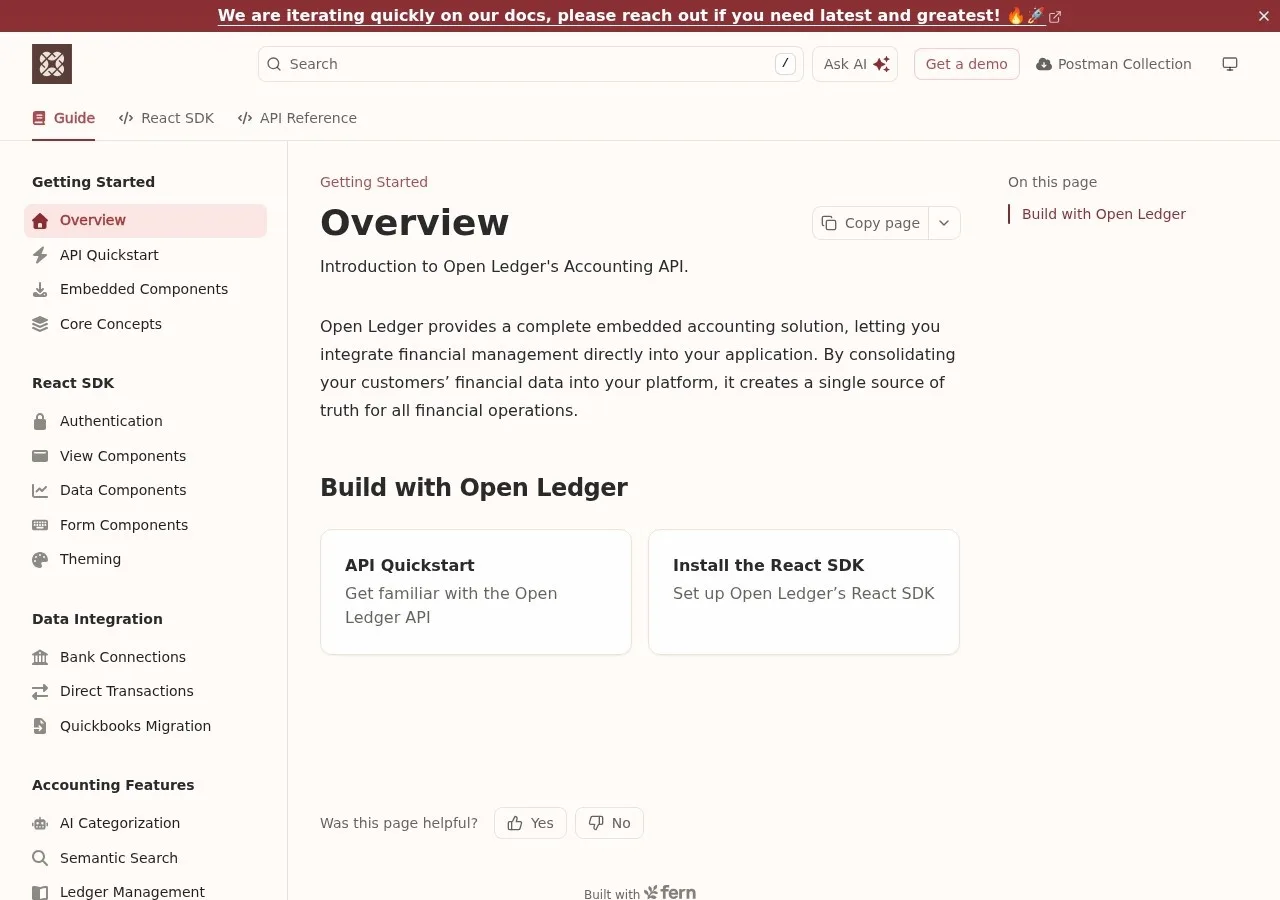
Open Ledger is a financial data and accounting infrastructure platform designed to integrate directly into third-party software products. Operating as an embedded accounting system, it lets software providers offer double-entry bookkeeping, automated transaction reconciliation, and financial reporting straight to their business customers.
Ownership and organization
Open Ledger operates under Collective, a back-office platform focused on business financial tools, which acquired the company to expand its automated accounting capabilities.
Platform architecture and core mechanics
The platform provides a modular three-tier financial architecture. At the interaction layer, developers embed pre-built NPM UI components and iframes to deliver client-facing accounting portals within their applications. The underlying data layer handles financial document processing, optical character recognition (OCR), and integrations with banking networks through Plaid, connecting with more than 12,000 banking institutions. Finally, the proprietary ledger engine manages transaction mapping, double-entry ledgers, and cashflow categorization models directly on host servers or through Open Ledger endpoints.
Integration and reporting features
Applications implement Open Ledger to handle automated bank feed synchronization, migrate historical data from QuickBooks, and create vertical-specific general ledger categories. The platform uses natural language processing models to categorize commercial transactions automatically and lets users pull ledger information via semantic search queries. In addition to programmatic ledger generation, the system prepares common business statements such as balance sheets and income reports.
Risks and technical trade-offs
Open Ledger provides centralized accounting infrastructure, with ledgers hosted on its servers or on client infrastructure. Integrating its financial stack creates platform-level dependencies on third-party aggregators such as Plaid, leaving developers exposed to external connection failures or upstream API rate restrictions.
Founders
Ronny BoesingCEO and Founder
Best for:B2B SaaS platforms embedding bookkeepingFinTech apps needing Plaid reconciliationSoftware teams replacing QuickBooks integrations
Pros and cons
Pros
- Supports bank connections across more than 12,000 banking institutions via Plaid
- Pre-built NPM components and iframes support embedded accounting interfaces
- Automates general ledger categorization through specialized accounting language models
- Native migration tools allow direct synchronization with existing QuickBooks ledgers
Cons
- Requires platform developers to manage API rate limits and external Plaid dependencies
- Tax management and tax reporting modules are not yet live on the platform
Our review
3.0/5
Fair
Open Ledger provides modular embedded accounting APIs and LLM automation for SaaS platforms, with tax management listed as coming soon.
Open Ledger develops an embedded accounting platform designed to help SaaS applications provide native bookkeeping, financial reporting, and account reconciliation. As part of Collective, the platform connects with banking aggregators such as Plaid across 12,000+ banks to ingest raw transaction data and organize it through double-entry accounting ledgers.
The service focuses on developer flexibility across three distinct architectural layers:
- An interaction layer featuring ready-made iframe integrations and NPM front-end components.
- A data processing layer combining financial optical character recognition and specialized accounting LLMs.
- A core ledger engine providing reconciliation APIs and ledger database hosting.
Developers access endpoints to manage bank connections, migrate legacy data from QuickBooks, and run automated categorization rules. The integrated LLM infrastructure allows end users to trigger semantic searches across historical financial activity and programmatically generate standard financial reports.
The platform suits B2B software vendors seeking to white-label automated bookkeeping features inside their existing client workflows.
Specs
| Services | Developer tooling, Data APIs · unverified |
|---|
Not disclosed by the provider: Chains supported, Free tier, Pricing from, Enterprise SLA, Open source, Token, Uptime SLA, Free tier limits, Server regions.
Data from the provider's website and public sources. Fees and availability change; confirm on the official site before you sign up.
Key features
Embedded UI modules
Provides iframe integrations and front-end NPM components to render accounting dashboards directly inside host applications.
Plaid bank integration
Connects with over 12,000 banking institutions to synchronize transactions and account balances programmatically.
Double-entry ledger engine
Generates double-entry accounting records, reconciles transactions, and supports hosting ledgers on internal or external servers.
QuickBooks data migration
Includes dedicated migration endpoints to import historical chart-of-accounts records and transactions from QuickBooks.
AI transaction categorization
Applies domain-specific language models to map incoming payment entries into relevant general ledger expense categories.
Semantic ledger search
Allows developers and business end-users to query historical accounting records and transactions using natural language prompts.
Inside Openledger
Interaction Layer
Provides pre-built NPM components and iframes to embed QuickBooks-style user interfaces directly into web applications.
Data Layer
Unifies incoming financial records using financial OCR tools, accounting LLM APIs, and ETL sync pipelines.
Ledger
Supplies ledger databases, reconciliation APIs, and balance tracking tools hosted on external servers or client infrastructure.
Openledger screenshots
User reviews
No user reviews yet. Have you used Openledger? Share your experience below.
FAQ
What is Open Ledger?
Open Ledger is an embedded accounting API platform that allows software companies to integrate double-entry bookkeeping, automated reconciliation, and financial reporting into SaaS products.
Who owns Open Ledger?
Open Ledger is owned by Collective, having joined the accounting company to develop AI-driven financial infrastructure.
Does Open Ledger support cryptocurrency chains?
Open Ledger focuses on traditional banking and business accounting systems rather than blockchain networks, connecting to commercial banks via Plaid.
How does Open Ledger handle transaction categorization?
Open Ledger uses accounting-focused large language models to categorize transaction records automatically according to general ledger standards.
Latest from Openledger on X
US space force enlists #blockchain firm to deploy hack-proof #datadefense.
https://t.co/M3GJ3tzXye
https://t.co/M3GJ3tzXye
Blockchain patents ‘skyrocketing’ in 2020 with Alibaba leading the way.
https://t.co/e0bGpPPQbH
#blockchain #alibaba
https://t.co/e0bGpPPQbH
#blockchain #alibaba
Blockchain applications and real-life examples in data management, describing the ways #blockchain technology can handle large data volumes. They truly impress.
Find these here 👇
https://t.co/UuQYvNXUyZ
#dlt #datamanagement
Find these here 👇
https://t.co/UuQYvNXUyZ
#dlt #datamanagement
The Total Cost of Ownership (TCO) of a vehicle is an important productivity measure for vehicle owners. Implementing #blockchain technology makes TCO indicators a valuable real-time #automotive index. 🚘
Finds more at https://t.co/RnGrA7CJXx https://t.co/NOgycFFR2N
Finds more at https://t.co/RnGrA7CJXx https://t.co/NOgycFFR2N

Recent public posts from @openledgerdc, shown as published. Not reviewed or endorsed by CryptoReview.
Alternatives to Openledger

Open-source smart contract libraries and enterprise security tooling backing over $38T in transfers
Developer toolingFree tier10 chains supported

Blockchain infrastructure platform supporting 100+ chains with a free 30M-compute-unit tier
RPC / nodes · Data APIs +3Free tier100 chains supported

Managed blockchain infrastructure across 70+ chains with a free 3M-request monthly tier
RPC / nodes · IndexingFree tier70 chains supported

EVM development and simulation platform supporting transaction debugging and testing across 50+ chains
Developer toolingFree tier50 chains supported

Open-source distributed ledger foundation hosting Fabric, Besu, and Cacti under the Linux Foundation
RPC / nodes · Developer toolingFree tier2 chains supported

Blockchain infrastructure platform providing RPC nodes and data streams across 76 networks
RPC / nodes · Data APIsFree tier76 chains supported