

KYVE has taken over the open-source IP and design stack of @useload.
This isn't just a handshake partnership; the technical overlap runs deeper than that. Load Network built a native EVM precompile (0x21) that fetches directly from KYVE's Trustless API, giving smart contracts access to permanently archived Ethereum blob data without going through oracles. KYVE infrastructure was embedded into Load's EVM execution layer. The acquisition reflects a connection that already existed at the code level.
What Load Network built is worth understanding in full. This was the highest-throughput EVM chain ever built around onchain data storage: a 2B gas limit (2 gigagas), ~125 MBps network throughput, and a sustained TPS of 60,000. To achieve permanent storage without sacrificing EVM performance, Load used Reth execution extensions to serialize each block in Borsh, compress it in Brotli, and settle it on Arweave. The result: one of the largest data protocols on Arweave by number of settled data items.
Beyond raw throughput, Load shipped something no other EVM chain had attempted, a fully bidirectional @onlyarweave data pipeline at the smart contract layer. Precompile 0x17 lets a Solidity contract upload data directly to Arweave. Precompile 0x18 reads it back. Precompile 0x20 gives smart contracts access to any historical Load block from genesis, not just the last 256. These aren't wrappers or oracle calls, they are native EVM operations. Chains like Metis, EigenLayer, and RSS3 ran on this infrastructure in production.
KYVE has spent seven years in the Arweave ecosystem building the only validation and archival layer that makes data trustless leading it to be the biggest data uploader on Arweave. Load Network spent its existence building the EVM execution layer that makes data programmable. The IP and design stack now sit under KYVE's stewardship.
To the Load Network team and community: what you built is genuinely impressive work. KYVE is glad to carry it forward.
KYVE Network
Decentralized Web3 data lake validating and archiving blockchain state to Arweave and Filecoin
3.1/ 5
Our score
Fair
Services
IndexingData APIsDeveloper tooling
Chains supported
13
Token
KYVE
What is KYVE Network?
KYVE Network is a decentralized data lake and archiving protocol built on the Cosmos SDK. The network validates, standardizes, and stores blockchain historical streams, enabling node operators and decentralized applications to query verified historical state without managing full archive nodes.
Team and foundation
KYVE Network was co-founded by CEO Fabian Riewe and CTO John Letey. The core team developed the network as an open-source decentralized protocol governed by token holders and network validators.
How data validation and storage work
The network operates via a dual-layer architecture powered by uploaders and protocol validators funded through the native KYVE token. Uploaders collect block data and snapshots from supported chains, while validators verify the accuracy of the data before it is permanently stored on decentralized storage backends like Arweave, Irys, and Filecoin Onchain Cloud. Data can be accessed through multiple interfaces: KSYNC for state-syncing Cosmos nodes, the Data Pipeline for loading validated datasets into conventional databases, a native REST interface, and a Trustless API that smart contracts can query via an EVM precompile.
Supported ecosystems and integrations
KYVE validates historical data across multiple ecosystems, including Cosmos Hub, Osmosis, Archway, Axelar, Cronos, Noble, Celestia, Avail, dYdX, Andromeda, and Ethereum blob transactions. Node operators use KYVE snapshots for block-sync and state-sync without relying on centralized snapshot services.
Track record and milestones
Following nine months of public development, KYVE deployed its mainnet on March 14, 2023. In February 2026, the network expanded its permanent storage integrations beyond Arweave by adding Filecoin Onchain Cloud. In April 2026, KYVE incorporated Load Network's open-source architecture, including an EVM precompile for smart contract access to archived Ethereum blob data.
Risks and limitations
Protocol stability and uploader operations rely directly on the economic incentives and staking mechanics of the KYVE token. Applications fetching historical datasets use decentralized storage integrations such as Arweave and Filecoin.
Founders
Fabian RieweCEO and Co-Founder
John LeteyCTO and Co-Founder
Best for:Cosmos node operators synchronizing stateDevelopers needing historical chain dataEVM teams querying archived blobsData analysts studying blockchain histories
Pros and cons
Pros
- Stores verified blockchain histories across Arweave and Filecoin
- Accelerates node startup times across supported Cosmos chains via KSYNC
- Open-source codebase with native EVM precompile integrations
Cons
- Data verification and pool maintenance depend directly on KYVE tokenomics
- Data availability relies on the long-term uptime of external storage networks
- Direct state-sync tooling is primarily focused on Cosmos SDK networks
Our review
3.1/5
Fair
KYVE provides verified, permanently archived blockchain data through open infrastructure, but its service scope and token-based network model add integration and operational complexity.
KYVE is a decentralized data infrastructure protocol built on the Cosmos SDK. Its main strength is the combination of data validation and permanent storage: uploaders and validators process blockchain data, while storage integrations include Arweave and, since February 2026, Filecoin Onchain Cloud. The network's Cosmos chain provides coordination, staking and governance through the KYVE token.
The product is broader than a single API. KSYNC can load blocks and state-sync snapshots into Cosmos nodes. Data Pipeline connects validated datasets to databases or data warehouses without code. Trustless API and REST endpoints provide access to archived node data, while Data Rollups-as-a-Service lets builders create custom data rollups. This makes KYVE relevant to applications, validators, researchers and teams that need historical data with a verification layer.
Coverage includes Cosmos, Arweave, Osmosis, Archway, Avail, Axelar, Cronos, Noble, Celestia, Ethereum, dYdX and Andromeda. The official site lists different services for different networks, such as block-sync and state-sync, so the chain count does not mean every integration supports the same access method.
KYVE launched its mainnet on March 14, 2023, after nine months of development. Fabian Riewe serves as CEO, while John Letey is CTO; both are co-founders. The protocol is open-source and permissionless. The KYVE token also links service participation and governance to token economics.
Two strengths stand out: several access methods cover both node synchronization and application data, and permanent storage gives historical datasets a longer-lived retrieval path. KYVE suits teams building data rollups or archived-data applications.
Specs
| Services | Indexing, Data APIs, Developer tooling · unverified |
|---|---|
| Chains supported | 13 · unverified |
| Open source | Yes · unverified |
| Token | KYVE · unverified |
Not disclosed by the provider: Free tier, Pricing from, Enterprise SLA, Uptime SLA, Free tier limits, Server regions.
Data from the provider's website and public sources. Fees and availability change; confirm on the official site before you sign up.
Key features
KSYNC node synchronization
Transfers validated chain blocks and state snapshots into Cosmos nodes.
Decentralized storage backends
Permanently archives verified blockchain data to decentralized storage providers including Arweave, Irys, and Filecoin.
Data Pipeline warehouse export
Streams and loads validated datasets from supported blockchains directly into developer databases and data warehouses.
Trustless API access
Provides querying endpoints and EVM precompiles for smart contracts and applications to retrieve verified historical chain data.
Data rollups-as-a-service
Enables decentralized applications and rollups to deploy custom data pipelines with validated data.
Ethereum blob archiving
Validates and permanently stores Ethereum blob data for historical analysis.
Inside KYVE Network
KSYNC
KSYNC syncs blocks and state-sync snapshots from the KYVE data lake directly into Cosmos blockchain nodes.
Data Pipeline
Data Pipeline loads validated KYVE data from supported blockchains into a preferred database or data warehouse without code.
Trustless API
Trustless API provides application access to verified historical node data.
REST
REST provides endpoint-based access to data stored through KYVE.
Data Directory
Data Directory lets users search supported data sources and find relevant stored datasets.
Data Rollups-as-a-Service (DRaaS)
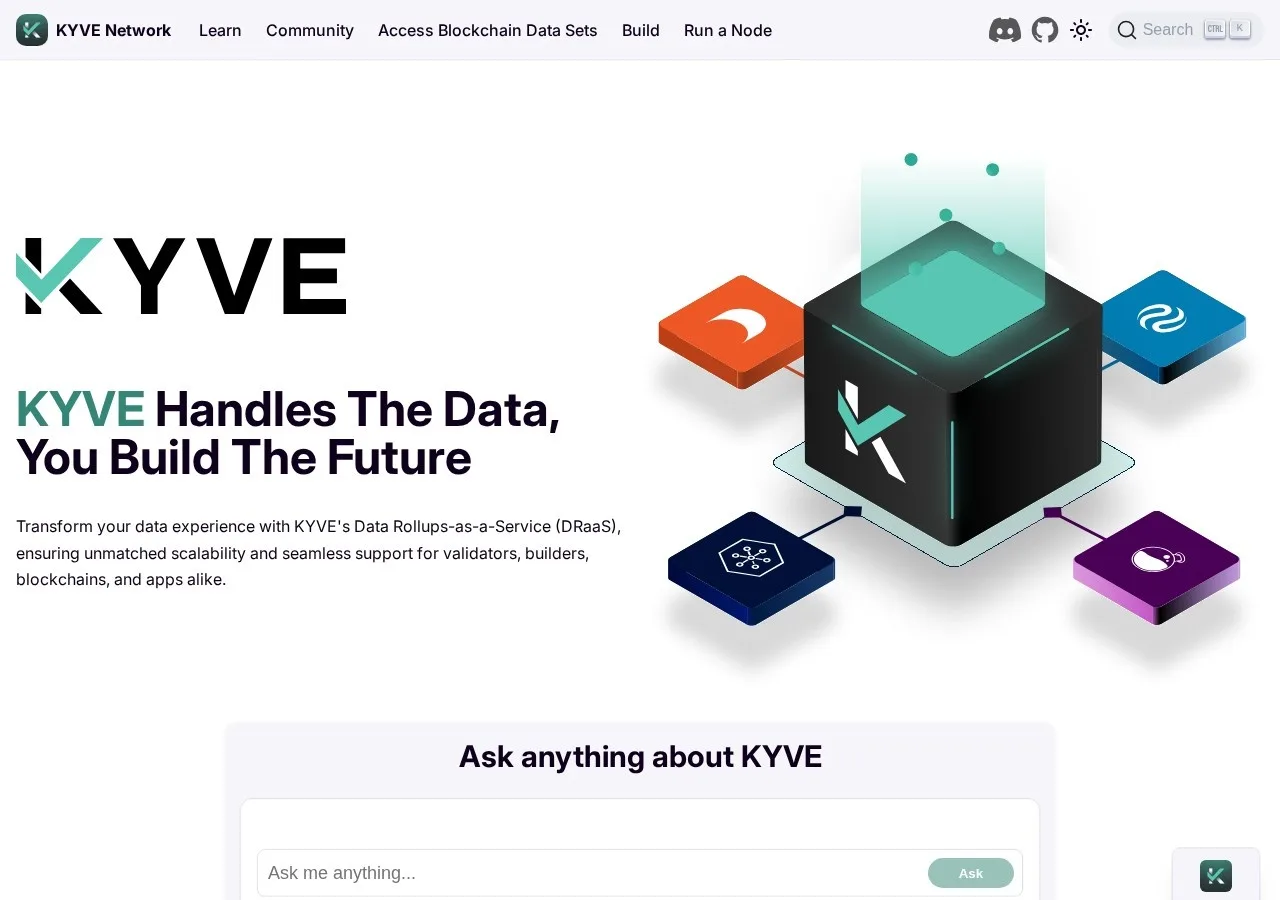
DRaaS lets builders create custom data rollups powered by KYVE, with data validation handled through the network.
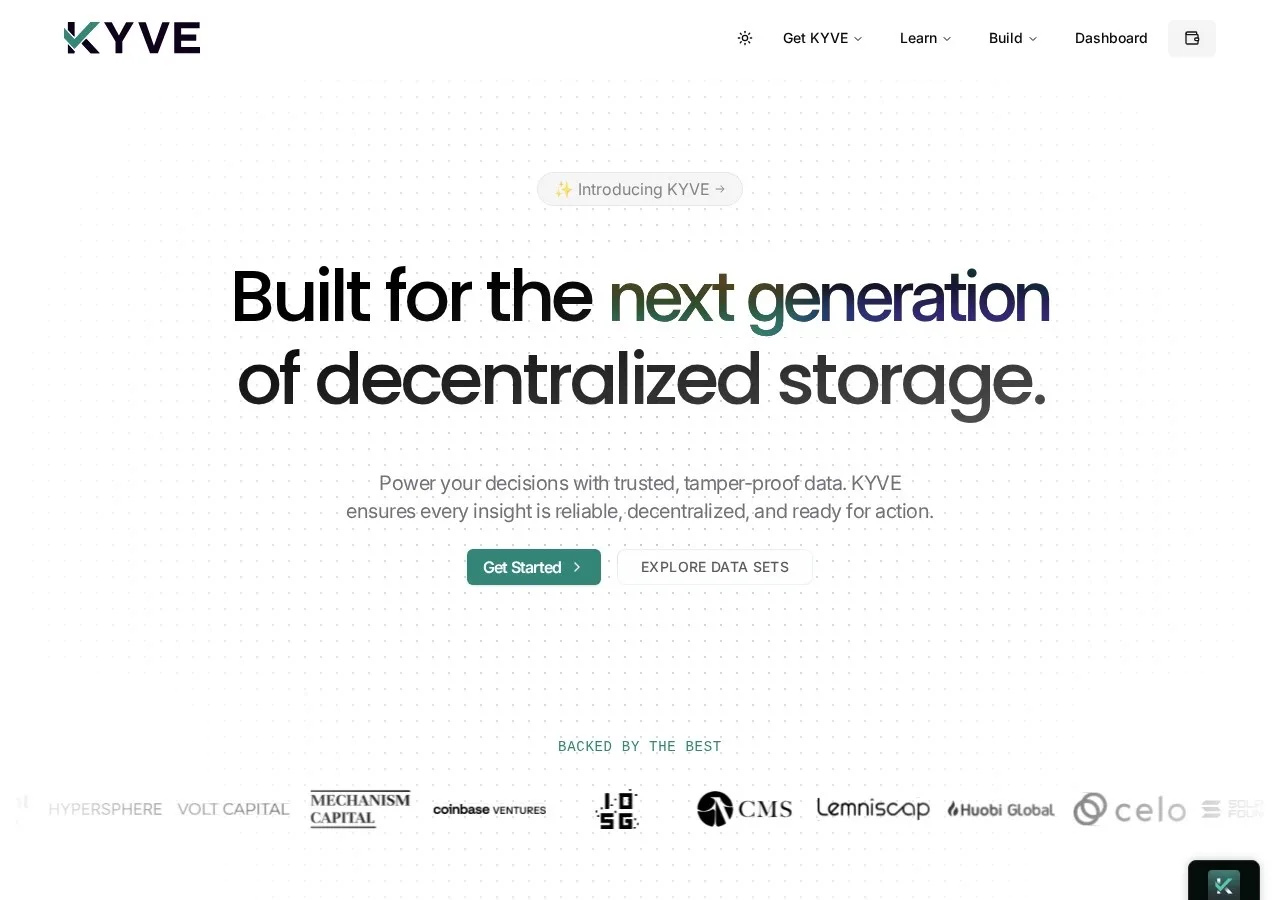
KYVE Network screenshots
What users say about KYVE Network
There is not enough user feedback to establish common themes or a balance of opinion. The provided posts only detail governance proposals from a single author.
Based on 2 Reddit posts and comments from the last 12 months, checked Oct 21, 2026. These are posts by users on other sites, not reviews submitted on CryptoReview.
User reviews
No user reviews yet. Have you used KYVE Network? Share your experience below.
FAQ
Who founded KYVE Network?
Fabian Riewe is the CEO and Co-Founder, and John Letey is the CTO and Co-Founder.
Is KYVE Network available worldwide?
KYVE is described as a global, open-source protocol with permissionless participation. Its network includes validators, uploaders and token holders.
Does KYVE Network have a token?
Yes, its token is KYVE. Token holders can stake to help secure the network and participate in governance.
Which chains does KYVE support?
KYVE lists Cosmos, Arweave, Osmosis, Archway, Avail, Axelar, Cronos, Noble, Celestia, Ethereum, dYdX and Andromeda. Available functions differ by network, including block-sync, state-sync and Ethereum blob data.
How does KYVE store and verify blockchain data?
KYVE uses uploaders and validators to process and validate data, then stores it through permanent-storage integrations such as Arweave and Filecoin Onchain Cloud.
What tools does KYVE offer for blockchain data?
KSYNC loads blocks and state-sync snapshots into Cosmos nodes, while Data Pipeline connects validated datasets to databases or data warehouses. Trustless API and REST provide application access to archived data.
Latest from KYVE Network on X
when you realize the data you built everything on… was never verified. https://t.co/j9lnfJyRxQ

Like many protocols, we've been navigating the growing challenges of maintaining a secure and high-quality environment on Discord, scam activity, bots, and noise have become harder to manage industry-wide. Rather than shut things down completely, we want to give our community a chance to shape what comes next.
We'll be consolidating activity to #general and #announcements only.
We'll be consolidating activity to #general and #announcements only.

Checking the archives... Pretty sure it's not one of the chains we've validated.
https://t.co/OcArEGCpgi

Recent public posts from @KYVENetwork, shown as published. Not reviewed or endorsed by CryptoReview.
Alternatives to KYVE Network

Open-source smart contract libraries and enterprise security tooling backing over $38T in transfers
Developer toolingFree tier10 chains supported

Blockchain infrastructure platform supporting 100+ chains with a free 30M-compute-unit tier
RPC / nodes · Data APIs +3Free tier100 chains supported

Managed blockchain infrastructure across 70+ chains with a free 3M-request monthly tier
RPC / nodes · IndexingFree tier70 chains supported

EVM development and simulation platform supporting transaction debugging and testing across 50+ chains
Developer toolingFree tier50 chains supported

Open-source distributed ledger foundation hosting Fabric, Besu, and Cacti under the Linux Foundation
RPC / nodes · Developer toolingFree tier2 chains supported

Blockchain infrastructure platform providing RPC nodes and data streams across 76 networks
RPC / nodes · Data APIsFree tier76 chains supported