
Open-source smart contract libraries and enterprise security tooling backing over $38T in transfers
Developer toolingFree tier10 chains supported

Open-source developer platform and CLI for scaffolding Cosmos SDK blockchains with IBC connectivity
Ignite is an open-source developer framework designed to scaffold, configure, and launch sovereign, application-specific blockchains built on the Cosmos SDK. Originally launched as Starport in 2020 before rebranding alongside the historic Tendermint organization, the platform reduces the friction of spinning up custom distributed networks by managing boilerplate code generation, configuration files, and inter-blockchain communication.
The company behind the project trace their roots to the foundational development of Tendermint and Cosmos. Jae Kwon serves as chief executive officer and founder, alongside co-founder Ethan Buchman. The team also includes Chjango Unchained as director of community. Ignite's tooling is the foundation for decentralized networks across the Cosmos ecosystem, including Osmosis, Juno, Stargaze, Crypto.org, KYVE, and Sifchain.
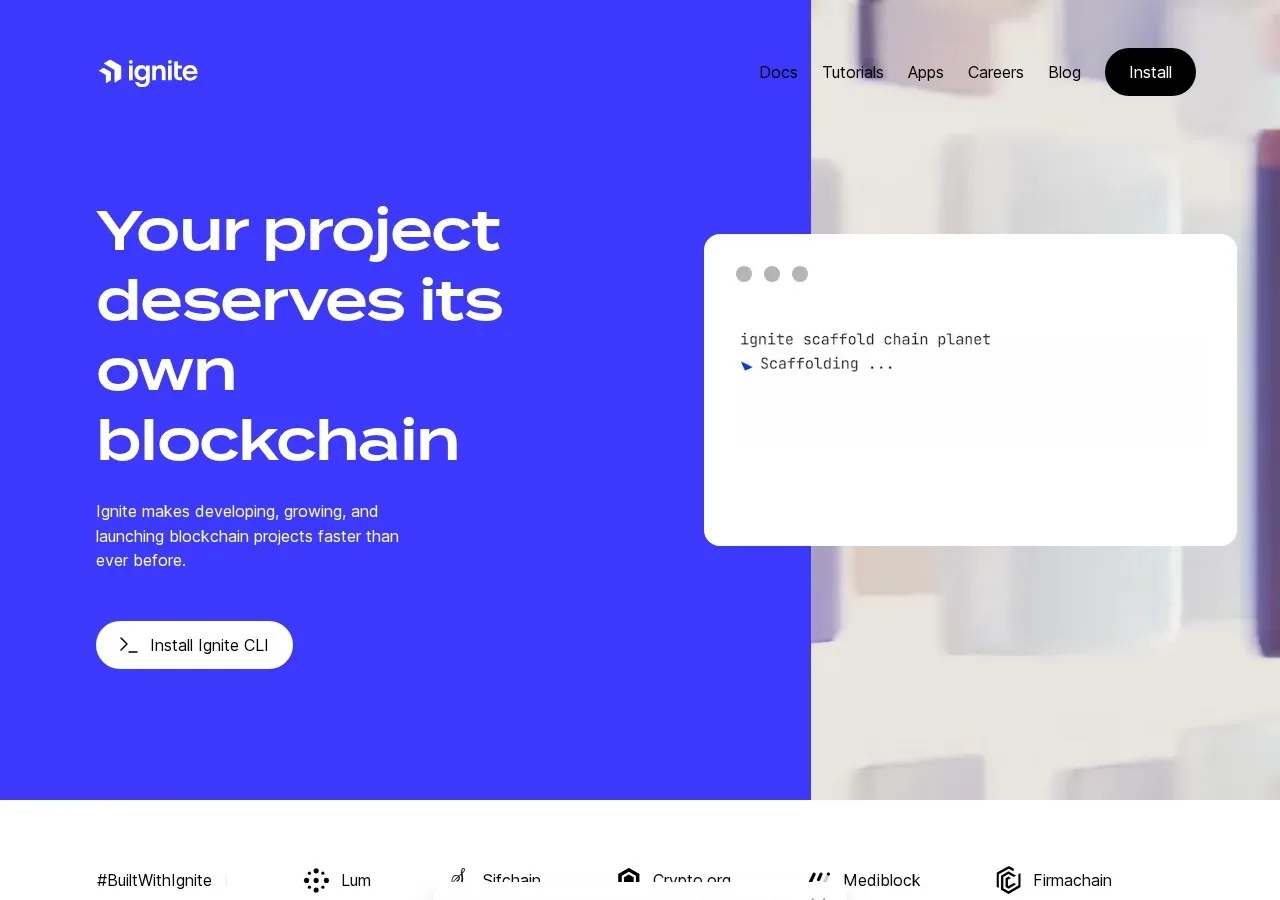
The platform centers on Ignite CLI, a terminal-based utility installed locally via a shell binary or run in web-based developer environments. Ignite CLI automates the creation of Cosmos SDK state modules and node scaffolding from a single declarative configuration file. Developers can configure faucets, manage validator accounts, and run a hot-reloading development server that recompiles code on save while the test chain remains active. In addition, it auto-generates TypeScript clients for front-end integration and includes native Inter-Blockchain Communication (IBC) configurations for direct cross-chain asset transfers and contract messaging.
Ignite CLI and its core scaffolding repositories are open source and freely accessible globally, without requiring account registration or licensing fees for individual builders. To expand the native command palette, the platform supports Ignite Apps. Contributors can build and distribute plug-in extensions for custom development workflows.
While Ignite accelerates early development, its ecosystem is tightly coupled to the Cosmos SDK and CometBFT architecture. This focus makes it unsuitable for teams targeting alternative settlement layers like Ethereum rollups or Substrate runtimes without separate tooling. Because developers remain fully responsible for bootstrapping their own sovereign validator networks and consensus security, teams face standard decentralized infrastructure trade-offs such as validator centralization risks and sovereign governance burdens.
Ignite delivers fast, turnkey scaffolding for Cosmos SDK blockchains, but its focus is tied directly to the Cosmos stack rather than general-purpose multi-chain infrastructure.
Ignite provides developer tooling centered on Ignite CLI, a suite designed to scaffold, test, and run sovereign blockchains. Originally launched as Starport in 2020 by Tendermint co-founders Jae Kwon and Ethan Buchman, the project rebranded to Ignite to anchor Cosmos-native chain development. It eliminates repetitive boilerplate by generating Cosmos SDK modules and configuration files from single terminal commands.
Developer experience is the platform's primary strength. A built-in local development server provides hot reloading, automatically compiling code and spinning up local nodes whenever files change. Ignite also generates TypeScript client libraries for both standard and custom modules, letting frontend developers build client interfaces alongside chain logic without manual API mapping. Built-in integration with the Inter-Blockchain Communication (IBC) protocol ensures that newly created networks connect out of the box to other Cosmos chains. Independent networks including Osmosis, Juno, Stargaze, Crypto.org, and KYVE have built chains using the framework.
The product carries clear trade-offs. Ignite is developer tooling rather than a managed infrastructure provider; it does not offer hosted RPC endpoints or managed validator node clusters with service-level agreements. Teams looking for managed RPC nodes or commercial uptime guarantees must deploy third-party infrastructure. The toolset is also focused entirely on Cosmos SDK architecture, providing no native support for EVM rollups, Solana programs, or Substrate runtimes unless bridged through Cosmos modules.
Ignite suits engineering teams building sovereign Layer 1 blockchains or application-specific chains within the Cosmos ecosystem who need rapid prototyping and native IBC interoperability. Teams seeking fully managed RPC networks or tools for non-Cosmos networks should look to general infrastructure platforms.
| Services | Developer tooling · unverified |
|---|---|
| Free tier | Yes · unverified |
| Open source | Yes · unverified |
Not disclosed by the provider: Chains supported, Pricing from, Enterprise SLA, Token, Uptime SLA, Free tier limits, Server regions.
Data from the provider's website and public sources. Fees and availability change; confirm on the official site before you sign up.
Generates complete Cosmos SDK boilerplate code, transaction handlers, and state modules using single terminal commands.
Recompiles Go code, regenerates Protobuf interfaces, and updates genesis blocks instantly as source files change on a running test node.
Integrates preconfigured Inter-Blockchain Communication protocol packets to enable cross-chain token transfers and remote data calls.
Defines validator parameters, accounts, token denominations, and test faucets within a single readable config file.
Produces client libraries for standard and custom modules to streamline front-end application integration.
Supports modular extensions and community plug-ins that expand the default command palette for specialized build pipelines.
The core command-line tool that scaffolds Cosmos SDK chains, generates boilerplate code, and manages local development with hot reloading.
A modular extension system that developers can build and install to add custom commands and functionality to the Ignite CLI palette.
A guided documentation portal containing step-by-step guides for building custom modules, cross-chain DeFi applications, and IBC packet routing.
No user reviews yet. Have you used Ignite? Share your experience below.
Ignite is an open-source blockchain development platform and command-line interface designed to scaffold, configure, and launch sovereign Cosmos SDK blockchains with native IBC interoperability.
Ignite was established by Tendermint co-founders Jae Kwon and Ethan Buchman, originating as the Starport developer tool in 2020 before rebranding to Ignite.
Ignite CLI is free, open-source software available via a single-line terminal command, with no platform usage fees or subscription tiers.
Ignite builds application-specific Layer 1 blockchains based on the Cosmos SDK, supporting native connectivity to other networks through the Inter-Blockchain Communication protocol.
No, Ignite provides command-line developer tooling and local testing environments rather than hosted enterprise RPC endpoints, managed node clusters, or uptime SLAs.
Open-source smart contract libraries and enterprise security tooling backing over $38T in transfers
Blockchain infrastructure platform supporting 100+ chains with a free 30M-compute-unit tier
Managed blockchain infrastructure across 70+ chains with a free 3M-request monthly tier
EVM development and simulation platform supporting transaction debugging and testing across 50+ chains
Open-source distributed ledger foundation hosting Fabric, Besu, and Cacti under the Linux Foundation
Blockchain infrastructure platform providing RPC nodes and data streams across 76 networks
Type at least two characters. Press ↵ to see all results.