Human Protocol

Decentralized labor and data annotation protocol coordinating AI tasks with automated on-chain escrow

Our score
Fair
Services OracleDeveloper tooling
Token HMT

What is Human Protocol?

HUMAN Protocol is a decentralized infrastructure network designed to coordinate, validate, and reward distributed work tasks for artificial intelligence models. Operating through smart contract escrows and specialized oracles, the protocol enables task requesters to launch data labeling and annotation jobs while distributing programmatic payments to independent workers.

Team and core contributors

The project is developed by an international team that includes Andreas Schemm, who leads ecosystem and operations, and Maxime Sebti, who serves as growth director. Protocol development also draws on design contributions from Alex Newman along with solutions architects Jalal Hannan and Adrian Portugues, operating across distributed engineering hubs.

Task coordination and oracle architecture

Work launched through HUMAN Protocol relies on automated smart contract workflows. Requesters define task specifications and fund an escrow smart contract using the native HMT utility token. Tasks are broken into micro-units and routed to contributors through applications like the HUMAN App or integrated third-party platforms such as CVAT and Audino.

Network verification relies on three distinct oracle types: Exchange Oracles, Recording Oracles, and Reputation Oracles. These components manage task routing, record completed submissions, and cryptographically score accuracy. Oracle operators must stake HMT to participate in job processing and risk having their staked tokens slashed if they misbehave or validate inaccurate work. Workers may also stake HMT to unlock priority access to higher-paying or specialized tasks.

Usage milestones and token governance

By January 2026, network activity had reached over 26.9 billion recorded tasks across 29.6 million on-chain transactions and 977,000 unique receiving addresses. In June 2026, the protocol initiated a governance token burn framework comprising an immediate 500 million HMT burn alongside an ongoing protocol burn mechanism deducting 5% of all task reward payouts based on network usage.

Operational trade-offs and risks

Using HUMAN Protocol entails specific operational trade-offs typical of decentralized coordination platforms. Reward disbursements and staking security depend strictly on the HMT token, exposing participants to token price fluctuations. Geographic restrictions also prevent access to HMT in multiple jurisdictions. Furthermore, relying on independent oracle operators introduces validator centralization risk if staking participation remains concentrated among limited operators.


Founders

Andreas SchemmEcosystem and Operations Director
Maxime SebtiGrowth Director
Best for:AI teams outsourcing data annotationDevelopers building decentralized labor appsOperators running oracle infrastructure

Pros and cons

Pros

  • Open-source smart contract and oracle infrastructure for custom task types
  • Recorded over 26.9 billion tasks and 29.6 million transactions by January 2026
  • Automated escrow ensures workers receive programmatic payouts upon task validation
  • Staking and slashing mechanisms enforce accountability across oracle operators

Cons

  • The native HMT token is geographically restricted in several countries
  • Task rewards and staking yields depend on the market volatility of HMT
  • Validation accuracy relies on the performance and honest consensus of oracle operators

Our review

3.3/5
Fair

Human Protocol offers decentralized, oracle-validated coordination for AI data labeling, but participation requires staking the native HMT token, which faces geographic availability restrictions.

Reliability3.5
Chain coverage3.0
Pricing3.0
Developer experience4.0
Support3.0

Human Protocol provides open-source decentralized infrastructure designed to coordinate, validate, and compensate distributed human work, with a primary focus on artificial intelligence data labeling and model training. Requesters post jobs using smart contract escrows via the Job Launcher, while distributed oracles allocate tasks and release automated payouts. As of January 2026, network activity logged 26.9B tasks, 29.6M transactions, and 977,000 unique reward receivers across its ecosystem.

The system relies on specialized oracles, including Exchange Oracles, Recording Oracles, and Reputation Oracles. These components automate task distribution and cryptographic validation so requesters only pay for completed, quality-verified work. Integrations include open-source annotation platforms like CVAT and academic collaborations such as pose-tracking tests with the Salk Institute. The entire stack is supported by developer SDKs, smart contracts, and open-source APIs.

A central trade-off is the protocol's reliance on its native utility token, HMT. Both oracle operators and workers stake HMT to qualify for assignments and establish reputation. Staked operators face slashing penalties for inaccurate task validation. Token access is also subject to geographic restrictions, preventing users in certain jurisdictions from participating directly.

The platform suits engineering teams needing programmatic, decentralized data annotation pipelines and developers looking to run work-verification oracles. Teams seeking traditional fiat-denominated data crowdsourcing or enterprise setups requiring fixed uptime SLAs and private worker pools will find general Web2 annotation platforms a better fit.

Listings are researched and drafted with AI assistance from public sources, then checked for accuracy and readability. Spot an error? Tell us. Editorial policy.
Sources (3)

Specs

Services Oracle, Developer tooling · unverified
Open source Yes · unverified
Token HMT · unverified

Not disclosed by the provider: Chains supported, Free tier, Pricing from, Enterprise SLA, Uptime SLA, Free tier limits, Server regions.

Data from the provider's website and public sources. Fees and availability change; confirm on the official site before you sign up.

Key features

Smart contract escrow

Locks requester funds on-chain and automatically distributes compensation to contributors once task requirements are met.

Decentralized oracle verification

Routes tasks and validates submissions through Exchange, Recording, and Reputation Oracles using cryptographic proofs.

Operator and worker staking

Requires oracle operators to stake HMT to process jobs under threat of slashing, while allowing workers to stake for early access to tasks.

Open-source developer SDKs

Provides SDKs, APIs, and smart contract primitives to integrate decentralized work pools into third-party machine learning applications.

HUMAN App integration

Connects individual contributors directly to data annotation, image classification, and AI training micro-tasks.

Inside Human Protocol

Build

The developer infrastructure layer offering open-source SDKs, APIs, and smart contract frameworks to deploy decentralized work applications and operate oracles.

Work & Earn

The participant interface where contributors complete data annotation and AI training tasks through the HUMAN App to build reputation and earn HMT rewards.

Launch Jobs

The requester portal enabling businesses to post tasks on-chain using smart contract escrows, verify incoming submissions via distributed oracles, and automate payouts.

Human Protocol screenshots

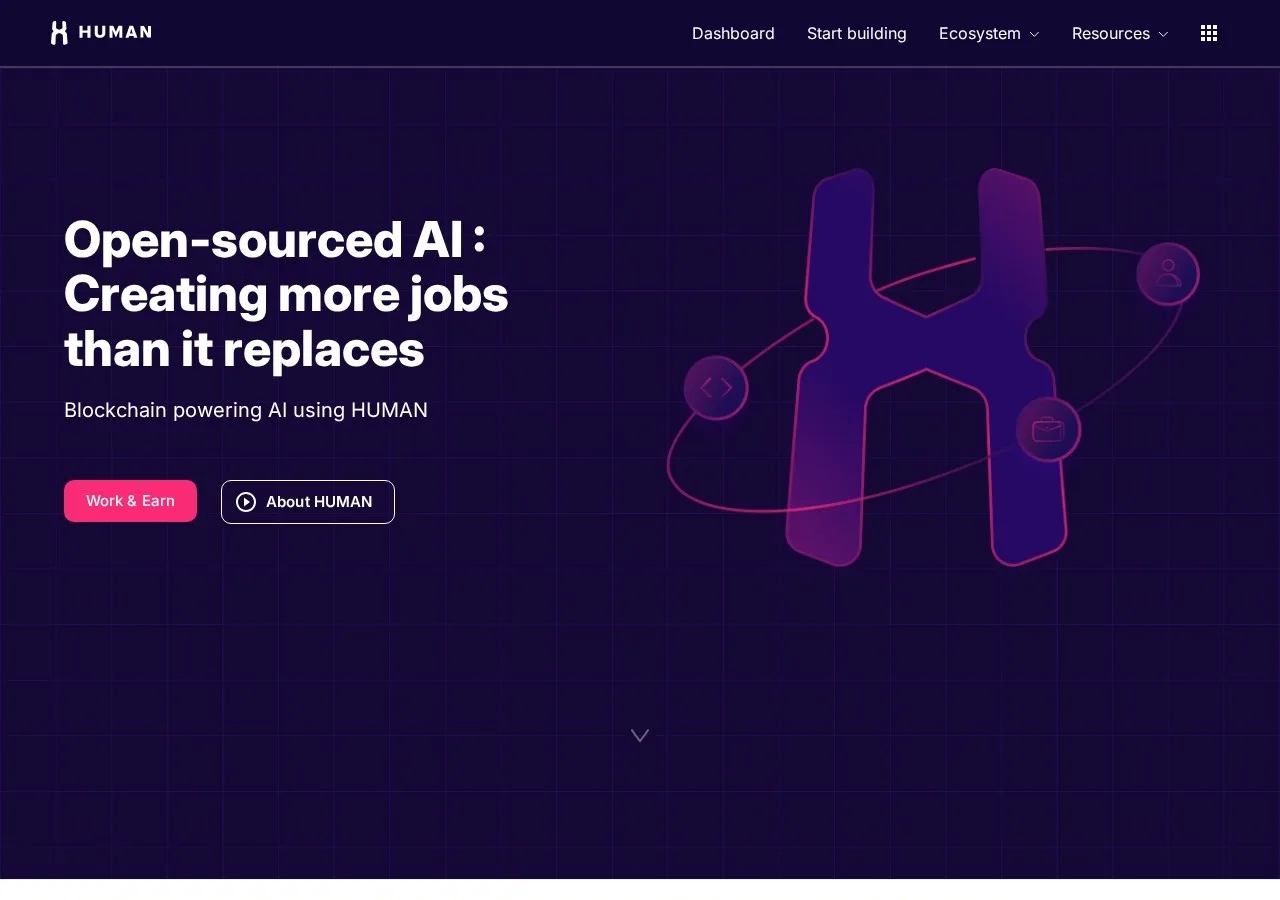
Human Protocol homepage with navigation, an AI-focused headline, description, and action buttons
Human Protocol homepage with navigation, an AI-focused headline, description, and action buttons · Oct 21, 2026
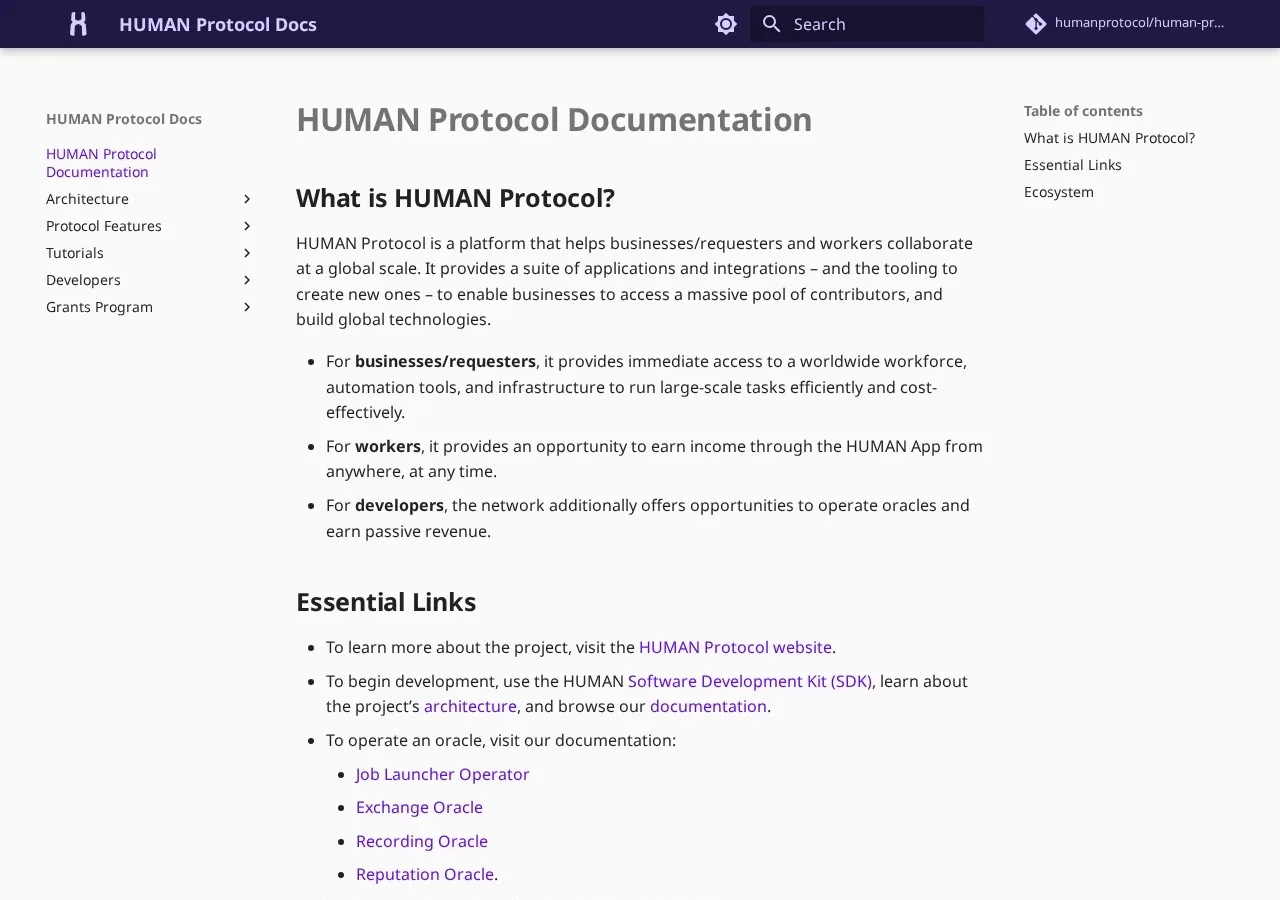
Docs: HUMAN Protocol documentation page describing the protocol, its participants, and essential links
Docs: HUMAN Protocol documentation page describing the protocol, its participants, and essential links · Oct 21, 2026

User reviews

No user reviews yet. Have you used Human Protocol? Share your experience below.

Write a review of Human Protocol

Your rating
At least 40 characters. Please write about your own experience.

Reviews are moderated before they appear.

FAQ

Who founded Human Protocol?

Human Protocol is led by Ecosystem and Operations Director Andreas Schemm and Growth Director Maxime Sebti, alongside a distributed engineering team.

Does Human Protocol have a token?

Yes, Human Protocol operates using its native utility token, HMT. The token is used for smart contract escrow payouts, oracle operator staking, slashing penalties, and worker reputation.

How does validation work on Human Protocol?

Work validation is automated through a network of specialized oracles, including Recording and Reputation Oracles. Operators stake HMT to qualify for processing tasks, verify submissions using cryptographic proofs, and risk slashing if they misbehave.

Is Human Protocol available globally?

No, HMT token transactions and certain platform features are geographically restricted in specific jurisdictions according to the protocol website.

What tasks can be processed on Human Protocol?

The network primarily processes machine learning data labeling and image or video annotation via tools like CVAT.

Latest from Human Protocol on X

HUMAN Protocol 🧬
@human_protocol · 51.2K followers
Follow
🗳 Two HMT burn phases

🗓 June 5, 2026 at 11:01 AM GMT+3
📌 Phas 1: Immediate Burn
Up to 500M HMT (50% of 1B) to be permanently burned via 0x000...dEaD address. Burn tx will be publicly shared right after confirmation.
📌 Phas 2: Protocol Burn
Up to 250M HMT allocated for long-term burns. Includes 5% burn on all reward payouts, fully driven by on-chain protocol activity.

Vote here 👇
https://t.co/z3VOKNLHlE

#HMT #ai #Burn
Image attached to the post
3 4 13 3.7K View on X
A great deep dive into how AI, distributed work, and blockchain infrastructure are reshaping the future of digital labor.
This post explains why transparent and decentralized coordination layers like HUMAN Protocol matter more than ever in the AI era 👇

https://t.co/I6I3HX6Skg https://t.co/HnTJ4ecvti
Image attached to the post
7 4 15 3.9K View on X
Same dataset. Same setup.
Very different results. 🫆

In 2025, Google Cloud Vision flagged ~3% of images.
In 2026, it flagged ~79% — with 435 false positives.
What changed?
A closer look at how automated moderation signals behave over time 👇

https://t.co/Ak946sOgrg https://t.co/rzmf166mqQ
Image attached to the post
35 4 11 4.3K View on X
🚨 HuFi Campaign Is LIVE 🚨

New opportunity just dropped. Early users always win 👇
🔥 Join now
👉 https://t.co/R9TjuIY9rk⁠
7 5 18 3.7K View on X
Most AI breakthroughs don’t come from new models.
They come from better data. 💫

A great perspective on why data quality and annotation infrastructure matter more than people think.

Worth the read 👇

https://t.co/FKcOqzu4Vm
Image attached to the post
9 8 41 3.1K View on X

Recent public posts from @human_protocol, shown as published. Not reviewed or endorsed by CryptoReview.

Alternatives to Human Protocol

Open-source smart contract libraries and enterprise security tooling backing over $38T in transfers

Developer toolingFree tier10 chains supported
4.5

Blockchain infrastructure platform supporting 100+ chains with a free 30M-compute-unit tier

RPC / nodes · Data APIs +3Free tier100 chains supported
4.3

Managed blockchain infrastructure across 70+ chains with a free 3M-request monthly tier

RPC / nodes · IndexingFree tier70 chains supported
4.3

EVM development and simulation platform supporting transaction debugging and testing across 50+ chains

Developer toolingFree tier50 chains supported
4.3

Open-source distributed ledger foundation hosting Fabric, Besu, and Cacti under the Linux Foundation

RPC / nodes · Developer toolingFree tier2 chains supported
4.2

Blockchain infrastructure platform providing RPC nodes and data streams across 76 networks

RPC / nodes · Data APIsFree tier76 chains supported
4.2