


Turbo Relayer is live: the fastest gasless infrastructure available.
→ Sub-300ms transaction confirmations
→ Up to 20x faster execution
→ 30-90 % lower gas overhead
Powering gasless UX for @inkonchain @avantisfi @GMX_IO @rainbowdotme @safe @chaoslabs @everclearorg @imtokenofficial @gnosispay @lifiprotocol @jumperapp @infinex @Gemini Wallet.
Read more: https://t.co/lMsVKKrZDT

Gelato
Web3 infrastructure and rollup platform powering account abstraction and custom chains across 100+ networks
3.8/ 5
Our score
Good
Services
Account abstractionDeveloper tooling
Chains supported
100
Token
GEL
What is Gelato?
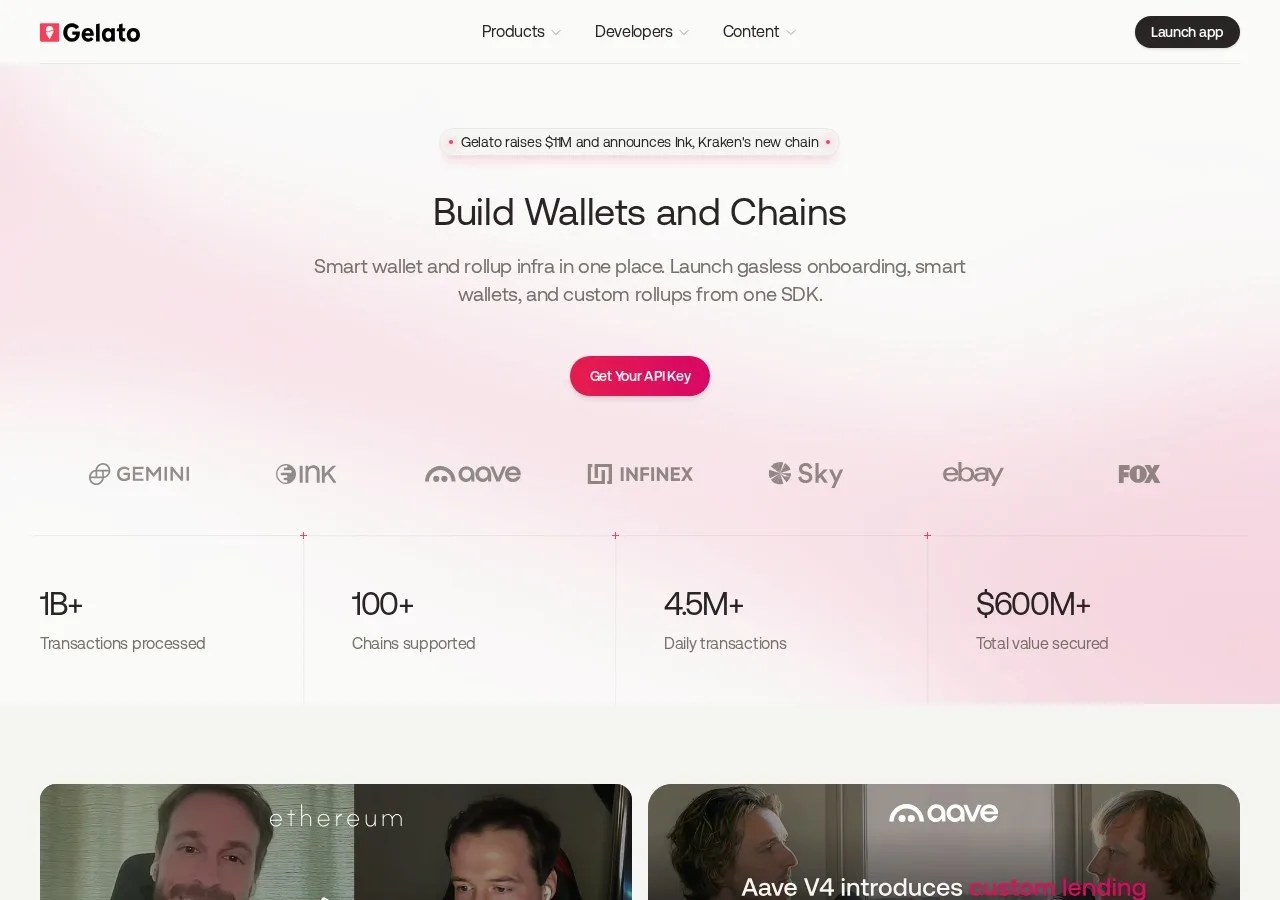
Gelato is a Web3 infrastructure and Rollup-as-a-Service (RaaS) platform providing smart wallet infrastructure, paymasters, bundlers, and custom Layer 2 chain deployment across more than 100 blockchains. The platform has processed over 1 billion transactions and secures more than $600M in total value.
Company background and funding
Founded in 2019 and headquartered in Zug, Switzerland, Gelato operates with a team of around 64 employees. The project has raised $23.2M in total funding across multiple rounds. Investors include Hack VC, Dragonfly Capital, Galaxy Digital, and IOSG Ventures. In September 2020, Gelato completed a $1.2M seed round led by IOSG Ventures and Galaxy Digital, followed by an $11M Series A led by Dragonfly Capital in September 2021. In October 2024, the team raised an $11M Series A extension led by Hack VC alongside announcing its infrastructure partnership for Kraken's Layer 2 network, Ink.
Core services and architecture
Gelato provides developer tools centered on transaction abstraction and chain deployment. Its account abstraction stack includes ERC-4337 and EIP-7702 paymasters and bundlers, enabling applications to sponsor user gas fees or accept fee payments in arbitrary ERC-20 tokens. Relaying tooling such as Turbo Relayer supports sub-300ms confirmation times with pre-confirmations on compatible networks like Ink. Through its Rollup-as-a-Service suite, developers can launch Based, ZK, and optimistic rollups using modular execution frameworks and data availability layers such as Celestia.
Track record and ecosystem adoption
Following its initial GEL token launch in September 2021, Gelato expanded its infrastructure across ecosystems including Ethereum, Arbitrum, Optimism, Base, and Polygon. Over 4.5 million daily transactions route through its systems. Gelato serves as the core rollup infrastructure provider behind Kraken's Ink chain, which exceeded $100M in total value locked and 70 million transactions within its launch cycle. Applications such as Avantis, Rainbow, Infinex, and MegaETH use Gelato for sponsored gas, airdrop distributions, and account abstraction flows.
Operational risks and trade-offs
Using Gelato involves outsourcing relayer and rollup operations to a specialized third-party provider, creating reliance on Gelato's infrastructure availability. Outages or latency spikes in bundler networks can delay user transactions or gas sponsorships. Projects launching custom rollups through managed providers also face potential vendor lock-in if migrating off proprietary orchestration stacks, while token-governed components linked to the GEL utility token can introduce governance or economic interdependencies.
Founders
Hilmar OrthCo-founder
Luis SchliesskeCo-founder
Best for:Dapp developers implementing gasless onboardingProtocols deploying custom Layer 2 rollupsTeams needing ERC-4337 paymaster infrastructure
Pros and cons
Pros
- Processed over 1 billion transactions across more than 100 supported chains
- Powers Kraken's Ink Layer 2 network with $100M+ in TVL
- Provides native support for both ERC-4337 and EIP-7702 account abstraction
- Backed by $23.2M in funding from Dragonfly Capital and Hack VC
- Processes more than 4.5 million daily transactions across integrated protocols
Cons
- Dapp transaction flows depend directly on Gelato relayer and paymaster uptime
- Proprietary rollup tooling creates potential migration friction away from the platform
- GEL governance token creates exposure to platform token economics
- Pricing tiers and enterprise SLA terms are not published on the site
Our review
3.8/5
Good
Gelato offers proven rollup deployment and high-throughput account abstraction across over 100 chains, though pricing transparency is low and rollup projects face centralized operator dependencies.
Gelato provides developer infrastructure focused on account abstraction and Rollup-as-a-Service (RaaS). Founded in 2019 in Zug, Switzerland, the company has raised $23.2M from investors such as Hack VC, Dragonfly Capital, and Galaxy Digital. Its stack includes paymasters, bundlers, and custom execution environments, handling over 1B transactions across more than 100 supported chains.
Gelato's transaction-relaying and account abstraction infrastructure supports ERC-4337 and EIP-7702. These tools let applications sponsor gas fees or permit end users to pay fees in arbitrary tokens. Its relay infrastructure powers gasless transactions for high-volume consumer applications, including wallet workflows for Rainbow and trading platforms like Avantis. Furthermore, its RaaS platform is the deployment infrastructure for Kraken's Layer 2 network, Ink.
Gelato presents several trade-offs that developers must weigh:
- Public pricing schedules and free tier limits are not listed on the site, requiring teams to request terms or generate an API key to evaluate costs.
- RaaS deployments introduce vendor dependencies, centralizing sequencer management within Gelato's infrastructure.
- Protocol dynamics connect partly to the GEL token, meaning future changes in network economics or staking mechanisms could impact relayer operations.
Gelato suits development teams that need account abstraction tooling or turn-key rollup deployment with established Layer 2 frameworks. Teams that prefer self-hosted infrastructure or transparent pricing models may choose alternative modular stacks.
Specs
| Services | Account abstraction, Developer tooling |
|---|---|
| Chains supported | 100 · unverified |
| Open source | Yes · unverified |
| Token | GEL |
Not disclosed by the provider: Free tier, Pricing from, Enterprise SLA, Uptime SLA, Free tier limits, Server regions.
Data from the provider's website and public sources. Fees and availability change; confirm on the official site before you sign up.
Key features
ERC-4337 paymasters
Sponsors transaction gas or allows end users to pay fees in arbitrary ERC-20 tokens across 100+ supported networks.
Turbo Relayer execution
Delivers transaction confirmations in under 300ms with up to 90% reduced gas overhead on integrated chains.
Rollup-as-a-Service deployment
Provides modular deployment tools for custom ZK, Based, and optimistic rollups with turnkey RPC and node management.
Automated fee collector
Gathers protocol fees across multiple tokens and executes automated daily swaps into USDC on networks like Ethereum, Base, and Arbitrum.
EIP-7702 wallet compatibility
Enables temporary smart contract functionality on existing externally owned accounts without requiring full contract migrations.
Inside Gelato
Paymaster & Bundler
Provides gas abstraction infrastructure that allows protocols to sponsor gas fees or enable users to pay network fees with any token under ERC-4337 and EIP-7702.
Turbo Rollups
A Rollup-as-a-Service environment for building and launching Based, ZK, and custom Layer 2 chains natively integrated with modular tooling.
Gelato screenshots
What users say about Gelato
User feedback directly reviewing the platform is currently insufficient to determine sentiment or key themes. Mentions are limited to passing references to documentation and blog content.
Based on 1 Reddit posts and comments from the last 12 months, checked Oct 20, 2026. These are posts by users on other sites, not reviews submitted on CryptoReview.
User reviews
No user reviews yet. Have you used Gelato? Share your experience below.
Funding and investors
$23.2MTotal raised
3Rounds
4Investors
-
Series A+ Oct 2024 $11M
-
Series A Sep 2021 $11M
-
Seed Sep 2020 $1.2M
FAQ
What is Gelato?
Gelato is a Web3 infrastructure provider that offers smart wallet tooling, gasless transaction relaying, and Rollup-as-a-Service. The platform supports ERC-4337 and EIP-7702 across more than 100 blockchain networks.
Does Gelato have a token?
Yes, Gelato has a native token under the ticker GEL. It held an initial coin offering in September 2021 and trades across networks including Ethereum, Polygon, and Fantom.
Which rollups run on Gelato infrastructure?
Gelato powers custom Layer 2 deployments, most notably serving as the rollup infrastructure provider for Kraken's Ink chain. Its rollup platform supports Based, ZK, and modular Layer 2 configurations.
What chains does Gelato support?
Gelato supports more than 100 networks, including Ethereum, Arbitrum, Optimism, Polygon, Base, and Celestia. Its tooling enables unified gas abstraction and relayer services across these environments.
How does Gelato handle account abstraction?
Gelato supplies bundlers and paymasters compatible with ERC-4337 and EIP-7702. This allows decentralized applications to sponsor network transaction fees or accept gas payments in any ERC-20 token.
How does Gelato compare with Chainlink CRE?
Chainlink Runtime Environment (CRE) runs workflows, written with TypeScript or Go SDKs, across Chainlink's decentralized oracle networks to connect smart contracts with APIs and outside systems. Gelato instead offers ERC-4337 and EIP-7702 paymasters and bundlers, smart wallets and rollup deployment on 100+ chains.
Is OpenZeppelin Defender still an alternative to Gelato?
OpenZeppelin disabled new Defender sign-ups on June 30, 2025 and set July 1, 2026 as the date the hosted platform retires. It now points teams to its open-source Relayer and Monitor, which run on any EVM chain and some non-EVM networks, including Solana and Stellar.
Latest from Gelato on X
Avantis now sponsors gas for all traders across all frontends, powered by Gelato's Paymaster & Bundler. The result: zero friction for every trade, setting a new standard for usability in onchain trading.
70K+ airdrop claims so far with zero gas fees. ✨
We partnered with @rainbowdotme to make the $RNBW airdrop gasless, so claiming is as simple as a click.
More gasless experiences are coming soon to Rainbow wallet as part of their 2026 roadmap. Stay tuned. 🌈
We partnered with @rainbowdotme to make the $RNBW airdrop gasless, so claiming is as simple as a click.
More gasless experiences are coming soon to Rainbow wallet as part of their 2026 roadmap. Stay tuned. 🌈
Ink has added $89M+ in TVS in the new year, making it the fastest-growing rollup by TVS on @l2beat. 👀
@inkonchain recently flipped Linea and is on track to overtake Starknet within a month.
2026 is Ink's year. This is only the beginning. https://t.co/KLFEJtfwaU
@inkonchain recently flipped Linea and is on track to overtake Starknet within a month.
2026 is Ink's year. This is only the beginning. https://t.co/KLFEJtfwaU

MegaETH Mainnet is now open to the public.
We're proud to be a day one infrastructure partner, enabling every builder on @megaeth to ship apps with fast, gasless UX at global scale. https://t.co/HC4zfSwoxG
We're proud to be a day one infrastructure partner, enabling every builder on @megaeth to ship apps with fast, gasless UX at global scale. https://t.co/HC4zfSwoxG
Recent public posts from @gelatonetwork, shown as published. Not reviewed or endorsed by CryptoReview.
Alternatives to Gelato

Open-source smart contract libraries and enterprise security tooling backing over $38T in transfers
Developer toolingFree tier10 chains supported

Blockchain infrastructure platform supporting 100+ chains with a free 30M-compute-unit tier
RPC / nodes · Data APIs +3Free tier100 chains supported

Managed blockchain infrastructure across 70+ chains with a free 3M-request monthly tier
RPC / nodes · IndexingFree tier70 chains supported

EVM development and simulation platform supporting transaction debugging and testing across 50+ chains
Developer toolingFree tier50 chains supported
Open-source distributed ledger foundation hosting Fabric, Besu, and Cacti under the Linux Foundation
RPC / nodes · Developer toolingFree tier2 chains supported

Blockchain infrastructure platform providing RPC nodes and data streams across 76 networks
RPC / nodes · Data APIsFree tier76 chains supported