dRPC is a modular blockchain infrastructure provider that delivers remote procedure call (RPC) endpoints, load balancing, and data indexing across 130+ blockchains and 232 networks. The platform uses a network of more than 60 independent node providers to distribute traffic and handle over 4 billion requests daily for more than 4,000 decentralized applications, including Instadapp, SushiSwap, and Aerodrome.
Leadership and company structure
dRPC is headquartered in George Town, Cayman Islands. Constantine Zaitcev has led the company as chief executive officer since October 2022. Zaitcev previously worked as head of product at P2P Validator and spent years as a database administrator in financial and telecommunications software before entering blockchain development at Ambisafe in 2015.
Platform architecture and products
dRPC offers four main infrastructure tools: NodeCloud, NodeCore, NodeCraft, and NodeHaus. NodeCloud provides managed cloud RPC access with automated routing across eight geographic clusters spanning four continents. NodeCore is an open-source gateway engine that developers can self-host to build custom RPC routing architectures without centralized dependencies. For dedicated deployments, NodeCraft provides custom routing, fallback mechanisms, and observability. NodeHaus supplies public RPC setups, branded faucets, health dashboards, and node onboarding directly to blockchain foundations. The company also provides REST Data APIs for indexed wallet balances and transactions, as well as Model Context Protocol (MCP) tooling for AI agents.
Pricing and regional availability
dRPC operates globally. Developers can begin on a free tier or purchase NodeCloud access starting from $10 with pay-as-you-go billing. Multichain overage requests cost $6 per 1 million calls, while standard Solana RPC overage is priced at $3.90 per 1 million requests and Solana gRPC overage costs $60 per terabyte. Enterprise teams can integrate SAML 2.0 single sign-on for access control.
Track record and operational risks
Since its launch, dRPC has expanded coverage to major ecosystems including Ethereum, Solana, Arbitrum, Base, Polygon, TON, and Tron, adding day-one RPC support for the Arc Layer-1 mainnet in September 2026. However, infrastructure users face trade-offs typical of decentralized routing platforms. In January 2026, the lb.drpc.live domain experienced downtime caused by an upstream DNS provider outage, requiring migration to a secondary DNS provider. The platform also suffered global request timeouts during a 20-minute window on March 17, 2026, alongside isolated disruptions to Katana endpoints in February 2026 and log queries in March 2026. Because dRPC aggregates 60+ third-party node providers, latency depends partly on external operator uptime.
Founders
CZ
Constantine ZaitcevCEO
Former Head of Product at P2P Validator, with earlier engineering and database administrator experience at Ambisafe.
Best for:Teams needing open-source self-hosted RPCMultichain dApps routing high trafficFoundations needing public node setupsAI developers using onchain MCP
Pros and cons
Pros
Serves over 4 billion requests daily across 130+ chains and 232 networks
NodeCore routing engine is fully open-source for self-hosted deployments
Underlying network aggregates over 60 independent node providers across 8 global clusters
Entry-level paid cloud tier starts from $10 with pay-as-you-go overage
Includes MEV protection and WebSocket subscription endpoints for EVM and Solana
Cons
Experienced global request timeouts and errors during an infrastructure outage in March 2026
Upstream DNS provider failure caused downtime on lb.drpc.live in January 2026
Relies on third-party node providers whose individual performance can fluctuate
Our review
4.0/5
Very good
dRPC delivers broad multi-chain coverage and open-source self-hosting options, but teams relying on shared endpoints remain exposed to upstream routing disruptions.
Reliability3.5
Chain coverage4.5
Pricing4.5
Developer experience4.0
Support4.0
dRPC operates a decentralized RPC network connecting applications to more than 60 independent node providers across 8 geographic clusters. Rather than routing all blockchain calls through proprietary data centers, the platform balances traffic across external node operators. By October 2026, the service handled over 4 billion requests daily across 130 chains and 232 networks, serving applications such as SushiSwap, Instadapp, and Aerodrome.
The service structure is divided between hosted endpoints and self-hosted software. NodeCloud gives developers managed access starting at a $0 free plan or a paid entry tier from $10, with pay-as-you-go pricing reaching $6 per 1M requests on standard multi-chain endpoints, $3.90 per 1M requests on Solana, and $60 per TB for Solana gRPC streaming. For chains and foundations, NodeHaus provides branded faucets and public endpoint management. Teams that require complete control over infrastructure can run NodeCore, an open-source RPC routing engine and load balancer, or contract custom implementations via NodeCraft.
Operational resilience is the core trade-off when using distributed RPC layers. While dRPC aggregates dozens of independent providers to avoid single-firm lock-in, infrastructure incidents have occurred. In January 2026, upstream DNS provider failure took down the lb.drpc.live domain, requiring a migration to a secondary provider. In March 2026, the service experienced two separate interruptions: a twenty-minute window of request timeouts on March 17 and network-wide log query failures on March 30. There is no native utility token governing routing or service access.
dRPC suits multi-chain dApp developers and foundations seeking flexible routing, predictable pay-as-you-go pricing, or self-hosted gateway software. Teams requiring dedicated bare-metal hardware under a single audited enterprise SLA without multi-provider routing intermediaries should evaluate traditional centralized node hosts instead.
Listings are researched and drafted with AI assistance from public sources, then checked for accuracy and readability. Spot an error? Tell us. Editorial policy.
RPC / nodes, Data APIs, Developer tooling · unverified
Chains supported
130 · unverified
Free tier
Yes· unverified
Pricing from
From $10 · unverified
Enterprise SLA
Yes· unverified
Open source
Yes· unverified
Server regions
8 geo clusters across 4 continents · unverified
Not disclosed by the provider: Token, Uptime SLA, Free tier limits.
Data from the provider's website and public sources. Fees and availability change; confirm on the official site before you sign up.
Key features
NodeCloud managed endpoints
Routes multichain RPC calls across 130+ chains and 8 geo-distributed clusters with pay-as-you-go pricing starting from $10.
NodeCore open-source gateway
Lets engineering teams self-host a modular RPC load balancer and connect proprietary or third-party node instances.
Multi-provider aggregation
Distributes incoming traffic across more than 60 independent underlying RPC node operators for increased redundancy.
NodeHaus chain infrastructure
Provides blockchain foundations with public RPC management, branded testnet faucets, and node health monitoring dashboards.
REST Data API
Delivers indexed wallet balances, transaction histories, historical PnL, and DeFi position data via standard endpoints.
MEV protection routing
Includes private transaction endpoints designed to shield user transactions from frontrunning and sandwich attacks.
AI agent integrations
Supports Model Context Protocol connections and onchain skills so autonomous AI agents can query blockchain states.
Inside dRPC
1
NodeCloud
A managed multi-chain cloud RPC service that routes calls across 60 node providers with pay-as-you-go pricing and usage insights.
2
NodeCore
An open-source self-hosted RPC load balancer and routing engine designed for deploying custom gateway clusters.
3
NodeCraft
Enterprise implementations built on NodeCore that deliver custom fallback logic, private endpoints, observability, and compliance tooling.
4
NodeHaus
A managed infrastructure suite for blockchain foundations that provides public RPC endpoints, branded testnet faucets, and node monitoring dashboards.
5
Data API
A REST API interface delivering indexed wallet balances, DeFi positions, transaction history, and profit-and-loss calculations.
6
AI Agents
Model Context Protocol integrations and on-chain tooling that enable autonomous AI agents to query blockchain networks via RPC.
dRPC screenshots
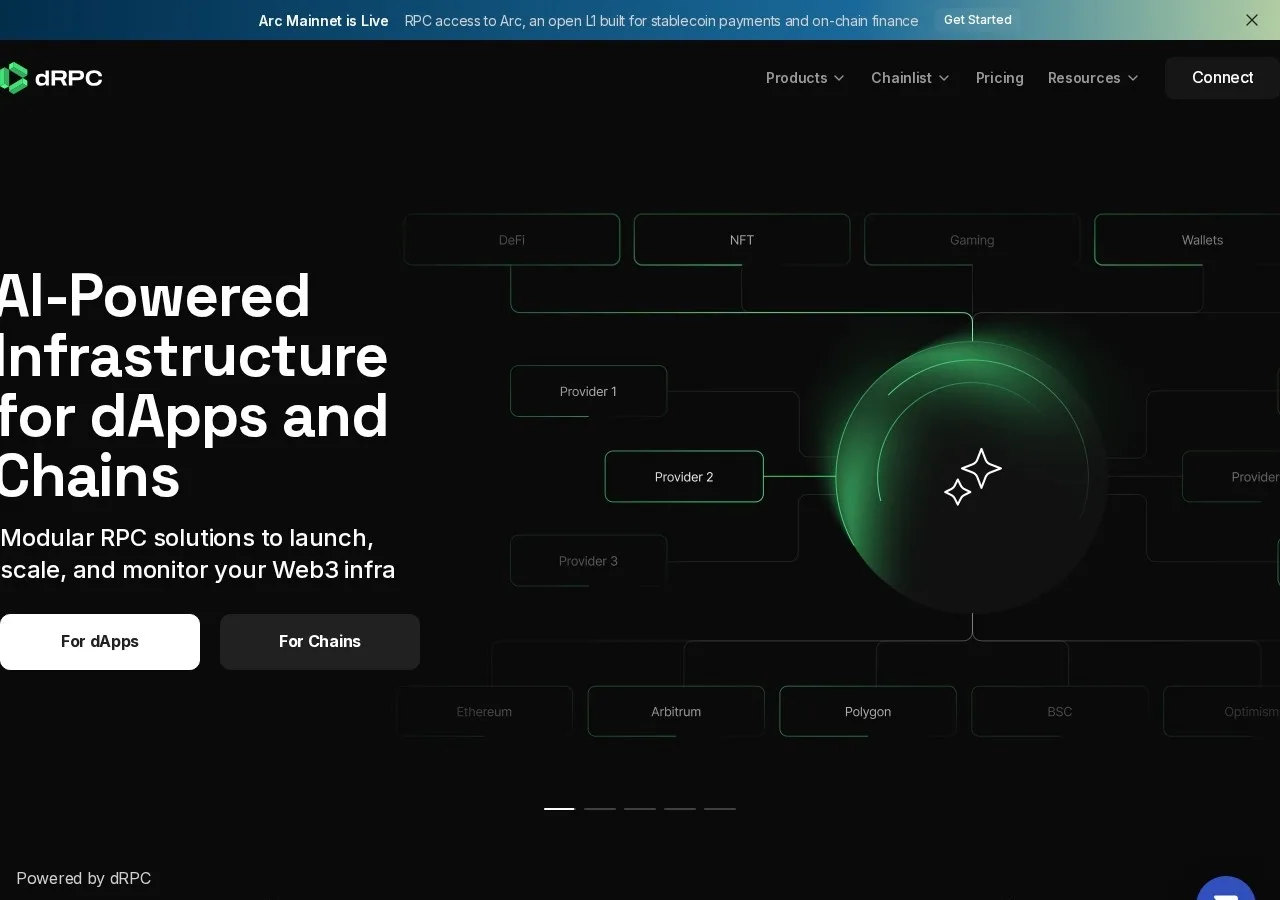
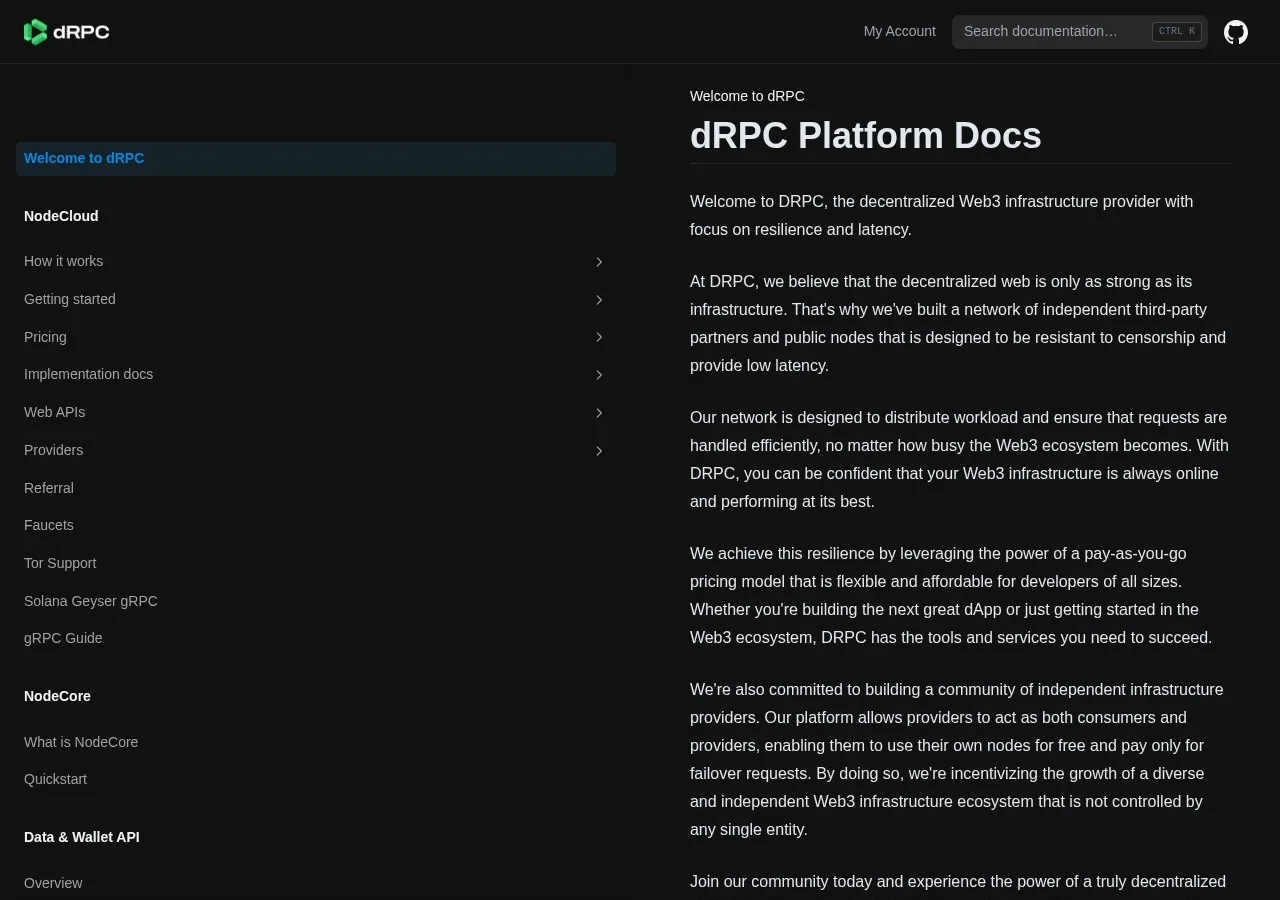
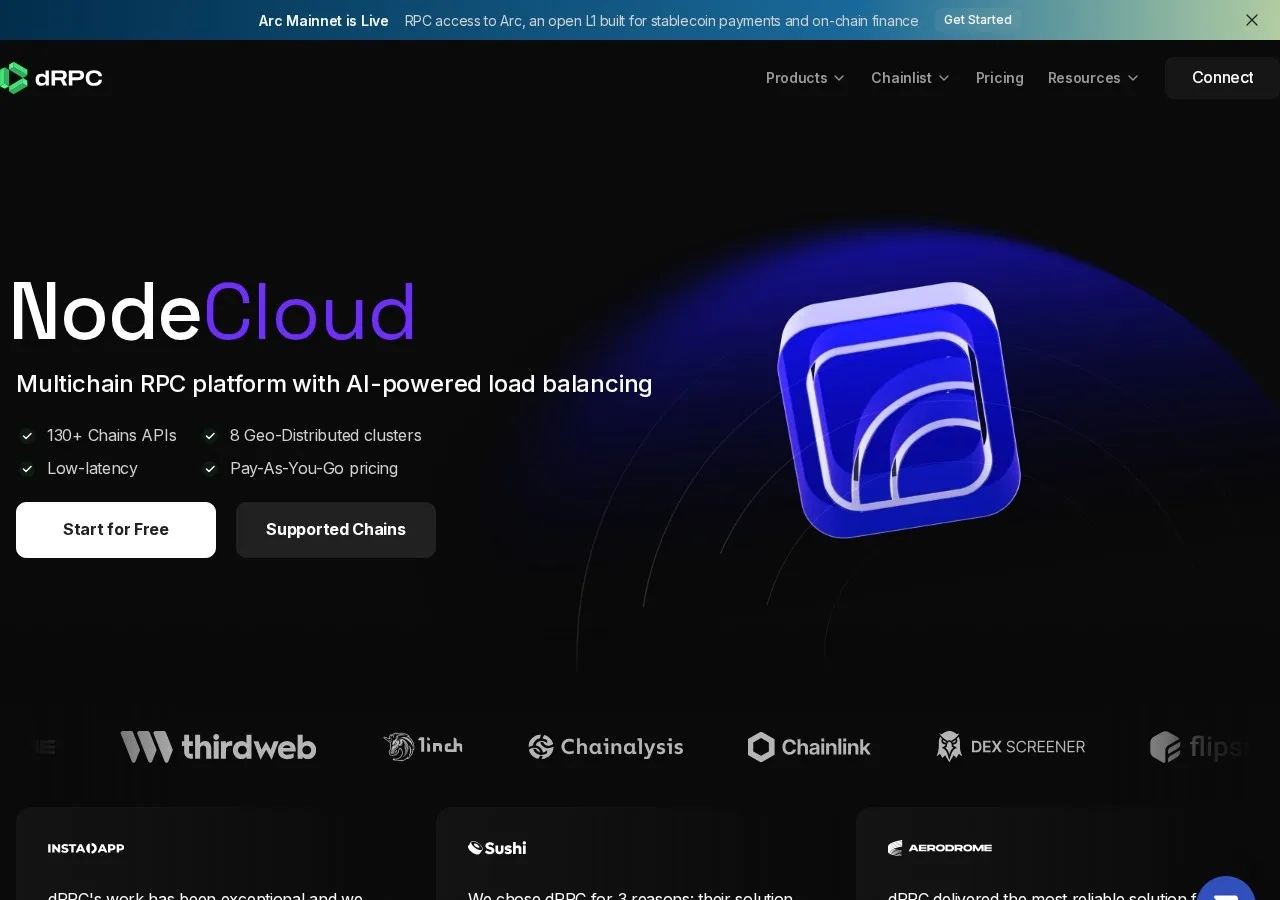
The dRPC homepage shows AI-powered infrastructure for dApps and chains with navigation and product options · Oct 21, 2026Docs: The dRPC Platform Docs welcome page displays documentation navigation and an introduction to decentralized Web3 infrastructure · Oct 21, 2026NodeCloud: The NodeCloud product page shows a multichain RPC platform with AI-powered load balancing, feature highlights, and customer logos · Oct 21, 2026
What users say about dRPC
There is insufficient user feedback to evaluate specific praise or complaints about the platform. Mentions primarily involve promotional or technical updates rather than multi-author experiences.
Based on 2 Reddit posts and comments from the last 12 months, checked Oct 21, 2026. These are posts by users on other sites, not reviews submitted on CryptoReview.
User reviews
No user reviews yet. Have you used dRPC? Share your experience below.
FAQ
Who leads dRPC?
Constantine Zaitcev has served as the CEO of dRPC since October 2022. He previously worked as Head of Product at P2P Validator and as an engineer at Ambisafe.
How much does dRPC cost?
dRPC offers a free plan alongside pay-as-you-go tiers starting at $10. Multi-chain RPC overages cost $6 per 1 million requests, while Solana requests cost $3.90 per 1 million calls.
What chains does dRPC support?
dRPC supports more than 130 blockchains across 232 networks. Supported environments include Ethereum, Solana, Arbitrum, Base, Polygon, Avalanche, TON, and Arc.
Has dRPC experienced any outages?
Yes, dRPC experienced upstream DNS issues on lb.drpc.live in January 2026 and temporary request timeouts on March 17, 2026. A service issue also affected log query requests on March 30, 2026.
Does dRPC have a token?
No, dRPC does not have a native cryptocurrency token. Platform billing is settled through standard fiat and direct payments.
Is dRPC open source?
dRPC provides NodeCore, an open-source RPC routing engine and load balancer that teams can self-host. Managed hosted endpoints are available through its proprietary NodeCloud service.
😴 London yesterday. Lisbon today. At this point, we’re starting to suspect dRPC’s 100 Hackathon Man has mastered the art of sleeping while walking.
After Encode Club’s hackathon in London, Armando has landed at Hack Meridian 2026 in Lisbon, sponsored by @BuildOnStellar. Two hackathons, two countries, barely 24 hours apart. Who needs sleep anyway?
If you’re hacking in Lisbon, find @armsves for RPC tips, instant access to 220+ networks with NodeCloud, or a look at our open-source, self-hosted NodeCore.
And yes, he’s still carrying the essentials: “Don’t talk to me” bucket hats, “Coding in my head” sleep masks, and “Don’t peep on me” webcam covers.
If you catch him sleeping standing up, just assume he’s debugging in his head.
🇬🇧 London calling! And apparently, 100+ hackathons still aren’t enough for dRPC’s 100 Hackathon Man.
Armando is back in action at the Encode Club Hackathon in London, ready for another round of ambitious builds, last-minute debugging, and questionable sleeping schedules.
Need RPC infra for your hack? Find @armsves for instant access to 220+ networks with NodeCloud, the open-source, self-hosted NodeCore, or a few survival tricks from someone who’s seen it all.
And yes, the hacker survival kit has crossed the Channel too: “Don’t talk to me” bucket hats, “Coding in my head” sleep masks, and “Don’t peep on me” webcam covers.
Because sleep is optional, but hacker survival gear isn’t.
⚡ 100+ hackathons in and apparently coding speed isn’t the only thing dRPC’s 100 Hackathon Man likes to compete on.
Armando is at the Origins Hackathon at @TOKEN2049 Singapore, sponsored by @Cardano, @solana, and @chainlink, hacking, helping builders with their RPC infra, and making his mark on the Strike Speed leaderboard. 🥊
Building this weekend? Find @armsves for instant access to 220+ networks with NodeCloud, your own open-source, self-hosted RPC setup with NodeCore, or a few hard-earned tips from 100+ hackathons.
And the essentials are covered: “Don’t talk to me” bucket hats, “Coding in my head” sleep masks, and “Don’t peep on me” webcam covers included.
そして、ハッカーのサバイバルギアも東京に到着済み。「Don’t talk to me」バケットハット、「Coding in my head」アイマスク、「Don’t peep on me」ウェブカメラカバーもあります。😎
東京のハッカーのみなさん、頑張って!🇯🇵
•••
🗼 100 Hackathon Man has reached the final boss: Tokyo.
Armando is at @ETHGlobal Tokyo for another weekend in his natural habitat: surrounded by hackers, half-finished projects, questionable amounts of caffeine, and problems that somehow only appear at 3am.
Need RPC infra for your hack? Find @armsves to connect instantly to 220+ networks with NodeCloud, build your own self-hosted setup with NodeCore, or just steal a few tips from 100+ hackathons.
And yes, the hacker survival gear made it to Tokyo too: “Don’t talk to me” bucket hats, “Coding in my head” sleep masks, and “Don’t peep on me” webcam covers included. 😎