Context Protocol

Decentralized semantic name service and identity layer organizing verifiable data for autonomous AI agents

Visit ctx.xyz
Our score
Fair
Services Data APIsAccount abstractionDeveloper tooling
Token TEX

What is Context Protocol?

Context Protocol is a decentralized semantic name service and infrastructure layer that organizes and validates structured data for autonomous AI agents. Built around a universal name registry (DNS3), the protocol binds unique human-readable domain names to versioned onchain documents and standard JSON schemas. This enables autonomous systems to read, verify, and reference real-world data without relying on centralized APIs or unstructured web scraping.

Team and corporate background

Context Protocol was founded by Alex Puig, who leads the European-based project team. The protocol emerged into broader public visibility through founder presentations, including the 10X Founders Demo Day in May 2026, after ranking among the top twelve teams selected by InspiraLabs and Yellow Capital. In June 2025, Context Protocol was named to the Raise Summit Top 100 AI startups list in Paris.

System architecture and core mechanics

The network operates through a layered architectural stack spanning application, abstraction, integration, and storage tiers. At the application layer, developers interact through software development kits or a public gateway. An enterprise dashboard supports data space administration. Smart account onboarding is handled via Biconomy account abstraction. The abstraction layer implements semantic caching through MongoDB Atlas alongside vector search to accelerate Retrieval-Augmented Generation (RAG) queries for AI models.

Interoperability across blockchains is orchestrated via LayerZero. Top-level domain contracts can execute cross-chain messages. For underlying persistence, Context Protocol splits data into public and private tiers. Public JSON data spaces settle on decentralized networks including Arweave, BNB Greenfield, and Swarm. Confidential data is routed through encrypted environments such as Ten Protocol.

Token mechanics and fees

Economic operations across the registry rely on the native $TEX utility token. Users and automated agents spend $TEX to register names and modify documents. They also use it to verify domain claims. Protocol fees are divided across three parties: the protocol treasury, the authors of specific schema templates, and the frontend applications initiating the call. Staking mechanisms in $TEX secure domain verification and back future sovereign AppChain validator sets.

Risks and technical limitations

Operating a composite decentralized infrastructure stack exposes users to specific counterparty dependencies. Protocol availability relies on external bridging via LayerZero and the continued uptime of connected networks like Arweave and Greenfield. As an early-stage infrastructure protocol, token volatility in $TEX directly impacts data update pricing, while full decentralized domain verification remains dependent on active community staking participation.


Founders

Alex PuigFounder
Best for:Developers building autonomous AI agentsWeb3 projects needing structured data schemasEnterprises managing verifiable decentralized identity

Pros and cons

Pros

  • Native JSON data versioning and schema validation for AI models
  • Multichain registry interoperability powered by LayerZero contracts
  • Flexible decentralized storage routing across Arweave, Swarm, and Greenfield
  • Template authors earn programmatic fee splits from registry calls

Cons

  • Registry write operations require paying transaction fees in $TEX
  • Document storage is restricted to structured JSON and excludes media files
  • Technical uptime depends on external networks including LayerZero and decentralized storage
  • Early ecosystem adoption leaves verification security dependent on growing staking pools

Our review

3.1/5
Fair

Context Protocol provides structured, verifiable semantic data spaces for AI agents across multiple chains, but its ecosystem relies heavily on an unlaunched L2 AppChain and utility token model.

Reliability3.0
Chain coverage3.5
Pricing3.0
Developer experience3.5
Support2.5

Context Protocol is a decentralized semantic name service (DNS3) and data verification layer built to structure real-world information for autonomous AI agents. Founded by Alex Puig, the platform acts as an identity and data provenance bridge between Web3 decentralized storage and AI execution frameworks. By indexing structured JSON records through standardized schemas, it addresses the data pollution and validation bottlenecks that affect retrieval-augmented generation (RAG) models.

The protocol splits its architecture across several operational tiers. Decentralized public data resolves through storage networks such as Arweave, BNB Greenfield, and Swarm, while private documents can be encrypted via Ten Protocol. The integration layer coordinates cross-chain top-level domains using LayerZero smart contracts, supported by MongoDB Atlas for vector search and Biconomy for smart wallet account abstraction. Developers query these endpoints directly through an SDK or public gateway, registering metadata under verifiable domain names.

Key advantages include:

  • Standardized data templates that enforce strict JSON schemas for real-time AI ingestion and RAG querying.
  • Multi-storage and cross-chain execution spanning Ethereum, Base, Arweave, and Greenfield through LayerZero.
  • Fine-grained agent controls, allowing developers to set session-level token spend limits directly in the integration middleware.

Trade-offs remain evident in its infrastructure readiness. Protocol updates and domain verifications depend on the $TEX token, creating economic exposure to registry staking mechanisms and token distribution. Much of the long-term throughput also depends on a planned AppChain L2 network that remains under development. Teams needing established decentralized name services with years of battle-tested uptime may prefer mature standards like ENS, while Context Protocol suits developers building autonomous AI agents that require verifiable, structured knowledge feeds onchain.

Listings are researched and drafted with AI assistance from public sources, then checked for accuracy and readability. Spot an error? Tell us. Editorial policy.
Sources (8)

Specs

Services Data APIs, Account abstraction, Developer tooling · unverified
Token TEX · unverified
Server regions Europe · unverified

Not disclosed by the provider: Chains supported, Free tier, Pricing from, Enterprise SLA, Open source, Uptime SLA, Free tier limits.

Data from the provider's website and public sources. Fees and availability change; confirm on the official site before you sign up.

Key features

Decentralized semantic name registry

Maps human-readable names to onchain JSON document spaces with native transaction version control and tracking.

Standardized schema templates

Enforces strict database schemas that allow structured AI retrieval across multiple decentralized applications.

Multichain cross-contract routing

Uses LayerZero smart contracts to register, query, and synchronize top-level domains across disparate networks.

Hybrid decentralized storage

Distributes public data across Arweave, BNB Greenfield, and Swarm while securing private records via Ten Protocol.

Agentic vector search caching

Implements MongoDB Atlas vector search and semantic caching to speed up RAG workflows for autonomous agents.

Account abstraction onboarding

Integrates Biconomy smart wallets to allow automated agents and users to sign transactions without raw key exposure.

Inside Context Protocol

Semantic Name Service (DNS3)

Assigns unique, decentralized names to structured JSON context documents, providing onchain identity and permanent version tracking for real-world data.

Public Gateway and SDK

Provides developer endpoints, MCP compatibility, and security middleware to query semantic data and execute tools with configurable session spend limits.

Enterprise Dashboard (SaaS)

Offers organizations centralized monitoring and operational management tools for their domains and data assets across Web3 networks.

Universal Name Registry

Is the reference directory for schemas and SmartPods. All stored records adhere to standardized, queryable blueprints.

Context Protocol screenshots

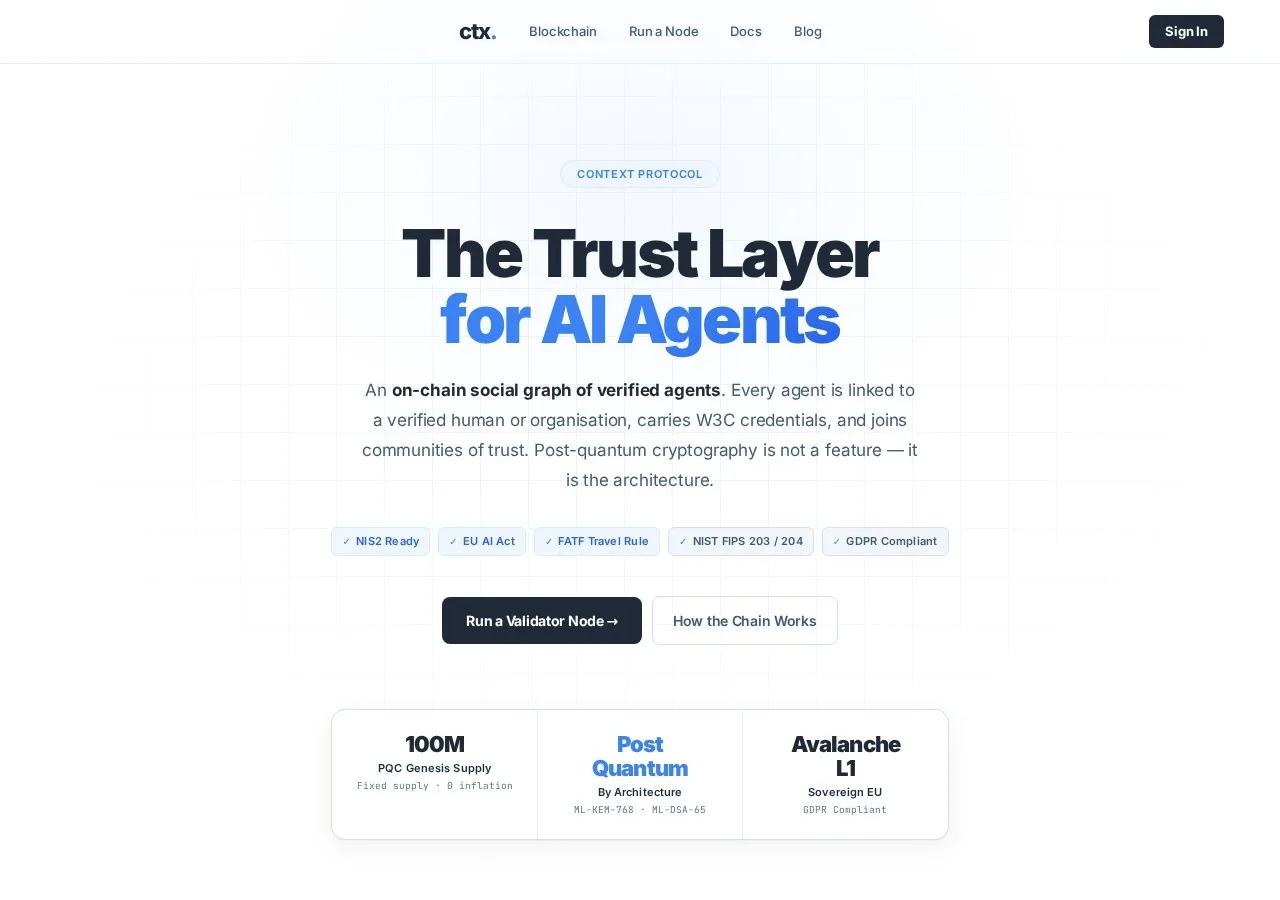
The Context Protocol homepage shows information about its trust layer for AI agents and validator nodes
The Context Protocol homepage shows information about its trust layer for AI agents and validator nodes · Oct 21, 2026
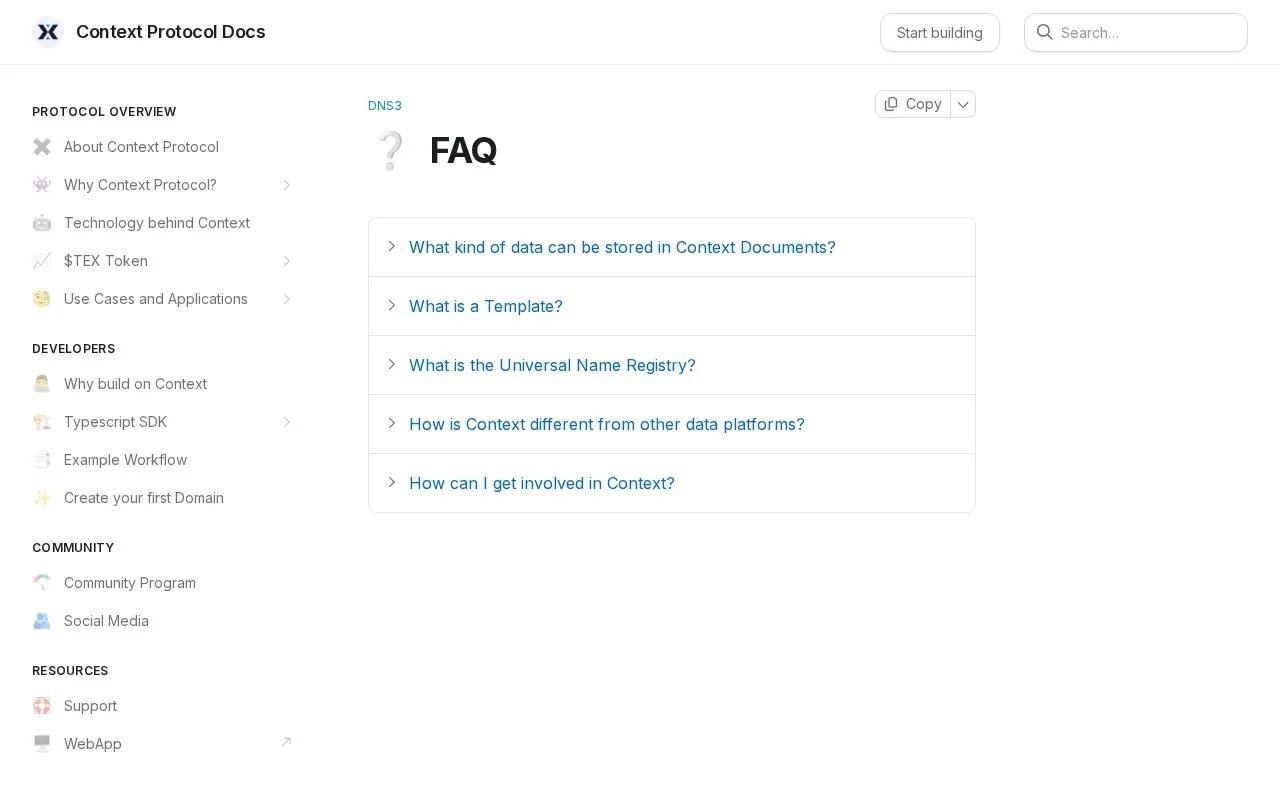
FAQ: Context Protocol Docs FAQ page with navigation sidebar and five expandable questions
FAQ: Context Protocol Docs FAQ page with navigation sidebar and five expandable questions · Oct 21, 2026
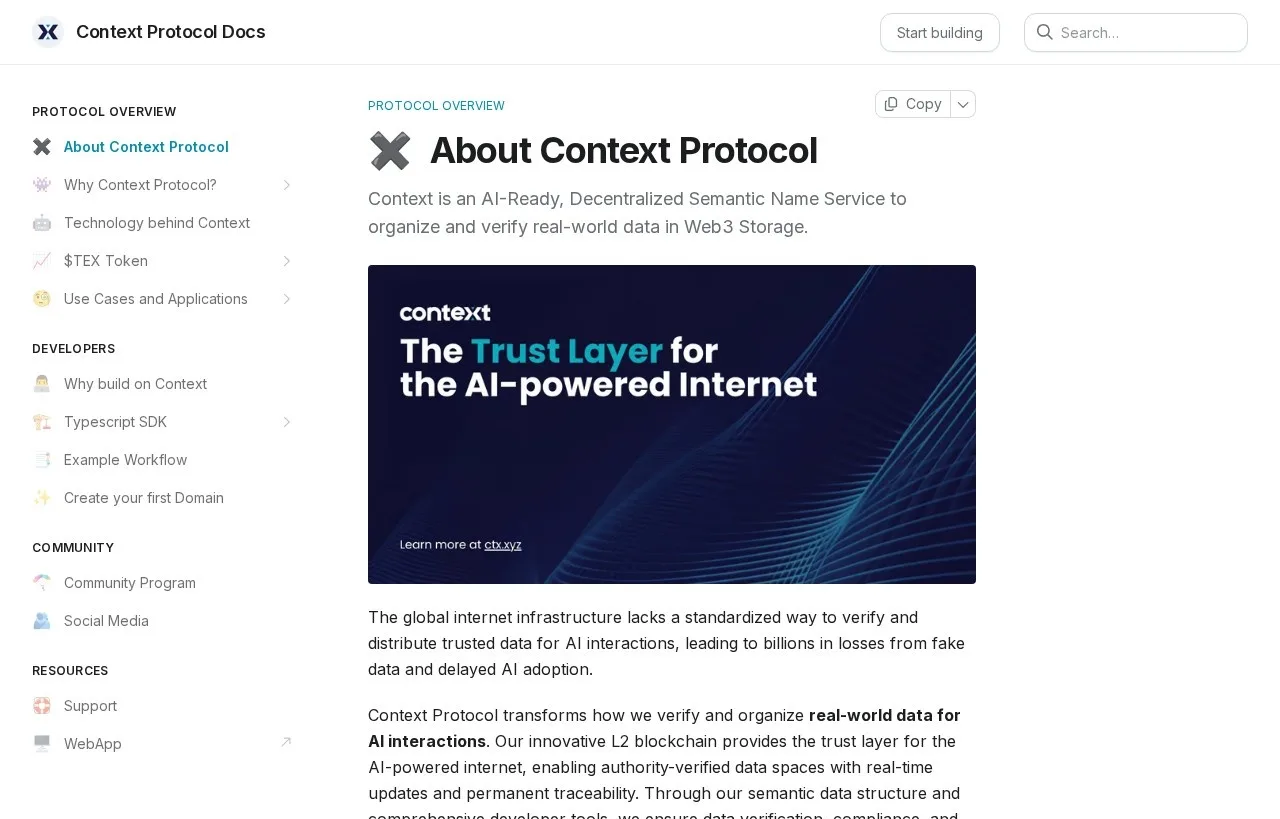
Docs: Context Protocol documentation page describing the protocol, its architecture, developers resources, and community links
Docs: Context Protocol documentation page describing the protocol, its architecture, developers resources, and community links · Oct 21, 2026

User reviews

No user reviews yet. Have you used Context Protocol? Share your experience below.

Write a review of Context Protocol

Your rating
At least 40 characters. Please write about your own experience.

Reviews are moderated before they appear.

FAQ

Who founded Context Protocol?

Context Protocol was founded by Alex Puig. The project operates primarily from Europe.

Does Context Protocol have a native token?

Yes, the protocol features the $TEX token. It is used to pay registry transaction fees, reward schema creators, and stake for domain verifications and network validation.

What data can be stored in Context Documents?

Context Documents store structured JSON data and metadata conforming to defined schema templates. They are not intended for storing raw media assets like images, audio, or video files.

Which blockchains and storage networks does Context Protocol support?

The protocol interacts with networks like Ethereum and Base, coordinating cross-chain registries via LayerZero. Storage backends include Arweave, BNB Greenfield, Swarm, and Ten Protocol.

How does Context Protocol prevent AI agents from overspending?

Its developer SDK includes middleware that lets builders configure strict per-session spend limits in USD, restricting autonomous transactions to defined caps.

Latest from Context Protocol on X

Context Protocol
@contextprotocol · 785 followers
Follow
$17B stolen in crypto last year. AI agents draining wallets in 72h. We're on the 10X Founders Demo Day stage May 1 with the fix — verifiable identity for AI agents in DeFi. Top 12 of 150+ for @InspiraLabsHQ, @yellow__capital, @Yellow. 🔗 https://t.co/cnYp3uksGT https://t.co/DgEWkCnQCh
Image attached to the post
1 0 4 190 View on X
The AI x Web3 buzz is catching up at Devconnect!

🎟️@AgenticZero is the AI x Web3 event at Devconnect, happening on November 20, that you shouldn't miss! Hence, why we are giving away 2 tickets!

1⃣Follow @AgenticZero + @ContextProtocol
2⃣💙 + 🔁
🗓Winners announced → Nov 16 https://t.co/qE3Zgwk50z
Image attached to the post
4 4 9 930 View on X
This is the beginning of something great. Wait and see...
0 1 2 222 View on X
💭 What IF:
Context + @dfiniity's ICP → Powering the Self-Writing Internet

What if your website wasn’t static...
But alive?
Able to think, adapt, verify, and respond in real time? https://t.co/IVvw6BtLby
Image attached to the post
1 2 8 334 View on X
What is an MCP Server and Why It Matters
Think of MCP Servers like the backend API for the AI internet.

Except it’s decentralized. Verifiable. Autonomous.

Agents don’t scrape, they connect directly to structured knowledge endpoints with action flows built-in. https://t.co/ctzCpqkfl7
Image attached to the post
1 0 1 124 View on X

Recent public posts from @contextprotocol, shown as published. Not reviewed or endorsed by CryptoReview.

Alternatives to Context Protocol

Open-source smart contract libraries and enterprise security tooling backing over $38T in transfers

Developer toolingFree tier10 chains supported
4.5

Blockchain infrastructure platform supporting 100+ chains with a free 30M-compute-unit tier

RPC / nodes · Data APIs +3Free tier100 chains supported
4.3

Managed blockchain infrastructure across 70+ chains with a free 3M-request monthly tier

RPC / nodes · IndexingFree tier70 chains supported
4.3

EVM development and simulation platform supporting transaction debugging and testing across 50+ chains

Developer toolingFree tier50 chains supported
4.3

Open-source distributed ledger foundation hosting Fabric, Besu, and Cacti under the Linux Foundation

RPC / nodes · Developer toolingFree tier2 chains supported
4.2

Blockchain infrastructure platform providing RPC nodes and data streams across 76 networks

RPC / nodes · Data APIsFree tier76 chains supported
4.2