

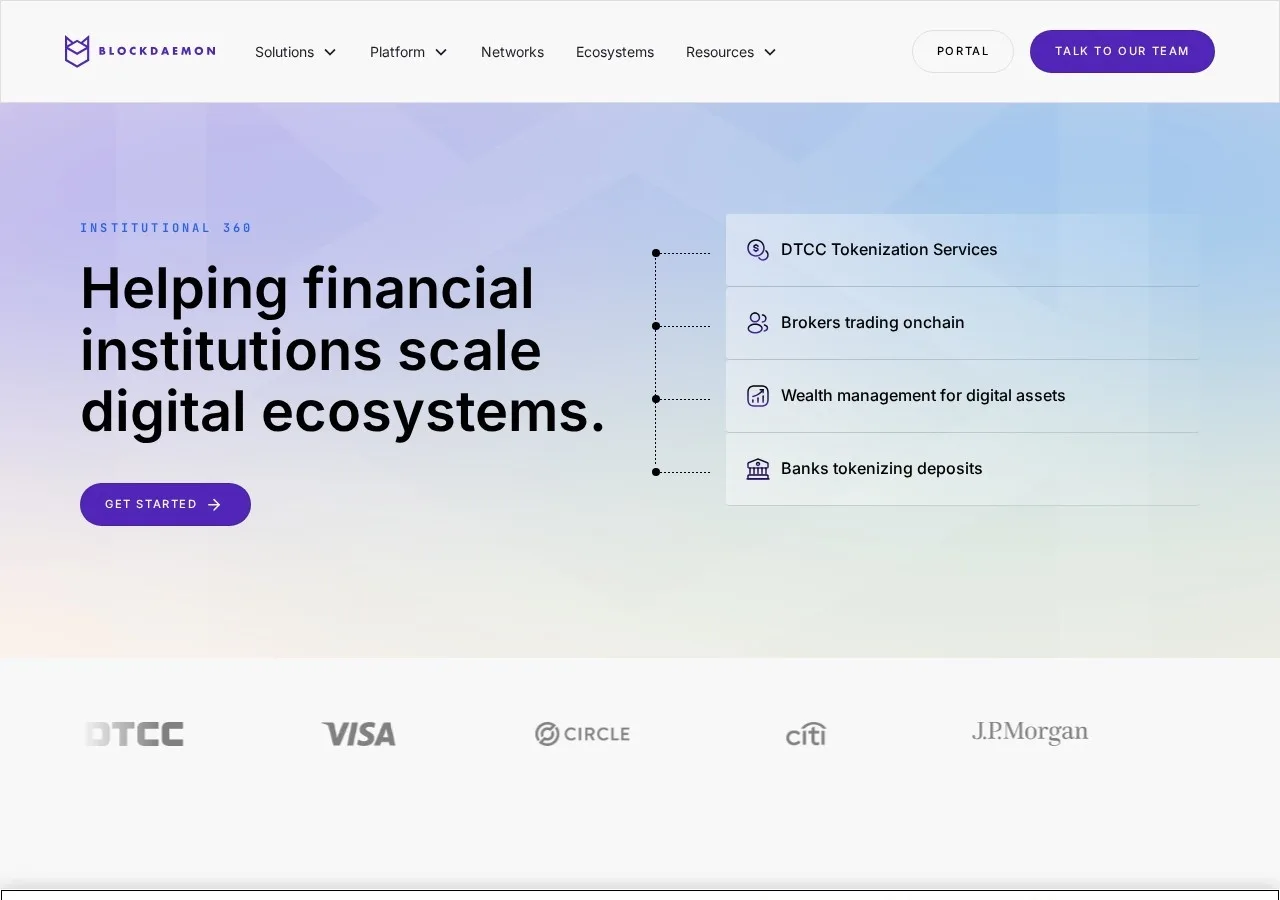
The Depository Trust & Clearing Corporation (@The_DTCC) Tokenization Service is live. Blockdaemon can provide firms with the infrastructure they need to connect on day one.
https://t.co/5jHtP6Z8Vq https://t.co/tfXK6h175y


Institutional blockchain infrastructure, validator hosting, and MPC wallet APIs for over 60 networks
Blockdaemon is an institutional blockchain infrastructure platform providing validator deployment, RPC endpoints, MPC wallet architecture, and normalized data APIs. As of October 2026, the company secures over $110B in digital assets across more than 60 supported protocols for over 400 institutional clients, including exchanges, custodians, and banks.
Blockdaemon was founded in October 2017 by Chief Executive Officer Konstantin Richter, who previously worked at Deutsche Telekom and founded Santiago Advisory. Headquartered in Los Angeles as a remote-first organization, the company grew to roughly 500 employees. In September 2021, the company closed a $155 million Series B financing round to expand its validator and node tooling footprint worldwide.
The platform provides institutional customers with several core service layers. Its Infrastructure Services include dedicated node clusters and validator infrastructure that organizations can deploy across multiple bare-metal environments or major cloud providers. Clients can license software packages to operate directly inside their own corporate security perimeters, or rely on managed infrastructure operated by Blockdaemon engineers with enterprise service-level agreements. For custody, the platform delivers multi-party computation (MPC) wallet architecture covering hot and cold storage configurations alongside approval policies and gas-station management. The Blockdaemon Earn Stack supplies institutional staking access and automated yield accounting across major networks including Ethereum, Solana, and Bitcoin.
Blockdaemon has expanded its footprint through integrations with institutional platforms such as Fireblocks, which added direct Ethereum staking to Blockdaemon validators in June 2026. The provider also adopted Obol distributed validator technology across its Lido staking operations in August 2026 to distribute Ethereum validation across separate physical environments. In September 2026, Blockdaemon went live as an infrastructure launch partner for Arc, delivering managed validators and real-time streaming connections. Its validator infrastructure regularly handles protocol validation for major institutions and networks, including tokenization work aligned with DTCC Tokenization Services.
Institutional infrastructure reliance carries specific operational trade-offs. Delegating validator and RPC operations introduces single-vendor exposure and infrastructure concentration risks common to large-scale node operators. Enterprise implementations requiring private deployments and custom MPC governance setups involve institutional sales cycles rather than standardized fixed-tier public pricing.
Blockdaemon delivers reliable institutional validator and node infrastructure across 60 protocols, but its enterprise sales model and private pricing suit large capital operators over retail developers.
Blockdaemon operates institutional blockchain infrastructure across more than 60 protocols, securing over $110 billion in digital assets across 400 institutional clients. Founded in 2017 by CEO Konstantin Richter, the company specializes in dedicated node clusters, multi-party computation (MPC) wallet custody, and validator infrastructure for enterprises like DTCC and LSEG. The platform allows institutions to deploy nodes inside their own security perimeters or rely on Blockdaemon-managed servers across multi-cloud and bare-metal environments.
Validator performance remains a core technical strength. In mid-2026, Blockdaemon Solana validators achieved a 6.18% Protocol Reward Rate compared to the 6.12% network average, while its Ethereum validator fleet maintained a 2.67% yield against the 2.66% CESR benchmark. To minimize slashing risks and client centralization, the operator began migrating Lido staking operations to Obol Collective distributed validator nodes. The suite also incorporates normalized historical data APIs and WebSocket event streaming alongside native RPC connectivity.
The service presents clear institutional trade-offs:
Individual hobbyists or bootstrapped teams seeking self-serve, free-tier developer tooling will find public endpoint providers easier to integrate. Blockdaemon fits custodians, trading firms, and banks requiring managed compliance guarantees and audited MPC key management systems.
| Services | RPC / nodes, Staking infrastructure, Wallet APIs |
|---|---|
| Chains supported | 60 · unverified |
| Enterprise SLA | Yes · unverified |
Not disclosed by the provider: Free tier, Pricing from, Open source, Token, Uptime SLA, Free tier limits, Server regions.
Data from the provider's website and public sources. Fees and availability change; confirm on the official site before you sign up.
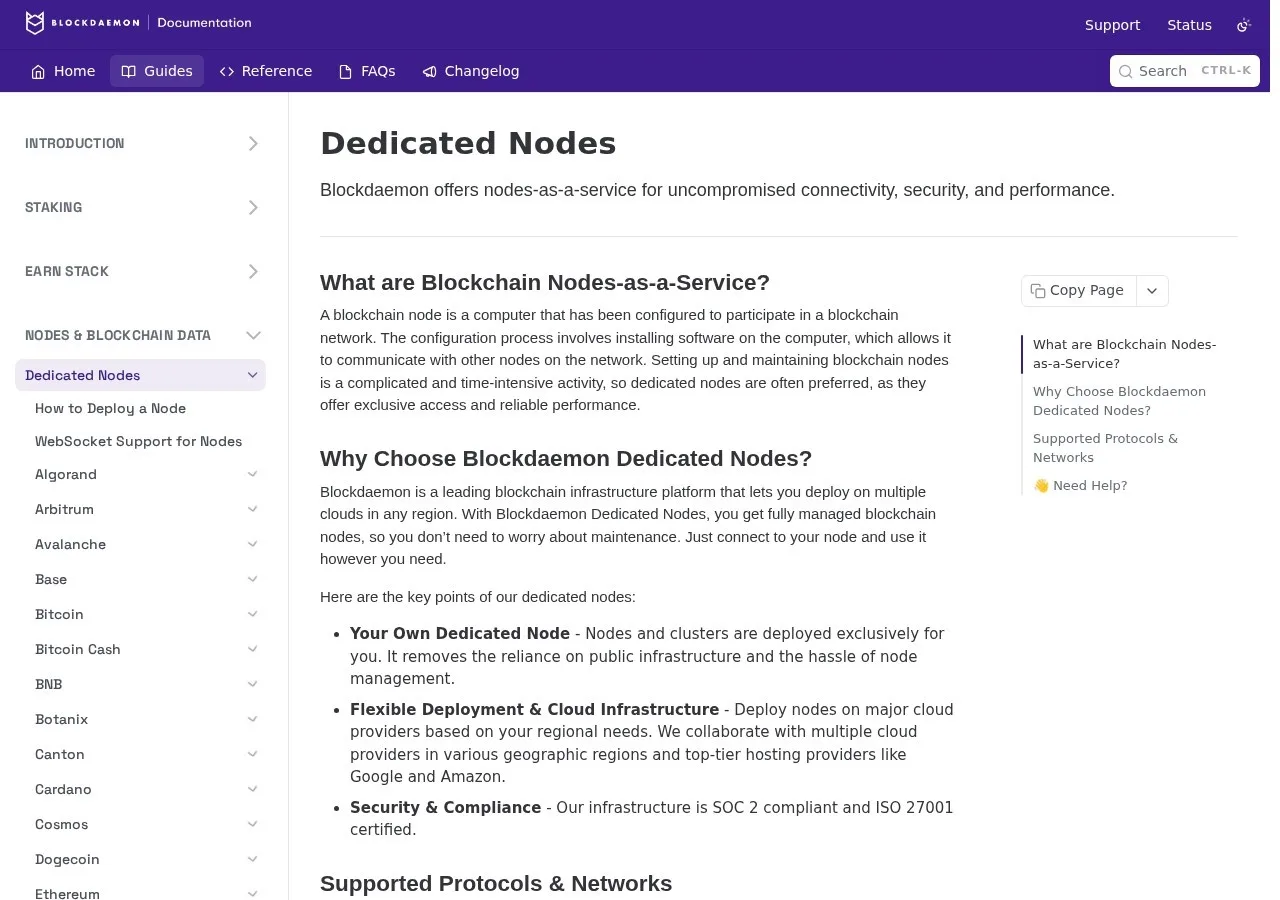
Deploys bare-metal or cloud-hosted dedicated nodes across more than 60 networks, complete with fleet management and protocol updates.
Runs non-custodial validator infrastructure and white-label staking tools with automated accounting across Ethereum, Solana, and other proof-of-stake chains.
Supplies multi-party computation wallet architecture designed to run hot, warm, or cold custody inside institutional security perimeters.
Provides standardized REST and WebSocket endpoints for historical blockchain data alongside real-time transaction event streaming.
Enforces granular threshold rules, clear signing for institutional approvers, and automated transaction crafting across networks.
Offers standardized licensed software packages that enterprise clients can deploy and operate inside their private infrastructure.
Handles transaction crafting across supported tokenization networks, integrating MPC key management, clear signing approvals, and automated gas stations.
Provides normalized real-time event streaming, historical data APIs, and native RPC endpoints across blockchains.
Deploys dedicated node clusters, fleet management, and validator infrastructure across multi-cloud and bare-metal environments.
Delivers multi-party computation wallet architecture designed to run inside enterprise perimeters across hot, warm, and cold configurations.
Powers institutional staking access through the Blockdaemon Earn Stack, providing white-label widgets and comprehensive reporting.
No user reviews yet. Have you used Blockdaemon? Share your experience below.
Konstantin Richter founded Blockdaemon in 2017 and serves as Chief Executive Officer. He previously held a role at Deutsche Telekom before starting the infrastructure firm.
No, Blockdaemon does not have a native token. The company operates as a traditional private software and infrastructure service provider.
Blockdaemon supports more than 60 protocols, including Ethereum, Bitcoin, Solana, Stellar, Arc, Canton, and Tempo. Supported services range from RPC access to active validator operations.
Blockdaemon uses multi-party computation wallet architecture supporting hot, warm, and cold storage configurations. This platform enables institutions to maintain threshold policy engines and clear signing workflows within their own security perimeter.
The Blockdaemon Earn Stack is an institutional staking suite that provides dedicated validator infrastructure, yield reporting, and white-label staking integrations. It includes validator access on networks such as Ethereum and Solana as well as integrations with custody partners like Fireblocks.

Recent public posts from @BlockdaemonHQ, shown as published. Not reviewed or endorsed by CryptoReview.
Open-source smart contract libraries and enterprise security tooling backing over $38T in transfers
Blockchain infrastructure platform supporting 100+ chains with a free 30M-compute-unit tier
Managed blockchain infrastructure across 70+ chains with a free 3M-request monthly tier
EVM development and simulation platform supporting transaction debugging and testing across 50+ chains
Open-source distributed ledger foundation hosting Fabric, Besu, and Cacti under the Linux Foundation
Blockchain infrastructure platform providing RPC nodes and data streams across 76 networks
Type at least two characters. Press ↵ to see all results.