
GM ☕️
Back to work.
Heavy week behind us. Coffee’s on. Let’s go. https://t.co/78AiZoeLSy

Cross-chain data oracle and unified data layer securing over $188M across 40+ networks
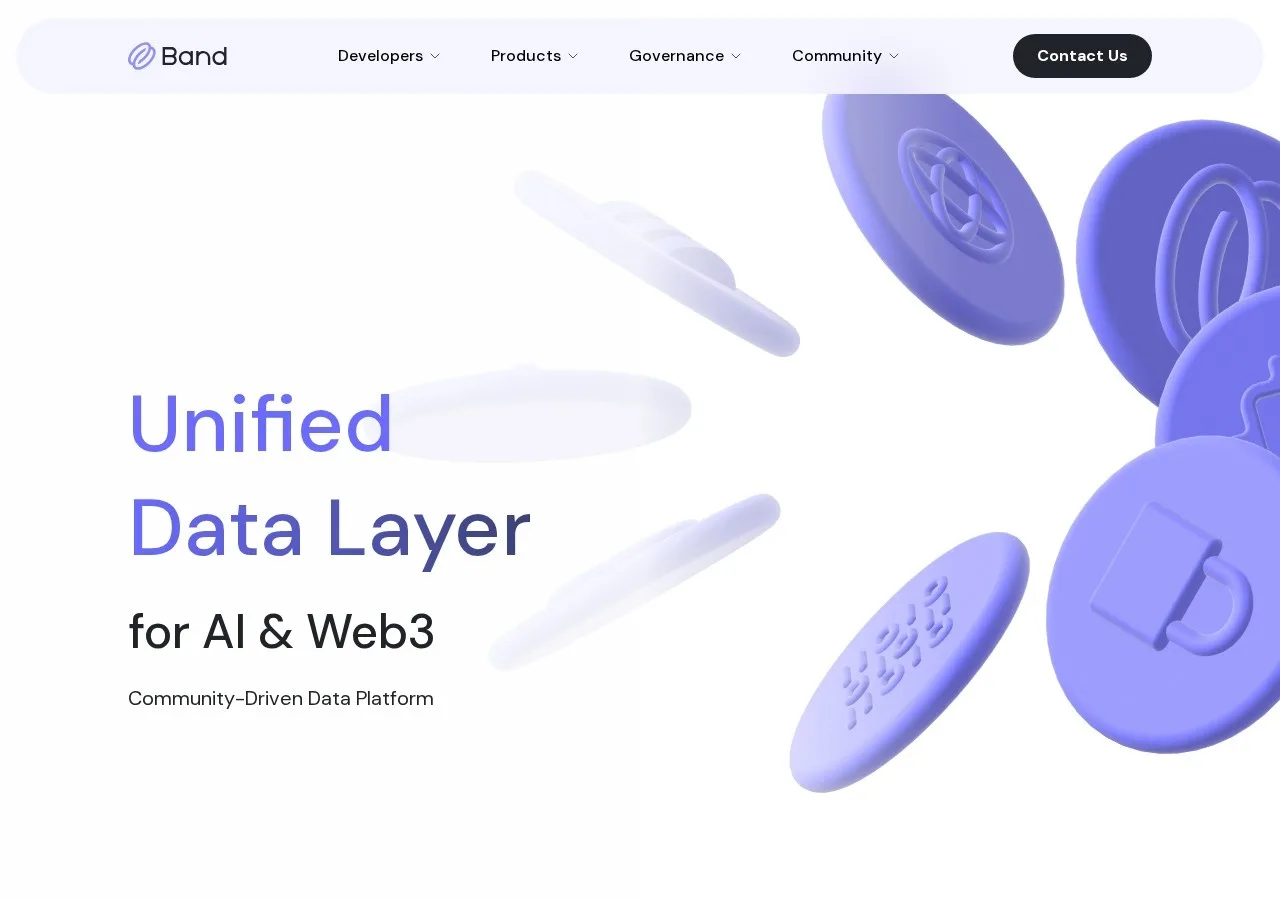
Band is a decentralized cross-chain data oracle and unified data layer that aggregates external real-world information and delivers it to smart contracts and artificial intelligence applications. The protocol operates via its dedicated Cosmos SDK-based blockchain, BandChain, and secures over $188M in total value across more than 40 supported blockchain ecosystems.
Band Protocol was founded in 2018. The Band Developer Portal is operated by the Band Foundation. In August 2025, the team rebranded the protocol from Band Protocol to Band, expanding its mandate to feed market intelligence and external web data directly into both smart contract applications and autonomous AI agents.
The network processes oracle requests through BandChain, where over 52 validators aggregate pricing and off-chain data points using median aggregation. These validators serve a dual role by validating BandChain blocks and fetching information from 11+ data sources. Cross-chain distribution uses Cosmos Inter-Blockchain Communication (IBC) and Router Protocol. The BAND utility token secures the network through staking and pays for data requests on BandChain.
Band operates without permissioned access controls or geographic restrictions. Developers can query oracles globally across networks like Ethereum, Monad, Stellar, XRPL EVM Sidechain, Sonic, and Initia. Developers configure feeds using the Band Developer Portal.
Initially deployed as an Ethereum token project in September 2019, the network transitioned to its standalone Cosmos chain with Band Protocol 2.0. By October 2026, BandChain had processed 550 million cumulative transactions and served more than 82 clients and partners. The BAND token is used to secure the network through staking.
Band offers multi-chain decentralized data feeds and on-chain randomness across 40+ chains, securing $188M in on-chain assets.
Band started in 2018 under co-founder Soravis Srinawakoon. Originally launched as an Ethereum ERC-20 token in September 2019, the network transitioned to BandChain, an independent Cosmos SDK blockchain. This architecture assigns validators a dual responsibility: participating in block production and fetching external data requests before relaying aggregated medians across chains using cross-chain communication tools.
As of October 2026, the network reports $188M in total value secured, operating with 52 active validators and supporting more than 40 chains, including Monad, Stellar, Sonic, and XRP Ledger EVM. The platform provides real-time financial data feeds, cryptographically verifiable random numbers via Band VRF, and an AI-focused data feed component called Membit. Developers deploy and manage custom price feeds across networks through the Band Developer Portal.
Band suits decentralized application developers building cross-chain DeFi protocols, gaming setups requiring verifiable randomness, and projects launching on newer layer-1 networks like Monad or Sonic.
| Services | Oracle, Data APIs, Developer tooling · unverified |
|---|---|
| Chains supported | 40 · unverified |
| Open source | Yes · unverified |
| Token | BAND · unverified |
Not disclosed by the provider: Free tier, Pricing from, Enterprise SLA, Uptime SLA, Free tier limits, Server regions.
Data from the provider's website and public sources. Fees and availability change; confirm on the official site before you sign up.
Queries external market data across 11 or more independent sources, aggregating median prices for DeFi protocols across 40+ blockchains.
Generates cryptographically verifiable on-chain randomness for smart contracts and Web3 gaming, live on networks including OPN Chain.
Connects off-chain market intelligence and updated web knowledge directly to large language models and autonomous AI agents.
Secures data collection using a dedicated Cosmos SDK blockchain operated by a network of over 52 validators.
Provides a deployment interface to configure and launch custom data feeds across supported chains using interchain messaging.
Connects smart contracts to real-time financial market data aggregated across multiple external data sources.
Provides market intelligence and knowledge updates to large language models and external AI systems.
Generates cryptographically verifiable random numbers on-chain for gaming and decentralized applications.
Enables developers to configure, manage, and deploy custom cross-chain price feeds across supported blockchains.
Serves as the staking asset and payment token used to validate blocks and pay for oracle queries on BandChain.
There is currently insufficient user feedback to determine specific praise or complaints regarding Band Protocol.
Based on 2 Reddit posts and comments from the last 12 months, checked Oct 20, 2026. These are posts by users on other sites, not reviews submitted on CryptoReview.
No user reviews yet. Have you used Band Protocol? Share your experience below.
Band Protocol was founded in 2018 by Soravis Srinawakoon. Soravis Srinawakoon leads the company as CEO.
Yes, BAND is the native utility, staking, and governance token. It secures the BandChain network through validator staking and pays for data request transactions.
Band supports more than 40 blockchain networks. Supported ecosystems include Ethereum, Cosmos, Monad, Stellar, Babylon, Sonic, Initia, and the XRPL EVM Sidechain.
Band provides decentralized financial data feeds, on-chain verifiable randomness through Band VRF, and the Membit data service for AI applications. Developers can configure feeds directly using the Band Developer Portal.
Band secures data through a network of 52 active validators on BandChain using Cosmos SDK. Validators fetch data from 11 or more sources, reach consensus on an aggregated median, and relay the result across chains.


Recent public posts from @bandprotocol, shown as published. Not reviewed or endorsed by CryptoReview.
Open-source smart contract libraries and enterprise security tooling backing over $38T in transfers
Blockchain infrastructure platform supporting 100+ chains with a free 30M-compute-unit tier
Managed blockchain infrastructure across 70+ chains with a free 3M-request monthly tier
EVM development and simulation platform supporting transaction debugging and testing across 50+ chains
Open-source distributed ledger foundation hosting Fabric, Besu, and Cacti under the Linux Foundation
Blockchain infrastructure platform providing RPC nodes and data streams across 76 networks
Type at least two characters. Press ↵ to see all results.