

A challenging day for the crypto market.
Following the news of the Binance security incident. Bitcoin hit a new monthly low, nearly $600 million in long positions were liquidated within an hour.
Binance has estimated the losses at around $6.3 billion and confirmed they will be covered by its SAFU fund.
When markets get volatile, finding the right exchange rate matters even more. With Swapzone, you can compare offers from multiple providers , explore available rates, and find the best option for your next swap.
🔗 Official Links | Website | X (ex-Twitter) | Chat | Bot | Mini-App

Swapzone
Non-custodial exchange aggregator comparing rates across 30+ instant swap providers with 0% platform fees
4.0/ 5
Our score
Very good
Maker fee
0%
Taker fee
0%
Coins listed
3,000
KYC required
No
Proof of reserves
No
What is Swapzone?
Swapzone is a non-custodial cryptocurrency exchange aggregator that scans and compares exchange rates across third-party swap services. The platform connects users directly to over 30 instant swap providers, covering more than 3,000 digital assets across networks including Bitcoin, Ethereum, Solana, BNB Chain, Avalanche, and Tron.
Company and headquarters
Founded in 2019, Swapzone operates from Tbilisi, Georgia. The company builds aggregation infrastructure for retail users and delivers exchange services through a B2B API integration toolkit that enables third-party crypto applications to route swaps, fiat on-ramps, and cross-chain transfers.
How swaps and fees work
The platform functions entirely without custodial accounts. Users do not register or hold a balance on Swapzone. Instead, you select an asset pair, compare real-time offers from integrated partners such as ChangeNOW, Changelly, SimpleSwap, and LetsExchange, choose between fixed or floating rates, and provide a payout address. Swapzone charges 0% in platform fees; the underlying partner exchange fee and blockchain network costs are built directly into the displayed swap rate. Swaps settle wallet-to-wallet once the deposit transaction confirms on-chain.
Availability and KYC verification
Access to Swapzone is global and registration-free, though transactions remain subject to the regional terms and compliance policies of the underlying partner fulfilling the trade. In June 2026, Swapzone introduced partner-specific KYC likelihood indicators alongside historical execution speeds directly in the quote selection interface, alerting users beforehand if a selected provider rarely or frequently flags transactions for identity verification.
Track record and platform risks
Swapzone contributed execution data from 150,000 completed trades to the Bitcoin.com Speed Benchmarks report in June 2026, followed by a major upgrade to its B2B crypto exchange API in July 2026. Because Swapzone routes trades through external providers rather than holding funds, users avoid direct exchange custody failure on Swapzone itself. However, counterparty risk remains with the individual partner handling the swap. Selected providers may freeze deposits under their own AML triggers, requiring identity verification to release funds, and market slippage can impact payouts on floating-rate trades during periods of high network volatility.
Best for:Traders wanting non-custodial swapsUsers avoiding account registrationCross-chain rate comparisonDevelopers integrating crypto swap APIs
Pros and cons
Pros
- Swapzone charges 0% in platform fees for swaps
- No user account creation or personal data registration required
- Compares offers across more than 30 instant swap services
- Surfaces partner KYC likelihood and historical execution speeds upfront
- Supports wallet-to-wallet trades across over 3,000 crypto assets
Cons
- Counterparty risk depends on third-party exchange partners fulfilling trades
- Partner exchanges can freeze deposits under their own AML and KYC rules
- No traditional order book, spot limit orders, or derivatives trading
- Network gas fees and partner spreads are embedded into quoted rates
Our review
4.0/5
Very good
Swapzone aggregates rates across dozens of instant exchanges without custody or platform fees, but actual execution and KYC triggers depend entirely on third-party routing partners.
Swapzone is a non-custodial crypto exchange aggregator headquartered in Tbilisi, Georgia, operating since 2019. Rather than running an internal order book or taking direct custody of deposits, it scans real-time swap rates, processing speeds, and execution parameters across more than 30 external exchange services, including ChangeNOW, Changelly, SimpleSwap, and LetsExchange. The service lists over 3,000 supported digital assets across blockchains like Bitcoin, Ethereum, Solana, Avalanche, BNB Chain, and Tron.
The core advantage of the platform is fee transparency and routing efficiency. Swapzone charges a 0% platform fee to end users, generating revenue through partner-side fee-sharing arrangements. Users can toggle between floating rates to track market volatility during confirmation periods and fixed rates to insulate trades from slippage. In June 2026, Swapzone introduced direct indicators for estimated arrival times and partner KYC likelihood. Traders can consult these markers to spot potential fund freezes before dispatching transactions.
Because Swapzone is purely an aggregator, its operational risks mirror those of its integrated counterparties. When a third-party exchange flags an incoming deposit under its automated anti-money-laundering controls, that partner can freeze the transfer and demand full identity verification before releasing funds. The service also lacks traditional centralized trading features: there are no derivatives markets, no margin leverage, no native order books, and no internal fiat custody or proof of reserves.
Swapzone suits traders looking to compare cross-chain swap offers without registering an account or leaving funds on a centralized exchange. Users seeking persistent fiat balances or dedicated perpetuals trading should choose a full-service spot and derivatives exchange instead.
Specs
| Markets | Spot · unverified |
|---|---|
| Maker fee | 0% · unverified |
| Taker fee | 0% · unverified |
| Coins listed | 3,000 · unverified |
| KYC required ⓘ | No · unverified |
| Proof of reserves | No · unverified |
| Staking / earn | No · unverified |
| Security features | Non-custodial routing, SSL encryption, Partner KYC risk indicators · unverified |
| Futures & perpetuals | No · unverified |
| Copy trading | No · unverified |
| P2P market | No · unverified |
| Earn / savings products | No · unverified |
| User protection fund | No · unverified |
| Referral program | Yes · unverified |
Not disclosed by the provider: Fiat deposit methods, Accepts US customers, Mobile app, Licenses & registrations, Max leverage (x).
Data from the provider's website and public sources. Fees and availability change; confirm on the official site before you sign up.
Key features
Aggregated exchange comparison
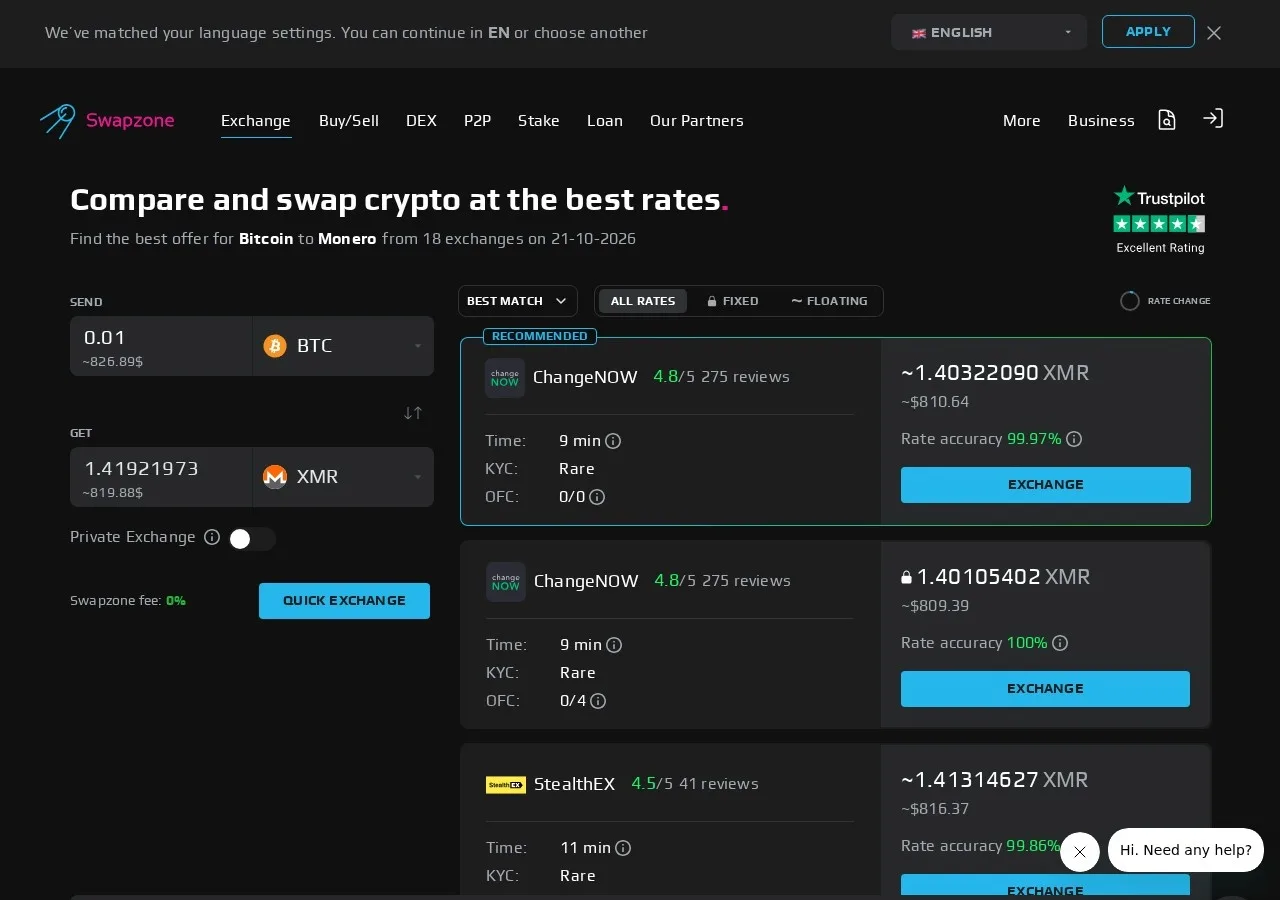
Compares real-time quotes, processing speed, and user ratings across more than 30 third-party exchange providers.
Fixed and floating rates
Offers fixed rates to protect against price volatility during settlement or floating rates to capture market moves.
Private exchange routing
Routes transactions through alternative paths to reduce direct on-chain links between deposit and receiving addresses.
KYC risk indicators
Displays the partner exchange's historical likelihood of triggering identity checks before you start a swap.
Multichain asset support
Supports over 3,000 cryptocurrencies across networks including Bitcoin, Ethereum, Solana, BNB Chain, and Avalanche.
B2B exchange API
Supplies an embedded API for third-party platforms to integrate instant cross-chain swaps with automated revenue sharing.
Inside Swapzone
Instant Crypto Exchange Aggregator
The main swap tool compares real-time rates, transaction speeds, and partner review scores across 30+ exchange providers for thousands of coins.
Private Exchange
This feature provides privacy-focused swap routing that reduces direct on-chain tracking between sending and receiving wallets.
Swapzone Crypto API & Widget
A B2B developer toolkit that enables third-party platforms to integrate non-custodial token swaps and fiat on-ramps with automated revenue sharing.
Swapzone screenshots
What users say about Swapzone
User sentiment is generally positive, with community members frequently recommending the platform for comparing exchange rates and trading privacy coins like Monero. The few negative mentions stem from broader frustration with linked third-party swap providers rather than the platform itself.
In their own words
“The best way to get XMR Hello guys, im not trying to sell anything but if you want get the best fees i use swapzone.io and sort it to best rate, some times you receive more value than you sent, also if you are new to XMR i recomend always use LTC-XMR”
“I bought my first Monero via swapzone.io. Worked great!”
“Swapzone.io aggregates best rates from DEX. Non-custodial, pick THORChain route.”
Scam warning: Malicious campaigns and fake exploit guides trick users into executing harmful browser JavaScript to intercept swap transactions.
Based on 60 Reddit posts and comments from the last 12 months, checked Oct 21, 2026. These are posts by users on other sites, not reviews submitted on CryptoReview.
User reviews
No user reviews yet. Have you used Swapzone? Share your experience below.
FAQ
What fees does Swapzone charge?
Swapzone charges a 0% platform fee for swaps. All third-party exchange and blockchain network fees are factored directly into the exchange rate displayed before confirming a transaction.
Does Swapzone require KYC verification?
Swapzone does not mandate account registration or identity verification to use its aggregator. However, individual partner exchanges may pause a transfer and request KYC if their compliance algorithms flag a deposit.
Is Swapzone a custodial exchange?
No, Swapzone is entirely non-custodial and does not hold user balances. Swaps execute wallet-to-wallet through integrated third-party partner exchanges.
Where is Swapzone based?
Swapzone is based in Tbilisi, Georgia, and has operated as an exchange aggregator since 2019.
What is Swapzone Private Exchange?
Private Exchange is a swap routing option designed to obscure the direct on-chain link between sending and receiving addresses. It alters transaction routing rather than bypassing partner AML or KYC checks.
Latest from Swapzone on Telegram
Swapzone
Join
@swapzone · 386 subscribers
“The operator Lucas is best ever.”
Crypto swaps don’t always go exactly as planned. And when something gets confusing, having someone who listens and helps you figure things out can make all the difference.
That’s what this review is about. Lucas helped clarify the situation and get the swap processed where it needed to be — and that meant enough for someone to take the time to share these kind words.
We’re proud of the people behind Swapzone who make a difference one conversation at a time.
Thank you for the trust, and Lucas, this one’s for you!
🔗 Official Links | Website | X (ex-Twitter) | Chat | Bot | Mini-App

Bitcoin swaps: can you cut the time in half?
Turns out, the route you choose can make a difference.
A five-week sample of completed swaps on Swapzone showed a median completion time of 3 minutes for Bitcoin Lightning swaps, compared to 6 minutes for regular BTC swaps.
That’s twice as fast in this sample and a good example of how the underlying network can shape the swap experience.
Our partners at @ChangeNOW_chat took a closer look at how Lightning makes this possible, and we were happy to contribute our data and insights to the discussion.
Curious about what makes the difference? Check out the full article
🔗 Official Links | Website | X (ex-Twitter) | Chat | Bot | Mini-App
Big moves from our partners at CoinRabbit
CoinRabbit is expanding the ways users can work with their digital assets by bringing tokenized stocks into the mix.
With options to hold and trade supported RWA assets, borrow against eligible holdings, and explore margin strategies, they’re taking another step toward more flexible asset management.
Love seeing our partners push boundaries and bring new ideas to the space. Keep building, CoinRabbit!
🔗 Official Links | Website | X (ex-Twitter) | Chat | Bot | Mini-App
Recent posts from the official Telegram channel @swapzone, shown as published. Not reviewed or endorsed by CryptoReview.
Alternatives to Swapzone

Institutional liquidity and turnkey trading infrastructure supporting over 1,500 instruments
KYC requiredSpot · Margin +2Futures & perpetualsBank transfer · Card

Regulated U.S. crypto exchange with 0% spot maker fees and over 200 listed assets
KYC requiredSpot · OTCAccepts US customersProof of reserves

Non-custodial swap aggregator offering wallet-to-wallet trading across 2,800+ cryptocurrencies
No KYCSpot2,800 coins listedCard

Regulated Canadian crypto marketplace acquired by Robinhood with Interac e-Transfer funding
KYC requiredSpot · OTCStaking / earn45 coins listed

European multi-asset broker offering 650+ cryptocurrencies, stocks, and precious metals under MiCAR rules
KYC requiredSpot · MarginStaking / earn650 coins listed

European crypto exchange with 453 assets, MiCA authorization and fees from 0.00%
Spot · MarginStaking / earnMaker fee 0.2%