

TON 🤝 Pumpfun
Welcome to TON, Pumpfun community!

TON
Proof-of-stake layer-1 blockchain integrated with Telegram featuring sub-second finality
3.6/ 5
Our score
Good
Layer
Layer 1
Consensus / design
Proof of Stake
Native token
GRAM
Block time
~0.4s
Typical transaction fee
0.00039 Gram
EVM compatible
No
What is TON?
The Open Network (TON) is a layer-1 proof-of-stake blockchain designed for high-throughput consumer applications. It embeds into Telegram Messenger, bringing peer-to-peer crypto transfers and decentralized web applications to Telegram users globally.
Founding and governance
TON was founded in 2018. Nikolai Durov authored the original whitepaper, and Pavel Durov served as co-founder. The initial project raised $1.7 billion via private SAFT token sales before Telegram stepped back from development in 2020 due to regulatory litigation with the SEC. Development continued under the TON Foundation alongside open-source contributors, with institutional backing from firms including Hypersphere and Mirana Ventures. In May 2026, Telegram re-engaged directly to steer development and operate as the network's largest validator.
Architecture and transaction mechanics
TON runs on an asynchronous actor model using dynamic sharding, where shardchains split and merge based on network demand. Smart contracts execute within the TON Virtual Machine (TVM) using languages such as FunC, Tact, and Tolk. Following the Catchain 2.0 consensus upgrade in April 2026, the network achieves block times of approximately 0.4 seconds and settlement finality in roughly 0.6 seconds. The native token is Gram (GRAM), previously known as Toncoin before a community rebrand in June 2026. Gram pays network execution fees, secures consensus, and enables governance voting.
Network fees and availability
Fees are fixed rather than dynamically scaled by network congestion. Standard transfers on TON cost 0.00039 Gram, USDt stablecoin transfers cost 0.001 Gram, and 50% of eligible fees are permanently burned. Mintless token mechanics allow drops to millions of recipients for a $1 network fee. TON is publicly accessible globally through non-custodial wallets and the embedded wallet interface inside Telegram globally through non-custodial wallets and Telegram's embedded wallet interface.
Track record and ecosystem risks
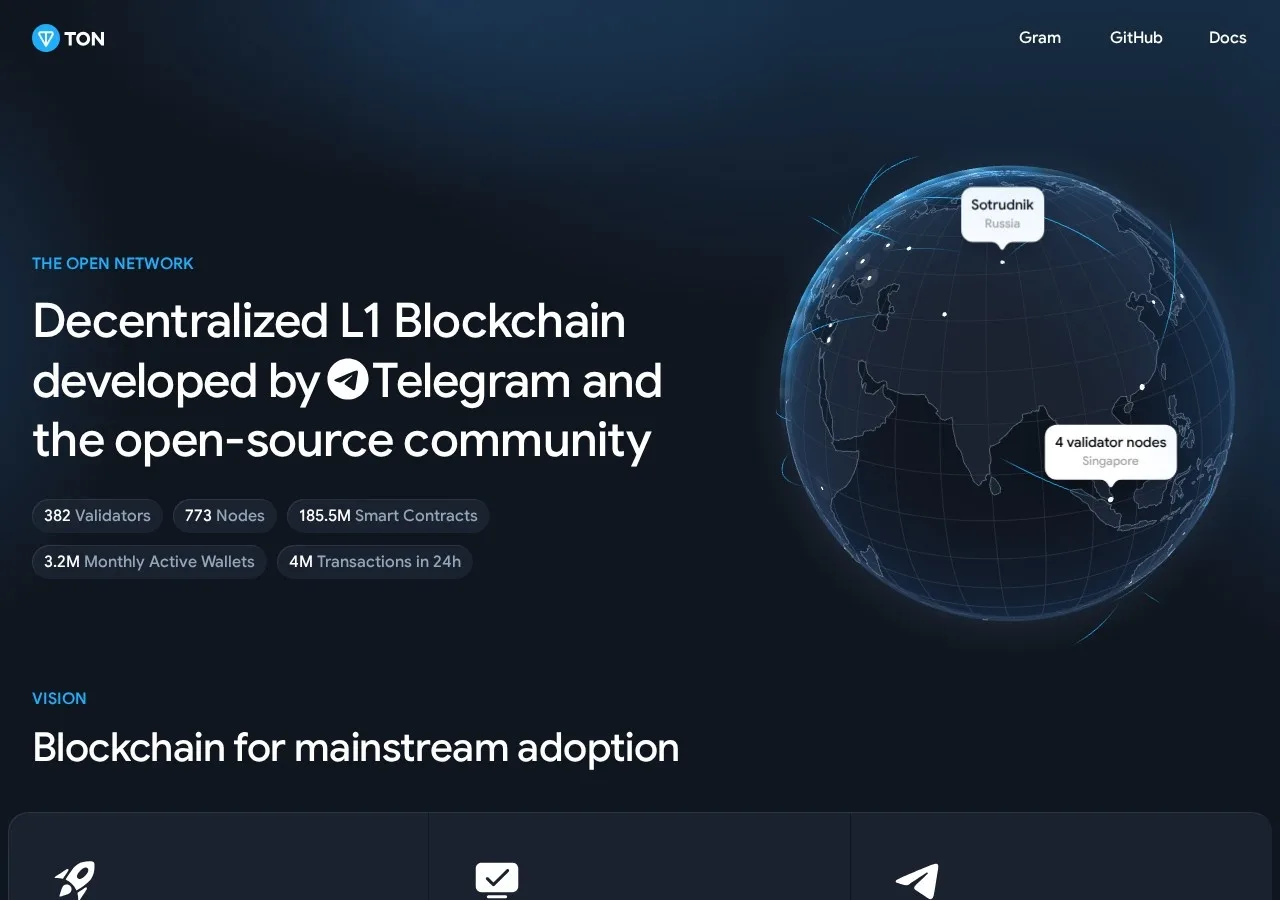
In October 2026, TON reported 382 active validators, over 760 active nodes, and 3.2 million monthly active wallets. Daily volume averaged roughly 4 million transactions, with approximately 1.4 billion USDt circulating natively on the chain. In May 2026, an exploit targeting the TAC Protocol cross-chain bridge path drained $2.8 million due to verification flaws in a custom contract. Staking decentralization also faces structural barriers, as running an independent validator requires substantial capital of around 1 million Gram, pushing smaller holders into delegation pools.
Founders
Nikolai DurovCo-founder
Co-founder of Telegram and primary author of the original TON whitepaper.
Pavel DurovCo-founder
Co-founder and CEO of Telegram.
Best for:Telegram mini-app developersLow-cost peer-to-peer stablecoin transfersMass token and NFT airdrops
Pros and cons
Pros
- Native access to Telegram users via embedded non-custodial wallets
- Sub-second settlement with 0.4-second block times and 0.6-second finality
- Fixed base fees of 0.00039 Gram per transfer regardless of network load
- Over 1.4 billion circulating native USDt on the network as of October 2026
Cons
- High validator staking requirement of roughly 1 million Gram limits solo validation
- DeFi liquidity and total value locked remain significantly lower than Ethereum and Solana
- Cross-chain bridge exploit in May 2026 led to $2.8 million in losses
- Non-EVM architecture requires developers to learn custom languages like Tact and FunC
Our review
3.6/5
Good
TON provides rapid, low-cost execution and broad reach via Telegram integration, but maintains high validator capital requirements and has a smaller DeFi footprint than competing layer-1s.
The Open Network (TON) operates as a Proof of Stake layer-1 blockchain built on an asynchronous actor model and dynamic sharding. Originally developed by Telegram founders Nikolai and Pavel Durov before being transitioned to open-source governance and later rejoined by Telegram, the network targets consumer-facing applications. The April 2026 deployment of the Catchain 2.0 consensus mechanism brought block times down to roughly 0.4 seconds and target finality to approximately 0.6 seconds. Transaction costs are fixed at 0.00039 Gram for standard transfers and 0.001 Gram for USDt transfers, remaining predictable regardless of on-chain traffic.
TON has native distribution inside Telegram Messenger. Over 3.2 million monthly active wallets interact with mini-apps, bots, and native peer-to-peer transfers through an embedded non-custodial wallet. With roughly 1.4B circulating USDt on the network in October 2026, stablecoin utility within social flows is established. The protocol burns 50% of eligible transaction fees. Gram was formerly known as Toncoin.
Technical and decentralization trade-offs include:
- Direct validation requires approximately 1 million Gram, while smaller holders can use delegation or liquid staking pools.
- Smart contracts execute on the stack-based TON Virtual Machine using Tolk, FunC, or Tact, and does not provide native EVM compatibility.
- The on-chain DeFi ecosystem remains relatively shallow, recording roughly $49M in total value locked in October 2026.
- Ecosystem security saw a major bridge vulnerability in May 2026, when an exploit on the TAC Protocol TON/EVM bridge resulted in $2.8 million in drained funds.
TON suits mini-app developers and projects seeking direct distribution to Telegram's audience.
Specs
| Layer | Layer 1 |
|---|---|
| Consensus / design | Proof of Stake |
| Native token | GRAM |
| EVM compatible | No |
| Smart contract languages | Tolk, FunC, Tact |
| Block time | ~0.4s · unverified |
| Typical transaction fee | 0.00039 Gram · unverified |
| Finality | ~0.6s · unverified |
| Validators / sequencer | 384 · unverified |
| Mainnet since | 2,021 · unverified |
| Throughput (TPS) | 100,000+ · unverified |
| Sequencer | Not applicable · unverified |
| Gas paid in | GRAM · unverified |
Not disclosed by the provider: Data availability.
Data from the provider's website and public sources. Fees and availability change; confirm on the official site before you sign up.
Key features
Telegram embedded wallet
A non-custodial wallet runs directly inside Telegram Messenger for peer-to-peer transfers and mini-app access.
Sub-second consensus
Catchain 2.0 Simplex consensus delivers 0.4-second block times and transaction finality in roughly 0.6 seconds.
Dynamic sharding
The mainnet automatically splits into parallel shardchains under heavy transaction volume and merges back during lower activity.
Fixed network fees
Gram transfers carry a predictable fee of 0.00039 Gram, while USDt transfers require 0.001 Gram regardless of traffic.
Native stablecoin support
Tether issues USDt directly on TON, with approximately 1.4 billion USDt circulating across the ecosystem.
Mintless token distributions
Jettons and NFTs can be distributed to millions of addresses simultaneously for a flat $1 network fee.
Inside TON
Gram Wallet in Telegram
A non-custodial wallet is embedded directly within Telegram Messenger for peer-to-peer transfers and interactions with mini-apps.
TON Connect
An authentication protocol that allows external applications and Telegram mini-apps to securely connect to TON wallet accounts.
TON DNS & Storage
Decentralized internet infrastructure protocols supporting human-readable on-chain domain names and distributed peer-to-peer file storage.
Catchain 2.0
The core Proof-of-Stake consensus engine running on a leader-based Simplex design that enables sub-second block generation and transaction finality.
TON screenshots
What users say about TON
Discussions directly evaluating TON are sparse, with positive feedback focusing on recent network fee reductions. There are no recurring complaints raised across multiple authors.
In their own words
“Make TON Great Again (MTONGA) Pavel Durov just revealed a major roadmap for TON called MTONGA (“Make TON Great Again”), and honestly, the upgrades already rolling out are pretty insane.”
Based on 22 Reddit posts and comments from the last 12 months, checked Oct 20, 2026. These are posts by users on other sites, not reviews submitted on CryptoReview.
User reviews
No user reviews yet. Have you used TON? Share your experience below.
Funding and investors
$1.7BTotal raised
3Rounds
3Investors
-
SAFT Jan 2018 $1.7BPS Private SAFT InvestorsSource
-
Funding round Amount undisclosed
-
Strategic Amount undisclosed
FAQ
Who founded TON?
Brothers Nikolai Durov and Pavel Durov founded TON in 2018 alongside Telegram. Following regulatory disputes in 2020, open-source contributors and the TON Foundation advanced the project before Telegram officially resumed direct involvement in 2026.
Does TON have a native token?
Yes, the native cryptocurrency is Gram (GRAM), which was previously known as Toncoin until a community rebrand in June 2026. Gram is used for gas fees, liquid staking, and validator voting.
What are the transaction fees on TON?
Standard Gram transfers cost 0.00039 Gram, while USDt transfers cost 0.001 Gram. Network fees are fixed and do not increase during periods of high network congestion.
Is TON compatible with the Ethereum Virtual Machine (EVM)?
No, TON does not run on the EVM. It uses the TON Virtual Machine (TVM) with dedicated programming languages including Tolk, FunC, and Tact.
Has TON experienced any security incidents?
In May 2026, a logic flaw in the TAC Protocol TON/EVM cross-chain bridge path resulted in an exploit that drained $2.8 million in assets.
Latest from TON on X
GRAM is now live on Aster! 💎
Today has been a very good day for GRAM listings.
Today has been a very good day for GRAM listings.
GRAM is now live on @binance.
Deposits, withdrawals, and spot trading all open.
With Binance done, most major exchanges have now completed the migration to GRAM. Big thanks to every team that handled the transition cleanly for users. https://t.co/pRC4B7cy69
Deposits, withdrawals, and spot trading all open.
With Binance done, most major exchanges have now completed the migration to GRAM. Big thanks to every team that handled the transition cleanly for users. https://t.co/pRC4B7cy69

GRAM is now live on Hyperliquid.
A big thank you goes out to the community for your support in getting Gram listed on Hyperliquid.
A big thank you goes out to the community for your support in getting Gram listed on Hyperliquid.
You can now trade GRAM on Bybit 💎
Recent public posts from @ton_blockchain, shown as published. Not reviewed or endorsed by CryptoReview.
Alternatives to TON
Proof-of-stake layer-1 blockchain securing nearly $50B in DeFi value since 2015
Layer 1Proof of StakeEVM compatible

Ethereum optimistic rollup securing over $12B with ~0.25-second block times and Stylus Rust contracts
Layer 2Optimistic rollupEVM compatible

Sharded Layer-1 blockchain supporting 1.2s finality and cross-chain execution across 35+ networks
Layer 1Proof of StakeNEAR
EVM sidechain with sub-two-second settlement, $0.002 average fees, and over 8 billion processed transactions
SidechainProof of StakeEVM compatible

Proof-of-stake layer 1 with sub-second finality and customizable sovereign appchains
Layer 1Proof of StakeEVM compatible
Ethereum layer 2 built on the OP Stack and incubated by Coinbase
Layer 2Optimistic rollupEVM compatible