

🔥 11 MILLION SHM. 30 WINNERS. BIG REWARDS!
Net Buy is heating up! 👀
Wondering what's at stake? Here's a look at the reward tiers! 🏆
🥇 Rank #1 takes home 2M SHM
🥈 Rank #2 grabs 1.75M SHM
🥉 Rank #3 scores 1.25M SHM
And that's not all! The Top 10 share 9M SHM, with rewards waiting for 30 winners!
Shardeum
EVM-compatible Layer 1 blockchain built for real-world asset tokenization and sub-3-second finality
3.2/ 5
Our score
Fair
Layer
Layer 1
Consensus / design
Proof of Stake
Native token
SHM
Block time
2-3 seconds
EVM compatible
Yes
What is Shardeum?
Shardeum is an EVM-compatible Layer 1 blockchain designed for real-world asset tokenization, decentralized finance, and high-throughput web applications. The network uses a modular architecture separating execution, state management, and consensus, delivering deterministic transaction finality with block times of 2 to 3 seconds.
Team and background
Founded in 2022, Shardeum is based in Zug, Switzerland, and operates with a team of 51 to 200 contributors. The project was co-founded by Nischal Shetty, who serves as President and is also the chief executive officer of Indian crypto exchange WazirX, alongside co-founder Omar Syed. Shardeum raised $23.6M in funding from venture investors to build out its infrastructure and ecosystem.
Architecture and core mechanics
Shardeum provides an EVM runtime that allows developers to deploy standard Solidity smart contracts using tools like Hardhat, Foundry, and Remix. End users interact with the network through EVM-compatible wallets such as MetaMask. State transitions and validation rely on a Proof-of-Stake mechanism where node operators stake the native SHM utility token to participate in consensus, and holders can delegate their SHM to active validators to earn staking rewards.
Fees and network utility
Transactions and smart contract executions require gas paid in SHM. The platform targets low, predictable fee structures to support microtransactions and consumer apps like social prediction tools and token launchpads.
Track record and milestones
Shardeum rolled out its EVM testnet in October 2025, followed by the deployment of its EVM mainnet in November 2025 alongside a 1:240 SHM redenomination token split. SHM trading subsequently expanded across exchanges including KuCoin, MEXC, and WazirX. In October 2026, the network enacted Governance Proposal 1 at block height 7,927,860, implementing the v1.1.0 upgrade that moved its underlying engine to Cosmos EVM v0.6.3.
Risks and operational trade-offs
The network remains in an early stage of operational maturity. In October 2026, the v1.1.0 protocol transition required a planned 25-minute network halt before operations resumed. As of May 2026, the active validator set stood at 24 nodes, presenting decentralization risks typical of early-stage proof-of-stake deployments. Projects and secondary asset transfers depend on ecosystem liquidity, while SHM token emission schedules expose delegators to inflation dynamics.
Founders
Nischal ShettyCo-founder & President
CEO and founder of Indian cryptocurrency exchange WazirX.
Omar SyedCo-founder
Best for:Developers deploying EVM Solidity dAppsReal-world asset tokenization issuersSHM holders seeking staking delegation
Pros and cons
Pros
- Block production every 2 to 3 seconds with deterministic finality
- Full EVM compatibility works directly with MetaMask and standard Solidity tooling
- Native SHM delegation lets holders earn staking yield without running hardware
- Raised $23.6M to back long-term infrastructure and ecosystem growth
Cons
- Relatively small active validator set of 24 nodes recorded in May 2026
- Experienced a planned 25-minute network halt during the October 2026 v1.1.0 upgrade
- SHM staking yield is vulnerable to token inflation and lockup schedules
- Young application ecosystem with limited total onchain liquidity
Our review
3.2/5
Fair
Shardeum offers low fees and EVM compatibility aimed at asset tokenization, but its active validator set remains small and decentralized adoption is still early.
Shardeum is an EVM-compatible Layer 1 blockchain founded in 2022 by Nischal Shetty and Omar Syed, operating out of Zug, Switzerland. The project has raised approximately $23.6 million in funding from venture investors. Following an initial testnet cycle, the network transitioned to its EVM mainnet in November 2025 alongside a 1:240 SHM token redenomination split. In October 2026, the network executed its first onchain governance-led mainnet upgrade, moving to Cosmos EVM v0.6.3 with a planned 25-minute network interruption at block height 7,927,860.
The network relies on Proof of Stake consensus, where validators stake SHM to produce blocks and achieve deterministic finality with block times between 2 and 3 seconds. SHM is the gas asset for transactions and powers staking delegation. Developers can deploy existing Solidity smart contracts using standard tools like Hardhat, Foundry, and Remix without architectural changes.
Key strengths include:
- Predictable transaction costs designed for microtransactions and real-world asset workflows.
- Full EVM parity allows standard Web3 wallets like MetaMask to connect directly via custom RPC.
- Deterministic block finality occurring within seconds, eliminating deep confirmation delays.
The network also faces trade-offs. The active validator set numbered 24 active nodes as of May 2026, presenting a narrower validator base than older Proof of Stake networks. Monthly trading volume stood at just over $300,000 in September 2026, and primary ecosystem activity remains concentrated in early-stage dApps like Sikka.fun and cross-chain tooling like Houdini Swap.
Shardeum suits Solidity developers and tokenization platforms seeking low-fee EVM execution with fast finality. Teams requiring deeply liquid DeFi markets, high total value locked, or battle-tested decentralization across hundreds of independent validators should consider established networks like Ethereum or Polygon.
Specs
| Layer | Layer 1 · unverified |
|---|---|
| Consensus / design | Proof of Stake · unverified |
| Native token | SHM · unverified |
| EVM compatible | Yes · unverified |
| Smart contract languages | Solidity · unverified |
| Block time | 2-3 seconds · unverified |
| Finality | Deterministic · unverified |
| Validators / sequencer | 24 · unverified |
| Mainnet since | 2,025 · unverified |
| Sequencer | Not applicable · unverified |
| Gas paid in | SHM · unverified |
Not disclosed by the provider: Typical transaction fee, Throughput (TPS), Data availability.
Data from the provider's website and public sources. Fees and availability change; confirm on the official site before you sign up.
Key features
EVM compatibility
Executes Solidity smart contracts natively, so developers can deploy applications using standard tooling like Hardhat, Foundry, and Remix.
Fast deterministic finality
Produces blocks every 2 to 3 seconds, settling transactions deterministically without waiting for multi-block confirmations.
Proof-of-Stake delegation
Enables SHM token holders to delegate tokens to active validators to secure the ledger and accrue staking rewards.
Programmable RWA infrastructure
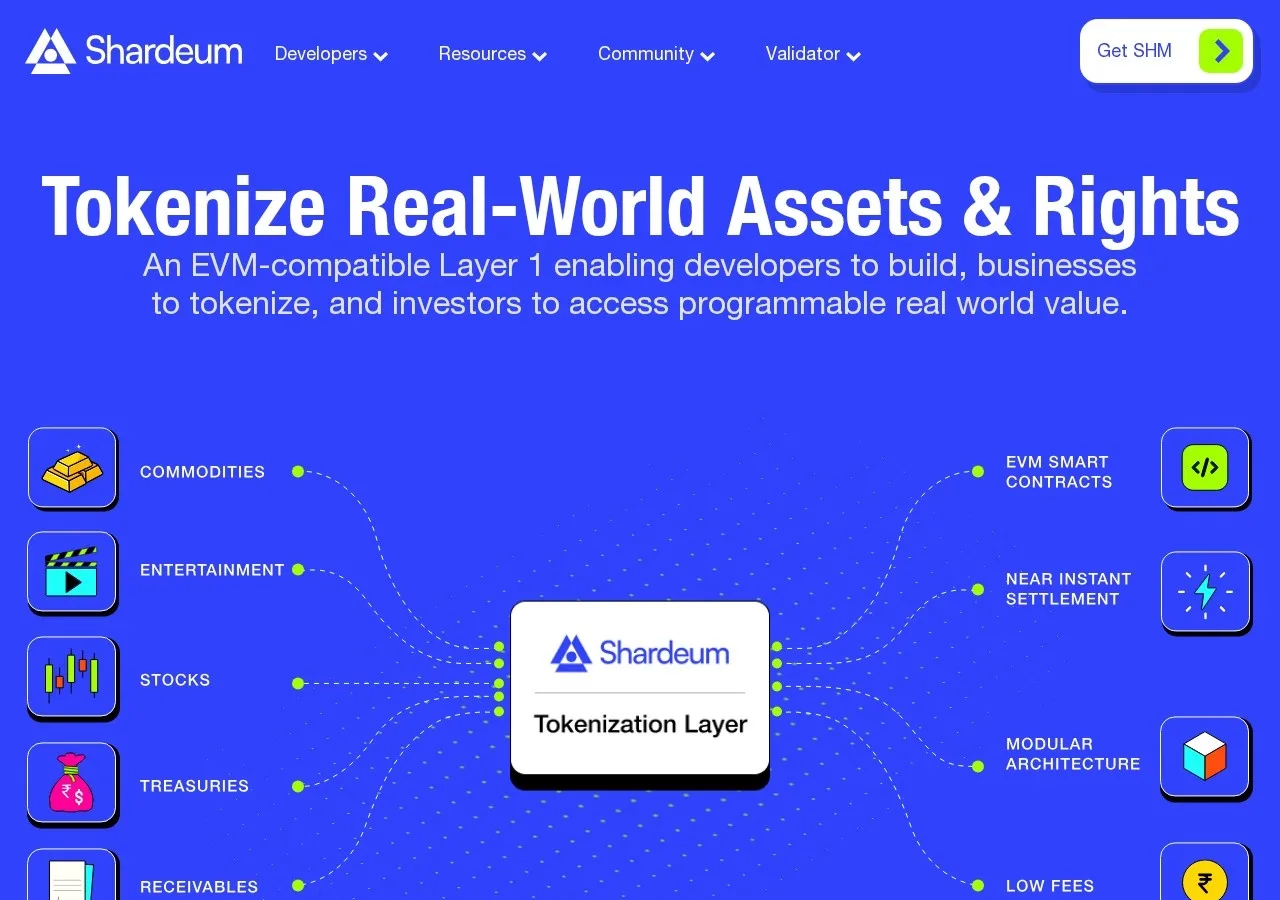
Provides smart contract rails to mint, pause, redeem, and program the lifecycle of tokenized real-world assets.
Cosmos EVM core
Runs on the Cosmos EVM stack updated to v0.6.3 as of the v1.1.0 mainnet governance upgrade.
Inside Shardeum
Shardeum L1
The core EVM-compatible Layer 1 blockchain offering deterministic finality within 2 to 3 seconds for smart contracts and asset tokenization.
SHM Staking & Delegation
The network's native staking portal where holders delegate SHM to active validators to help secure the Proof of Stake consensus.
Smart Contracts & Developer Tooling
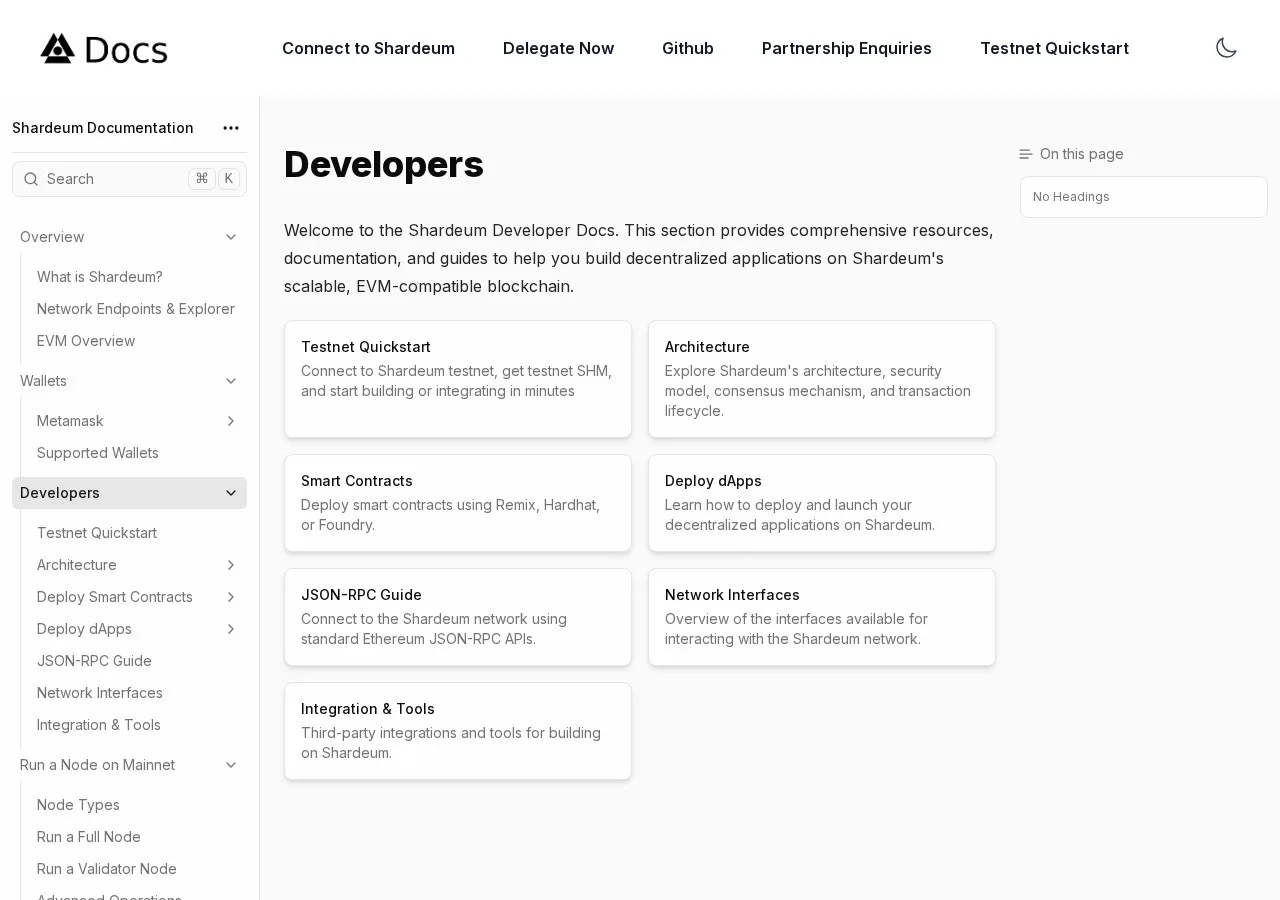
Standard EVM integration points allowing developers to build and deploy contracts using Remix, Hardhat, or Foundry.
Shardeum screenshots
User reviews
No user reviews yet. Have you used Shardeum? Share your experience below.
FAQ
Who founded Shardeum?
Shardeum was co-founded in 2022 by Nischal Shetty, the CEO of crypto exchange WazirX, and Omar Syed.
What is the native token of Shardeum?
SHM is the native token of the network. It pays for gas fees, secures the chain through validator staking and delegation, and is traded on exchanges like KuCoin, MEXC, and WazirX.
Is Shardeum compatible with Ethereum smart contracts and MetaMask?
Yes, Shardeum is fully EVM compatible. Developers can write contracts in Solidity, and users can interact with the network using standard EVM wallets like MetaMask via custom RPC endpoints.
Has Shardeum experienced any network halts or security incidents?
Shardeum conducted a planned 25-minute network halt on October 13, 2026, to execute its v1.1.0 mainnet upgrade to Cosmos EVM v0.6.3 at block height 7,927,860.
How does staking work on Shardeum?
SHM holders can secure the network by operating a validator node or by delegating their tokens to active validators to earn staking rewards.
Latest from Shardeum on X
Congratulations to our winners @INvioneL8B8 @OzenAlaz @oluwaseun96164 🎉
Please dm us your wallet details for prizes! 👻
Please dm us your wallet details for prizes! 👻
🔥 The race for 11M SHM in rewards is on!
🥇 2M SHM for Rank #1
🏆 Rewards for the Top 10
🎁 100K SHM each for Ranks 11 to 30
📊 Rankings are based on net buy, not trading volume. Every buy adds to your net buy, while sells reduce it.
🛒 Buy Period ends 2 Nov, 6 PM IST
🥇 2M SHM for Rank #1
🏆 Rewards for the Top 10
🎁 100K SHM each for Ranks 11 to 30
📊 Rankings are based on net buy, not trading volume. Every buy adds to your net buy, while sells reduce it.
🛒 Buy Period ends 2 Nov, 6 PM IST
Gm Shardians 🚀
GM frensss & Happy November!
New month, new energy! 💃 https://t.co/nMoROf9LqM
New month, new energy! 💃 https://t.co/nMoROf9LqM

Recent public posts from @shardeum, shown as published. Not reviewed or endorsed by CryptoReview.
Latest from Shardeum on Telegram

Shardeum
Join
@shardeum · 7.9K subscribers
⏳ Just 22 Hours Left in Sikka.fun Contest 40!
🔥 The race for 11M SHM in rewards is on!
🥇 2M SHM for Rank #1
🏆 Rewards for the Top 10
🎁 100K SHM each for Ranks 11 to 30
📊 Rankings are based on net buy, not trading volume. Every buy adds to your net buy, while sells reduce it.
🛒 Buy Period ends 2 Nov, 6 PM IST.
Make your moves before the contest closes! 🚀
Check the leaderboard 👇
https://sikka.fun/leaderboard/contest-40

👀 Know the Reward Tiers: Sikka.fun Contest 40 · Net Buy!
💰 11M SHM in rewards for the Top 30 traders!
🥇 2M SHM for Rank #1
🥈 1.75M SHM for Rank #2
🥉 1.25M SHM for Rank #3
🎁 250K to 1M SHM for Ranks 4 to 10
🏅 100K SHM each for Ranks 11 to 30
📊 Rankings are based on net buy. Buys increase your net buy, while sells reduce it.
🪙 Trade the 3 eligible coins and qualify for your reward tier:
🔹 Shantum (STM) 👉 https://sik.gg/shantum
🔹 Conso (Conso) 👉 https://sik.gg/conso
🔹 Smiley (SML) 👉 https://sik.gg/smiley
Check the leaderboard 👇
https://sikka.fun/leaderboard/contest-40

101 View on Telegram
📢 Climb the Leaderboard: Sikka Net Buy Contest
💰 11M SHM in rewards!
🥇 2M SHM for Rank #1
🏆 9M SHM shared among the Top 10
🎁 100K SHM each for Ranks 11 to 30
Buy Shantum, Conso, or Smiley on Sikka and climb the leaderboard!
📊 Rankings are based on net buy. Make sure to maintain your qualifying position throughout the holding period to remain eligible for rewards.
📈 Track the live leaderboard:
https://sikka.fun/leaderboard/contest-40

109 View on Telegram
🚨 Quiz Alert!
👉 Topic: Sikka Net Buy Contest
👉 When: Friday, 30th October 2026
👉 Time: 2:30 PM UTC
👉 Where: https://discord.gg/shardeum
Test your knowledge on Sikka Net Buy Contest & win - Top 5 winners will share 100,000 $SHM!
Click on interested to get notified ⤵️
https://discord.com/events/933959587462254612/1425379276760551424

105 View on Telegram
Recent posts from the official Telegram channel @shardeum, shown as published. Not reviewed or endorsed by CryptoReview.
Alternatives to Shardeum
Proof-of-stake layer-1 blockchain securing nearly $50B in DeFi value since 2015
Layer 1Proof of StakeEVM compatible

Ethereum optimistic rollup securing over $12B with ~0.25-second block times and Stylus Rust contracts
Layer 2Optimistic rollupEVM compatible
Sharded Layer-1 blockchain supporting 1.2s finality and cross-chain execution across 35+ networks
Layer 1Proof of StakeNEAR
EVM sidechain with sub-two-second settlement, $0.002 average fees, and over 8 billion processed transactions
SidechainProof of StakeEVM compatible
Proof-of-stake layer 1 with sub-second finality and customizable sovereign appchains
Layer 1Proof of StakeEVM compatible
Ethereum layer 2 built on the OP Stack and incubated by Coinbase
Layer 2Optimistic rollupEVM compatible