
Monday check-in from LightLink Mainnet:
→ 235.7M blocks
→ 94.6M txs
→ 6.0M addresses
→ 705.1K txs in the last 30 days
1.2M of those blocks landed this week alone, one every ~0.5s, nights and weekends included 🤠 https://t.co/7hs5ffowBs


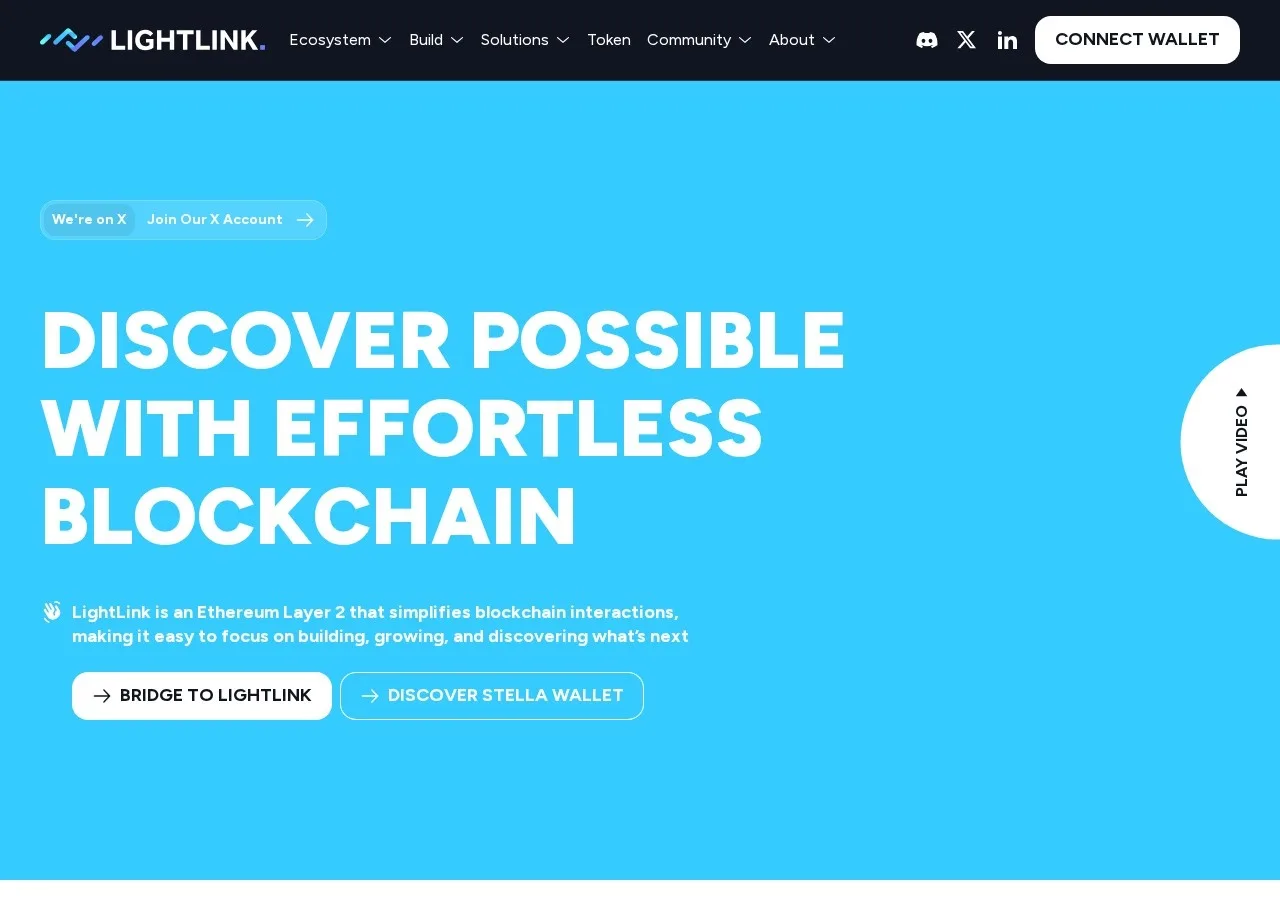
Ethereum Layer 2 Optimium network featuring gasless enterprise transactions and Celestia data availability
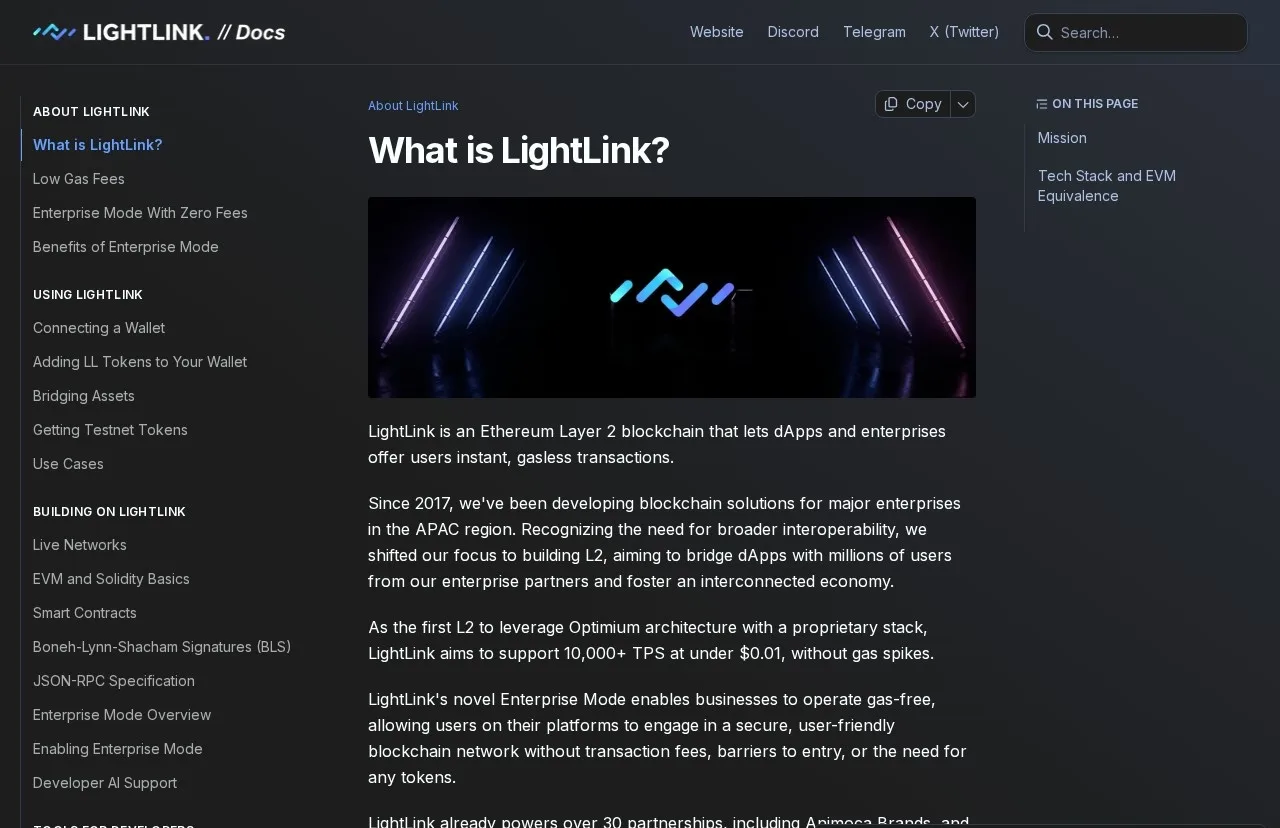
LightLink is an EVM-equivalent Ethereum Layer 2 blockchain designed to remove end-user transaction fees through a dedicated Enterprise Mode subscription model. Built using an Optimium architecture with Celestia for off-chain data availability, the network settles state updates to Ethereum while processing blocks at approximately 0.5-second intervals.
The network was developed out of Pellar Technology, an enterprise blockchain development studio founded in 2017. Co-founder and CEO Roy Hui, a computer science graduate who has been active in cryptocurrency since 2012, leads the project. LightLink has raised $11.5 million in total funding, including an initial $4.5 million seed round announced in February 2024 led by APAC firms MQDC and T&B Media Global, with participation from Blue7, JellyC, and B3V.
LightLink operates Phoenix mainnet alongside its Pegasus testnet. Built on a modified Geth client, the chain allows developers to deploy standard Solidity smart contracts without code changes. Standard user transactions execute at roughly $0.01 per operation. To eliminate friction for consumer applications, businesses can activate Enterprise Mode by registering smart contracts and paying upfront subscriptions in stablecoins. The protocol converts these stablecoins into native LL tokens to subsidize gas, letting whitelisted end-user accounts send transactions with a gas price of zero. Users move assets onto the network via the official bridge or third-party liquidity routes like Stargate.
LightLink launched its Phoenix mainnet in 2023. The project partnered with Animoca Brands and powers Lamborghini's Fast ForWorld digital platform. In October 2025, the team deployed a Strategic Reserve treasury mechanism to channel enterprise fees into LL token acquisitions, followed by an early access beta of its chain-abstracted Stella Wallet in November 2025. By October 2026, the mainnet had processed over 94 million transactions across more than 5.9 million generated wallet addresses.
Because LightLink uses an Optimium architecture relying on Celestia rather than posting all transaction call data directly to Ethereum Layer 1, users rely on external data availability committees. The network operates centralized sequencer infrastructure typical of early-stage Layer 2 rollups, creating potential single-point-of-failure risks. Additionally, secondary exchange liquidity experienced a setback when Bybit delisted the native LL token in January 2026, and total value locked in decentralized finance protocols stood under $25,000 as of October 2026.
LightLink enables zero-fee end-user transactions through its enterprise gas subsidy model, but its on-chain liquidity remains low with about $22,000 in total value locked.
LightLink is an Ethereum Layer 2 network designed around Optimium architecture that uses Celestia for data availability and settles state to Ethereum. Founded out of Pellar Technology by CEO Roy Hui, who started purchasing Bitcoin in 2012, the project launched its Phoenix mainnet in 2023 after raising $11.5M from investors including MQDC and T&B Media Global. The chain operates with approximately 0.5-second block times and claims capacity exceeding 10,000 transactions per second, with standard user transactions costing around $0.01 in gas.
The network's primary differentiator is Enterprise Mode. Instead of forcing end users to manage native gas tokens, decentralized applications and commercial partners can pay an upfront subscription in stablecoins. This registers smart contracts to subsidize executions directly. Users can then interact on-chain with zero gas fees. While this model eliminates onboarding friction for consumer and enterprise integrations like Lamborghini's Fast ForWorld, it introduces distinct architectural trade-offs:
LightLink suits enterprise developers and consumer-facing applications aiming to abstract away gas fees entirely for non-technical users. Traders and DeFi protocols requiring deep native liquidity or distributed sequencer redundancy should consider larger rollups such as Arbitrum or Optimism instead.
| Layer | Layer 2 · unverified |
|---|---|
| Consensus / design | Optimistic rollup · unverified |
| Native token | LL · unverified |
| EVM compatible | Yes |
| Smart contract languages | Solidity · unverified |
| Block time | ~0.5s · unverified |
| Typical transaction fee | $0.01 · unverified |
| Finality | 0.5s · unverified |
| Mainnet since | 2,023 · unverified |
| Throughput (TPS) | 10000+ · unverified |
| Data availability | Celestia · unverified |
| Gas paid in | ETH · unverified |
Not disclosed by the provider: Validators / sequencer, Sequencer.
Data from the provider's website and public sources. Fees and availability change; confirm on the official site before you sign up.
Applications pay a fixed monthly subscription in stablecoins so end users can execute on-chain transactions with zero gas fees.
The protocol implements an Optimium model that leverages Celestia for off-chain data availability while settling to Ethereum.
Developers can deploy unmodified Solidity smart contracts using standard Ethereum tooling, RPC endpoints, and Geth-based architecture.
Phoenix mainnet produces blocks roughly every 0.5 seconds, delivering nominal transaction fees of approximately $0.01 for standard operations.
Users move assets between Ethereum Layer 1 and LightLink using the official canonical bridge or integrated cross-chain protocols.
A native chain-abstracted wallet supports social logins via Apple, Google, and X without requiring users to store seed phrases.
A gas-subsidy protocol feature where applications pay a fixed stablecoin subscription so registered users transact on-chain with zero gas fees.
A chain-abstracted account wallet that offers social logins through Google, Apple, or X and incorporates natural language AI agent execution.
The native cross-chain portal that moves ETH and other digital assets between Ethereum Layer 1 and the LightLink network.
The live production Layer 2 network operating with Chain ID 1890 and EVM execution settled to Ethereum.
The public developer testbed anchored to Ethereum test networks for testing contracts and Enterprise Mode parameters.
No user reviews yet. Have you used LightLink? Share your experience below.
LightLink was founded by CEO Roy Hui, who established Pellar Technology and has worked in the blockchain industry since 2017.
Standard transactions cost approximately $0.01 on the Phoenix mainnet. Applications running Enterprise Mode can cover transaction costs upfront so end users pay $0 in gas.
Yes, LightLink's native token is LL. It is utilized within the ecosystem for governance, network incentives, and treasury reserves.
Enterprises and dApps purchase gas quotas in stablecoins and whitelist specific smart contracts. Users interacting with those contracts send transactions with gas price set to zero without holding tokens.
While no protocol smart contract exploits have occurred, the native LL token was delisted by the Bybit exchange in January 2026.
Yes, LightLink is fully EVM-equivalent. Developers can deploy unmodified Solidity smart contracts using standard tools like Geth, Hardhat, or Foundry.


Recent public posts from @lightlinkchain, shown as published. Not reviewed or endorsed by CryptoReview.
Proof-of-stake layer-1 blockchain securing nearly $50B in DeFi value since 2015
Ethereum optimistic rollup securing over $12B with ~0.25-second block times and Stylus Rust contracts
Sharded Layer-1 blockchain supporting 1.2s finality and cross-chain execution across 35+ networks
EVM sidechain with sub-two-second settlement, $0.002 average fees, and over 8 billion processed transactions
Proof-of-stake layer 1 with sub-second finality and customizable sovereign appchains
Ethereum layer 2 built on the OP Stack and incubated by Coinbase
Type at least two characters. Press ↵ to see all results.