

Why does moving $100 across chains require locking 8-9 figures somewhere? Genuinely asking. We already fixed it, we just want to know why everyone else is still doing it.
Coinweb
Cross-chain layer 2 execution platform connecting 12 blockchains without an intermediate consensus layer
3.4/ 5
Our score
Fair
Layer
Layer 2
Consensus / design
Other
Native token
CWEB
EVM compatible
Yes
What is Coinweb?
Coinweb is a cross-chain computation layer and interoperability platform that runs decentralized applications across multiple underlying blockchains without introducing an independent consensus mechanism. By proving data directly from connected base layers, the protocol executes cross-chain logic while relying on the finality and security of the underlying networks.
Leadership and background
Founded in 2017, Coinweb is led by co-founder and chief executive officer Toby Gilbert alongside co-founder and chief technology officer Knut Vinger. Gilbert previously founded startups and completed exits across three telecommunications businesses in Europe, Africa, and Asia. Vinger studied at the University of Oslo, where his thesis on evolutionary hardware was published by NASA and the United States Department of Defense, and previously served as chief technology officer of Nouvel Air Group Inc.
Architecture and operational mechanics
Unlike traditional layer 2 rollups or sidechains that maintain their own validator sets, Coinweb is a distributed computation model over base networks. It reads canonical data directly from underlying layer 1 blockchains so smart contracts can run deterministically. Contracts self-activate and execute autonomously as long as they retain a gas balance in the native utility token, CWEB. Supported networks include Bitcoin, Ethereum, BNB Chain, Polygon, Arbitrum, Litecoin, and MultiversX, reaching 12 supported chains by July 2026. Transaction batching, ordinal address encoding, and signature aggregation reduce gas consumption to as low as 1,250 gas per EVM transaction. With these optimizations, theoretical execution throughput reaches up to 32,000 transactions per second on BNB Chain and 12,000 transactions per second on Polygon.
Fees and network assets
Platform execution and inter-chain coordination require the native CWEB token, which also trades as an ERC-20 token (wCWEB) on external exchanges. Decentralized applications can issue native cross-chain tokens through tools like Linkmint, so end users can conduct transactions without holding the underlying layer 1 gas asset. Coinweb also supports decentralized trading through Pact Swap, built on its PACT framework to coordinate cross-chain settlements using bonded collateral rather than pooled bridge liquidity.
Track record and limitations
In December 2020, two payment platforms deployed using Coinweb components issued and sold more than $90M in stable tokens within their first year. The project published an updated whitepaper detailing its parallel computation model in May 2021 and added Arbitrum support in July 2026. However, Coinweb nodes target Kubernetes clusters, resulting in fewer installations than traditional Layer 1 networks. Applications remain exposed to the latency, finality rules, and fee conditions of whichever base chains they read or settle on.
Founders
Toby GilbertCo-Founder & CEO
Previously invested in and exited three telecommunications companies operating in Europe, Africa, and Asia.
Knut VingerCo-Founder & CTO
Studied at the University of Oslo, had research on evolutionary hardware published by NASA and the US DoD, and served as CTO of Nouvel Air Group Inc.
Best for:Cross-chain dApp developersMulti-network automated smart contractsToken issuers avoiding base-chain gas requirements
Pros and cons
Pros
- Eliminates intermediate bridge consensus sets by verifying base-layer data directly
- Optimizes data footprints down to 1,250 gas per EVM transaction
- Runs autonomous contracts powered by a single gas token across 12 blockchains
- Demonstrated stability during external network halts on connected base layers
Cons
- Kubernetes-targeted node deployments mean fewer independent node installations than standard L1s
- Cross-chain transaction finality remains bounded by underlying base layer settlement times
- Protocol smart contract execution requires holding and managing balances of CWEB
Our review
3.4/5
Fair
Coinweb provides cross-chain computation without adding a separate consensus layer, though its execution relies on base-layer settlement and node infrastructure geared toward Kubernetes clusters.
Founded in 2017 by Toby Gilbert and Knut Vinger, Coinweb operates as an interoperability computation layer rather than a standalone Layer 1 blockchain. The network connects multiple chains, including Bitcoin, Ethereum, BNB Chain, Polygon, Arbitrum, Litecoin, and MultiversX. Instead of introducing an intermediate validator set to vote on cross-chain transactions, Coinweb verifies state deterministically from underlying base networks. Transactions settle into host layer-1 blocks, inheriting the finality and consensus guarantees of the specific chains in use.
- Coinweb reduces layer-1 gas consumption down to 1,250 gas per transaction using batching, address compression, and signature aggregation, reaching a theoretical maximum throughput of 32,000 TPS on BNB Chain, 12,000 TPS on Polygon, and 2,000 TPS on Ethereum.
- Reactive smart contracts monitor connected base chains continuously and execute logic autonomously as long as a sufficient CWEB gas balance remains.
- Coinweb targets Kubernetes deployments and relies on client-side proofs, so a client requires access to only one honest node to verify computational accuracy.
Coinweb eliminates intermediate cross-chain bridges for cross-chain execution. The PACT framework relies on bonded collateral and canonical base-chain state for cross-chain settlement. However, transaction execution remains bound by the finality periods and gas fees of whichever host blockchains an application touches.
Coinweb suits developers building multi-chain decentralized applications that require unified cross-chain logic across diverse networks such as Bitcoin and EVM chains.
Specs
| Layer | Layer 2 · unverified |
|---|---|
| Consensus / design | Other · unverified |
| Native token | CWEB · unverified |
| EVM compatible | Yes · unverified |
| Throughput (TPS) | Up to 32,000 on BNB Chain, 12,000 on Polygon, 2,000 on Ethereum · unverified |
| Data availability | Underlying base layer blockchains · unverified |
| Gas paid in | CWEB · unverified |
Not disclosed by the provider: Smart contract languages, Block time, Typical transaction fee, Finality, Validators / sequencer, Mainnet since, Sequencer.
Data from the provider's website and public sources. Fees and availability change; confirm on the official site before you sign up.
Key features
Cross-chain contract execution
Reactive smart contracts monitor underlying chains directly and execute autonomous logic across 12 supported networks without third-party bridges.
Consensus-free verification
The protocol validates base-layer data directly through cryptographic proofs, removing the need for an intermediate validator consensus layer.
Gas-free token transfers
Tokens issued on the network allow end users to transact without maintaining separate layer 1 gas balances on each underlying chain.
Optimized EVM throughput
Batching and signature aggregation lower EVM transaction sizes to 1,250 gas, delivering up to 32,000 TPS on BNB Chain.
CWEB fuel and coordination
Network operations, smart contract runtime balances, and cross-chain data synchronization are settled with the CWEB utility token.
PACT bonded settlement
Cross-chain swaps use bonded collateral and final base-layer states rather than locked bridge liquidity pools.
Inside Coinweb
Coinweb Protocol
The core computation layer executing cross-chain logic and parallel smart contracts without an intermediate consensus chain.
Linkmint
A token issuance solution designed to launch cross-chain tokens that run natively across multiple underlying blockchains.
PACT Framework
A cross-chain settlement framework that uses bonded collateral and overlay verification to execute swaps and transfers without multi-sig bridge pools.
Deconx DEX
A decentralized trading exchange built to handle cross-chain asset swaps on Coinweb's execution architecture.
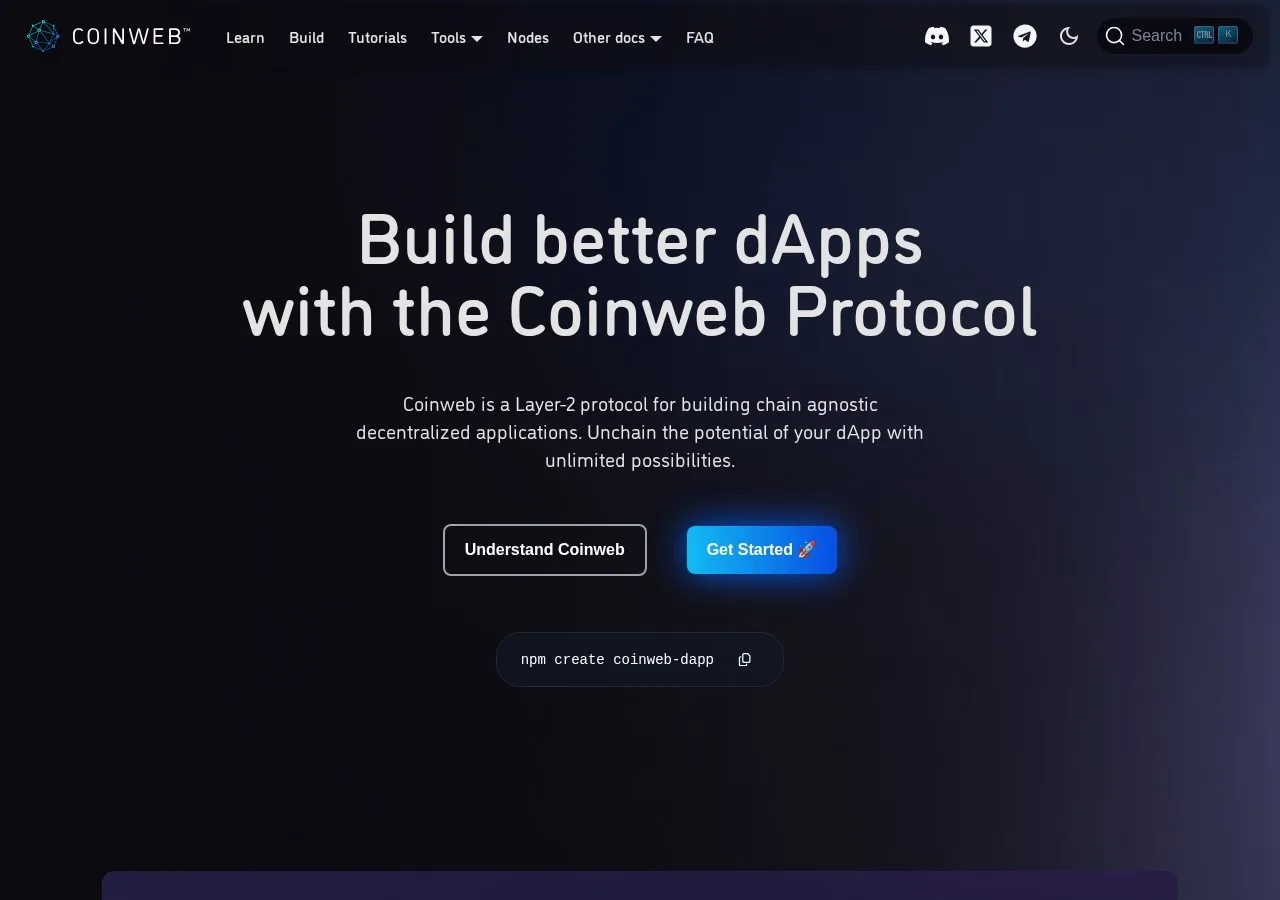
Coinweb screenshots
User reviews
No user reviews yet. Have you used Coinweb? Share your experience below.
FAQ
Who founded Coinweb?
Coinweb was founded in 2017 by Toby Gilbert, who serves as CEO, and Knut Vinger, who serves as CTO. Gilbert previously built and exited three telecommunications companies, while Vinger conducted research on evolutionary hardware published by NASA.
Does Coinweb have a native token?
Yes, Coinweb uses the CWEB token to power its network. CWEB pays for transaction fees, powers reactive smart contract execution, and rewards information traders who synchronize data across chains.
What consensus mechanism does Coinweb use?
Coinweb does not run its own consensus layer. It verifies transaction data directly from underlying blockchains deterministically, inheriting the consensus and finality of whichever chains an application touches.
What blockchains does Coinweb support?
Coinweb supports 12 blockchains, including Bitcoin, Ethereum, BNB Chain, Polygon, Arbitrum, Litecoin, and MultiversX. The network allows smart contracts to read and coordinate state across these chains without intermediary bridges.
What are Coinweb's transaction fees?
Coinweb optimizes transactions to consume as little as 1,250 gas on EVM networks via batching and address compression. Users pay computation and protocol fees using CWEB alongside the storage costs required by the underlying layer-1 chains.
Latest from Coinweb on X
The real cost of a cross-chain transaction isn't gas. It's the collateral sitting idle because your bridge can't prove your funds are safe without locking multiples of their value.
Provable finality changes that math entirely.
Provable finality changes that math entirely.
Every dollar of excess collateral locked in a bridge exists for one reason: the system has no way to verify what happened on the other chain, so it substitutes capital for certainty.
Fix the verification problem and the capital requirement collapses with it. That's the entire thesis behind the PACT Framework.
Fix the verification problem and the capital requirement collapses with it. That's the entire thesis behind the PACT Framework.
Here are 5 things about the PACT Framework everyone should know:
Cross-chain settlement? We fixed the trust problem.
🔹 No trusted third party.
🔹 No extra synchrony needed.
🔹 Bonded collateral enforces it.
Bridges get exploited. PACT gets bonded.
🔹 Overlay layers watch, don't guess.
🔹 Only acts on final state.
🔹 No reorg surprises.
One other party doesn't deliver? You're covered.
🔹 Stable party safeguarded by collateral.
🔹 Unstable party pays compensation.
🔹 No arbiter required.
Timing matters. PACT makes it explicit.
🔹 Staggered leader/follower timeouts.
🔹 Confirmations always arrive first.
🔹 No silent race conditions.
Delayed finality? Built in.
🔹 Actions wait for stability.
🔹 Queues respect chain delays.
🔹 Settlement you can prove.
This is the PACT Framework. Bonded settlement for cross-chain, without the trust.
Small progress update.
MultiversX halted their network shortly after the Supernova upgrade, and Coinweb kept running smart contract deployments the entire time without interruption. This is the benefit of building on top of many chains instead of betting everything on one: no single chain's heartbeat can stop the system.
We've also started exploring private swaps built using the PACT Framework, albeit very very very early stage.
New price oracles are in testing now, including ARB-USD and SOL-USD, and Solana smart contract event gathering has been introduced at the core level.
On the infra side: our testing SDK and core simulation got a serious upgrade, cutting some test runs from minutes down to seconds. The new Contract Kit is being hardened ahead of migrating existing contract code, and early improvements have already cut some contract-flow execution times by around 50%.
Steady progress across the board.
Recent public posts from @CoinwebOfficial, shown as published. Not reviewed or endorsed by CryptoReview.
Alternatives to Coinweb
Proof-of-stake layer-1 blockchain securing nearly $50B in DeFi value since 2015
Layer 1Proof of StakeEVM compatible

Ethereum optimistic rollup securing over $12B with ~0.25-second block times and Stylus Rust contracts
Layer 2Optimistic rollupEVM compatible

Sharded Layer-1 blockchain supporting 1.2s finality and cross-chain execution across 35+ networks
Layer 1Proof of StakeNEAR
EVM sidechain with sub-two-second settlement, $0.002 average fees, and over 8 billion processed transactions
SidechainProof of StakeEVM compatible
Proof-of-stake layer 1 with sub-second finality and customizable sovereign appchains
Layer 1Proof of StakeEVM compatible
Ethereum layer 2 built on the OP Stack and incubated by Coinbase
Layer 2Optimistic rollupEVM compatible