

TRON is part of everyday spending.
New @oobit research connects onchain activity with real-world card payments across groceries, dining, transport, and more.
TRON
Delegated proof-of-stake layer-1 blockchain hosting over $92B in circulating USDT
3.7/ 5
Our score
Good
Layer
Layer 1
Consensus / design
Delegated PoS
Native token
TRX
Block time
3 seconds
Typical transaction fee
0
EVM compatible
Yes
What is TRON?
TRON is an EVM-compatible layer-1 blockchain running on a delegated proof-of-stake consensus architecture. It is widely used for digital payments and carries over $92.7B in circulating USDT, maintaining more than $5.5B in total value locked as of October 2026.
Founders and governance
TRON was founded in Singapore in July 2017 by Justin Sun, the former chief representative for Ripple's China business and founder of Peiwo. The project raised approximately $70M through an initial coin offering in September 2017 before mainland China banned digital token sales. In November 2021, Sun resigned as CEO of the TRON Foundation to take a diplomatic post for Grenada, and governance reorganized under the community-led TRON DAO structure.
Consensus and network mechanics
The network secures transactions through 27 elected Super Representatives selected by native token holders. Block times stand at 3 seconds, supporting a theoretical throughput capacity of around 2,000 transactions per second. Smart contracts execute through the Tron Virtual Machine using Solidity. Instead of traditional gas fees, execution costs depend on an internal system of bandwidth and energy. Users generate bandwidth and energy by staking Tronix (TRX), or they burn small fractions of TRX when transactions exceed their allocated quotas.
Track record and regulatory history
TRON deployed its mainnet in May 2018, shedding its original Ethereum ERC-20 token format to run on an independent peer-to-peer network. In July 2018, the foundation acquired Rainberry, the operating company behind BitTorrent. In September 2024, TRON partnered with Tether and TRM Labs to establish the T3 Financial Crime Unit to monitor illicit transactions. In the third quarter of 2026, the network processed $2.21T in stablecoin settlement volume across 1.1B transactions. A 2023 SEC enforcement action alleging unregistered token sales against Sun and TRON entities concluded when regulators dropped the lawsuit in 2025.
Ecosystem risks and trade-offs
The 27 Super Representative validator model concentrates consensus power in a relatively narrow set of operators compared to broader proof-of-stake protocols. In February 2024, Circle ceased minting USDC on TRON, leaving network stablecoin liquidity heavily dependent on Tether. Earlier vulnerabilities, including an addressed 2019 denial-of-service vector, and past white paper attribution controversies also mark the platform's history.
Founders
Justin SunFounder
Led development for Ripple's China business and founded Peiwo after studying at Peking University and the University of Pennsylvania.
Best for:Global USDT payment settlementCross-border remittance providersEVM smart contract developers
Pros and cons
Pros
- Three-second block times provide fast payment settlement
- Staking TRX allows zero-fee transactions via bandwidth and energy credits
- Circulating USDT liquidity exceeds $92B across the network
- EVM compatibility lets developers reuse Ethereum Solidity code
Cons
- Consensus relies on a small set of 27 elected validators
- Circle discontinued support for USDC on the network in 2024
- Transactions incur TRX burn fees when staking limits are exceeded
Our review
3.7/5
Good
TRON provides fast, high-volume stablecoin settlement with minimal transaction friction, but its governance relies on a small validator set with historical regulatory scrutiny.
TRON launched its independent mainnet in May 2018 after migrating away from Ethereum, where it originated as an ERC-20 token following a $70M initial coin offering in 2017. Founded by Justin Sun, the network transitioned its governing TRON Foundation into TRON DAO in late 2021. Today, TRON operates primarily as a global settlement layer for fiat-pegged tokens, supporting over $92.7B in circulating USDT as of the third quarter of 2026, alongside a network total value locked of approximately $5.58B in October 2026.
The network uses a Delegated Proof of Stake consensus model with 3-second block times and a theoretical throughput of roughly 2,000 transactions per second. Rather than requiring users to pay direct gas on every execution, TRON uses an internal bandwidth and energy system. Staking the native TRX token generates bandwidth and energy credits, which allows regular active accounts to conduct transfers without paying fee burns when limits are respected. For smart contract developers, the chain provides EVM compatibility with Solidity support for teams using familiar Ethereum tooling.
However, the architecture presents significant trade-offs:
- Decentralization is narrow, as block production is coordinated by 27 elected Super Representatives.
- Regulatory and institutional friction has occurred, including a 2023 SEC enforcement action against Justin Sun that was dropped in 2025, and Circle discontinuing native USDC on TRON in February 2024.
- The ecosystem relies disproportionately on stablecoin transfers rather than a diverse spectrum of decentralized finance primitives.
TRON suits payment providers, remittance users, and cross-border traders seeking fast settlement for Tether with predictable execution overhead.
Specs
| Layer | Layer 1 |
|---|---|
| Consensus / design | Delegated PoS |
| Native token | TRX |
| EVM compatible | Yes |
| Smart contract languages | Solidity |
| Block time | 3 seconds |
| Typical transaction fee | 0 · unverified |
| Validators / sequencer | 27 Super Representatives · unverified |
| Mainnet since | 2,018 · unverified |
| Throughput (TPS) | 2000 · unverified |
| Sequencer | Not applicable · unverified |
| Gas paid in | TRX · unverified |
Not disclosed by the provider: Finality, Data availability.
Data from the provider's website and public sources. Fees and availability change; confirm on the official site before you sign up.
Key features
Delegated proof-of-stake consensus
Transactions are validated and added to the ledger every 3 seconds by 27 elected Super Representatives.
Dual-resource fee system
Staking TRX generates energy and bandwidth quotas that cover transaction execution, eliminating gas fees until quotas are exhausted.
Solidity smart contract support
Developers deploy applications using standard Solidity code executed inside the Tron Virtual Machine environment.
High-volume USDT settlement
The network handles settlement for more than $92B in circulating Tether tokens across global exchanges and payment applications.
High throughput capacity
The protocol architecture accommodates theoretical throughput of up to 2,000 transactions per second.
Inside TRON
TRON Blockchain
A Delegated Proof of Stake Layer 1 blockchain offering EVM compatibility, 3-second block times, and resource-based transaction execution.
USDD
A decentralized stablecoin built and traded natively across the TRON ecosystem.
SunPerp
A decentralized perpetual contract exchange deployed directly on the TRON network.
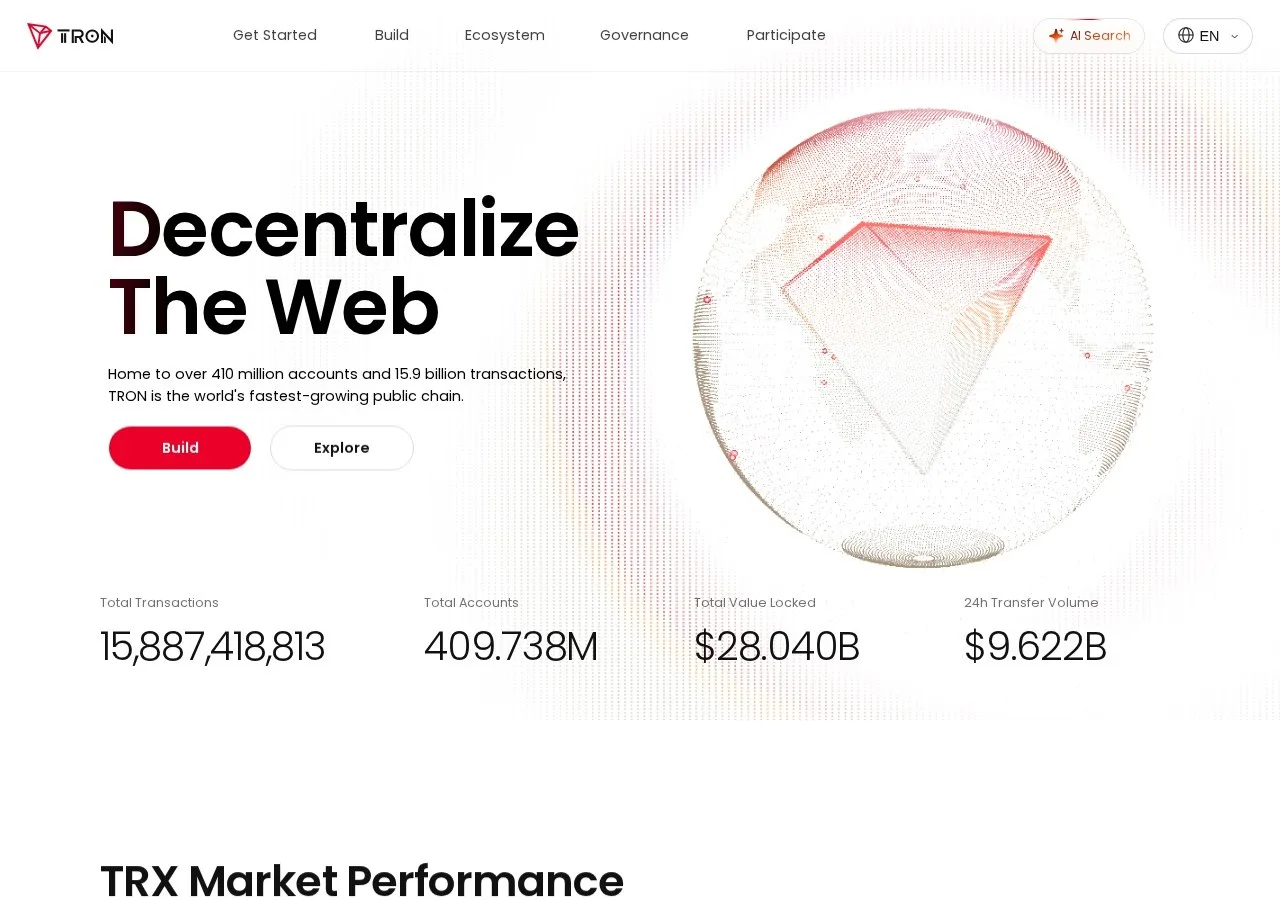
TRON screenshots
What users say about TRON
Recent community discussions center on automated market reports, community giveaways, and user inquiries regarding legacy account recovery.
Based on 3 Reddit posts and comments from the last 12 months, checked Oct 20, 2026. These are posts by users on other sites, not reviews submitted on CryptoReview.
User reviews
No user reviews yet. Have you used TRON? Share your experience below.
Funding and investors
$70MTotal raised
1Round
1Investor
-
ICO Sep 2017 $70MIC Initial coin offeringSource
FAQ
Who founded TRON?
TRON was founded in 2017 by Justin Sun, the former head of development for Ripple's China operations. The governing TRON Foundation transitioned into a decentralized autonomous organization, TRON DAO, in late 2021.
What fees does TRON charge for transactions?
TRON uses a bandwidth and energy model where transactions can be fee-free if covered by resources earned from staking TRX. When an account lacks sufficient bandwidth or energy, nominal burn fees in TRX are deducted.
Has TRON experienced security incidents or regulatory challenges?
In 2019, a denial-of-service vulnerability that could allow high request volumes to stall the chain was disclosed and patched via HackerOne. In March 2023, the US SEC sued Justin Sun and TRON over token sales and trading practices, but the lawsuit was dropped in 2025.
Does TRON have a native token?
Yes, TRON's native token is Tronix (TRX). TRX is used for governance voting for Super Representatives, paying burn fees, and staking to generate energy and bandwidth.
Which stablecoins operate on TRON?
TRON hosts Tether (USDT) as its primary asset, alongside ecosystem-native tokens such as USDD. Circle discontinued native USDC support on TRON in February 2024.
Latest from TRON on X
GM ☕
November’s headline: Keep building. 🔻 https://t.co/ODOeN7mNZz
November’s headline: Keep building. 🔻 https://t.co/ODOeN7mNZz

Trick or #TRON! 👻
Happy Halloween #TRONics! 🎃
Stablecoins, payments, and smart contract activity are driving usage across TRON at scale.
16 billion lifetime transactions shows the level of demand the network continues to support.
16 billion lifetime transactions shows the level of demand the network continues to support.
Recent public posts from @trondao, shown as published. Not reviewed or endorsed by CryptoReview.
Alternatives to TRON
Proof-of-stake layer-1 blockchain securing nearly $50B in DeFi value since 2015
Layer 1Proof of StakeEVM compatible

Ethereum optimistic rollup securing over $12B with ~0.25-second block times and Stylus Rust contracts
Layer 2Optimistic rollupEVM compatible

Sharded Layer-1 blockchain supporting 1.2s finality and cross-chain execution across 35+ networks
Layer 1Proof of StakeNEAR
EVM sidechain with sub-two-second settlement, $0.002 average fees, and over 8 billion processed transactions
SidechainProof of StakeEVM compatible
Proof-of-stake layer 1 with sub-second finality and customizable sovereign appchains
Layer 1Proof of StakeEVM compatible
Ethereum layer 2 built on the OP Stack and incubated by Coinbase
Layer 2Optimistic rollupEVM compatible