

https://t.co/nZD80dEZeT

Starknet
Ethereum validity rollup powered by STARK proofs, native account abstraction, and Cairo
3.4/ 5
Our score
Fair
Layer
Layer 2
Consensus / design
ZK rollup
Native token
STRK
EVM compatible
No
What is Starknet?
Starknet is a permissionless Layer 2 validity rollup designed to scale Ethereum by processing transactions off-chain and verifying their execution using cryptographic STARK proofs. Rather than executing EVM bytecode, it runs on Cairo, Starknet’s native smart contract language designed for provable computation. In October 2026, Starknet held about $160M in network total value locked alongside more than $368M secured in its canonical Ethereum bridge.
Founding and funding
The network was created by StarkWare, which raised a $100M funding round led by Coatue Management in May 2022 at an $8B valuation. Network governance and ecosystem expansion are stewarded by the Starknet Foundation, which formally launched in November 2022 with a seven-person board and an initial allocation of 5.01 billion STRK tokens out of a 10 billion total supply. In 2023, the foundation appointed former Meta regional director Diego Oliva as its first Chief Executive Officer.
Technical architecture and operations
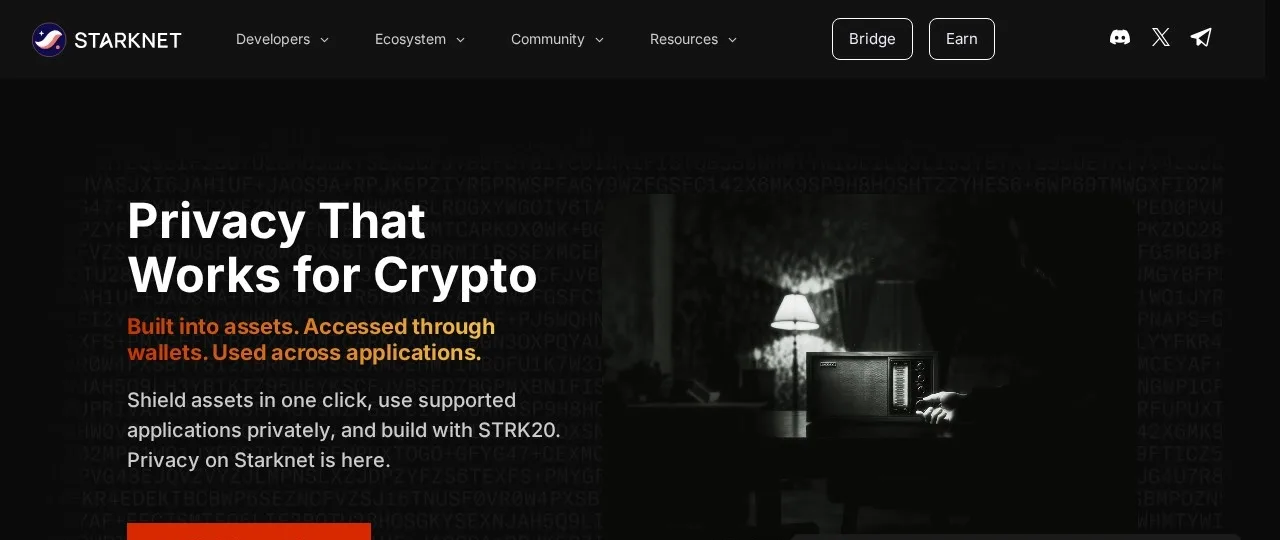
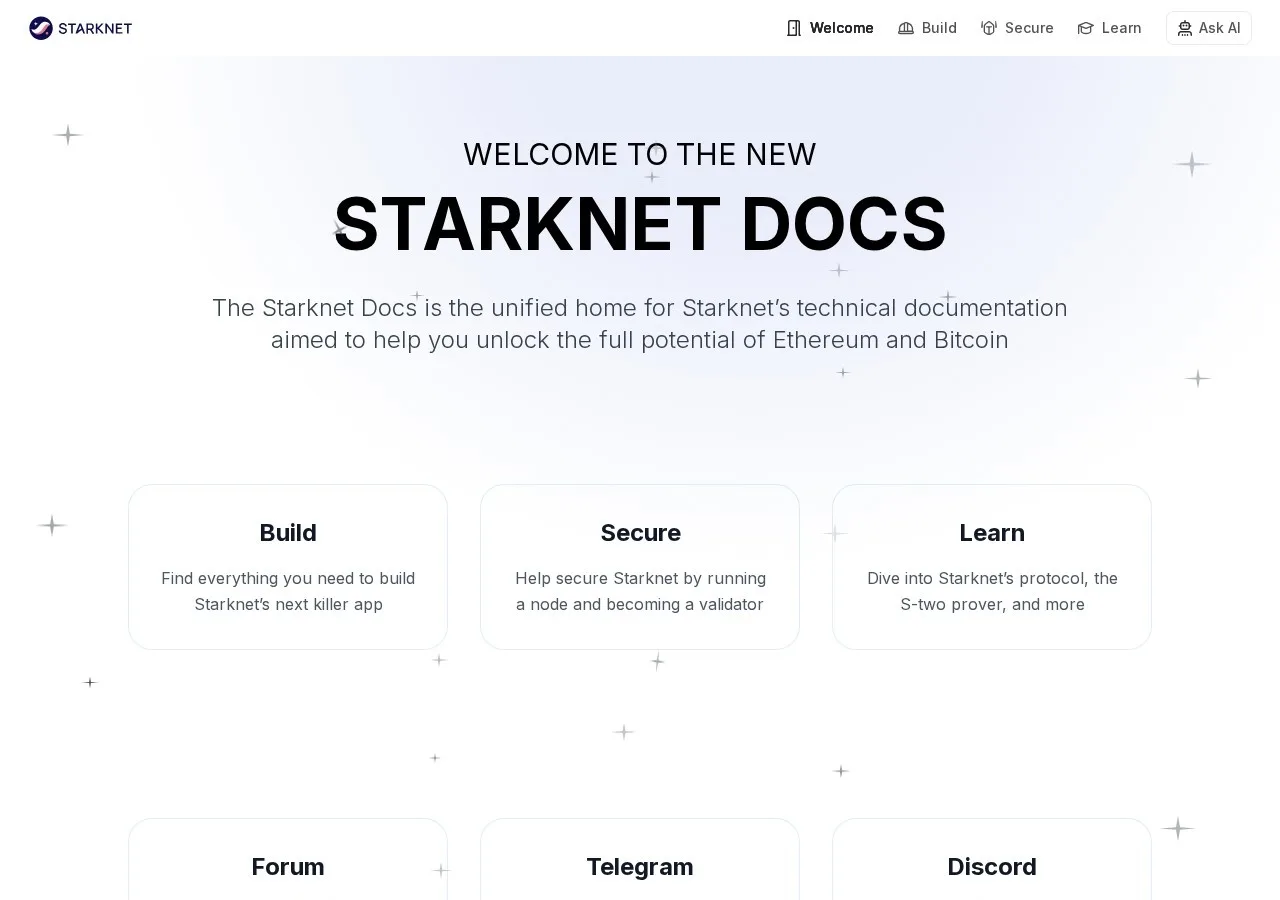
Starknet bundles transactions and proves them off-chain before settling state transitions directly to the Ethereum mainnet. The platform implements native account abstraction, treating every user wallet as a programmable smart contract account without relying on externally owned accounts. Developers write business logic in Cairo, while the S-two prover handles zero-knowledge proof generation. Beyond traditional ERC-20 transfers, the STRK20 standard introduces shielded transactions and private balances through tools like strkBTC and Shadow Accounts, which let traders manage DeFi positions without exposing their main wallet addresses. Network gas fees can be paid in the native STRK token.
Availability and network track record
Starknet is a public blockchain network accessible globally. On January 5, 2026, the network paused block sequencing for roughly four and a half hours following a bug in its Blockifier revert logic, requiring an 18-minute chain reorganization before operators restored normal block production. Security events have also touched hosted protocols; in September 2026, the ecosystem lending market Nostra suffered a $3.5M exploit through oracle price manipulation.
Systemic trade-offs and risks
Starknet relies on a non-EVM environment, so Solidity contracts cannot be deployed directly without rewriting or transpilation into Cairo. The network continues to progress along its decentralization roadmap, but sequencer operations remain centralized during the transition. Users face the risk of smart contract exploits in third-party ecosystem protocols.
Founders
Eli Ben-SassonCo-founder
Co-inventor of STARKs and former computer science professor at Technion.
Uri KolodnyCo-founder
Serial entrepreneur who served as CEO of StarkWare.
Best for:Cairo smart contract developersUsers needing native account abstractionTraders using private DeFi positionsEthereum users seeking Layer 2 scaling
Pros and cons
Pros
- Native account abstraction makes every wallet a programmable smart account
- STARK proofs provide mathematical validity without relying on trusted setup ceremonies
- STRK20 enables confidential balances and unlinked DeFi interactions via Shadow Accounts
- StarkWare raised a $100M funding round led by Coatue Management
Cons
- Lacks native EVM compatibility, requiring developers to build dApps in Cairo
- Paused block sequencing for over four hours during a January 2026 Blockifier bug
- Ecosystem protocols have experienced exploits, including a $3.5M attack on Nostra
- Decentralization roadmap remains ongoing, with sequenced block production still transitioning
Our review
3.4/5
Fair
Starknet scales Ethereum through STARK proofs and native account abstraction, but its non-EVM Cairo architecture and sequencer reliability issues remain notable operational hurdles.
Starknet is an Ethereum Layer 2 validity rollup that validates transactions off-chain using STARK cryptographic proofs. Instead of running the Ethereum Virtual Machine, it uses the Cairo programming language, which enables custom business logic and native account abstraction directly at the protocol level. All accounts function as smart accounts, eliminating the rigid distinction between externally owned accounts and contracts found on traditional chains.
The network is backed by developer StarkWare, which raised a $100 million round led by Coatue Management in May 2022 at an $8 billion valuation. Network governance and ecosystem expansion are overseen by the Starknet Foundation, launched in November 2022 with 5.01 billion STRK tokens from the 10 billion total supply and led by former Meta regional director Diego Oliva. In October 2026, Starknet held roughly $160 million in on-chain TVL, with over $368 million locked in its Ethereum canonical bridge.
Key strengths include its native account abstraction, client-side proving through the S-two prover, and STRK20-based privacy tools like Shadow Accounts for applications such as Ekubo and Opus. These privacy tools decouple public DeFi interactions from primary wallet addresses without fragmenting liquidity.
However, the platform carries distinct trade-offs:
- Non-EVM architecture requires builders to write smart contracts in Cairo rather than Solidity, increasing migration overhead.
- Sequencing remains centralized during its ongoing roadmap, and an outage on January 5, 2026, halted block sequencing between 09:42 and 14:17 UTC due to a bug in Blockifier revert logic.
- Ecosystem protocols face application-level security challenges, exemplified by a $3.5 million oracle manipulation exploit on Nostra in September 2026.
Starknet suits developers seeking advanced cryptographic capabilities, account abstraction, and privacy-preserving primitives.
Specs
| Layer | Layer 2 |
|---|---|
| Consensus / design | ZK rollup |
| Native token | STRK |
| EVM compatible | No |
| Smart contract languages | Cairo |
| Mainnet since | 2,021 · unverified |
| Data availability | Ethereum · unverified |
| Gas paid in | ETH, STRK · unverified |
Not disclosed by the provider: Block time, Typical transaction fee, Finality, Validators / sequencer, Throughput (TPS), Sequencer.
Data from the provider's website and public sources. Fees and availability change; confirm on the official site before you sign up.
Key features
STARK validity proofs
Executes transactions off-chain and verifies their state transitions on Ethereum using cryptographic STARK proofs.
Native account abstraction
Every wallet operates as a programmable smart account.
Cairo smart contracts
Executes provable dApp business logic written in Cairo instead of standard EVM bytecode.
STRK20 shielded privacy
Enables confidential asset balances and transfers, supporting private Bitcoin integration via strkBTC.
Shadow Accounts
Allows users to trade, borrow, and provide liquidity in public DeFi pools through secondary addresses unlinked to their primary wallet.
S-two prover
Generates zero-knowledge proofs designed for client-side proving on consumer hardware.
Inside Starknet
Validity Rollup
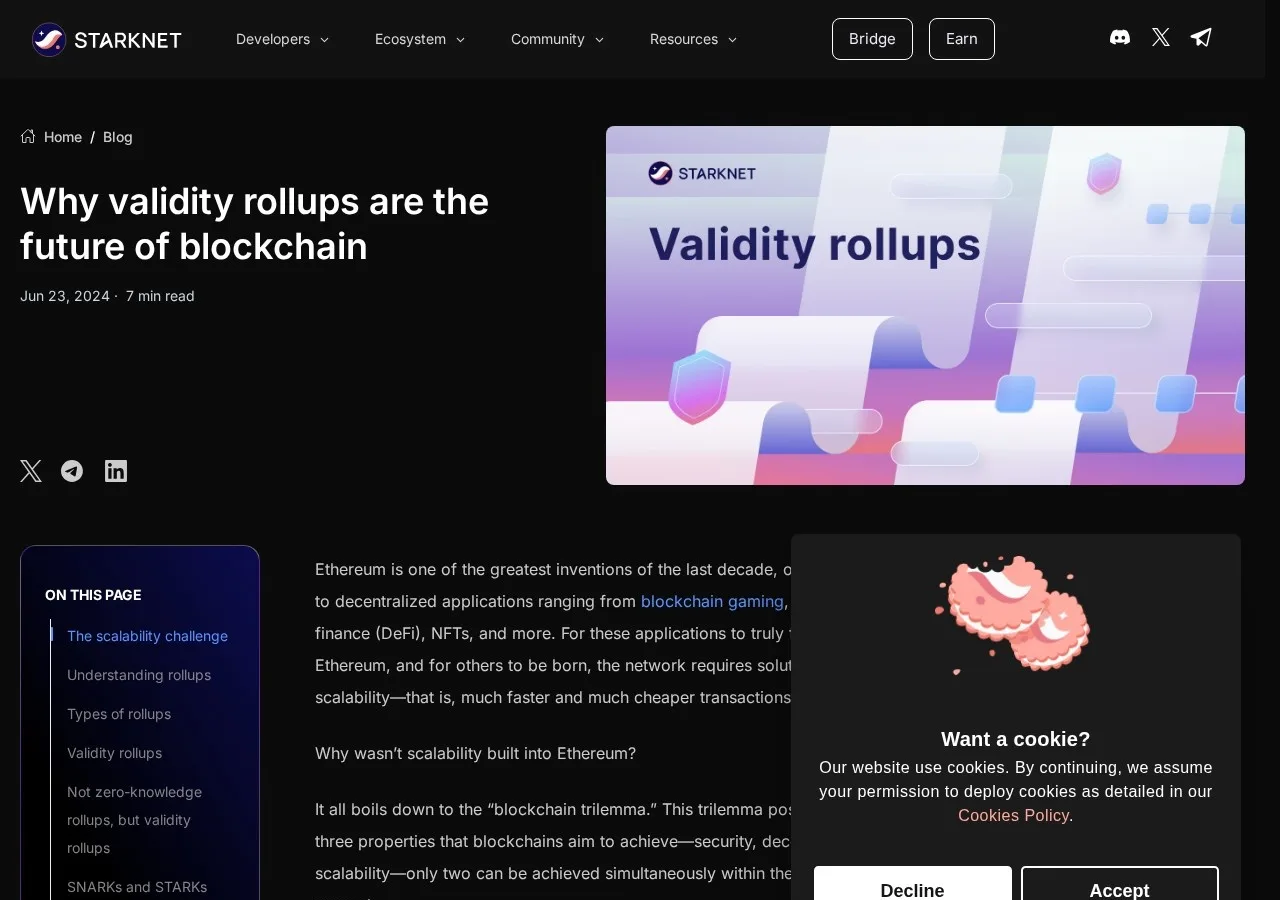
The core Layer 2 network that processes transactions off-chain and validates them on Ethereum using STARK cryptographic proofs.
Cairo
Starknet's native programming language designed to let developers write arbitrary verifiable logic and smart accounts.
STRK20
A privacy standard that enables shielded asset balances, private transfers, and Shadow Accounts across Starknet applications.
S-two
A zero-knowledge prover engineered for client-side proving and rapid proof generation on everyday consumer devices.
strkBTC
A private Bitcoin implementation on Starknet that allows users to shield balances and deploy BTC into Starknet DeFi.
Starknet screenshots
What users say about Starknet
User feedback remains insufficient to assess community sentiment, and concrete experiences or reviews have not yet emerged.
Based on 1 Reddit posts and comments from the last 12 months, checked Oct 20, 2026. These are posts by users on other sites, not reviews submitted on CryptoReview.
User reviews
No user reviews yet. Have you used Starknet? Share your experience below.
Funding and investors
$100MTotal raised
1Round
1Investor
-
Funding round May 2022 $100MSource
FAQ
Who founded and oversees Starknet?
Starknet was created by StarkWare, with governance and ecosystem growth overseen by the Starknet Foundation, which launched in November 2022. Former Meta executive Diego Oliva is the foundation's Chief Executive Officer.
Does Starknet have a native token?
Yes, Starknet uses the STRK token. The initial token supply is 10 billion, with 5.01 billion allocated to the Starknet Foundation for ecosystem growth and governance.
Is Starknet EVM compatible?
No, Starknet is not EVM-compatible. Its smart contracts are written in Cairo, a programming language designed to produce verifiable STARK proofs.
Has Starknet experienced any security incidents or outages?
Starknet halted block sequencing for over four hours on January 5, 2026, due to an internal bug in Blockifier revert logic. In September 2026, ecosystem lending protocol Nostra experienced an external $3.5 million oracle manipulation incident.
What is native account abstraction on Starknet?
Native account abstraction means that every Starknet account is deployed as a smart contract without relying on externally owned accounts.
What is strkBTC?
strkBTC is a private Bitcoin asset on Starknet powered by the STRK20 standard. It allows users to hold shielded Bitcoin balances and transact privately across Starknet decentralized finance applications.
Latest from Starknet on X
18 years ago today, Satoshi published the Bitcoin whitepaper.
But have you actually read it?
Answer 5 questions to claim your proof-of-read → https://t.co/cIgyTTjrUG https://t.co/CoG1nPqWKV
But have you actually read it?
Answer 5 questions to claim your proof-of-read → https://t.co/cIgyTTjrUG https://t.co/CoG1nPqWKV
https://t.co/h893STtmDv
Bring your AI and a lot of curiosity.
Post-quantum crypto research is going IRL in Mumbai on Nov 5th.
Register now → https://t.co/q2j9MiqySX
Post-quantum crypto research is going IRL in Mumbai on Nov 5th.
Register now → https://t.co/q2j9MiqySX
Quantum-safe transactions, priced in cents.
In an open challenge, Falcon-512 verification reached ~$0.023 per transaction.
Participants and their AI agents set 434 records in the challenge from @StarknetFndn and @StarkWareLtd, in collaboration with @OpenZeppelin.
https://t.co/vWlU2seY53
In an open challenge, Falcon-512 verification reached ~$0.023 per transaction.
Participants and their AI agents set 434 records in the challenge from @StarknetFndn and @StarkWareLtd, in collaboration with @OpenZeppelin.
https://t.co/vWlU2seY53

Recent public posts from @Starknet, shown as published. Not reviewed or endorsed by CryptoReview.
Alternatives to Starknet
Proof-of-stake layer-1 blockchain securing nearly $50B in DeFi value since 2015
Layer 1Proof of StakeEVM compatible

Ethereum optimistic rollup securing over $12B with ~0.25-second block times and Stylus Rust contracts
Layer 2Optimistic rollupEVM compatible

Sharded Layer-1 blockchain supporting 1.2s finality and cross-chain execution across 35+ networks
Layer 1Proof of StakeNEAR
EVM sidechain with sub-two-second settlement, $0.002 average fees, and over 8 billion processed transactions
SidechainProof of StakeEVM compatible
Proof-of-stake layer 1 with sub-second finality and customizable sovereign appchains
Layer 1Proof of StakeEVM compatible
Ethereum layer 2 built on the OP Stack and incubated by Coinbase
Layer 2Optimistic rollupEVM compatible