

Introducing Pre-Mainnet Staking.
GEN arrives on THE DAY. Mainnet comes later. This programme covers the time in between.
Here's how it works 👇 https://t.co/TxACeZLwGK

GenLayer
AI-powered adjudication network resolving subjective contracts through multi-model consensus
3.1/ 5
Our score
Fair
Layer
Layer 2
Consensus / design
Other
Native token
GEN
EVM compatible
Yes
What is GenLayer?
GenLayer is a decentralized consensus network engineered to serve as an adjudication layer for the agentic economy. Traditional smart contract environments require deterministic computations, whereas GenLayer executes non-deterministic tasks by allowing independent validator nodes to run multiple large language models that reason over ambiguous questions and reach agreement.
Team and governance structure
GenLayer was founded in 2024 and is led by co-founder and chief executive officer Albert Castellana. Protocol development is led by GenLayer Labs, an engineering research organization, while the GenLayer Foundation functions as an administrative steward established to oversee network decentralization before eventually dissolving once community governance takes over.
Protocol mechanics and intelligent contracts
The network operates across two coordinated systems: a specialized RPC interface that executes contracts called Intelligent Contracts, and an underlying Layer 2 settlement chain. Rather than using Solidity, developers write Intelligent Contracts in Python. These programs can natively fetch live internet data, process natural language, and evaluate images without relying on external oracle networks. Execution occurs inside GenVM, a sandboxed virtual machine on each validator node. To resolve non-deterministic inputs, GenLayer uses an Optimistic Democracy consensus mechanism. Independent validator nodes run diverse models such as Claude, GPT, Gemini, Llama, Mistral, and DeepSeek under a technique termed Greyboxing, where the specific model assigned to a node remains undisclosed to prevent targeted prompt injections. When leaders propose an adjudication, peer validators verify the reasoning, and disputes escalate through appeal rounds governed by economic staking stakes.
Network activity and testnet roadmap
The core protocol and Optimistic Democracy architecture went live on testnet during the Asimov milestone in June 2025. The Bradbury testnet phase, operating under chain ID 4221 with testnet currency GEN, focused on validator LLM configurations and inference tuning. Across testnet environments, the network recorded over 1,001,164 trustless decisions, 326,000 daily transactions, 25,800 daily decisions, and an average throughput of 3.77 transactions per second as of October 2026. Over 300 builders and 91,700 community members are active across the ecosystem. Mainnet deployment is scheduled for the fourth quarter of 2026, transitioning from a permissioned validator set toward progressive decentralization.
Risks and structural trade-offs
Because the network remains in testnet phases ahead of mainnet deployment, its economic staking, slashing mechanisms, and model inference costs remain subject to ongoing parameter shifts. Relying on commercial and open-weight large language models introduces non-deterministic execution times, with dispute adjudications typically taking between 30 and 60 minutes rather than sub-second block finality. Early mainnet operations also rely on a permissioned validator set, creating initial validator concentration risks.
Founders
Albert CastellanaCofounder & CEO
Best for:Autonomous AI agent commerce disputesPrediction market resolutionParametric insurance claims verificationPython smart contract developers
Pros and cons
Pros
- Native web access and text processing eliminate reliance on third-party oracle networks
- Smart contracts written directly in Python instead of Solidity
- Multi-model validation mitigates prompt injection vulnerabilities through Greyboxing
- More than 1M trustless decisions completed on testnet as of October 2026
Cons
- Production mainnet remains pending with launch targeted for late 2026
- Dispute resolution cycles require 30 to 60 minutes for multi-model finality
- Initial mainnet release relies on a permissioned validator set
Our review
3.1/5
Fair
GenLayer introduces native AI dispute adjudication via Python contracts, but remains on testnet with non-deterministic execution risks and a permissioned initial validator roadmap.
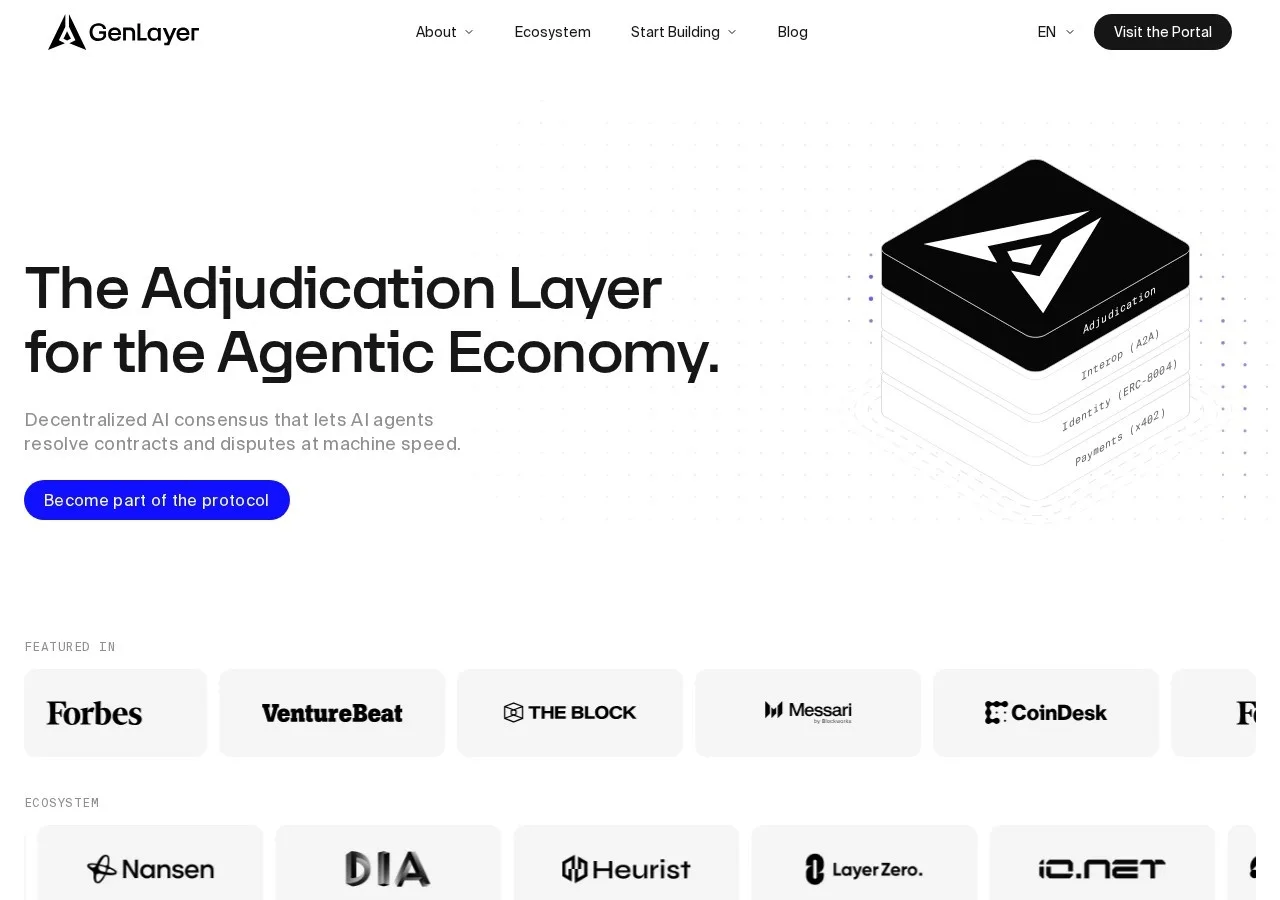
GenLayer is an adjudication blockchain designed to resolve non-deterministic disputes and subjective agreements for autonomous AI agents. Rather than relying on external oracles or standard deterministic smart contracts, the protocol runs intelligent contracts written in Python inside a sandboxed runtime called GenVM. These programs can access the public web and prompt independent large language models directly during execution.
Consensus relies on a mechanism called Optimistic Democracy. For any submitted task, a randomly selected committee of validator nodes executes the contract using diverse, undisclosed foundation models including Claude, GPT, Llama, and Mistral. A proposed outcome is verified across the committee, applying an equivalence principle to determine whether differing outputs share the same semantic meaning. Decisions settle typically within 30 minutes, with sample adjudication fees ranging from $0.85 for parametric insurance to $1.45 for prediction market checks.
The network operates as an execution architecture split across two layers: a dedicated GenLayer RPC for subjective calls and an underlying Arbitrum Orbit layer-2 rollup chain for standard EVM operations and staking using the GEN token. In October 2026, network activity reached about 326,000 daily transactions and 25,800 daily decisions across over 300 builders on the Bradbury testnet, with mainnet launch scheduled for the fourth quarter of 2026.
The project offers distinct strengths:
- Native connectivity to web data and multi-model LLM inference without standalone oracle middleware.
- Python-based contract logic that lowers the barrier for AI developers.
- Greyboxing techniques that obscure active validator models to mitigate targeted prompt-injection attacks.
Trade-offs remain significant. The system runs on a testnet, and the planned mainnet rollout relies initially on a permissioned validator set before transitioning to progressive decentralization. Subjective consensus introduces latency compared to standard sub-second layer-2 finality, and developers must design explicit equivalence criteria to prevent verification deadlocks. The platform suits developers building agentic commerce, prediction markets, and subjective dispute systems, whereas high-frequency decentralized finance protocols requiring deterministic microsecond execution should look to standard rollups.
Specs
| Layer | Layer 2 · unverified |
|---|---|
| Consensus / design | Other · unverified |
| Native token | GEN · unverified |
| EVM compatible | Yes · unverified |
| Smart contract languages | Python · unverified |
| Validators / sequencer | Optimistic Democracy AI validator set · unverified |
| Throughput (TPS) | 3.77 TPS · unverified |
| Gas paid in | GEN · unverified |
Not disclosed by the provider: Block time, Typical transaction fee, Finality, Mainnet since, Sequencer, Data availability.
Data from the provider's website and public sources. Fees and availability change; confirm on the official site before you sign up.
Key features
Optimistic Democracy consensus
A leader node proposes an evaluation and peer validators running distinct AI models cross-verify outputs, escalating disagreements through an appeal process.
Python intelligent contracts
Developers deploy contracts written in Python that can directly fetch live web pages and parse unstructured language without external oracles.
GenVM sandbox
A sandboxed virtual machine executes non-deterministic functions and web requests securely on each validator node.
Greyboxing defense
Validators run diverse, undisclosed language models to defend against prompt injections and adversarial inputs.
Dual-layer RPC architecture
The network routes standard Ethereum transactions through chain ID 4221 while handling non-deterministic gen_* methods via specialized node endpoints.
Inside GenLayer
Intelligent Contracts
Python-based programs that read web data, process natural language, and execute non-deterministic contract logic directly on-chain.
GenVM
A sandboxed virtual machine environment on validator nodes that securely manages external web access and language model calls.
Optimistic Democracy
A consensus protocol where committees of validators running different foundation models propose, verify, and settle subjective decisions.
Studionet
A hosted web-based development environment that provides an integrated faucet, an account selector, and an explorer for testing contracts without running a local node.
Bradbury Testnet
A production-like testnet environment running on chain ID 4221 that processes live LLM workloads and validator staking.
GenLayer screenshots
User reviews
No user reviews yet. Have you used GenLayer? Share your experience below.
FAQ
Who founded GenLayer?
GenLayer was co-founded by Albert Castellana, who serves as the company's Chief Executive Officer.
What is GenLayer's native token?
GenLayer uses the GEN currency for testnet gas, chain operations, and validator staking.
What programming language does GenLayer use for smart contracts?
GenLayer executes Intelligent Contracts written in Python rather than Solidity or Vyper. These contracts run inside a sandboxed GenVM environment that natively supports web access and model prompting.
How does GenLayer reach consensus on subjective tasks?
GenLayer uses Optimistic Democracy, where a committee of validators running diverse AI models evaluates contract execution. A leader proposes an answer, peer nodes verify semantic equivalence, and disputes escalate through an appeals system.
Is GenLayer live on mainnet?
GenLayer is live on testnet, with its mainnet release scheduled for the fourth quarter of 2026. The testnet deployment operates on chain ID 4221.
Latest from GenLayer on X
"When things go wrong, Visa is there."
Agents paying each other don't have that yet. @kstellana with @HenriArslanian on The Future of Crypto Compliance. https://t.co/nVTDnbNGyx
Agents paying each other don't have that yet. @kstellana with @HenriArslanian on The Future of Crypto Compliance. https://t.co/nVTDnbNGyx
Your AI agent is about to spend your money. Who does it work for?
@driudor on the most important employee you never hired. https://t.co/SNIcyuymME
@driudor on the most important employee you never hired. https://t.co/SNIcyuymME
"We spent the last few years making money programmable. Now we need to make recourse programmable too."
@kstellana in @CoinDesk on why AI agents can pay for things online but can't dispute a charge.
Full article here 👇
@kstellana in @CoinDesk on why AI agents can pay for things online but can't dispute a charge.
Full article here 👇
57.5% of all web traffic is now bots.
The internet stopped being human. It still has no judge.
#JusticeNeedsAnUpgrade https://t.co/5FJbqPMvob
The internet stopped being human. It still has no judge.
#JusticeNeedsAnUpgrade https://t.co/5FJbqPMvob

Recent public posts from @GenLayer, shown as published. Not reviewed or endorsed by CryptoReview.
Alternatives to GenLayer
Proof-of-stake layer-1 blockchain securing nearly $50B in DeFi value since 2015
Layer 1Proof of StakeEVM compatible

Ethereum optimistic rollup securing over $12B with ~0.25-second block times and Stylus Rust contracts
Layer 2Optimistic rollupEVM compatible

Sharded Layer-1 blockchain supporting 1.2s finality and cross-chain execution across 35+ networks
Layer 1Proof of StakeNEAR

EVM sidechain with sub-two-second settlement, $0.002 average fees, and over 8 billion processed transactions
SidechainProof of StakeEVM compatible

Proof-of-stake layer 1 with sub-second finality and customizable sovereign appchains
Layer 1Proof of StakeEVM compatible

Ethereum layer 2 built on the OP Stack and incubated by Coinbase
Layer 2Optimistic rollupEVM compatible