

This week is Flare fundamentals.
What should we cover first? FXRP, Smart Accounts, FLR, FIRE, data, or something else?
Tag a friend who has always wanted to know about Flare ↓ https://t.co/fKXdVD4s4P
Flare Network
EVM Layer 1 network featuring enshrined data oracles and cross-chain bridging for XRP, BTC, and DOGE
3.7/ 5
Our score
Good
Layer
Layer 1
Consensus / design
Proof of Stake
Native token
FLR
Block time
≈1.8 seconds
EVM compatible
Yes
What is Flare Network?
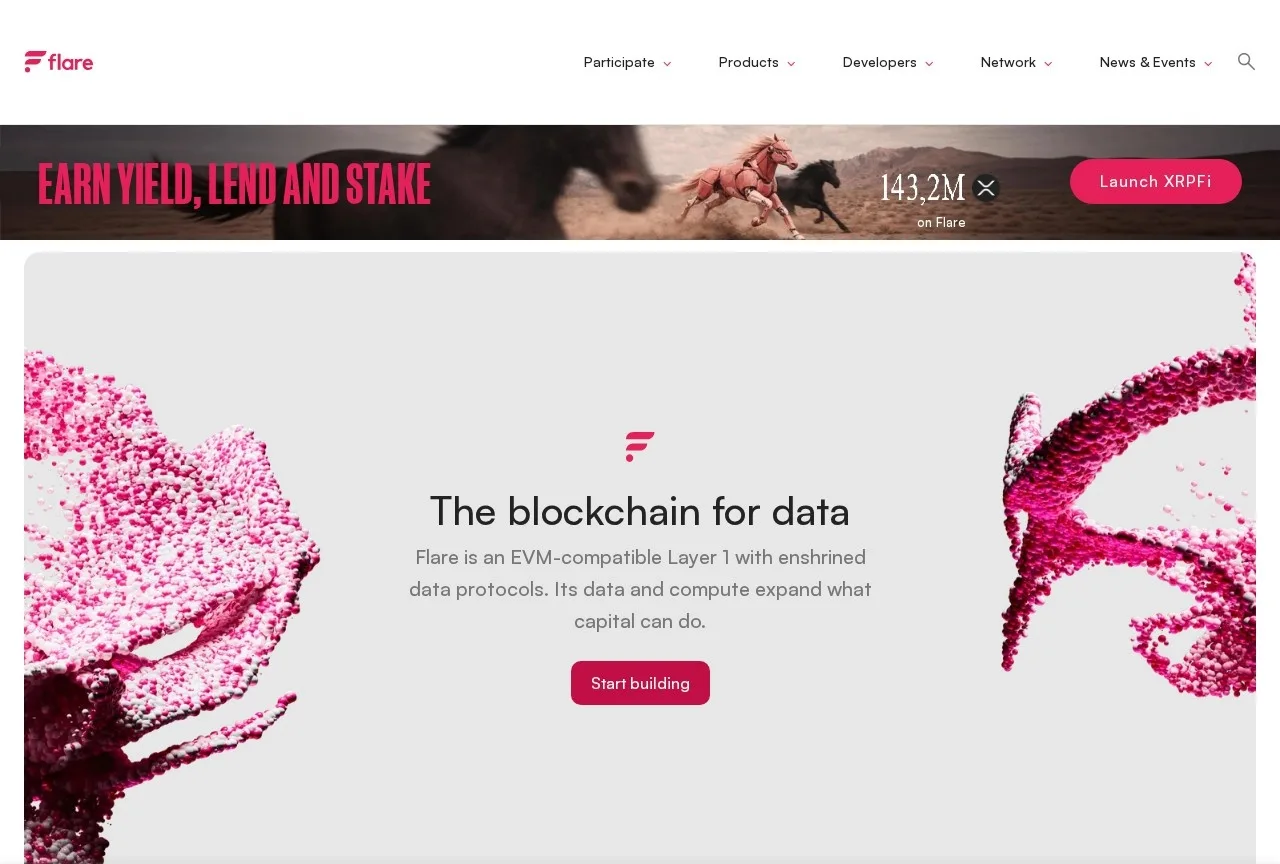
Flare is an EVM-compatible Layer 1 blockchain engineered specifically for data-intensive and cross-chain decentralized applications. Rather than relying on external third-party oracle networks, Flare integrates data feeds directly into its base validator set. Total value locked on the network reached approximately $183M in October 2026.
Team and governance
Flare was co-founded by Chief Executive Officer Hugo Philion, Chief Technology Officer Sean Rowan, and Chief Scientist Dr. Naïri Usher. The core development organization operates across North America and Europe, overseeing network architecture alongside the Songbird canary network used for protocol-level testing.
Consensus and data architecture
The network employs the Snowman++ consensus engine combined with a Proof of Stake mechanism, delivering block times of roughly 1.8 seconds alongside single-slot finality. Full EVM compatibility supports smart contracts compiled through standard Solidity and Vyper toolchains, including Foundry and Hardhat, with opcode support through Ethereum's Cancun hard fork. Two native protocols are enshrined into core consensus: the Flare Time Series Oracle (FTSOv2) for price feeds, and the Flare Data Connector (FDC) for reading external blockchain states and web APIs. Through its FAssets system and Flare Smart Accounts, the network enables non-smart contract assets such as XRP, BTC, and DOGE to operate within Flare smart contracts.
Economics and network fees
Transactions are denominated in the native FLR token, supporting both legacy Type 0 and EIP-1559 Type 2 gas fee structures. A core economic design choice dictates that 100% of network transaction fees are permanently burned. By October 2026, network participation included 23.1B FLR actively staked across validators, with staking carrying five times the weight of delegation under governance rule FIP.16.
Risks and structural trade-offs
Bringing assets like XRP and BTC into smart contracts depends on the economic security and bridge integrity of the FAssets protocol. Additionally, validator nodes must balance dual responsibilities, serving as both consensus participants and data providers for enshrined oracle feeds, which concentrates operational dependency on the active validator set.
Founders
Hugo PhilionCo-Founder & CEO
Sean RowanCo-Founder & CTO
Dr. Naïri UsherCo-Founder & Chief Scientist
Best for:Developers building cross-chain DeFi protocolsXRP and Bitcoin holders accessing smart contractsApplications requiring high-frequency on-chain data
Pros and cons
Pros
- Native oracles and data connectors are enshrined directly into validator consensus
- Fast single-slot finality with average block times of approximately 1.8 seconds
- Burns 100% of all transaction fees on the network
- Enables smart-contract utility for non-programmable assets like XRP and BTC
Cons
- Cross-chain asset functionality introduces smart contract and bridge dependency risks
- Staking FLR on the P-chain requires a 50,000 token minimum and 14-day lock
- Enshrined oracle reliance ties data integrity directly to the active validator set
Our review
3.7/5
Good
Flare offers EVM smart contracts with enshrined data oracles and fast block times, but its DeFi ecosystem remains modest compared to established Layer 1 networks.
Flare is an EVM-compatible Layer 1 blockchain optimized for data-heavy decentralized applications. Built using the Snowman++ consensus protocol derived from Avalanche, the network runs a Proof-of-Stake model that achieves single-slot finality alongside block times of roughly 1.8 seconds. Instead of relying entirely on off-chain third-party oracle networks, Flare enshrines core data protocols into its validator duties, giving applications direct on-chain access to external feeds without adding external trust layers.
The network's primary technical strengths center on this enshrined architecture. The Flare Time Series Oracle (FTSOv2) distributes decentralized price feeds natively, while the Flare Data Connector (FDC) allows smart contracts to verify external state events and web API data. Validators secure both the base chain consensus and serve as data providers for these systems. Transaction execution mirrors Ethereum, supporting opcodes up to the Cancun hard fork and burning 100% of all gas fees across both legacy Type 0 and EIP-1559 Type 2 formats.
Ecosystem size and asset liquidity present clear limitations. Flare recorded about $183.1M in total value locked in October 2026, which is small relative to major EVM peers. While the FAssets protocol expands utility for non-smart contract tokens such as XRP, BTC, and DOGE, bridging mechanisms introduce wrapping dependencies that carry higher smart contract risk than holding native base assets. Additionally, running validator infrastructure carries governance-defined self-bond requirements, while staking on the P-chain requires a minimum of 50,000 FLR locked for at least 14 days.
Flare suits developers building applications that require frequent price feeds, external data proofs, or cross-chain integrations with assets like XRP. Developers seeking massive organic on-chain liquidity or mature multi-billion-dollar DeFi ecosystems should look to larger Layer 1 or Layer 2 networks.
Specs
| Layer | Layer 1 · unverified |
|---|---|
| Consensus / design | Proof of Stake · unverified |
| Native token | FLR |
| EVM compatible | Yes · unverified |
| Smart contract languages | Solidity, Vyper · unverified |
| Block time | ≈1.8 seconds · unverified |
| Finality | Single-slot finality · unverified |
| Mainnet since | 2,022 · unverified |
| Sequencer | Not applicable · unverified |
| Data availability | Flare DA Layer · unverified |
| Gas paid in | FLR · unverified |
Not disclosed by the provider: Typical transaction fee, Validators / sequencer, Throughput (TPS).
Data from the provider's website and public sources. Fees and availability change; confirm on the official site before you sign up.
Key features
Enshrined FTSOv2 price feeds
Delivers decentralized pricing data directly from network validators rather than off-chain third-party oracle networks.
Flare Data Connector
Verifies state events and transactions from external blockchains like Bitcoin and XRPL, as well as real-world web APIs.
FAssets bridging
Enables non-smart-contract tokens including XRP, BTC, and DOGE to bridge and participate in Flare decentralized finance applications.
Snowman++ PoS consensus
Produces blocks in roughly 1.8 seconds with single-slot finality and transaction ordering determined by block proposers.
Complete fee burning
Burns 100% of base and priority transaction fees collected under both Type 0 and EIP-1559 gas models.
EVM tooling compatibility
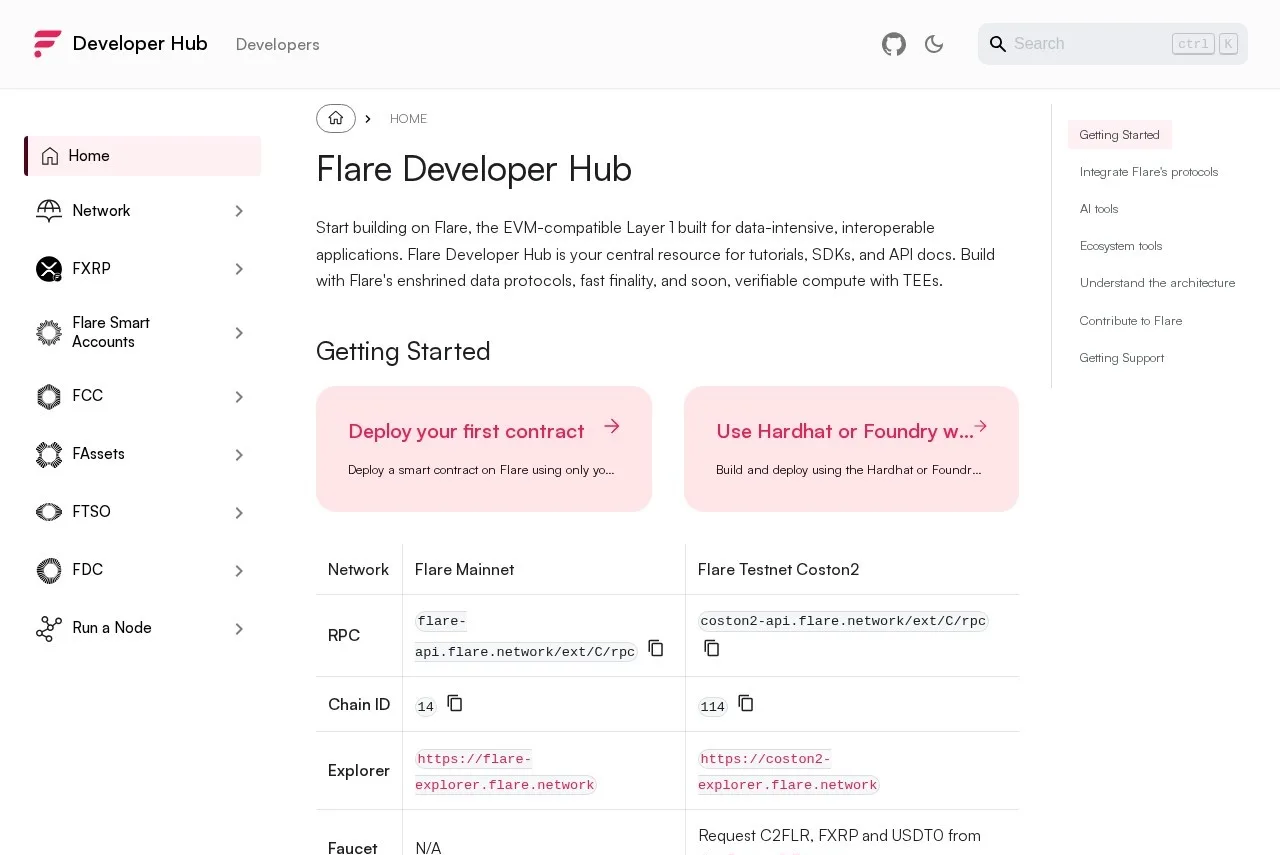
Supports Solidity contracts up to the Cancun hard fork, compatible with standard RPCs, Hardhat, and Foundry.
Inside Flare Network
Flare Mainnet
The primary production EVM blockchain operating under Chain ID 14 where users transact and pay gas fees in FLR.
Flare Time Series Oracle (FTSOv2)
An enshrined protocol where validators deliver decentralized price feeds directly to smart contracts on the network.
Flare Data Connector (FDC)
A native protocol enabling smart contracts to verify external blockchain events and internet API responses.
FAssets
A bridge system that brings non-smart contract assets such as XRP, BTC, and DOGE to Flare for use in DeFi applications.
Flare Smart Accounts
An account abstraction layer built to provide XRPL account holders direct access to Flare applications.
Songbird Canary-Network
A live experimental network where protocol changes, upgrades, and smart contracts are tested with the native SGB token before deployment on Flare Mainnet.
Flare Network screenshots
What users say about Flare Network
Community sentiment leans cautiously positive, driven by enthusiasm for FAssets integration and staking and delegation rewards. However, users frequently express confusion and frustration over inconsistent reward payouts, complex cross-chain mechanics, and reduced delegation rates.
Top goods
In their own words
“Dude move out from CDC. Stake from the flare portal directly to a validator. You will win wayyy more”
“Should You Buy Flare (FLR)? 1. Utility: FLR powers Flare Network (EVM blockchain) for DeFi, data oracles (FTSO), and cross-chain assets (F-Assets like FXRP). Used for staking, governance, fees (burned for deflation). 2.”
“I've tried staking so many times using FLR metrics to select my providers. Everytime delegation provides more consistently for me. Staking always seems to be inconsistent for me. My delegation reqards are consistent. On average 1000-1100 per month. Roughly 5.4% annually.”
“Delegation Rewards Dramatically Lowered... Thoughts? Probably due to the new F:P on Flare Network, delegation reward APY percentage has significanty gone down. Looks like I/2 to 1/3 decrease in delegation rewards.”
“I built a free staking intelligence dashboard for FLR holders - looking for feedback Hey everyone — I’m a FLR holder and active staker who got frustrated with the lack of tooling around managing my Flare portfolio.”
Scam warning: Malicious phishing websites and fake social media links mimic official portals to trick users into signing approvals that drain their wallets.
Based on 200 Reddit posts and comments from the last 12 months, checked Oct 21, 2026. These are posts by users on other sites, not reviews submitted on CryptoReview.
User reviews
No user reviews yet. Have you used Flare Network? Share your experience below.
FAQ
Who founded Flare Network?
Flare Network was co-founded by CEO Hugo Philion, CTO Sean Rowan, and Chief Scientist Dr. Naïri Usher.
Does Flare Network have a native token?
Yes, FLR is the native utility and gas token on Flare Mainnet, while SGB serves as the native currency on its Songbird canary network. FLR is used for transaction gas, validator staking, and data delegation.
How does Flare handle transaction fees?
Flare uses Type 0 legacy and Type 2 EIP-1559 fee formats. The network burns 100% of all transaction fees.
What is the Flare Time Series Oracle (FTSO)?
The Flare Time Series Oracle is an enshrined on-chain data protocol that provides decentralized price feeds. Network validators directly act as data providers to deliver rapid pricing data without third-party oracle intermediaries.
What are FAssets on Flare?
FAssets is a protocol designed to bridge non-smart contract cryptocurrencies like XRP, BTC, and DOGE onto Flare. Once bridged, these assets can interact with EVM-compatible decentralized finance applications.
Latest from Flare Network on X
XRP yield coming to new venues is gaining attention.
Flare Smart Accounts are the distribution layer that brings Flare's XRPFi opportunities into wallets as one-click flows. @HugoPhilion explains how, with @CoinDesk.
Full interview on YouTube ↓
https://t.co/5etFEbQLOh https://t.co/cZpSXpRcba
Flare Smart Accounts are the distribution layer that brings Flare's XRPFi opportunities into wallets as one-click flows. @HugoPhilion explains how, with @CoinDesk.
Full interview on YouTube ↓
https://t.co/5etFEbQLOh https://t.co/cZpSXpRcba
Deposit into @Firelightfi from the XRPL wallet you already use.
Flare Smart Accounts abstract the steps, and FAssets makes the XRP programmable.
Associated fees are still paid in $FLR, and route to FIRE.
Flare Smart Accounts abstract the steps, and FAssets makes the XRP programmable.
Associated fees are still paid in $FLR, and route to FIRE.
Hugo covered one of the ways. The XRPFi site has the rest.
Mint FXRP, borrow against it, put it into vaults, or start from your XRPL wallet with Smart Accounts ↓
https://t.co/FaPeIhyaCw https://t.co/qlTCG2o4Lh
Mint FXRP, borrow against it, put it into vaults, or start from your XRPL wallet with Smart Accounts ↓
https://t.co/FaPeIhyaCw https://t.co/qlTCG2o4Lh

FIRE is the Flare Income Reinvestment Entity.
Its primary mandate: reduce $FLR supply through things like burns and buybacks, funded by fees from usage on Flare.
Track it live: https://t.co/COvLy4DIj0 https://t.co/LP4QdNbXhS
Its primary mandate: reduce $FLR supply through things like burns and buybacks, funded by fees from usage on Flare.
Track it live: https://t.co/COvLy4DIj0 https://t.co/LP4QdNbXhS

Recent public posts from @FlareNetworks, shown as published. Not reviewed or endorsed by CryptoReview.
Alternatives to Flare Network
Proof-of-stake layer-1 blockchain securing nearly $50B in DeFi value since 2015
Layer 1Proof of StakeEVM compatible

Ethereum optimistic rollup securing over $12B with ~0.25-second block times and Stylus Rust contracts
Layer 2Optimistic rollupEVM compatible

Sharded Layer-1 blockchain supporting 1.2s finality and cross-chain execution across 35+ networks
Layer 1Proof of StakeNEAR

EVM sidechain with sub-two-second settlement, $0.002 average fees, and over 8 billion processed transactions
SidechainProof of StakeEVM compatible

Proof-of-stake layer 1 with sub-second finality and customizable sovereign appchains
Layer 1Proof of StakeEVM compatible
Ethereum layer 2 built on the OP Stack and incubated by Coinbase
Layer 2Optimistic rollupEVM compatible