

Ledger hardware wallet support is now live in the NNS app
See your Ledger accounts, send and stake ICP, and approve every step on your device.
Settings → Ledger device → add your device.
Dfinity
Decentralized cloud network running WebAssembly canisters with reverse gas and native cross-chain signing
3.8/ 5
Our score
Good
Layer
Layer 1
Consensus / design
Other
Native token
ICP
Block time
1s
Typical transaction fee
0
EVM compatible
No
What is Dfinity?
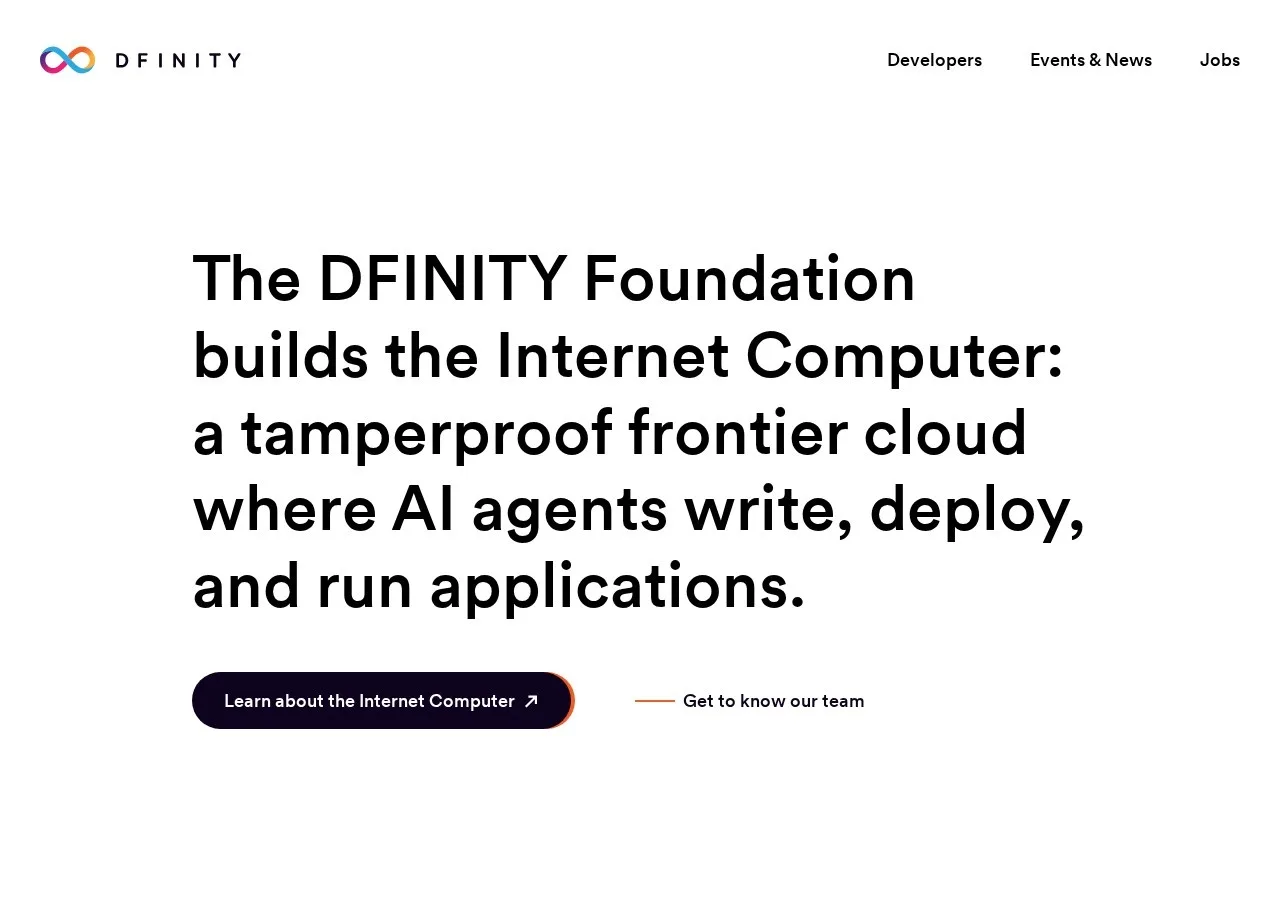
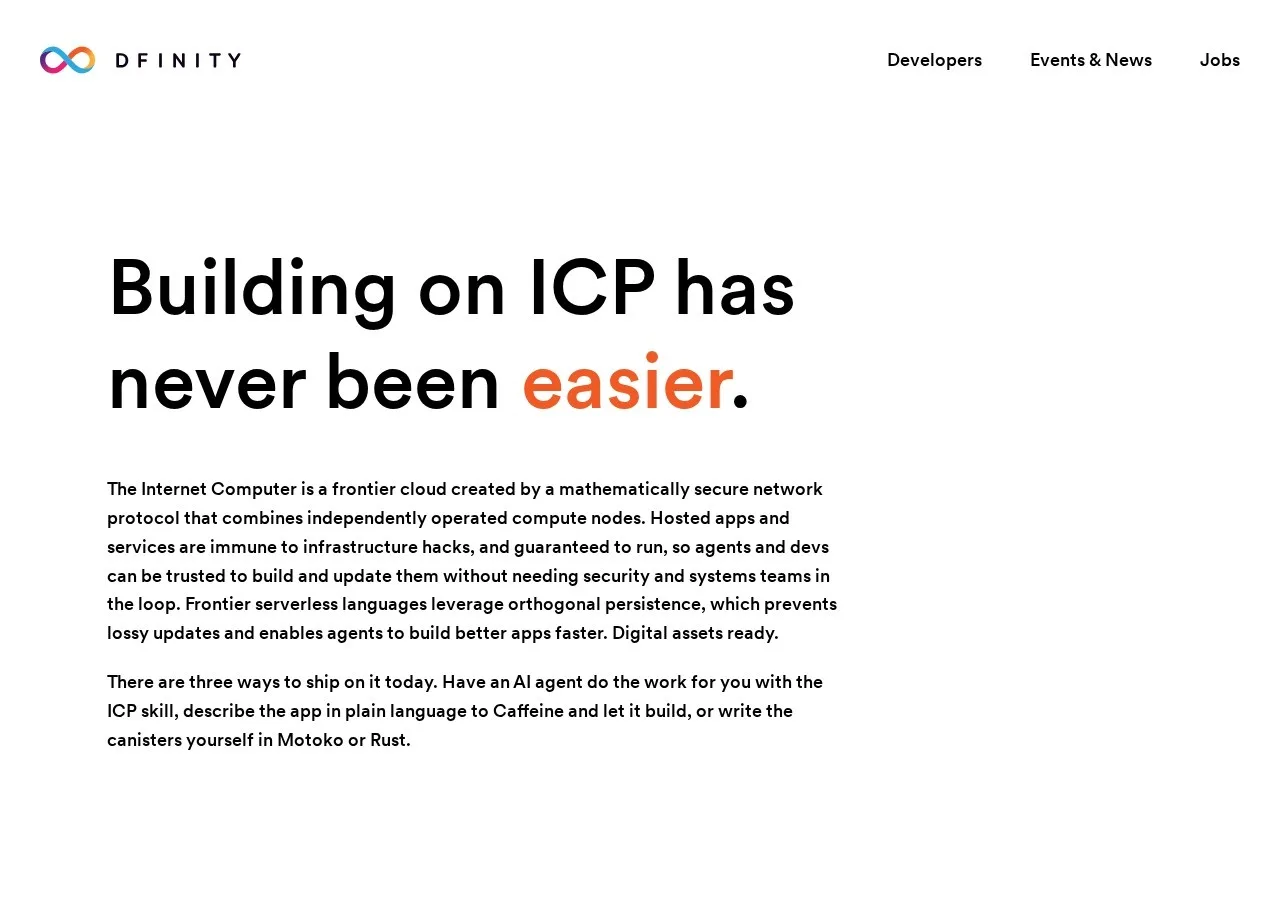
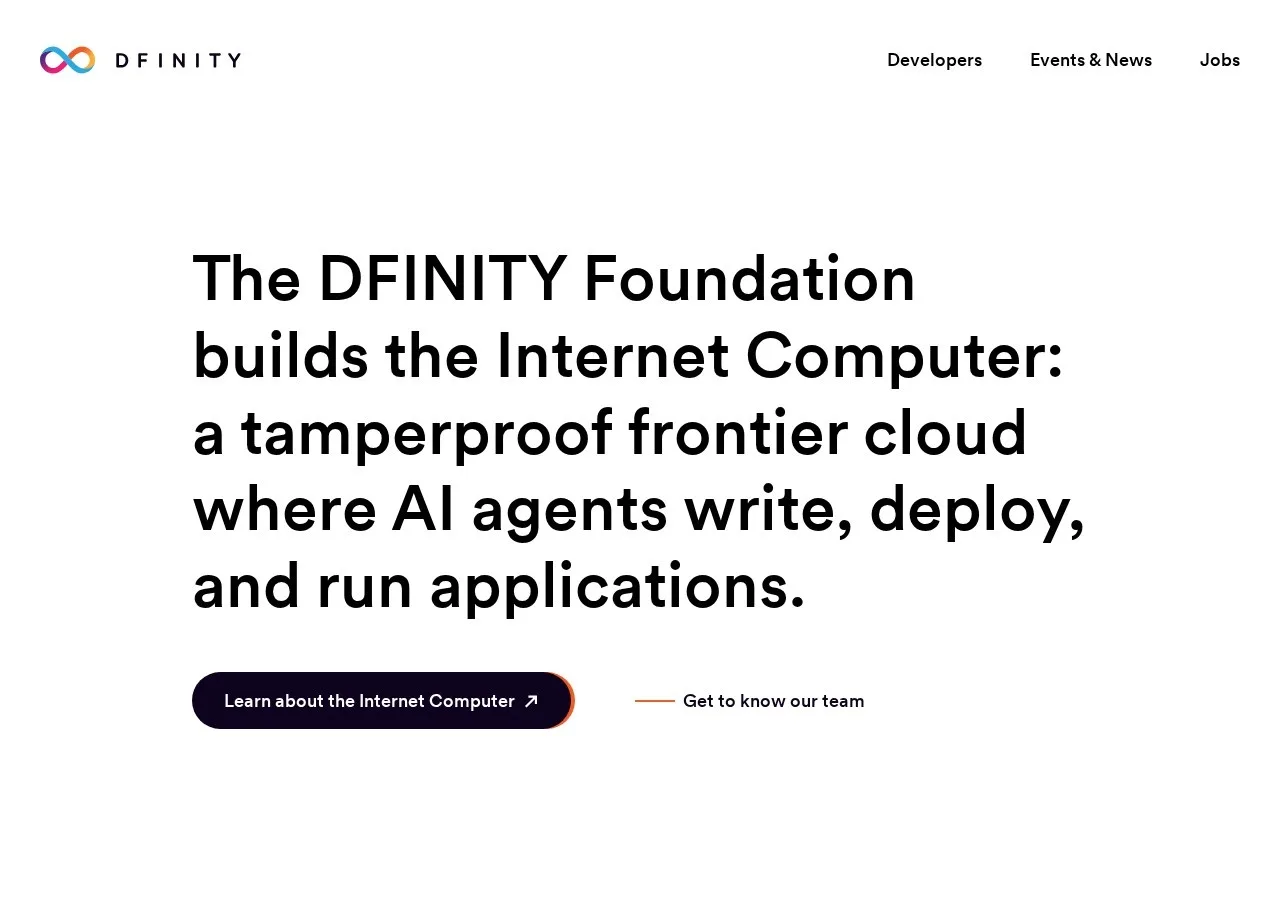
DFINITY develops the Internet Computer Protocol (ICP), a decentralized layer-1 compute network designed to host tamperproof software and full-stack web applications entirely on-chain. Rather than traditional smart contracts executing on a sequential virtual machine, the network runs stateful WebAssembly compute containers called canisters, which can serve HTTP traffic natively and hold internal persistent storage without external databases.
Organization and leadership
The DFINITY Foundation is a Swiss not-for-profit foundation established in October 2016, headquartered in Zurich, Switzerland. Dominic Williams founded the project and is its Founder and Chief Scientist. The foundation employs more than 180 team members focusing on distributed systems and advanced cryptography. Its website lists 250+ patents and 1,600+ employee publications.
Network architecture and core mechanics
The network relies on a subnet architecture coordinated by the Network Nervous System (NNS), an on-chain autonomous governance system that controls network topology, protocol upgrades, and node onboarding. Blocks are produced through a randomized generation process and finalized using quorum-based validation, yielding block finality within 1 to 2 seconds. The execution environment uses a reverse gas model: end users pay 0 gas fees to interact with canisters. Instead, developers fund their applications with Cycles. Canisters can execute external HTTP outcalls directly without third-party oracles. Through Chain Key cryptography and threshold ECDSA and Schnorr signatures, the network supports native multi-chain interactions without bridges. Canisters can directly sign transactions on Bitcoin, Ethereum, and Solana.
Track record and ecosystem milestones
The Internet Computer mainnet genesis launched on 10 May 2021 with 389 independent node machines. Ecosystem development has since added native integrations, including a 1:1 backed Solana token called ckSOL in October 2026. In the same month, an official plugin added Internet Computer app interoperability to ChatGPT. As of October 2026, the network reached a market capitalization of roughly $1.63B.
Risks and technical trade-offs
The Internet Computer does not offer native EVM compatibility, requiring developers to build in languages like Motoko or Rust using custom toolchains like the icp CLI. Hardware demands are high: node providers must operate specialized, high-performance data center machines approved via NNS proposals rather than consumer hardware.
Founders
Dominic WilliamsFounder & Chief Scientist
Best for:Developers hosting full-stack web applications on-chainTeams needing bridge-free multi-chain smart contractsConsumer applications requiring zero-fee user onboarding
Pros and cons
Pros
- Zero gas fees for end users via the canister reverse gas model
- Fast settlement with block finality between 1 and 2 seconds
- Native Bitcoin, Ethereum, and Solana transactions without third-party bridges
- Canisters serve web interfaces and external HTTP outcalls without oracles
- Autonomous on-chain governance with no centralized sequencer
Cons
- No native EVM compatibility, requiring specialized languages like Motoko or Rust
- Requires high-specification enterprise hardware, limiting individual validator participation
- Developer costs fluctuate based on compute and storage usage via Cycles
Our review
3.8/5
Good
Dfinity provides web-speed smart canisters and zero-fee user transactions via a reverse-gas model, though its specialized architecture requires non-EVM tooling and customized node hardware.
The DFINITY Foundation is a Swiss non-profit organization established in Zurich in October 2016 that developed the Internet Computer Protocol (ICP). Its mainnet went live on May 10, 2021, launching with 389 node machines. Unlike standard EVM blockchains, ICP relies on WebAssembly-based computing units called canisters, combining computation, storage, and direct HTTP serving into stateful containers without separate databases or oracles.
ICP achieves finality in 1 to 2 seconds while producing approximately one block per second across its subnets. Its reverse-gas architecture shifts compute and storage costs to developers, who pre-load canisters with Cycles. End users can interact with applications without paying transaction fees. Interoperability relies on Chain Fusion, employing threshold ECDSA and Schnorr signatures to sign transactions directly on networks like Bitcoin, Ethereum, and Solana without cross-chain bridge contracts.
- Canisters execute WebAssembly natively and support languages such as Motoko, Rust, TypeScript, and Python, but lack standard EVM compatibility.
- Governance and protocol upgrades are coordinated by the Network Nervous System (NNS).
- Hardware requirements for independent node providers remain specialized, separating ICP from blockchains that run on consumer equipment.
ICP suits developers building web-facing decentralized services and sovereign tools requiring native HTTP handling.
Specs
| Layer | Layer 1 · unverified |
|---|---|
| Consensus / design | Other · unverified |
| Native token | ICP · unverified |
| EVM compatible | No · unverified |
| Smart contract languages | Motoko, Rust, TypeScript, Python · unverified |
| Block time | 1s · unverified |
| Typical transaction fee | 0 · unverified |
| Finality | 1-2s · unverified |
| Validators / sequencer | Independent node machines via NNS · unverified |
| Mainnet since | 2,021 · unverified |
| Sequencer | Not applicable · unverified |
| Data availability | Subnet replication · unverified |
| Gas paid in | Cycles · unverified |
Not disclosed by the provider: Throughput (TPS).
Data from the provider's website and public sources. Fees and availability change; confirm on the official site before you sign up.
Key features
Reverse gas execution
End users pay zero transaction fees because developers pre-load canisters with computational Cycles converted from ICP.
WebAssembly canisters
Applications run inside WebAssembly modules with built-in persistent storage, native HTTP outcalls, and on-chain compute.
Chain Fusion interoperability
Uses threshold ECDSA and Schnorr signatures to sign transactions directly on Bitcoin, Ethereum, and Solana without bridges.
Network nervous system
An on-chain governance system where staked ICP token holders vote on network upgrades, economics, and node admissions.
Subnet consensus and fast finality
Processes decentralized compute across independent subnets, achieving transaction finality within 1 to 2 seconds.
Canonical developer tooling
Developers deploy applications using the icp CLI, writing backends in Motoko, Rust, Python, or TypeScript.
Inside Dfinity
Canisters
WebAssembly execution modules that combine persistent application state, computation, and direct HTTP serving without external databases.
Network Nervous System (NNS)
The autonomous on-chain governance system where ICP token holders stake voting neurons to control protocol upgrades, economics, and subnet creation.
Chain Fusion
Native multi-chain interoperability technology that uses threshold ECDSA and Schnorr signatures to transact directly on Bitcoin, Ethereum, and Solana.
icp CLI
The canonical command-line interface tool used by developers to create, test, and deploy canister applications on the Internet Computer.
Motoko
A programming language built specifically for the Internet Computer that features actor-based concurrency, orthogonal persistence, and native WebAssembly output.
Dfinity screenshots
What users say about Dfinity
Community discussions reflect concern over internal team departures and layoffs at DFINITY.
In their own words
“Over 99.9% of retail is in the red Unless you just found ICP this week and bought under $2.7 or had a huge limit order in during last year’s October crash wick at $2.0, nearly every ICP retail investor has lost money on this coin and we are at all time lows. To add to this: 1.”
“Thoughts on the Dfinity 2.0 reorg? It looks like Jan Camenisch and Samuel Burri have left DFINITY. The DFINITY.org homepage also appears to have fewer team members. Have Emilio Canessa and Bruno Calabretta left as well? I don’t see their profile pictures.”
Based on 6 Reddit posts and comments from the last 12 months, checked Oct 21, 2026. These are posts by users on other sites, not reviews submitted on CryptoReview.
User reviews
No user reviews yet. Have you used Dfinity? Share your experience below.
FAQ
Who founded Dfinity?
Dominic Williams founded the DFINITY Foundation in Switzerland in October 2016 and serves as its Chief Scientist.
How do transaction fees work on the Internet Computer?
End users pay zero transaction fees. Dfinity uses a reverse-gas model where developers pre-load their canister smart contracts with Cycles to pay for computation and storage.
Does Dfinity have a native token?
Yes, ICP is the native utility and governance token. It is used to participate in Network Nervous System governance and converts into Cycles to fuel canister computation.
Which blockchains can the Internet Computer connect to without bridges?
ICP connects directly to Bitcoin, Ethereum, and Solana using Chain Key threshold cryptography. This design enables canisters to sign transactions natively on other networks without custodial bridges.
Is the Internet Computer EVM compatible?
No, ICP is not natively EVM compatible. Applications are deployed as WebAssembly canisters written in languages such as Motoko, Rust, TypeScript, or Python.
Latest from Dfinity on X
Happy Halloween from the DFINITY Foundation. https://t.co/6jYjEnz3bT

What comes next in Pakistan builds on what is already running. The cloud engine in the country is going to be extended. And Caffeine AI is being made available there, which was part of DFINITY's commitment to the government, reaching academia and the startup sector as well as the state itself.
Pierre Samaties set those out alongside congratulations to the Pakistan Digital Authority for a forward-looking approach to the digital transformation of the entire country.
@PierreSamaties @dfinity @digitalauthpk
Pierre Samaties set those out alongside congratulations to the Pakistan Digital Authority for a forward-looking approach to the digital transformation of the entire country.
@PierreSamaties @dfinity @digitalauthpk
The Internet Computer is now a connector in Claude.
Search for it in Claude's connectors, connect it once, and start prompting. Set up a cloud engine for your business, launch a client portal, keep building, all from the same conversation.
Build on the Internet Computer directly from @claudeai.
Search for it in Claude's connectors, connect it once, and start prompting. Set up a cloud engine for your business, launch a client portal, keep building, all from the same conversation.
Build on the Internet Computer directly from @claudeai.
Control over cloud infrastructure is becoming a boardroom issue, and two pressures are driving it.
Geopolitical tension means governments want certainty that foreign powers cannot access their data or cut off their infrastructure.
And AI is taking a growing role in building and running online services, on infrastructure designed for human developers and sysadmins.
Erika Masako Welch's article in @EntMagazineME brings both front and centre, following Dominic Williams and cloud engines on the Internet Computer.
https://t.co/73mLIIbu74

Recent public posts from @dfinity, shown as published. Not reviewed or endorsed by CryptoReview.
Alternatives to Dfinity
Proof-of-stake layer-1 blockchain securing nearly $50B in DeFi value since 2015
Layer 1Proof of StakeEVM compatible

Ethereum optimistic rollup securing over $12B with ~0.25-second block times and Stylus Rust contracts
Layer 2Optimistic rollupEVM compatible

Sharded Layer-1 blockchain supporting 1.2s finality and cross-chain execution across 35+ networks
Layer 1Proof of StakeNEAR
EVM sidechain with sub-two-second settlement, $0.002 average fees, and over 8 billion processed transactions
SidechainProof of StakeEVM compatible

Proof-of-stake layer 1 with sub-second finality and customizable sovereign appchains
Layer 1Proof of StakeEVM compatible

Ethereum layer 2 built on the OP Stack and incubated by Coinbase
Layer 2Optimistic rollupEVM compatible