

https://t.co/arTyOnUZXm

Cartesi
Application-specific rollup framework running a full RISC-V Linux OS with settlement on Ethereum
3.8/ 5
Our score
Good
Layer
App-chain
Consensus / design
Optimistic rollup
Native token
CTSI
EVM compatible
No
What is Cartesi?
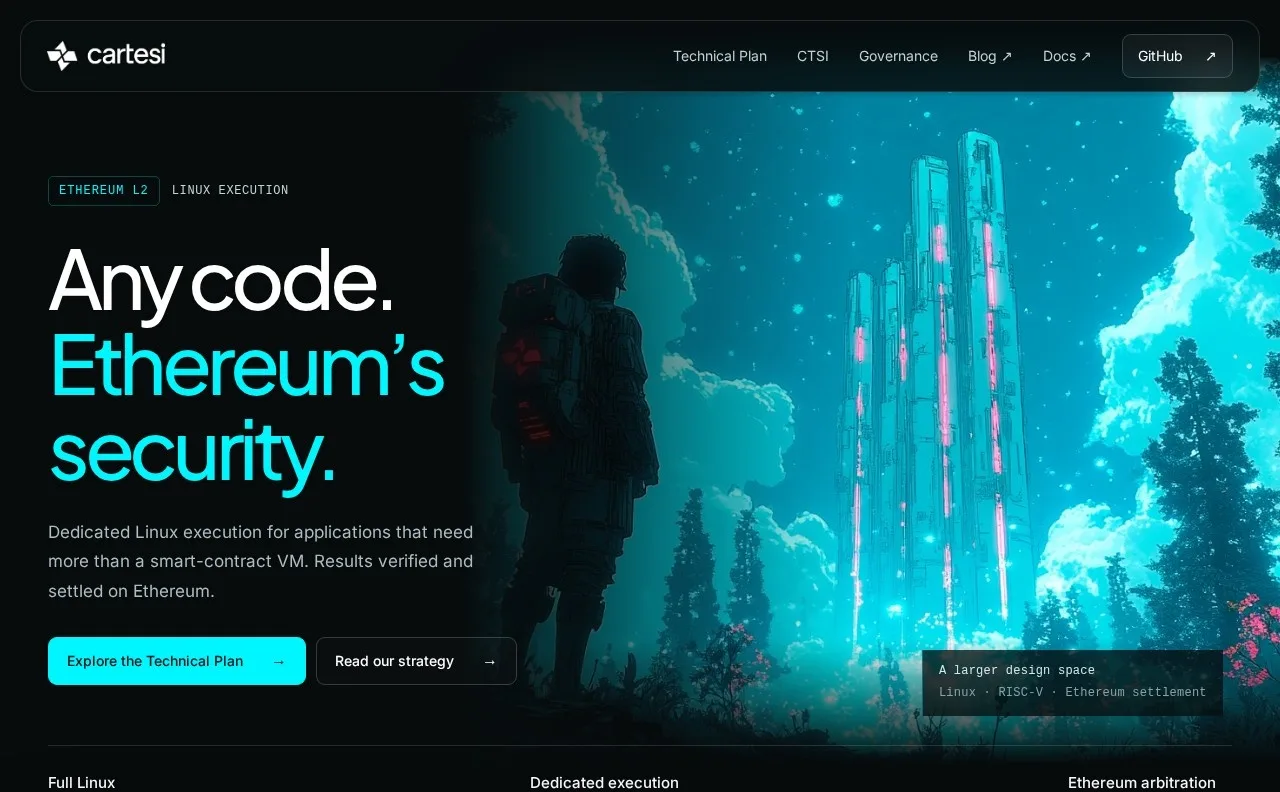
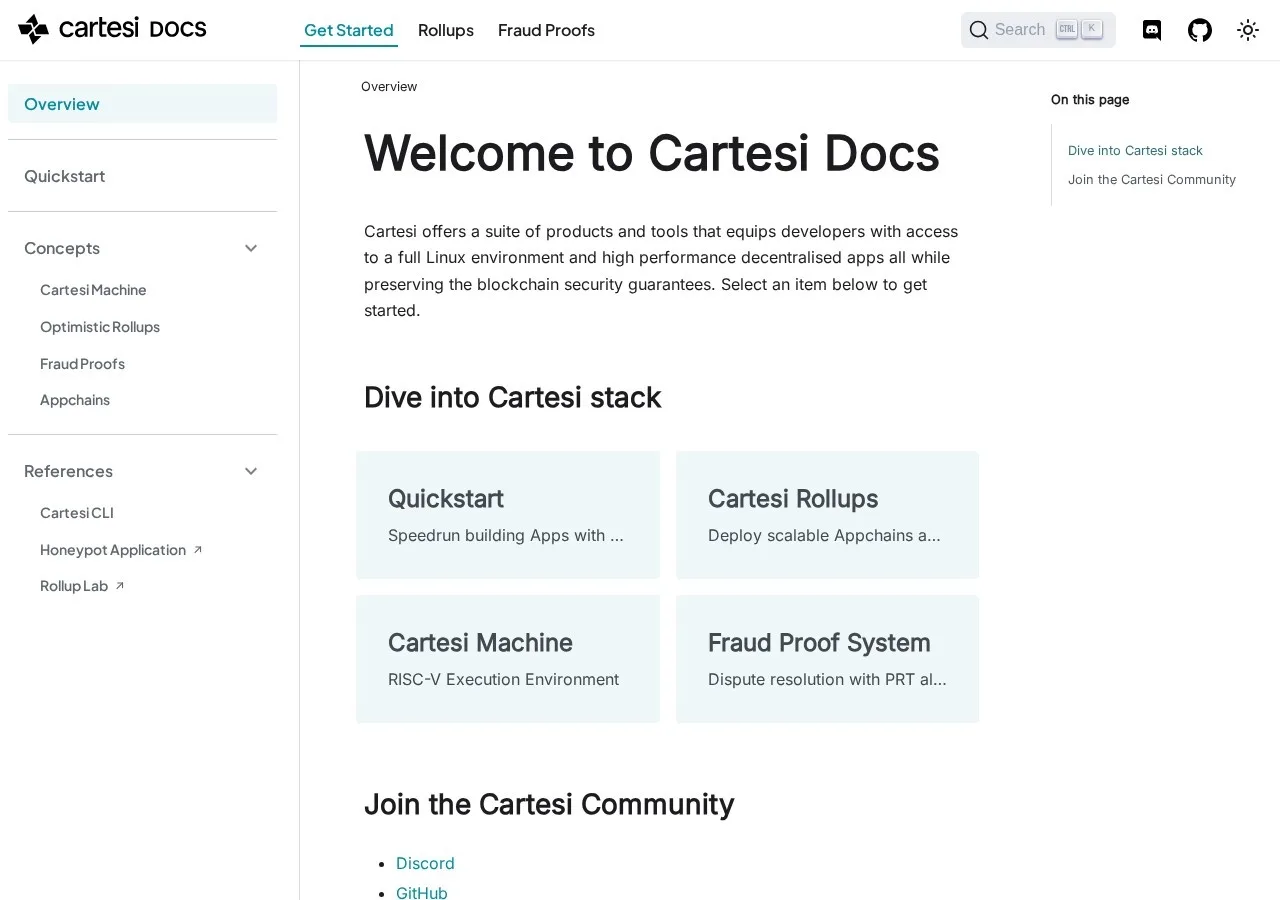
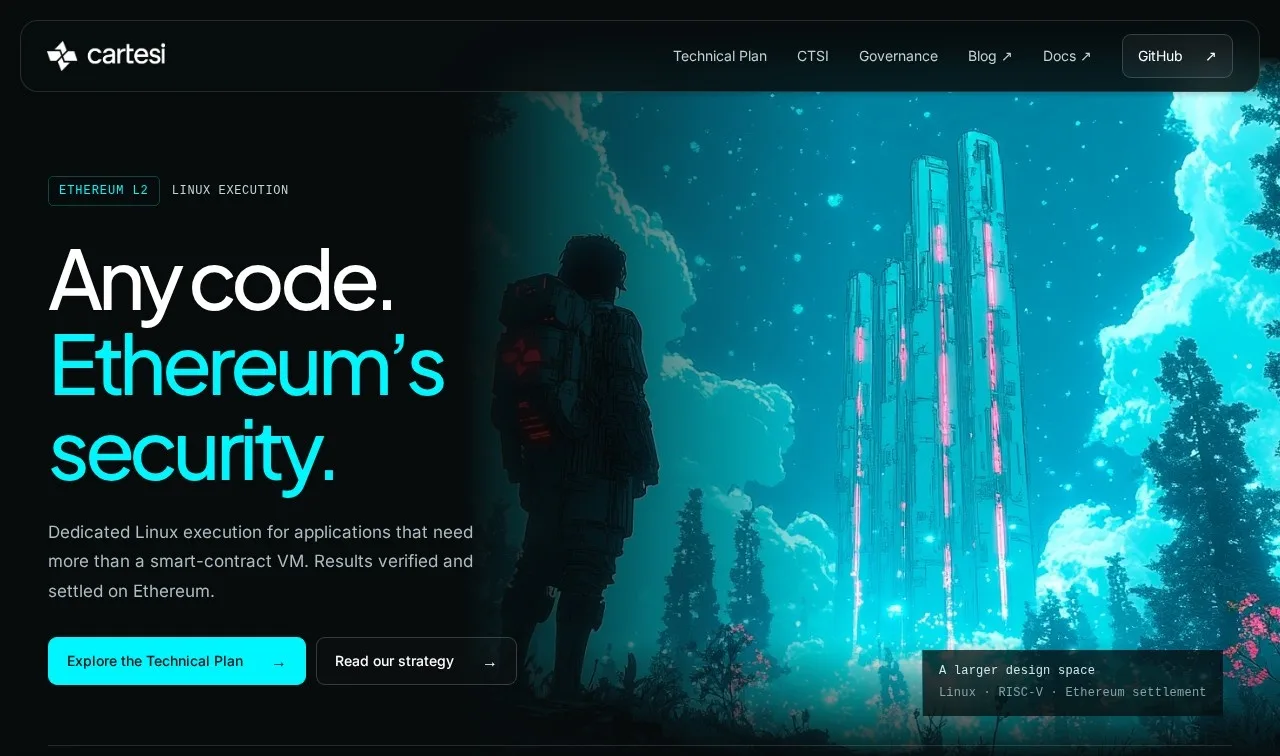
Cartesi is an application-specific rollup framework that runs a deterministic Linux operating system on an off-chain RISC-V virtual machine, using Ethereum for arbitration and final value settlement. Rather than executing dApp code within the constrained Ethereum Virtual Machine, Cartesi gives each application its own computational space. Developers can run software written in standard languages such as Python, Rust, C++, and Go under blockchain-enforced integrity.
Leadership and backing
The network was founded by Chief Executive Officer Erick de Moura, Chief Scientific Officer Augusto Teixeira, PhD, Chief Technology Officer Diego Nehab, PhD, and Chief Operating Officer Colin Steil. The project is supported by the Cartesi Foundation and directs engineering and business-development efforts toward Knoss.
How the execution architecture works
Cartesi decouples computationally heavy processing from Ethereum. Users submit transactions through base-layer contracts, which forward inputs to the off-chain Cartesi Machine. This virtual machine executes application logic deterministically inside a Linux environment and produces state checkpoints. To defend against invalid states, Cartesi relies on an interactive fraud-proof system known as Permissioned Resolution Trees (PRT). Under its single-honest-validator assumption, any participant can compute the reproducible RISC-V execution and trigger on-chain dispute resolution on Ethereum if an incorrect state is proposed.
Fees and economic design
Execution takes place within an isolated appchain environment; Ethereum gas applies to base-layer transactions. Users pay Ethereum network gas fees when bridging assets, submitting initial state inputs, processing finalized withdrawals, or running staking operations. Staking the network native asset, CTSI, requires several Ethereum smart-contract interactions including token approvals and staking, alongside gas allocations for block production and state proposals.
Track record and ecosystem milestones
Cartesi demonstrated its fraud-proof mechanisms through Honeypot, an on-chain bug bounty dApp holding real funds on Ethereum. Rollups Node v2.0.0-alpha.10 was released in March 2026 with an updated bond refund process, followed by Cartesi Skills in May 2026. The project shipped Machine Emulator v0.21.0 in August 2026 to expand fraud-proof documentation and state persistence. In the third quarter of 2026, Cartesi recorded 130 merged pull requests, 673 commits, and 58 software releases across its repositories, later introducing CLI 2.0.0-alpha.39 and emergency deposit refund capabilities.
Risks and operational limitations
Because Cartesi Rollups rely on optimistic fraud proofs, native withdrawals to Ethereum require a dispute window spanning several days before final settlement occurs. Unlocking funds faster requires third-party liquidity providers. Staking and node deployment depend directly on Ethereum gas prices, which can cause failed block production attempts to incur unreimbursed network fees during periods of network congestion.
Founders
Erick de MouraChief Executive Officer
Software architect and entrepreneur with a background in software development and business leadership.
Augusto TeixeiraChief Scientific Officer
Holds a PhD in mathematics and worked as an associate professor at IMPA.
Diego NehabChief Technology Officer
Holds a PhD in computer science from Princeton University and worked as a researcher at Microsoft Research.
Colin SteilChief Operating Officer
Operations professional with experience in business management and venture development.
Best for:Developers writing dApps in Python, Go, or RustComputationally heavy DeFi protocolsComplex on-chain logic needing standard Linux libraries
Pros and cons
Pros
- Supports standard programming languages like Python, Go, C++, and Rust
- Isolated execution prevents dApps from competing for shared transaction gas
- Single-honest-validator model secures appchain states via Ethereum arbitration
- Active engineering track record with 58 releases and 673 commits in Q3 2026
Cons
- Native Ethereum withdrawals require a multi-day fraud-proof dispute window
- Failed staking block submissions still consume non-refundable Ethereum gas
- Lack of shared composability between separate application rollups
Our review
3.8/5
Good
Cartesi enables complex computation through dedicated Linux rollups settled on Ethereum, but users must accept multi-day dispute windows for native finality.
Cartesi provides an application-specific rollup environment inside a reproducible RISC-V Linux virtual machine. Instead of restricting developers to standard smart-contract environments like the EVM, the Cartesi Machine allows teams to deploy workloads coded in Python, Rust, C++, and Go alongside mature software libraries such as SQLite and NumPy. Base settlement and verification remain anchored to Ethereum through interactive fraud proofs.
The architecture combines Linux-based computation with application isolation. Because each deployment functions as an application-specific rollup, execution resources are not shared or congested by unrelated decentralized applications. Security relies on a single honest validator assumption, allowing anyone to reproduce execution off-chain and trigger an on-chain verification challenge on Ethereum. The architecture includes emergency withdrawal systems and deposit refunds if an application enters foreclosure.
These capabilities bring distinct trade-offs:
- Native settlement finality is slow, relying on an interactive challenge period that requires several days to resolve before withdrawals finalize on Ethereum.
- Application-specific rollups isolate execution and liquidity.
- Staking and operational transactions, such as validator node registration and block management, incur direct Layer 1 Ethereum gas costs.
Cartesi supports software engineers building computationally intensive decentralized applications and exchange engines like the Knoss derivatives protocol. Cartesi does not provide instantaneous Layer 1 withdrawal finality or composable shared-state smart contracts.
Specs
| Layer | App-chain · unverified |
|---|---|
| Consensus / design | Optimistic rollup · unverified |
| Native token | CTSI · unverified |
| EVM compatible | No · unverified |
| Smart contract languages | Python, Rust, C++, Go · unverified |
| Finality | Several days dispute window · unverified |
| Validators / sequencer | Interactive fraud proofs (one honest validator assumption) · unverified |
| Data availability | Ethereum · unverified |
| Gas paid in | ETH · unverified |
Not disclosed by the provider: Block time, Typical transaction fee, Mainnet since, Throughput (TPS), Sequencer.
Data from the provider's website and public sources. Fees and availability change; confirm on the official site before you sign up.
Key features
Linux on RISC-V
Executes application logic inside a deterministic Linux environment running on a 64-bit RISC-V emulator.
Permissionless fraud proofs
Resolves disputed state claims on Ethereum through an interactive verification game requiring only one honest validator.
Isolated appchain compute
Allocates dedicated computational space to each dApp so heavy processing does not compete for shared base-layer gas.
Standard language runtimes
Allows developers to deploy applications using standard libraries and compilers for Python, Rust, C++, Go, and SQLite.
Emergency withdrawal handling
Enables direct fund recovery and deposit refunds from base-layer contracts if an application enters foreclosure.
Cartesi Coprocessor
Provides verifiable off-chain compute support to existing smart contracts deployed on Ethereum.
Inside Cartesi
Cartesi Machine
A deterministic RISC-V virtual machine that runs an entire Linux operating system to execute complex computations outside the base blockchain.
Cartesi Rollups
A modular application-specific rollup framework that settles transactions and resolves disputes on Ethereum using interactive fraud proofs.
Cartesi Coprocessor
An off-chain verifiable computing layer designed to support heavy computational tasks for existing smart contracts.
Cartesi Honeypot
A live, permissionless bug bounty application holding real funds on Ethereum to battle-test the PRT fraud-proof system.
Cartesi screenshots
What users say about Cartesi
User feedback is currently unavailable due to an empty input. No praise, complaints, or scam warnings could be identified.
Based on 200 Reddit posts and comments from the last 12 months, checked Oct 20, 2026. These are posts by users on other sites, not reviews submitted on CryptoReview.
User reviews
No user reviews yet. Have you used Cartesi? Share your experience below.
FAQ
Who founded Cartesi?
Cartesi was founded by Erick de Moura, Augusto Teixeira, Diego Nehab, and Colin Steil.
What is the Cartesi token and what is it used for?
The native token is CTSI, which is used for network operations and staking across Cartesi nodes.
How does Cartesi achieve security on Ethereum?
Cartesi secures its state updates through interactive fraud proofs, which allow any single honest validator to reproduce off-chain Linux execution and dispute invalid claims on Ethereum.
How long does native transaction finality take on Cartesi?
Native settlement finality takes several days because Cartesi rollups rely on an interactive fraud-proof dispute window on Ethereum.
What programming languages does Cartesi support?
Because Cartesi runs a reproducible RISC-V Linux operating system, developers can write decentralized applications in Python, Rust, C++, Go, and any other language supported by Linux.
Latest from Cartesi on X
October brought a lot to catch up on: a $CTSI MinterRole consultation as staking rewards end ~July 2027, new Node, CLI, Sequencer, and Machine releases, the Q3 Engineering Report, the Foundation backing @knoss_xyz, and more.
All treats, no tricks ↓
https://t.co/64oe6qTyrT
All treats, no tricks ↓
https://t.co/64oe6qTyrT
Throwback Thursday to the simplest version of our thesis: the software that powers the world should power smart contracts too. Still true, still building ↓
Have you explored the new Cartesi website? Well, you should. https://t.co/obVZYXzO85
Two Cartesi Foundation updates for stakers and $CTSI holders:
→ a notice on the Mine Reserve’s remaining lifecycle (staking rewards)
→ a proposal to permanently renounce the MinterRole on the CTSI token
The first is a notice, the second a 21-day consultation before a vote 🧵↓
→ a notice on the Mine Reserve’s remaining lifecycle (staking rewards)
→ a proposal to permanently renounce the MinterRole on the CTSI token
The first is a notice, the second a 21-day consultation before a vote 🧵↓
Recent public posts from @cartesiproject, shown as published. Not reviewed or endorsed by CryptoReview.
Alternatives to Cartesi
Proof-of-stake layer-1 blockchain securing nearly $50B in DeFi value since 2015
Layer 1Proof of StakeEVM compatible

Ethereum optimistic rollup securing over $12B with ~0.25-second block times and Stylus Rust contracts
Layer 2Optimistic rollupEVM compatible

Sharded Layer-1 blockchain supporting 1.2s finality and cross-chain execution across 35+ networks
Layer 1Proof of StakeNEAR

EVM sidechain with sub-two-second settlement, $0.002 average fees, and over 8 billion processed transactions
SidechainProof of StakeEVM compatible

Proof-of-stake layer 1 with sub-second finality and customizable sovereign appchains
Layer 1Proof of StakeEVM compatible

Ethereum layer 2 built on the OP Stack and incubated by Coinbase
Layer 2Optimistic rollupEVM compatible