

Since 2019, our goal has always been to make professional-grade algo trading accessible to everyone in the world, with Hummingbot and now with the Condor agent harness.
The tricky part was making it sustainable. Now that it is, there's no end in sight. The job's not done.

Hummingbot
Open-source algorithmic trading framework with 318 connectors across CEXs and DEXs
4.0/ 5
Our score
Very good
Supported chains
EthereumSolanaBNB ChainAvalanche+1
Fee per trade
0%
Custody
Non-custodial (API keys)
Perpetual futures
Yes
Platforms
DesktopWebTelegram
What is Hummingbot?
Hummingbot is an open-source Python framework for building and running automated trading strategies, specializing in market making, cross-exchange arbitrage, and perpetuals trading across centralized and decentralized markets. By October 2026, the ecosystem reported more than $47B in lifetime trade volume across over 111,000 bot instances and 318 exchange connectors.
Governance and background
Originally created in 2017 by software development firm CoinAlpha, governance of the codebase moved in November 2021 to the Hummingbot Foundation. Headquartered in the Cayman Islands, the foundation operates as a decentralized organization owned and guided by holders of the HBOT governance token on Ethereum. All historical founding team and investor allocations completed vesting in January 2025, leaving a circulating supply of 666,576,768 HBOT.
Architecture and custody
Hummingbot runs as a local client or containerized service, preserving a non-custodial operational model. Users retain their private keys and exchange API credentials on their own infrastructure rather than routing them through hosted web services. The software ecosystem contains four core components: the Hummingbot Client CLI, the Hummingbot API server, the Gateway middleware that bridges transactions directly to on-chain decentralized exchanges and AMMs across networks like Ethereum, Solana, BNB Chain, and Avalanche, and Condor, an open-source AI harness added in April 2026 to connect natural language trading agents to the execution engine.
Pricing and availability
The core software is licensed under Apache 2.0 and is free to download and compile. Platform fees are zero across standard exchange connectors, though third-party API deployments may apply small integrations, such as a 1 bps fee enforced when routing orders through the Hyperliquid Condor API image rather than the direct CLI. Because the software is self-hosted and does not handle account onboarding, it requires no identity verification, though traders must satisfy the individual KYC and regional requirements of their chosen exchanges.
Risks and operational trade-offs
Running autonomous bots involves inherent operational hazards. Market-making and cross-venue arbitrage strategies expose operators to inventory risk, rapid adverse price movements, and execution latency gaps across fragmented order books. Connecting to on-chain liquidity via Gateway exposes swaps to front-running, maximum extractable value (MEV), and network slippage. Operators must also manage their own server environments, API security configurations, and process uptime to avoid missed fills or accidental double-spends.
Best for:Algorithmic crypto market makersDevelopers running local trading infrastructureCross-exchange arbitrage traders
Pros and cons
Pros
- Free and open source under the Apache 2.0 software license
- Non-custodial architecture keeps API keys and private keys locally stored
- Supports 318 modular connectors spanning centralized and decentralized exchanges
- Native Gateway middleware executes on-chain orders across multiple blockchains
Cons
- Requires command-line familiarity and self-hosted infrastructure maintenance
- No hosted web interface for non-technical retail traders
- Exposes capital to strategy losses, inventory skew, and adverse selection
- On-chain orders routed through Gateway remain vulnerable to MEV and slippage
Our review
4.0/5
Very good
Hummingbot offers free, non-custodial market making and arbitrage across centralized and decentralized venues, but operating its local CLI and middleware demands technical proficiency.
Hummingbot is an open-source Python framework designed for algorithmic crypto trading, market making, and cross-venue arbitrage. Originally launched in 2017 by CoinAlpha, the codebase transitioned in late 2021 to the Hummingbot Foundation, an organization governed by holders of the HBOT token. Instead of operating as a hosted web app, Hummingbot runs locally via command-line interface or Docker containers. This non-custodial architecture ensures private keys and exchange API credentials never leave the host machine.
The software connects to centralized and decentralized venues using over 300 exchange connectors, covering spot and perpetual derivatives markets including Binance, Hyperliquid, and Kalshi. For decentralized execution, the Gateway middleware handles interaction with automated market makers and order books across networks such as Ethereum, Solana, BNB Chain, and Avalanche. Traders can deploy standard pure market-making strategies or custom scripts written in Python. In 2026, the project introduced Condor, an AI tool that ties large language models to the Hummingbot API to trigger orders or control bots using natural language.
Key strengths include:
- Open-source software published under the Apache 2.0 license with zero monthly platform subscription costs.
- Complete local control over exchange API keys and on-chain private keys.
- Broad venue connectivity spanning both centralized order books and on-chain protocols.
The primary trade-off is usability. Deploying and maintaining Hummingbot requires familiarity with terminal commands and Python scripting. Users must manage their own infrastructure, keep daemons running reliably, and monitor against adverse fills and inventory skew. For traders who want a point-and-click hosted bot with graphical backtesting, managed platforms provide a lower barrier to entry. Hummingbot is built for developers and quantitative traders who put local key custody and customizable execution logic first.
Specs
| KYC required ⓘ | No · unverified |
|---|---|
| Strategies | Market making, Arbitrage |
| Exchanges supported | 318 · unverified |
| Custody | Non-custodial (API keys) · unverified |
| Free plan | Yes |
| Paid plans from (per month) | Free · unverified |
| Backtesting | Yes · unverified |
| Paper trading | Yes · unverified |
| On-chain (DEX) trading | Yes |
| Mobile app | No · unverified |
| Supported chains | Ethereum, Solana, BNB Chain, Avalanche, XRP Ledger · unverified |
| Platforms | Desktop, Web, Telegram · unverified |
| Fee per trade ⓘ | 0% · unverified |
| Perpetual futures | Yes · unverified |
| Limit orders | Yes · unverified |
| New-token sniping | Yes · unverified |
| Prediction markets | Yes · unverified |
| Points or rewards program | Yes · unverified |
Not disclosed by the provider: Max leverage (x), Copy trading / wallet tracking, MEV protection, Built-in yield, Referral program.
Data from the provider's website and public sources. Fees and availability change; confirm on the official site before you sign up.
Key features
Cross-venue market making
Automates pure market making, dynamic spreads, and cross-exchange arbitrage across spot and perpetual futures markets.
Gateway DEX middleware
Routes transactions to on-chain AMMs and CLOB DEXs across Ethereum, Solana, Avalanche, and BNB Chain.
Condor AI harness
Integrates large language models with the Hummingbot API to deploy autonomous trading agents and issue natural language commands.
Local key management
Stores API keys and private wallet keys locally on your own machine rather than on third-party cloud servers.
Broad venue connectivity
Features 318 modular connectors supporting centralized exchanges, hybrid perpetual markets like GRVT, and prediction venues like Kalshi.
Inside Hummingbot
Hummingbot Client
A command-line trading engine and modular Python framework that runs automated market-making and arbitrage strategies across centralized and decentralized venues.
Condor
An open-source tool connecting large language models to the trading framework. Users can orchestrate autonomous agents and issue natural-language trade instructions.
Hummingbot API
A server API that centralizes order execution, retrieves market data, and manages instances across multiple bot deployments.
Gateway
Middleware designed to connect the client to decentralized exchanges and submit on-chain transactions across networks such as Solana and EVM chains.
Hummingbot screenshots
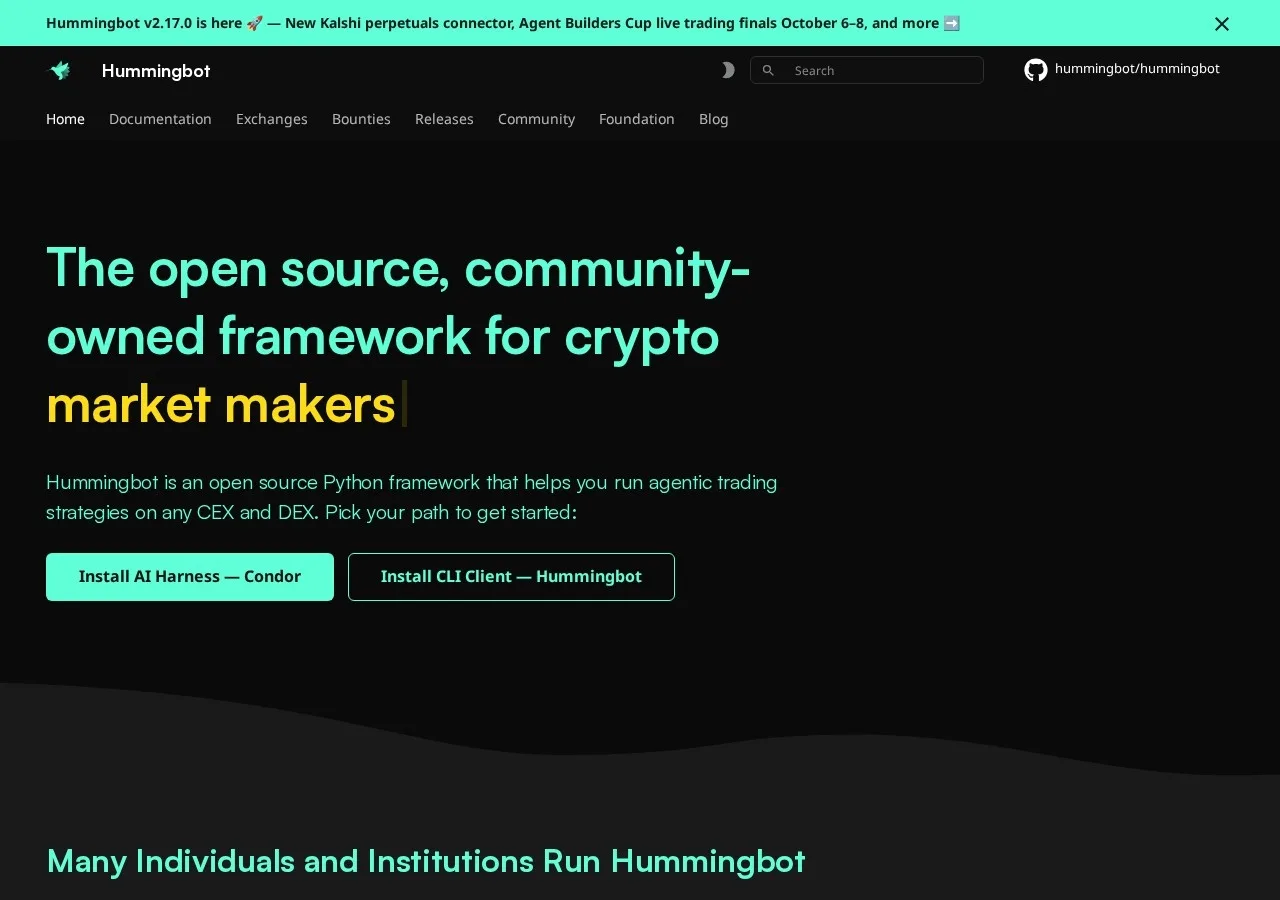
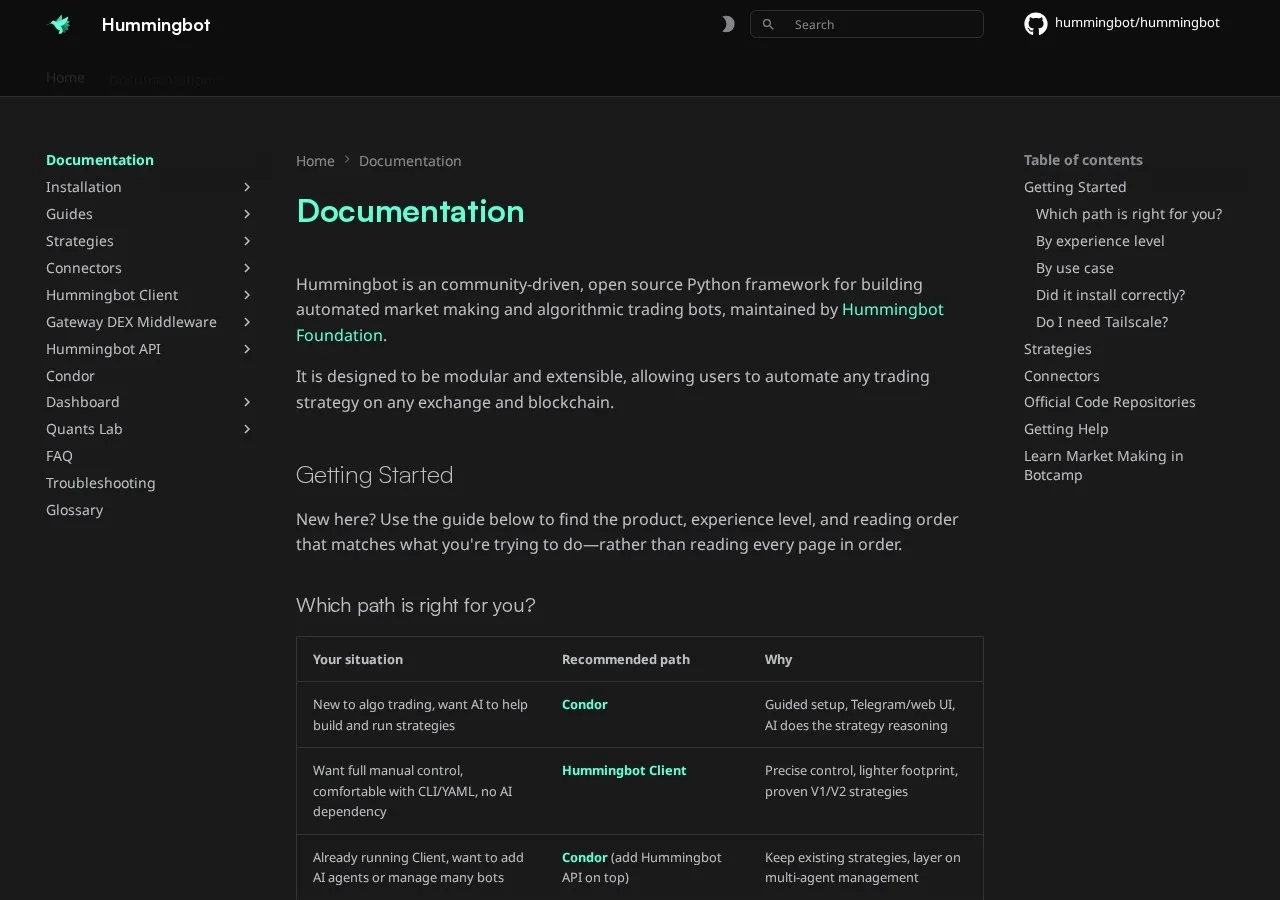
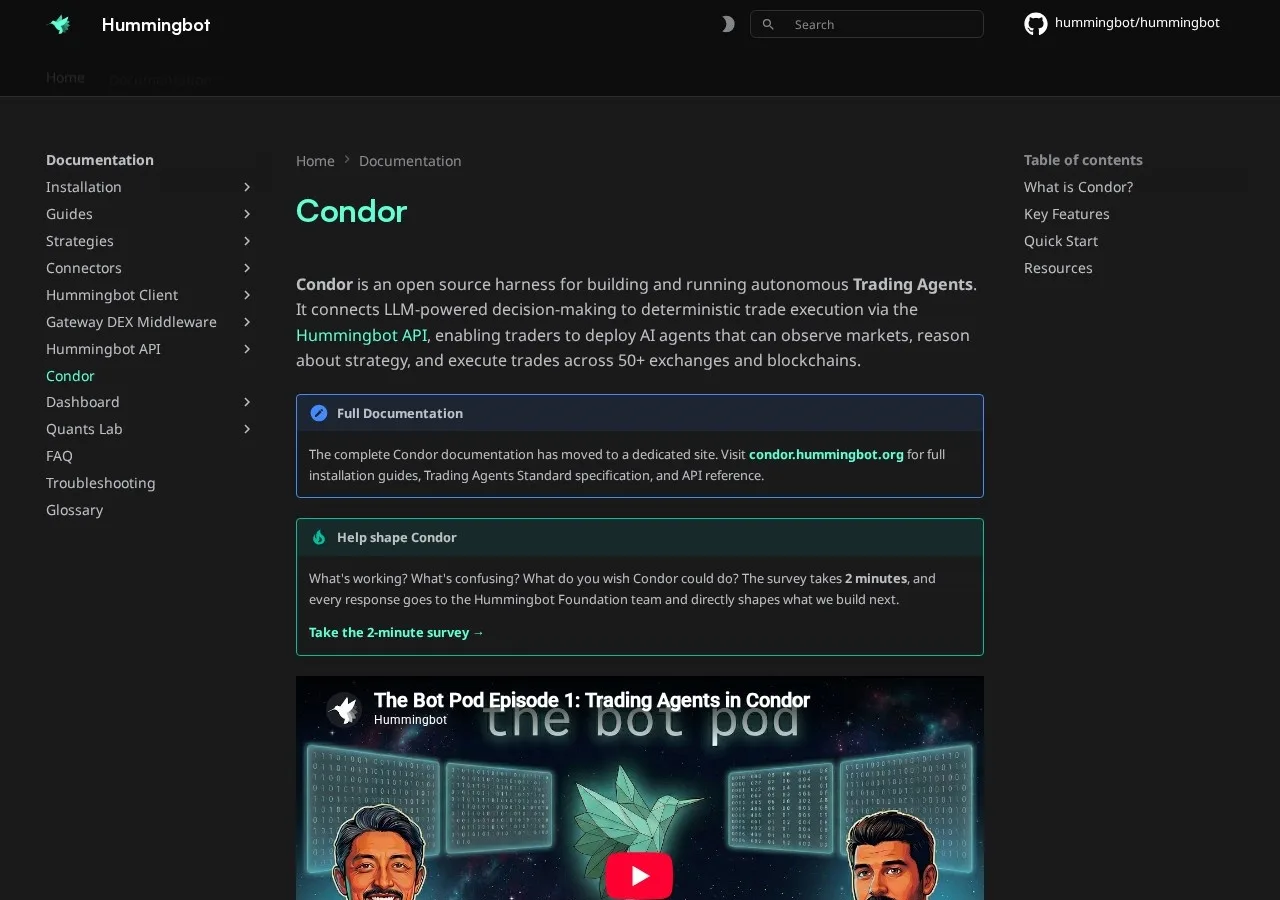
What users say about Hummingbot
One Reddit user on r/Hummingbot reported difficulty getting the software to run and noted that they were not receiving help.
In their own words
“Very supportive community here, thanks to all of you who responded”
“I can't even get it to run properly. Not really getting anyone to help me either 🥲”
“Any active builders & traders here? Hi, just recently discovered HB, it seems like a cool project. Anyone who is actively building and trading using it? It looks like the community has not been active for a while.”
Based on 160 Reddit posts and comments from the last 12 months, checked Oct 20, 2026. These are posts by users on other sites, not reviews submitted on CryptoReview.
User reviews
No user reviews yet. Have you used Hummingbot? Share your experience below.
FAQ
Who founded and runs Hummingbot?
Hummingbot was originally created in 2017 by CoinAlpha and transferred in late 2021 to the Hummingbot Foundation. The foundation is governed as a decentralized organization by holders of the HBOT token.
What fees does Hummingbot charge?
The Hummingbot client is free and open-source under the Apache 2.0 license. Using the Hyperliquid connector via Condor or the Hummingbot API incurs a 1 bps fee, but running the direct client carries no platform fee.
Does Hummingbot require KYC?
No, Hummingbot is self-hosted software that does not require an account or identity verification. Any KYC requirements depend entirely on the underlying exchanges you trade on.
How does Hummingbot handle custody and security?
Hummingbot is non-custodial software that runs locally on your own machine or private server. Your exchange API keys and wallet private keys remain encrypted on your host device rather than stored on third-party cloud servers.
Does Hummingbot have a token?
Yes, the governance token is HBOT, an Ethereum-based token used to vote on foundation proposals and framework developments. Its circulating supply reached approximately 666.6 million tokens following the end of its vesting period in January 2025.
Which blockchains and exchanges does Hummingbot support?
The framework supports more than 300 connectors across centralized and decentralized venues. On-chain trading works through the Gateway component on networks including Ethereum, Solana, BNB Chain, and Avalanche.
Latest from Hummingbot on X
🔒 Quick note for Condor / Hummingbot users
Tailscale released a security update (TS-2026-013).
Not a panic moment for most traders, your private mesh is not the main issue but please update Tailscale to v1.104.2+ on:
✅Condor machine
✅Hummingbot API server
✅other devices on your tailnet
Keep the API private (Tailscale only, not open to the internet).
Official: https://t.co/uoITu1Zpir
The Bot Pod Episode 16: Hackathon Recap and Strategy Cloning https://t.co/LCFTrzlr8U
https://t.co/LCFTrzkTjm
New reward campaign for Hummingbot market makers from our friends at @volmexfinance 💰💰💰
Example bot: https://t.co/0QX6NLyFr8 https://t.co/uvHscN0pjg
Example bot: https://t.co/0QX6NLyFr8 https://t.co/uvHscN0pjg

Recent public posts from @_hummingbot, shown as published. Not reviewed or endorsed by CryptoReview.
Alternatives to Hummingbot
Multi-exchange crypto trading terminal and automated bot platform launched in 2017
No KYCGrid · DCA +1Non-custodial (API keys)Backtesting

Multi-exchange crypto trading terminal and bots connecting to 19+ exchanges via non-custodial API keys
No KYCTerminal · Grid +1Non-custodial (API keys)Backtesting

Self-hosted algorithmic crypto trading bot running locally across 25+ exchanges since 2016
Grid · DCA +1Non-custodial (API keys)Backtesting

No-code crypto and stock automation platform backed by Y Combinator with over 350 strategy templates
No KYCGrid · DCA +2Non-custodial (API keys)Free plan

Non-custodial algorithmic crypto trading platform connecting to 19 exchanges with zero per-trade fees
No KYCGrid · DCA +3Non-custodial (API keys)Backtesting

Crypto prop firm offering funded accounts up to $200K with Bybit and BloFin execution
TerminalNon-custodial (API keys)Web · Desktop