

Your AI trading bot can execute trades. But it can't touch your funds.
What if Claude could connect to your exchange, analyze the market, and execute trades automatically, without having withdrawal permissions?
Here's how to set it up with Altrady's MCP Server and Claude Code.
1. Secure your API key: Enable trading permissions only. Withdrawals remain disabled, keeping your funds on the exchange.
2. Connect Altrady: Activate the MCP Server directly in the Altrady Desktop App. It runs locally on your machine.
3. Launch Claude Code: Paste your trading prompt and connect Claude to Altrady. Your API credentials stay on your computer.
4. Give it instructions: Ask Claude to analyze the market, identify opportunities, and execute your trading strategy. Nothing goes live until you approve it.
5. Let it trade: Once authorized, the bot can automatically open and close positions according to your instructions.
Your trades. Your exchange. Your funds.
Claude can trade, but it cannot withdraw. You remain in control of your capital.
The future of AI-powered crypto trading is here.

Altrady
Multi-exchange crypto trading terminal and bots connecting to 19+ exchanges via non-custodial API keys
4.1/ 5
Our score
Very good
Fee per trade
0%
Custody
Non-custodial (API keys)
Perpetual futures
Yes
Copy trading / wallet tracking
Yes
Platforms
WebiOSAndroidDesktop
What is Altrady?
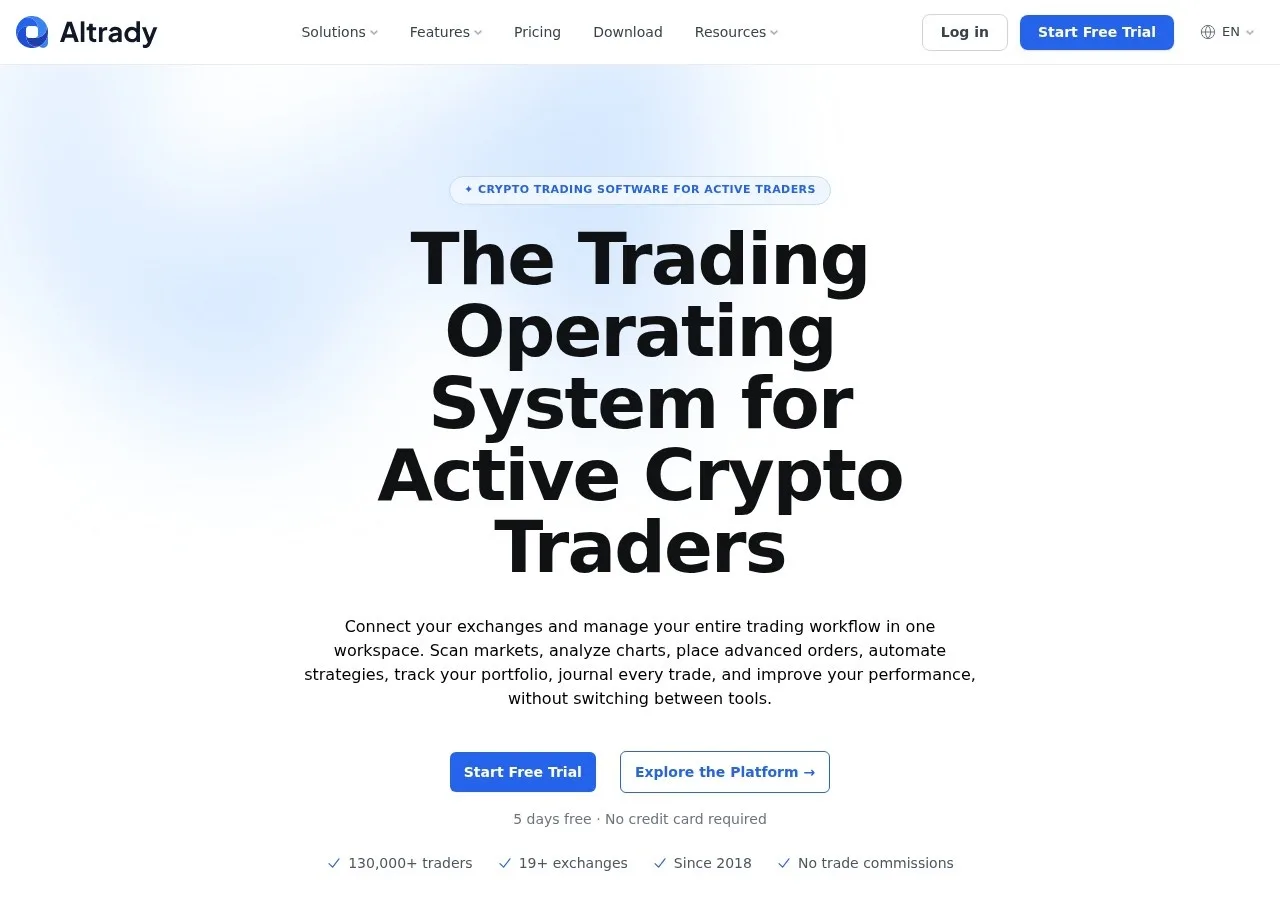
Altrady is a multi-exchange cryptocurrency trading terminal and automation suite that connects to 19 or more exchanges through non-custodial API keys. It consolidates market scanning, technical charting, smart order routing, trading bots, portfolio tracking, and trade journaling into a single interface.
Who is behind Altrady
Altrady was founded in 2018 by Benoist Claassen, who is the company's chief executive officer. Claassen began trading crypto in early 2017 and originally built an automated algorithmic market scanner to optimize his own trading routines before turning the software into a commercial platform. The company is headquartered in The Hague, Netherlands.
How it works and core tools
Altrady does not custody user funds or take custody of private keys. Instead, traders connect their accounts from supported spot and futures platforms, including Binance, Bybit, Coinbase, Kraken, OKX, and KuCoin, using exchange API keys. The software strictly requires trading permissions and does not accept withdrawal rights. The terminal provides smart order entry forms that bundle entry points, laddered targets, break-even adjustments, and stop-loss levels into a single submission. For automation, Altrady runs six bot configurations: Grid, DCA with configurable safety-order ladders, hold, Signal, TradingView, and Webhook. Users can also backtest setups against historical price data and execute virtual orders via paper trading.
Pricing and account setup
New users can test the platform with a five-day free trial that requires no credit card. Altrady charges subscription fees rather than trade-based commissions, with recurring pricing starting at €28 per month on monthly billing or €20 per month when billed annually, as well as an Essential tier at €50 per month. Onboarding requires no identity verification (KYC) directly with Altrady, although individual linked exchanges maintain their own identity and compliance requirements.
Track record and operational risks
Since its launch in 2018, Altrady reports having served more than 130,000 traders. User funds remain on connected exchanges, while automated trading can still incur losses during sharp volatility. These include algorithmic execution losses during sharp volatility, unexpected exchange API latency, rate limiting, and compromised API keys. Capital remains held directly on third-party exchanges, so funds remain subject to counterparty solvency risks on each connected venue.
Founders
Benoist ClaassenFounder
Bought his first cryptocurrency in early 2017 and developed an algorithm to automate market searching before building Altrady.
Best for:Traders managing multiple exchange accountsActive algorithmic and DCA bot usersTraders wanting integrated trade journaling
Pros and cons
Pros
- Connects to 19+ spot and futures exchanges from one dashboard
- Non-custodial architecture that never requires withdrawal API permissions
- No platform commissions charged on individual trades
- Includes paper trading and historical strategy backtesting tools
- No KYC required directly on Altrady to open an account
Cons
- Requires an ongoing paid monthly or annual subscription after the trial
- Users remain exposed to counterparty risks on linked exchanges
- Automated bots risk capital drawdowns during abrupt market swings
- Depends entirely on third-party exchange API stability and latency
Our review
4.1/5
Very good
Altrady unifies multi-exchange spot and futures execution with six automated bots without requiring withdrawal API permissions, though it requires monthly paid subscriptions after a short trial.
Altrady is a non-custodial multi-exchange trading terminal that manages spot and futures trading from one workspace. Founded in 2018 in the Netherlands by Benoist Claassen, the platform connects to over 19 centralized exchanges, including Binance, Bybit, KuCoin, OKX, and Coinbase. Because it interacts via API keys, users retain custody of their assets on their exchange accounts without granting withdrawal permissions.
The terminal combines market analysis with execution tools. It features custom scanners using more than 100 technical indicators, multi-timeframe trend verification, and smart orders that combine laddered entries, trailing take-profits, and break-even stop losses into one submission. For automated trading, Altrady provides six bot frameworks: Grid, DCA, Signal, hold, Webhook, and TradingView alerts. Traders can also backtest strategies on historical candles or use paper trading accounts to test automation without financial exposure.
Pricing runs on a tiered software subscription starting at €28 per month, or €20 monthly when billed annually, while the Essential tier costs €50 per month. Altrady charges zero platform commissions on executed trades. However, traders must factor fixed monthly software costs into their margins, and the platform provides only a 5-day free trial rather than a permanent free plan. Its coverage remains focused on centralized exchange APIs and does not include direct DEX integrations or on-chain automated sniping for decentralized finance traders.
Altrady suits active crypto traders and systematic bot operators who need unified order routing and advanced risk management across multiple exchange accounts.
Specs
| KYC required ⓘ | No · unverified |
|---|---|
| Strategies | Terminal, Grid, Signal / copy trading |
| Exchanges supported | 19 · unverified |
| Custody | Non-custodial (API keys) |
| Free plan | No · unverified |
| Paid plans from (per month) | $20 · unverified |
| Backtesting | Yes · unverified |
| Paper trading | Yes |
| On-chain (DEX) trading | No · unverified |
| Mobile app | Yes · unverified |
| Platforms | Web, iOS, Android, Desktop · unverified |
| Fee per trade ⓘ | 0% · unverified |
| Perpetual futures | Yes · unverified |
| Limit orders | Yes · unverified |
| Copy trading / wallet tracking | Yes · unverified |
| New-token sniping | No · unverified |
| MEV protection | No · unverified |
| Prediction markets | No · unverified |
| Built-in yield | No · unverified |
Not disclosed by the provider: Supported chains, Max leverage (x), Points or rewards program, Referral program.
Data from the provider's website and public sources. Fees and availability change; confirm on the official site before you sign up.
Key features
Smart order execution
Places entries, risk sizing, trailing take profits, break-even stops, and laddered orders through a single setup form.
Automated bot strategies
Supports six automated bot types including Grid, DCA with safety orders, TradingView alerts, HODL, Signal, and Webhook integrations.
Multi-exchange market scanner
Screens markets across connected exchanges using 100+ technical indicators, multi-timeframe rules, and quick-alert triggers.
Non-custodial API connections
Executes spot and futures trades across 19+ platforms without requesting or accepting fund withdrawal permissions.
Unified portfolio and journaling
Consolidates multi-exchange balances, calculates real-time profit and loss, and logs closed positions automatically and lets users attach chart screenshots.
Backtesting and paper trading
Allows traders to test automated strategies on historical price feeds and practice order execution with virtual funds.
Inside Altrady
Scanners
Screen markets across connected exchanges using over 100 technical indicators, multi-timeframe trend conditions, and real-time alerts.
Trade
Execute spot and futures orders using an all-in-one smart order form that configures laddered entries, break-even protection, and multi-target take-profits.
Automate
Deploy six automated bot formats including DCA, Grid, Signal, Webhook, HODL, and TradingView strategy bots to manage positions across exchanges.
Unified Portfolio
Track overall asset allocation, realized and unrealized profit and loss, and combined account balances across all connected exchanges in real time.
Trading Journal
Automatically log closed positions and trade history with options to attach chart screenshots and notes for performance review.
Paper Trading and Backtesting
Practice trade setups using virtual balances in live environments, or replay historical candle data to validate rule sets before deployment.
Altrady screenshots
What users say about Altrady
User sentiment for Altrady is largely positive, with traders valuing its multi-exchange portfolio management and frequent software updates. Complaints focus on the mobile app's limitations compared to desktop, specifically missing password manager integration and restricted trading capabilities.
In their own words
“Hands down the best available I’ve been using this app for years. It’s constantly being improved and updated. Nothing better out there for managing multiple positions, across pairs and exchanges. Well done team!”
“Not a shill… its just THAT good. This app saves so much time by allowing you to monitor multiple exchanges or portfolios from one single interface (with ease). It really is worth the investment. The crypto scanner and base scanner alone make it worth the money. It’s easy to use.”
“Great app I love Altrady and just set up a new grid bot which is awesome. What would make it the best is if it worked with password managers like 1Password or iCloud Keychain. Without this support logging in is a huge pain and actually makes me not want to use it on my iPhone.”
“Watered Down Desktop version is great, but as a dev told me “Apple Does Not Allow Trading from 3rd Party Apps” I guess I have to write this software off when it comes to non-desktop use.”
Based on 2 Reddit posts and comments, 6 App Store reviews from the last 12 months, checked Oct 20, 2026. These are posts by users on other sites, not reviews submitted on CryptoReview.
User reviews
No user reviews yet. Have you used Altrady? Share your experience below.
FAQ
Who founded Altrady?
Altrady was founded in 2018 by Benoist Claassen in the Netherlands. Claassen built the tool after writing automated algorithms to manage his own crypto trading.
Does Altrady charge trading fees?
No, Altrady charges no platform commissions or per-trade fees. Users pay Altrady's monthly or annual software subscription, which starts at €28 per month.
Is KYC required to use Altrady?
No identity verification (KYC) is required to sign up for Altrady or start its five-day trial. However, the connected cryptocurrency exchanges may enforce their own identity verification requirements.
How does Altrady secure user funds?
Altrady is non-custodial and connects to external exchanges via API keys. It does not require or support withdrawal permissions, so funds never leave your exchange accounts.
Which trading bots does Altrady provide?
Altrady includes six automated bot types: DCA, Grid, Signal, hold, Webhook, and TradingView bots. These allow automated order management based on custom webhooks, signal feeds, or technical indicators.
Can I test trading strategies on Altrady without real money?
Yes, Altrady offers built-in paper trading with virtual funds in live market conditions. It also features a backtesting engine that simulates strategies against historical candle data.
Latest from Altrady on X
+3% PROFIT IN JUST 2 DAYS. ONE SETUP. ZERO MANUAL SCANNING.
Great trades start with spotting the right opportunity at the right time.
In this example, Altrady's TA Scanner identified a SHORT setup using the EMA Pullback strategy, generating an 3% profit in just two days.
Here's how it works:
- Set your strategy: Define the indicators, parameters, and market conditions you want to trade.
- Scan the market: TA Scanner automatically searches multiple assets for setups matching your criteria.
- Catch the trigger: A real-time bell notification appears directly on the chart when your entry conditions are met.
- Take control: Evaluate the setup, confirm your entry, and manage your risk.
No need to jump between hundreds of charts or wait for opportunities to appear.
Let automation handle the search. You focus on the trading decisions.
Find the setup. Catch the signal. Trade with a plan.
We Tested 1,000 Order Blocks. Here’s When They Work.
We backtested 1,000 Bitcoin order blocks across five years. The results reveal which conditions actually make them profitable.
Backtest results:
- Standard order blocks: 31% win rate, -$14,000.
- Trading with the trend: 31%, no improvement.
- Strong displacement: 39%, marginally profitable.
- Fair Value Gap confirmation: 40%, +$2,000.
- Liquidity sweep: 49%, the strongest performance.
Backtest parameters:
- 4H timeframe.
- 2:1 Risk/Reward.
- $100 risk per trade.
- Trading fees included.
The takeaway: not all order blocks are equal. Liquidity sweeps delivered the strongest results, outperforming traditional order block setups.
Buy or Sell? Price Action Test for Traders!
Price tests the same resistance for the fourth time. Buy or sell?
The answer lies in the market structure.
At first glance, repeated rejections suggest a selling opportunity. But look at the lows: each pullback forms a higher low, showing increasing buying pressure.
This is a classic Ascending Triangle:
- Flat resistance.
- Higher lows.
- Increasing buying pressure.
- Bullish breakout confirmed by rising volume.
Trading strategy:
- Entry: Breakout above resistance.
- Stop Loss: Below the latest higher low.
- Take Profit: Triangle height projected upward.
Don't trade resistance blindly. Read the market structure and identify which side is gaining control.
Weekend prep with the Altrady Scanner.
Set your own rules once, for example RSI below 30 on the 4h chart and volume above its 20-period average, and see which markets match across your connected exchanges.
You build the rules from 100+ technical indicators, so the scan follows your strategy, not a generic list of top movers.
A shorter watchlist for Monday, built in a few minutes.

Recent public posts from @altradyapp, shown as published. Not reviewed or endorsed by CryptoReview.
Alternatives to Altrady

Multi-exchange crypto trading terminal and automated bot platform launched in 2017
No KYCGrid · DCA +1Non-custodial (API keys)Backtesting

Self-hosted algorithmic crypto trading bot running locally across 25+ exchanges since 2016
Grid · DCA +1Non-custodial (API keys)Backtesting

No-code crypto and stock automation platform backed by Y Combinator with over 350 strategy templates
No KYCGrid · DCA +2Non-custodial (API keys)Free plan

Open-source algorithmic trading framework with 318 connectors across CEXs and DEXs
No KYCMarket making · ArbitrageNon-custodial (API keys)Free plan

Non-custodial algorithmic crypto trading platform connecting to 19 exchanges with zero per-trade fees
No KYCGrid · DCA +3Non-custodial (API keys)Backtesting

Crypto prop firm offering funded accounts up to $200K with Bybit and BloFin execution
TerminalNon-custodial (API keys)Web · Desktop