

Security Reminder: Stay Alert to Scams as Withdrawals Resume
Withdrawals are resuming in phases and opportunistic scammers may try to take advantage of this period. They may impersonate Binance through DMs, emails, group chats and even small transfers with a message attached, offering to "speed up withdrawals," give "priority processing," help you "claim compensation," or move your assets into a "Binance vault".
Please remember that Binance will never:
• Contact you first about your account or funds
• Offer or sell you a place in the withdrawal queue
• Charge a fee to unlock a network or asset
• Ask you to connect a wallet, sign, authorize anything, or transfer funds to "unlock" a withdrawal
• Ask you to move your assets into a "vault", "safe account", "secured wallet" or any address provided by someone else
• Send you an "eligibility", "status" or "compensation claim" link
• Ask for your password, 2FA codes or seed phrase
• Point you to a unofficial PoR site
• Offer paid "asset recovery" services
Once you connect, sign, or authorize a request, third parties can move your assets — and on-chain transactions are usually irreversible.
If your withdrawal is still pending, check its status in the Binance app. Anyone promising to expedite it for a fee is scamming you.
Only use the official Binance app and official channels for updates. To check whether a channel, account or website is real, use the official verification page:
https://t.co/aywEixOmJB
If you see anything suspicious, or think your account may be at risk, change your password right away, review your security settings and contact in-app Customer Support.
Keeping your assets safe is always our top priority. Thank you for your trust and support.

Binance Earn
Custodial yield and staking suite from an exchange with over 300 million registered accounts
3.9/ 5
Our score
Good
Products
Savings / earnFixed-term depositsStakingDual investment
Proof of reserves
Yes
KYC required
Yes
What is Binance Earn?
Binance Earn is the centralized yield and staking division of Binance, the world's largest cryptocurrency exchange by trading volume. The platform aggregates flexible savings accounts, fixed-term staking deposits, collateralized lending, and structured products such as dual investment into a single account interface.
Company background and leadership
Binance was founded in 2017 by Changpeng Zhao, who previously worked at Blockchain.info and served as CTO of OKCoin, and Yi He, a former executive at OKCoin. The parent company, Binance Holdings Ltd., is headquartered in the United Arab Emirates and is led by CEO Richard Teng. After an initial coin offering that raised $15 million in July 2017, the company secured a $2 billion institutional investment from Abu Dhabi-based investment firm MGX in March 2025.
Product mechanics and custody
Deposits in Binance Earn operate under a custodial model, meaning user assets are held by the exchange rather than in individual self-custodial wallets. Users can choose between flexible savings accounts that distribute daily yield and allow redemption at any time, or locked staking pools that require fixed deposit durations in exchange for higher yields. Binance also offers collateralized borrowing via Binance Loans, featuring hourly or daily interest rates alongside partial liquidation buffers and automated collateral top-ups. The exchange publishes a Merkle-tree-based proof of reserves system to demonstrate 1:1 backing for customer assets.
Availability and compliance
Identity verification (KYC) is required to access all Binance Earn products. The international platform excludes US persons. Residents of the United States are directed to Binance.US, a separate entity operating under independent state and FinCEN regulatory oversight.
Track record and platform risks
By late 2025, Binance reported surpassing 300 million registered users worldwide. The exchange has experienced major security and regulatory events over its history. In May 2019, attackers withdrew 7,000 Bitcoin from hot wallets, which the exchange reimbursed fully from its emergency insurance fund. In November 2023, Binance resolved US regulatory investigations by pleading guilty to anti-money laundering violations and paying a $4.3 billion settlement to the US Department of Justice. Using centralized yield accounts carries counterparty risk and insolvency exposure, with fixed terms also restricting access to committed assets.
Founders
Changpeng ZhaoCo-founder
Founded Fusion Systems in Shanghai, worked at Blockchain.info, and served as CTO at OKCoin.
Yi HeCo-founder
Former executive at OKCoin who hired Changpeng Zhao before co-founding Binance.
Best for:Binance exchange traders holding idle balancesInternational crypto depositors seeking flexible yieldsBorrowers needing collateralized loans
Pros and cons
Pros
- Merkle-tree proof of reserves provides verifiable 1:1 asset backing
- Flexible products permit withdrawals at any time
- Collateralized lending offers automated margin top-ups and hourly interest
Cons
- Custodial structure exposes user funds to central platform insolvency
- Completely unavailable to United States residents
- Full identity verification (KYC) is mandatory for all yield products
- Fixed-term products restrict asset withdrawals until the lock-up expires
- History includes a $4.3 billion Department of Justice regulatory settlement in 2023
Our review
3.9/5
Good
Binance Earn offers flexible and locked products, staking, dual investment, and crypto-backed loans, with centralized counterparty risk and past regulatory penalties.
Binance Earn consolidates the exchange's yield products under one roof, spanning flexible savings, locked deposits, on-chain staking, and structured dual-investment instruments. Co-founded by Changpeng Zhao and Yi He in 2017, parent company Binance Holdings Ltd. operates the largest digital asset exchange globally, reporting over 300 million registered users by late 2025.
Depositors access several earning mechanisms depending on their liquidity preferences. Flexible products allow anytime redemption, while locked options commit tokens for set durations. Binance provides collateralized borrowing through Binance Loans, with interest rates set hourly or daily and partial liquidation protections.
Security and counterparty exposure remain primary considerations for any centralized earn product. Binance publishes a Merkle-tree proof of reserves system to demonstrate 1:1 backing for depositor balances. However, users face institutional risks common to custodial platforms. In May 2019, Binance lost 7,000 Bitcoin in an exchange exploit, which it reimbursed via emergency reserves. In November 2023, the parent company entered a $4.3 billion settlement with the US Department of Justice regarding anti-money laundering compliance. Financial backing received an institutional boost in March 2025 when Abu Dhabi-based MGX acquired a minority stake through a $2 billion investment paid in stablecoins.
Binance Earn suits active exchange users seeking convenient yield generation across a wide asset catalog without managing separate on-chain wallets. The global platform excludes US persons, and the service uses a custodial model rather than self-custody.
Sources (1)
Specs
| KYC required ⓘ | Yes · unverified |
|---|---|
| Products | Savings / earn, Fixed-term deposits, Staking, Dual investment |
| Proof of reserves | Yes |
| Flexible (withdraw any time) | Yes · unverified |
| Fixed terms | Yes · unverified |
Not disclosed by the provider: Highest advertised APY, Max loan-to-value, Loan APR from, Supported assets, Available in, Insurance, Licenses & registrations, Auto-compounding.
Data from the provider's website and public sources. Fees and availability change; confirm on the official site before you sign up.
Key features
Flexible savings accounts
Flexible products offer anytime redemption.
Fixed-term locked staking
Users lock specific cryptocurrencies for set intervals.
Collateralized crypto loans
Binance Loans allows borrowing without credit checks, with partial liquidation and variable hourly rates.
Dual investment options
Structured yield product based on directional price movements.
Merkle-tree proof of reserves
Onchain cryptographic reserve verification confirms 1:1 asset backing against user exchange liabilities.
Inside Binance Earn
Binance Loans
Collateralized lending service that allows users to borrow cryptocurrencies without credit checks, featuring partial liquidation options and auto top-up.
Proof of Reserves System
A verification framework using Merkle trees that allows depositors to confirm their assets are backed 1:1 by exchange reserves.
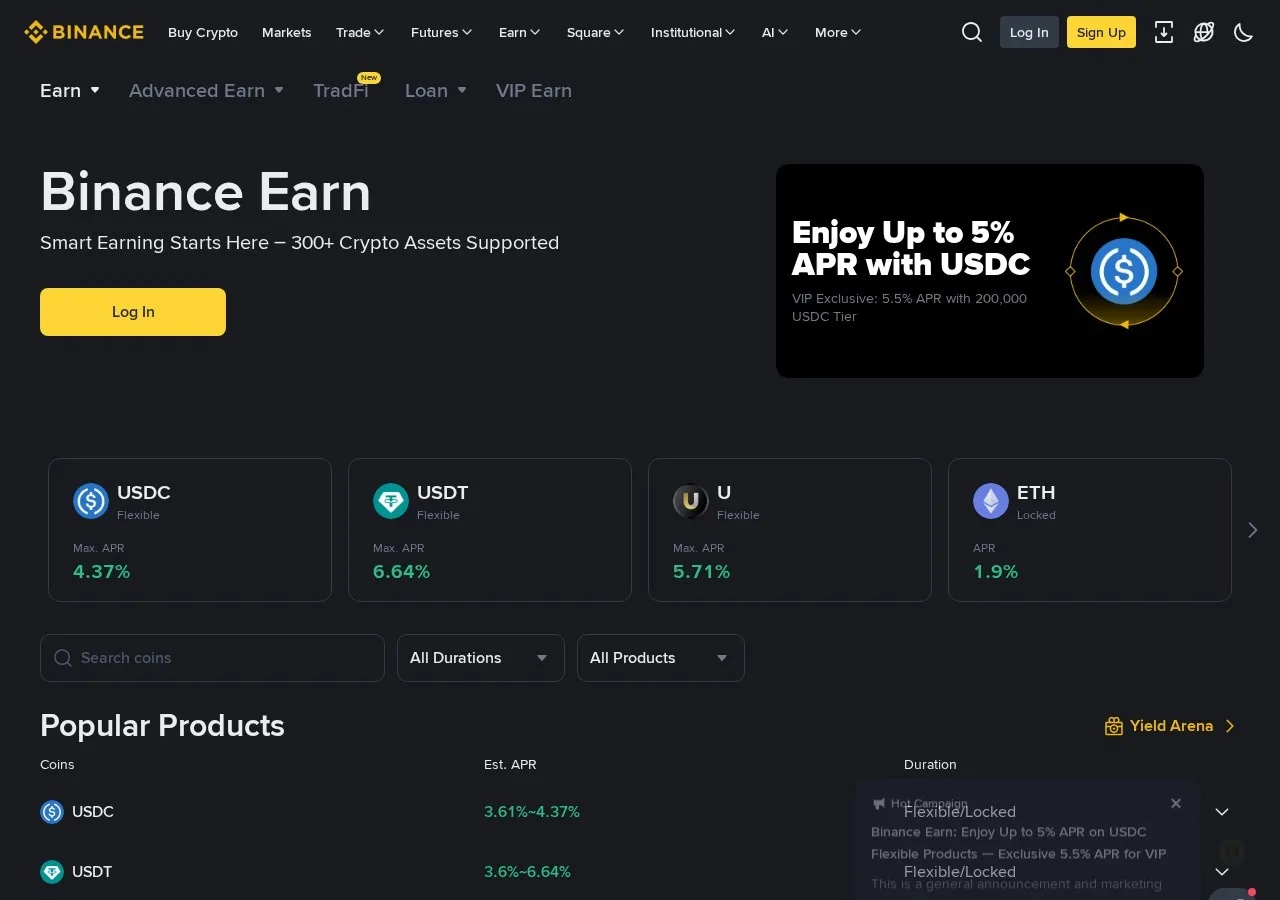
Binance Earn screenshots
What users say about Binance Earn
User sentiment is heavily impacted by strict compliance measures, regional restrictions, and locked balances. Feedback also highlights concerns regarding blocked withdrawals and account freezes.
In their own words
“Exchange: Binance.com Case ID: #166631173 Issue: My withdrawal function has been disabled with error RW00302. My identity verification has already been completed successfully.”
“Best VPN for Binance A friend texted me last month in a mild panic. He'd been using a sketchy free VPN to access Binance from the US for eight months. One morning he woke up, opened the app, and stared at a frozen account with $3,200 inside. No warning email. No support response for six days.”
Scam warning: Fraudsters use SMS spoofing, phishing emails mimicking automated Binance notices, and fake phone calls impersonating support to hijack user credentials.
Based on 200 Reddit posts and comments from the last 12 months, checked Oct 20, 2026. These are posts by users on other sites, not reviews submitted on CryptoReview.
User reviews
No user reviews yet. Have you used Binance Earn? Share your experience below.
Funding and investors
$15MTotal raised
1Round
1Investor
-
ICO Jul 2017 $15MPI Public ICOSource
FAQ
Who founded Binance Earn?
Binance was co-founded in 2017 by Changpeng Zhao and Yi He. The platform is operated by Binance Holdings Ltd. under the leadership of CEO Richard Teng.
Does Binance Earn have a native token?
Binance operates the BNB token, which was originally launched via an initial coin offering in July 2017.
Is Binance Earn available in the United States?
No, the global Binance Earn platform excludes US persons. Users in the United States are served by an independent entity, Binance.US, which operates under distinct state and federal regulatory frameworks.
How does Binance prove custody of deposited funds?
Binance uses a Merkle-tree proof of reserves system to verify that user asset balances are backed 1:1 against exchange liabilities.
Has Binance experienced any past security incidents?
Binance experienced a security breach in May 2019 resulting in the theft of 7,000 Bitcoin, which the company covered and reimbursed to users. In November 2023, Binance also paid a $4.3 billion settlement with the US Department of Justice over anti-money laundering violations.
What lending services are connected to Binance Earn?
Binance Loans allows users to borrow cryptocurrencies against their existing collateral without credit checks, charging variable hourly or daily interest rates.
Latest from Binance Earn on X
https://t.co/Dg2lQ9txpX
Trust is earned, and we’re grateful for the confidence you place in us. #ThankYouBinancians
This campaign reflects that appreciation: eligible users can claim a 100 USDC Spot fee rebate voucher, share 20,000,000 USDC, and earn up to 10% APR.
Learn more 👉 https://t.co/11kIiwtH9P
This campaign reflects that appreciation: eligible users can claim a 100 USDC Spot fee rebate voucher, share 20,000,000 USDC, and earn up to 10% APR.
Learn more 👉 https://t.co/11kIiwtH9P

Fiat Withdrawal Update
Fiat withdrawals are now available for the following currencies:
New
✅ USD
✅ AED
✅ VND
✅ PHP
✅ IDR
Current:
JPY, VES, BRL, MXN, ARS, BHD, KZT, EUR, CHF, CZK, HUF, KWD, PLN, RON, SEK, CDF, KES, SLE, UGX, XAF, XOF, ZMW, and KGS.
We will continue to share further updates through official Binance channels.

Binance began restoring withdrawals in phases at 06:00 UTC on November 1, 2026. By 12:36 UTC, withdrawals had resumed for all 15 networks and assets in the initial phase. After an initial spike, withdrawal volumes have declined and are stabilising as expected, while deposit volumes have remained substantial.
Between 06:00 and 15:30 UTC on November 1, we processed $4.649 billion in withdrawals and $1.01 billion in deposits, resulting in a net outflow of approximately $3.64 billion. This represents 2.1% of our $171 billion in total assets under management (AUM), based on the latest available Proof of Reserves (PoR) data as of October 28, 2026. A new PoR snapshot was taken at 00:00 UTC on October 31, and zero-knowledge proof (ZKP) computation began. The updated report is expected to be available on our PoR website tomorrow.
Our team continues testing rigorously the remaining networks and assets. We know how important safe and reliable access to your funds is and will share details of the next phase as soon as we can. Rest assured that market conditions are stable.
Thank you for your patience and continued support.

Recent public posts from @binance, shown as published. Not reviewed or endorsed by CryptoReview.
Alternatives to Binance Earn

Gibraltar-licensed private bank offering interest-bearing USD accounts paid daily in Bitcoin
KYC requiredSavings / earn · Crypto-backed loansUnited Kingdom · GlobalFlexible (withdraw any time)

Blockchain lending platform originating over $30B in loans with crypto-backed credit at 50% LTV
KYC requiredSavings / earn · Crypto-backed loansUnited StatesHighest advertised APY 9%

Bitcoin-backed lending platform operating since 2018, with $11.5B in lifetime loans funded
KYC requiredCrypto-backed loansGlobal · Canada +6Proof of reserves

Crypto earning suite with on-chain staking and MiCA regulation covering 30 European markets
KYC requiredSavings / earn · Staking +1Europe (EEA) · United States +1Proof of reserves

Crypto-backed loans in USD or USDC with segregated custody at Anchorage Digital
KYC requiredCrypto-backed loansUnited StatesFlexible (withdraw any time)

Digital asset wealth manager offering tokenized yield, MPC custody, and loans for private clients
Savings / earn · Crypto-backed loansFlexible (withdraw any time)Highest advertised APY 7.5%