

Weekly XRP Update
RIPPLE BACKS FLUTTERWAVE FOR AFRICA PAYMENTS EXPANSION
Ripple invested in Flutterwave’s Series E round, valuing the African fintech at $3.2 billion. The partnership will integrate Ripple’s RLUSD stablecoin and XRP Ledger into Flutterwave’s payments network, aiming to lower costs and accelerate cross-border transactions across Africa while expanding RLUSD adoption.
RIPPLE TARGETS AI PAYMENTS WITH XRPL AND RLUSD
Ripple is positioning $XRP and RLUSD as payment rails for AI agents through its XRPL AI Starter Kit and x402 protocol support. The initiative aims to enable autonomous software to pay for APIs, data, and computing services, challenging the early dominance of USDC-powered transactions on Base and Solana in the emerging machine-to-machine payments market.
RIPPLE LAUNCHES AI PAYMENT TOOLS ON XRPL
Ripple unveiled the XRPL AI Starter Kit, enabling developers to build AI agents that can make autonomous payments using $XRP and RLUSD. The move targets the growing machine-to-machine payments market, where USDC currently dominates x402 transactions on Base and Solana, with Ripple betting on XRPL’s fast settlement, low fees, and native payment infrastructure to gain adoption.

Osprey Bitcoin Trust (OBTC)
Nasdaq-listed spot Bitcoin exchange-traded product tracking CME CF reference pricing at a 0.49% expense ratio
2.8/ 5
Our score
Weak
Ticker
OBTC
Expense ratio
0.49%
Holds
Bitcoin
Assets under management
$61.8M
Listed on
Nasdaq
What is Osprey Bitcoin Trust (OBTC)?
Osprey Bitcoin Trust (OBTC) is an exchange-traded product holding spot Bitcoin, structured to track the CME CF Bitcoin Reference Rate (New York Variant) minus fund expenses. As of October 2026, the trust held 735 Bitcoins representing approximately $61.8M in assets under management across 2,290,535 outstanding shares.
Sponsor and background
The trust is sponsored by Osprey Funds, LLC, an investment firm based in Tarrytown, New York, originally founded in 2019 as a crypto unit within REX Shares before spinning out as an independent business in 2021. The firm is led by founder and CEO Greg King, who previously structured exchange-traded products at Barclays, Credit Suisse, Citigroup, and Global X Funds.
Structure and mechanics
OBTC holds physical Bitcoin directly rather than futures contracts. The trust uses third-party institutional custody. The fund operates as a Delaware statutory trust and is not registered under the Investment Company Act of 1940. Investors access the vehicle through standard brokerage and retirement accounts, trading secondary shares on Nasdaq without holding native wallet keys. The trust does not provide a redemption rail for physical Bitcoin delivery to individual retail shareholders.
Expenses and trading liquidity
The fund carries a total annual expense ratio of 0.49%, deducted continuously from the trust's underlying Bitcoin holdings. As of October 2026, OBTC traded at a net asset value of $27.07 per share with a -0.37% discount and a 30-day median bid-ask spread of 0.42%. Daily trading volume averaged roughly 7,500 shares.
Operational milestones and risks
OBTC launched as a private placement vehicle for accredited investors in 2019 before commencing public trading on OTC markets in February 2021 under ticker OBTC on the OTCQX Best Market. In August 2024, Osprey explored strategic alternatives and agreed to sell the trust's Bitcoin assets to the Bitwise Bitcoin ETF (BITB), but the transaction was terminated in February 2025 following a settlement payment. Osprey subsequently filed for conversion and successfully transferred OBTC's secondary trading listing to the Nasdaq Stock Market on December 19, 2025.
Key risks include underlying Bitcoin price volatility, bid-ask spread costs resulting from modest secondary liquidity, and tracking deviations from spot pricing due to the trust expense ratio and exchange trading premiums or discounts.
Founders
Greg KingFounder & CEO
Launched over 100 exchange-traded products with previous experience at firms including Barclays, Credit Suisse, Citi, and Global X Funds.
Best for:US brokerage account holdersRetirement account crypto allocationsInvestors seeking spot Bitcoin tracking
Pros and cons
Pros
- Trades directly on Nasdaq under ticker OBTC
- Backs shares with 100% spot Bitcoin rather than futures contracts
- Eligible for tax-advantaged US retirement accounts like IRAs
- 0.49% total annual expense ratio
Cons
- Modest fund size of about $61.8M compared to larger spot Bitcoin ETFs
- Median 30-day bid-ask spread of 0.42% increases trading friction
- No option for shareholders to withdraw physical Bitcoin directly
- Exempt from protections provided by the Investment Company Act of 1940
Our review
2.8/5
Weak
OBTC offers direct spot Bitcoin exposure on Nasdaq through traditional brokerage accounts, but carries a 0.49% expense ratio and modest secondary market liquidity.
Osprey Bitcoin Trust (OBTC) is an exchange-traded product that tracks the CME CF Bitcoin Reference Rate (New York Variant). Sponsored by Osprey Funds and affiliated with REX Shares, the vehicle originally traded on the OTCQX Best Market before converting to a Nasdaq listing on December 19, 2025. It holds spot Bitcoin directly, backed by institutional custody, removing the need for investors to manage self-custody private keys.
As of October 2026, OBTC manages $61.8M in fund assets across 735 BTC, with a net asset value of $27.07 per share. Its expense ratio is 0.49% annually. That fee is higher than many direct spot Bitcoin exchange-traded funds launched in the United States. While conversion to a national exchange eliminated the wide structural discounts typical of OTC trusts, trading liquidity remains modest, reflected in daily trading volumes around 7,500 shares and a 30-day median bid-ask spread of 0.42% in October 2026.
Osprey Funds was founded in 2019 by Chief Executive Officer Greg King, who previously structured exchange-traded products at Barclays, Credit Suisse, and Global X Funds. The trust experienced corporate turbulence prior to its national listing. In August 2024, Osprey agreed to sell its Bitcoin holdings to the Bitwise Bitcoin ETF (BITB), but that agreement was terminated in February 2025 following a settlement payment before Osprey pursued its own exchange conversion.
OBTC suits investors who require exposure to Bitcoin through tax-advantaged retirement accounts or standard brokerages and prefer an established independent trust structure. Active traders or institutional allocators seeking tight bid-ask spreads and the lowest expense ratios may prefer larger spot Bitcoin funds with deeper secondary market order books.
Specs
| Ticker | OBTC |
|---|---|
| Issuer | Osprey Funds |
| Holds | Bitcoin · unverified |
| Structure | Grantor trust · unverified |
| Expense ratio | 0.49% · unverified |
| Assets under management | $61.8M · unverified |
| Listed on | Nasdaq · unverified |
| Launch date | 2025-12-19 · unverified |
| Stakes its holdings | No · unverified |
| Market | United States · unverified |
Not disclosed by the provider: Fee waiver, Custodian, Options available.
Data from the provider's website and public sources. Fees and availability change; confirm on the official site before you sign up.
Key features
Spot Bitcoin backing
OBTC holds native Bitcoin in institutional custody, holding 735 BTC as of October 2026.
Index tracking
The trust benchmark tracks the CME CF Bitcoin Reference Rate (New York Variant) to establish daily net asset values.
Brokerage account access
Shares trade directly on the Nasdaq exchange under ticker OBTC for access via standard taxable or retirement brokerage accounts.
Continuous creation and redemption
Authorized participants manage share liquidity via block basket sizes of $270,765 to align market prices with net asset value.
Annual expense structure
The fund operates under a 0.49% total expense ratio deducted from trust assets.
Inside Osprey Bitcoin Trust (OBTC)
Fact sheet
Summarizes the fund's objective, primary portfolio metrics, expense ratio, exchange listing details, and current net asset value.
Prospectus
Provides official regulatory disclosures, detailed risk factors, fee breakdowns, and statutory trust operational rules.
Discount / premium chart
Tracks daily share market prices relative to net asset value per share. The chart records tracking performance alongside historical premium and discount variations.
Holdings
Lists current portfolio assets, reporting the exact number of Bitcoin held alongside cash equivalents and associated portfolio weightings.
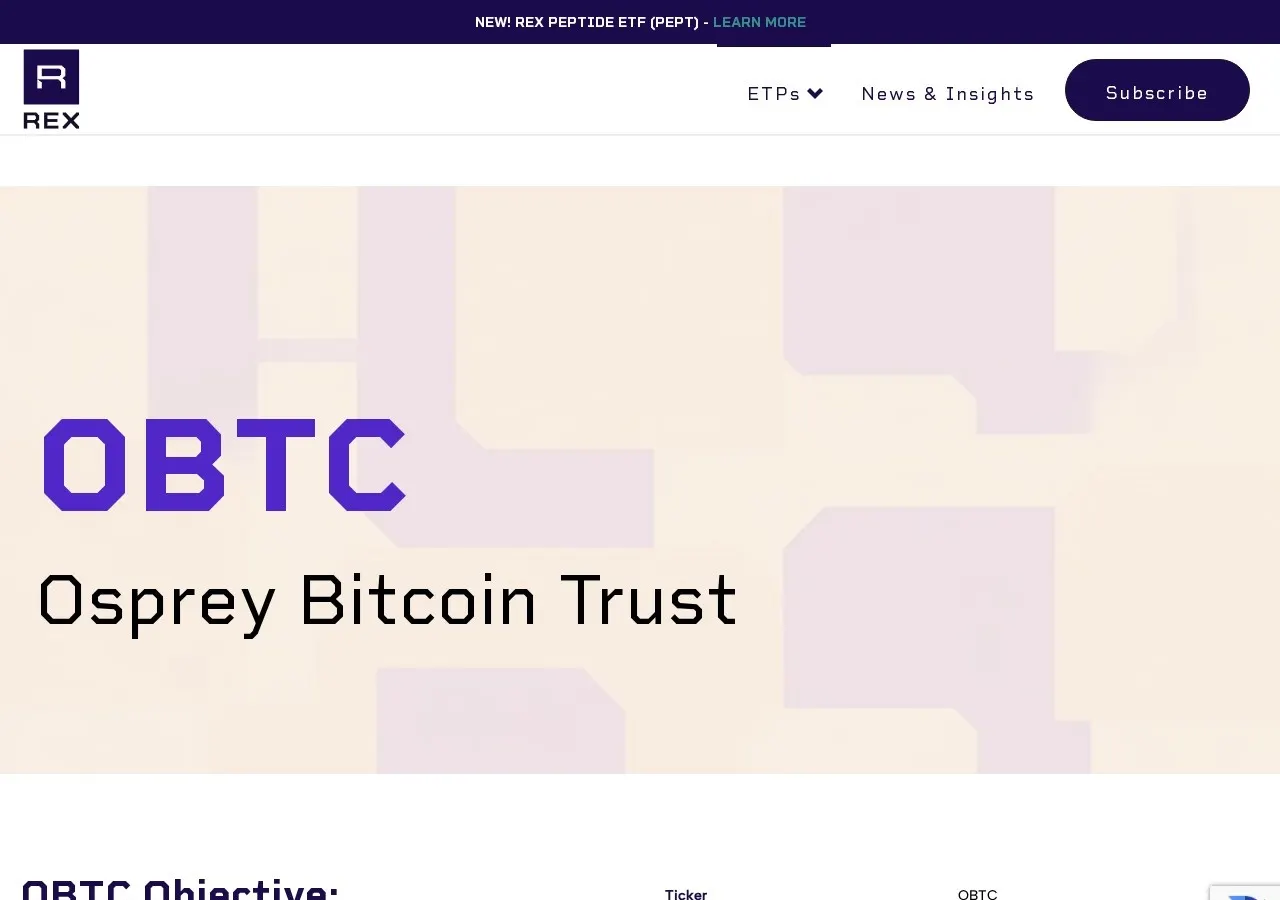
Osprey Bitcoin Trust (OBTC) screenshots
What users say about Osprey Bitcoin Trust (OBTC)
There is insufficient user feedback to evaluate Osprey Bitcoin Trust, as no relevant reviews or user experiences were provided.
Based on 1 Reddit posts and comments from the last 12 months, checked Oct 26, 2026. These are posts by users on other sites, not reviews submitted on CryptoReview.
User reviews
No user reviews yet. Have you used Osprey Bitcoin Trust (OBTC)? Share your experience below.
FAQ
Who founded Osprey Bitcoin Trust (OBTC)?
Osprey Funds was founded by Chief Executive Officer Greg King, who launched the firm in 2019 as a crypto unit affiliated with REX Shares before spinning it off in 2021.
What are the fees for Osprey Bitcoin Trust (OBTC)?
OBTC charges an annual total expense ratio of 0.49% to cover management and fund administrative operations.
Where is OBTC available to trade?
OBTC trades under the ticker symbol OBTC on the Nasdaq Stock Market and can be purchased through standard US brokerage and retirement accounts.
Who provides custody for OBTC?
The trust's spot Bitcoin holdings are safeguarded under institutional custody.
Does OBTC hold physical Bitcoin or futures contracts?
OBTC holds physical Bitcoin directly, with 735 BTC held on behalf of the trust in October 2026 rather than derivatives or futures contracts.
Does OBTC offer staking rewards or yield?
No, the trust does not stake assets or distribute yield, functioning as a passive grantor trust that tracks the spot price of Bitcoin.
Latest from Osprey Bitcoin Trust (OBTC) on X
Weekly Solana Update
COINBASE STABLECOIN PUSH
$COIN partnered with Flipcash to launch USDF, a USDC-backed stablecoin on Solana $SOL. The move expands Coinbase’s branded stablecoin infrastructure for apps seeking dollar-based settlement rails without building compliance and payments systems in-house.
SOLANA TARGETS PERPS MARKET
Solana co-founder Anatoly Yakovenko backed development of a new SVM-native perpetuals DEX aimed at challenging Hyperliquid’s dominance in onchain derivatives. The effort highlights Solana’s push to recapture trading activity as Hyperliquid strengthens liquidity and pursues U.S. regulatory clarity.
SOLANA ATTRACTS WALL STREET CAPITAL
Solana is gaining institutional traction as firms including BlackRock, Visa, Stripe, PayPal, and Franklin Templeton expand tokenized asset and payment activity on the network. Messari said Solana’s growing stablecoin, ETF, and RWA ecosystem is shifting its image from memecoin hub to core financial infrastructure.
Weekly XRP Update
CLARITY ACT ADVANCES
The U.S. Senate Banking Committee approved the Digital Asset Market Clarity Act in a bipartisan 15-9 vote, moving the crypto market structure bill closer to full Senate and House consideration. Key negotiations remain around DeFi oversight, investor protections, and ethics rules tied to government officials’ crypto involvement.
XRPL PREPS FOR QUANTUM SECURITY
Project Eleven will conduct a full audit of the XRP Ledger’s validator, custody, networking, and wallet layers ahead of deploying quantum resistant cryptography. XRPL’s native account architecture and built-in key rotation are designed to let users upgrade to quantum secure signatures without changing existing wallet addresses.
XRP ALLIANCE LAUNCHES YIELD PUSH
Flare and D’CENT introduced hardware wallet integration enabling XRP holders to access noncustodial yield vaults directly through XRPL signatures. The launch also unveiled the XRP Alliance, backed by Flare, D’CENT, Banxa, Doppler, and Squid, aimed at expanding XRP’s programmable DeFi ecosystem.
Weekly Solana Update
SOLANA ALPENGLOW TESTNET LIVE
solana:So11111111111111111111111111111111111111112's proposed Alpenglow consensus overhaul is now running on a community test cluster, marking the biggest consensus upgrade in Solana history. The redesign aims to replace parts of Proof-of-History and TowerBFT to significantly reduce transaction finality times and improve network stability ahead of a potential mainnet launch next quarter.
COINBASE EXPANDS SOL-BACKED LENDING
$COIN added support for Solana-backed loans through its Morpho integration on Base, allowing users to borrow up to $100,000 against solana:So11111111111111111111111111111111111111112 holdings. Coinbase said its crypto-backed lending platform has now surpassed $2.3 billion in total loan originations as it expands deeper into onchain financial services.
Weekly XRP Update
QUANTUM-PROOFING XRP LEDGER PLAN
Ripple outlines a four-phase roadmap to make the XRP Ledger $XRP quantum-resistant by 2028, including emergency migration measures and zero-knowledge recovery. The plan progresses through vulnerability assessments, testing post-quantum cryptography, and full deployment to mitigate future quantum threats.
XRP EXPANDS TO SOLANA DEFI
Ripple-linked $XRP is now accessible on Solana via Hex Trust’s 1:1 backed wrapped token (wXRP), with ~$1.2M already minted. The move broadens XRP’s DeFi utility beyond XRPL, tapping into Solana’s larger liquidity ecosystem and institutional demand.
SOFI ENABLES XRP DEPOSITS, LIMITS WITHDRAWALS
$SOFI added $XRP deposit support, expanding retail access, but faces criticism for blocking external wallet transfers. The restriction limits ecosystem utility, though the firm signals future withdrawal functionality as crypto adoption grows.
Recent public posts from @ospreyfunds, shown as published. Not reviewed or endorsed by CryptoReview.
Alternatives to Osprey Bitcoin Trust (OBTC)
BlackRock exchange-traded fund combining ether price tracking with Ethereum staking yield
EtherSpot ETFNasdaq

Spot Bitcoin ETF on NYSE Arca with direct custody and a 0.15% sponsor fee
BitcoinSpot ETFNYSE Arca

Spot bitcoin ETF listed on NYSE Arca with a 0.20% expense ratio and public reserve verification
BitcoinSpot ETFNYSE Arca

Spot ether ETF trading on NYSE Arca with native staking and a 0.15% expense ratio
EtherSpot ETFNYSE Arca

Spot bitcoin exchange-traded fund with a 0.21% management fee and multi-custodian cold storage
BitcoinSpot ETFCboe BZX
Spot bitcoin exchange-traded trust by Morgan Stanley charging a 0.14% sponsor fee
BitcoinETP / ETNNYSE Arca