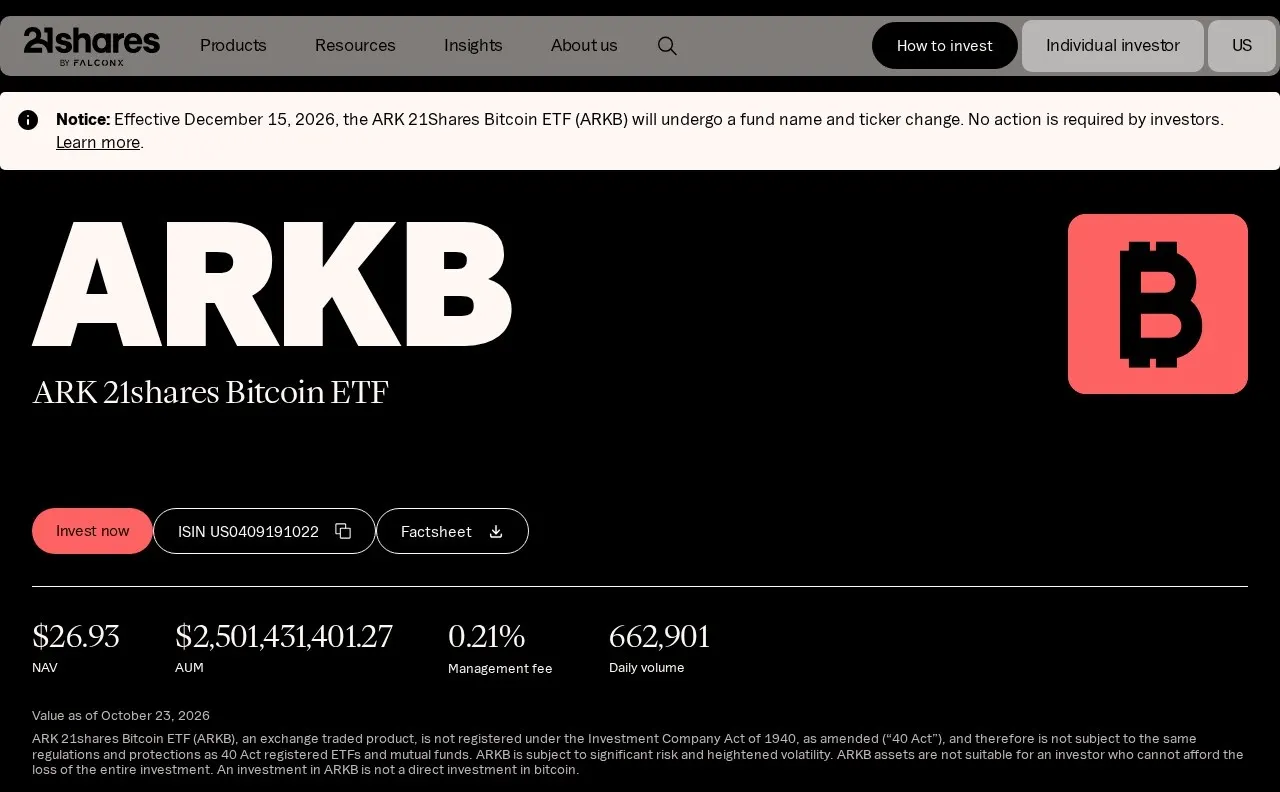
ARK 21Shares Bitcoin ETF (ARKB) is a spot bitcoin exchange-traded product listed on the Cboe BZX Exchange. It provides retail and institutional investors with direct exposure to bitcoin price movements within standard brokerage and tax-advantaged retirement accounts, avoiding the need to hold private keys or manage exchange wallets.
Sponsorship and management
The fund is sponsored and operated by 21Shares US LLC, an affiliate of European crypto ETP issuer 21Shares. Ark Investment Management LLC, founded and led by Cathie Wood, acts as the sub-advisor. Foreside Global Services LLC serves as the marketing agent, while Resolute Investment Distributors, Inc. handles sales services.
Structure and multi-custodian storage
ARKB holds physical bitcoin rather than derivatives. Its custody is diversified across three qualified institutional custodians: Anchorage Digital Bank N.A., BitGo Bank & Trust, N.A., and Coinbase Custody International, Ltd. The bitcoin is stored entirely in segregated offline cold storage. To compute its daily net asset value (NAV), the trust tracks the FTSE Bitcoin Index, which acts as the pricing benchmark.
Fees and trading availability
The fund carries a unitary management fee of 0.21% per year, which covers all standard operational and custodial costs. ARKB trades on the Cboe BZX Exchange under the ticker ARKB. It is available to investors in the United States through equity brokerages and self-directed retirement platforms, subject to standard broker account registration.
Track record and operational updates
ARKB launched on January 10, 2024, alongside the initial cohort of approved US spot bitcoin funds. On August 27, 2026, the trust shifted its pricing benchmark from the CME CF Bitcoin Reference Rate (New York Variant) to the FTSE Bitcoin Index. As of October 2026, the fund holds approximately $2.5B in net assets under management across 92.89 million shares outstanding. Effective December 15, 2026, the fund is scheduled to undergo a name and ticker change.
Risks and structural trade-offs
ARKB is an exchange-traded grantor trust and is not registered under the Investment Company Act of 1940, meaning it lacks the specific regulatory protections granted to traditional open-end mutual funds. Investors cannot redeem their fund shares for physical bitcoin directly. While the multi-custodian architecture spreads counterparty risk, investors remain exposed to bitcoin spot market volatility, tracking discrepancies between secondary market pricing and NAV, and long-term fee compounding.