Chainalysis

Blockchain intelligence platform used by over 50 regulators and 9 of the top 10 exchanges

Analytics tool Founded 2014 United States
Visit chainalysis.com
Our score
Very good
Tool type On-chain analytics
API access Yes
Alerts Yes

What is Chainalysis?

Chainalysis is a blockchain data and intelligence platform that helps organizations track illicit transactions, manage AML compliance, and investigate digital asset crime. Its data has assisted in freezing or seizing $34 billion in illicit cryptocurrency funds across more than 1,500 public and private sector clients.

Company background and leadership

Co-founded in 2014 by Michael Gronager, Jan Møller, and Jonathan Levin, the firm initially organized around analyzing the Mt. Gox hack. Gronager was previously the Chief Operating Officer of Kraken. Chainalysis is headquartered in New York City, with backers including Archetype and Digital Currency Group. In May 2024, the company relocated its regional headquarters for Southern Europe, the Middle East, Central Asia, and Africa to Dubai.

Core products and mechanics

The platform provides specialized software tools tailored to compliance and forensic workflows. Chainalysis Reactor visually maps the flow of funds across wallet clusters, identifying counterparties and tracing stolen assets across blockchains. For ongoing risk management, KYT (Know Your Transaction) evaluates transactions in real time to generate risk alerts for virtual asset service providers. Other products include Sentinel for stablecoin risk tracking, Rapid for automated triage, and Address Screening to flag exposure to sanctioned entities. The firm also maintains an API pipeline under Chainalysis Data Solutions for automated compliance monitoring.

Pricing and client onboarding

Chainalysis does not offer a public self-service pricing schedule or free tiers for individuals. Access requires scheduling a sales demo and negotiating institutional contracts based on transaction volumes, organization size, and software seat allocations. Services are deployed primarily to institutional compliance desks, banks such as BNY, and government agencies like IRS-CI.

Track record and operational trade-offs

The company's software is deployed across more than 50 regulators worldwide and is used by 9 of the top 10 centralized cryptocurrency exchanges. In October 2026, Chainalysis Reactor's attribution methodology withstood legal challenges under the Daubert evidentiary standard on appeal in U.S. federal court. However, its probabilistic clustering models have faced technical scrutiny in court trials, including Roman Sterlingov's 2022 legal proceedings, where defense experts questioned the reproducibility of proprietary heuristic outputs. The platform is designed solely for enterprise and legal investigators rather than retail market analytics.


Founders

Michael GronagerCo-founder

Former COO of Kraken

Jan MøllerCo-founder
Jonathan LevinCo-founder
Best for:Centralized exchange AML teamsLaw enforcement investigatorsFinancial regulators and tax agenciesInstitutional digital asset custodians

Pros and cons

Pros

  • Used by over 50 global regulatory agencies and 1,500 institutions
  • Assisted in seizing, freezing, or recovering over $34 billion in illicit assets
  • Reactor clustering methodology has withstood Daubert evidentiary review in federal court
  • Real-time transaction alerts integrate directly into exchange compliance pipelines

Cons

  • No free plan or self-serve individual tier available
  • Requires enterprise demo and custom sales contract pricing
  • Probabilistic clustering heuristics have faced scrutiny regarding reproducible court evidence
  • Not built for retail portfolio tracking or personal yield analytics

Our review

4.1/5
Very good

Chainalysis offers standard-setting blockchain forensics and compliance data for institutions, but its closed pricing and enterprise focus make it inaccessible to everyday retail traders.

Data quality5.0
Features4.5
Pricing2.0
Ease of use4.0
Coverage4.5

Chainalysis is the primary on-chain investigations and compliance platform used by law enforcement, regulators, and digital asset institutions. Founded in 2014, the New York-based firm built its reputation tracing stolen funds from early exchange breaches, eventually expanding its intelligence software across more than 1,500 enterprise customers, 50 regulatory bodies, and nine of the top ten centralized crypto exchanges. The platform specializes in entity clustering, real-time transaction monitoring, and risk scoring rather than retail portfolio management or trading charting.

The platform's primary strength lies in its forensic data quality and deep attribution graph. Its flagship visual investigation tool, Reactor, maps multi-hop fund flows across cross-chain bridges and mixing protocols. These attribution models have cleared the Daubert standard for admissibility in U.S. federal courts, standing up under evidentiary scrutiny in major criminal appeals. Complementing Reactor is KYT (Know Your Transaction), which delivers automated, API-driven risk scoring to screen wallet deposits and monitor virtual asset service providers (VASPs) for sanctions exposure. By October 2026, the company's intelligence had assisted in seizing, freezing, or recovering $34 billion in illicit assets.

However, Chainalysis has trade-offs that limit its utility outside institutional circles. Its forensic clustering relies on probabilistic heuristics, which drew intense scrutiny during the 2022 Bitcoin Fog trial regarding methodology transparency. The company does not offer a public self-serve tier or free plans; all deployments require private enterprise contracts and sales demos. Individual token traders seeking gas tracking, decentralized exchange liquidity heatmaps, or personal tax accounting will find the tool set misaligned with their everyday needs.

Chainalysis suits compliance officers and law enforcement investigators managing strict AML requirements. Retail crypto users and independent on-chain researchers should choose consumer-facing analytics dashboards or dedicated open-access portfolio trackers instead.

Listings are researched and drafted with AI assistance from public sources, then checked for accuracy and readability. Spot an error? Tell us. Editorial policy.
Sources (1)

Specs

Tool type On-chain analytics
API access Yes · unverified
Alerts Yes · unverified
Wallet tracking Yes · unverified

Not disclosed by the provider: Free plan, Paid plans from (per month), Chains covered, Mobile app, NFT data, CSV export.

Data from the provider's website and public sources. Fees and availability change; confirm on the official site before you sign up.

Key features

Reactor tracing

Maps transaction paths visually across blockchains to identify addresses linked to hacks, mixing services, and illicit entities.

KYT monitoring

Evaluates wallet deposits and withdrawals in real time, delivering automated alerts on AML and sanctions risk exposure.

Address screening API

Screens inbound and outbound cryptocurrency wallet addresses directly against sanctions lists and risk databases.

Sentinel stablecoin monitoring

Assesses and tracks transactional risk profiles across tokenized dollar networks and stablecoin issuers.

Rapid automated triage

Applies AI-assisted models to parse transaction patterns and speed up preliminary case assessments.

VASP risk profiling

Evaluates compliance policies and counterparty risk tiers for virtual asset service providers globally.

Inside Chainalysis

Reactor

An investigative tool that traces and maps fund flows across blockchains to identify entity connections and illicit activity.

KYT (Know Your Transaction)

A real-time transaction monitoring and anti-money laundering solution that flags risky transfers for digital asset businesses.

Address Screening

An API and web interface for checking wallet addresses against sanctions lists and risk databases before processing deposits.

Wallet Scan

A forensic tool that checks recovery seeds to identify and value seizable cryptocurrency balances.

Rapid

An AI-powered triage utility designed for fast, initial assessment of cryptocurrency investigation leads.

Sentinel

A compliance monitoring suite tailored to track stablecoin holdings, issuance, and secondary-market risk profiles.

VASP Risking

A profiling framework to assess the counterparty and regulatory risk of virtual asset service providers.

Alterya

An AI-assisted fraud detection and prevention module built to identify consumer scams before assets move.

Chainalysis screenshots

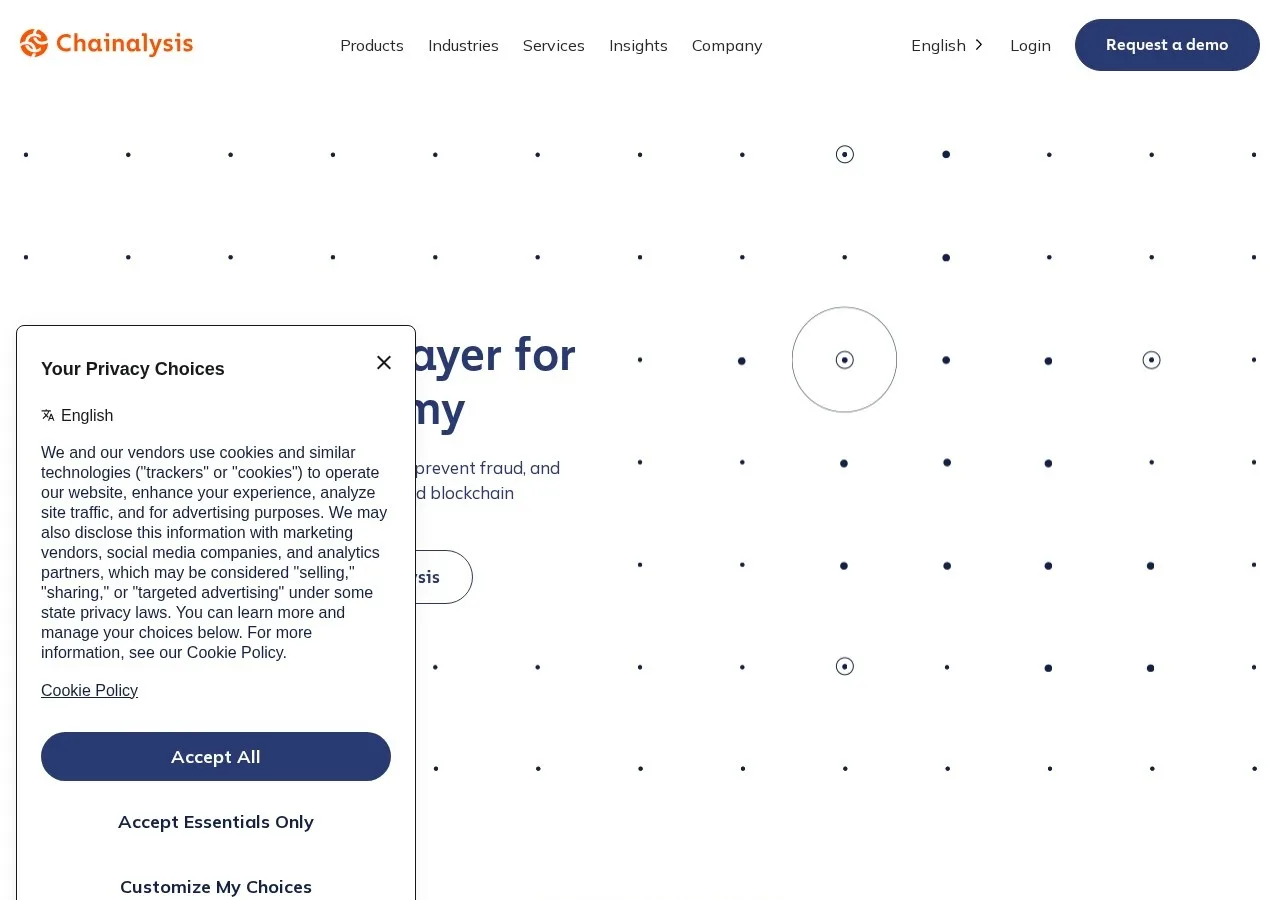
The Chainalysis homepage shows navigation, a hero section, and a privacy choices dialog
The Chainalysis homepage shows navigation, a hero section, and a privacy choices dialog · Oct 20, 2026

What users say about Chainalysis

Chainalysis is primarily referenced as an external reporting portal alongside law enforcement agencies, with no recurring user praise or complaints about its actual software.

Based on 17 Reddit posts and comments from the last 12 months, checked Oct 20, 2026. These are posts by users on other sites, not reviews submitted on CryptoReview.

User reviews

No user reviews yet. Have you used Chainalysis? Share your experience below.

Write a review of Chainalysis

Your rating
At least 40 characters. Please write about your own experience.

Reviews are moderated before they appear.

Funding and investors

1Round
2Investors
  1. Funding round Amount undisclosed

FAQ

Who founded Chainalysis?

Chainalysis was founded in 2014 by Michael Gronager, Jan Møller, and Jonathan Levin. Gronager previously served as chief operating officer at Kraken.

How much does Chainalysis cost?

Chainalysis does not publish fixed fee tiers or pricing schedules. Access requires contacting their enterprise sales team for a custom commercial contract.

What is Chainalysis Reactor used for?

Reactor is an investigative tool that connects cryptocurrency transactions to real-world entities. Analysts use it to visually trace stolen funds, identify laundering paths, and examine cross-chain transfers.

Has Chainalysis faced scrutiny over its forensic methods?

Defense teams during the 2022 Roman Sterlingov trial challenged Chainalysis heuristics over probabilistic clustering and software reproducibility. However, Reactor's evidentiary methodology was upheld under Daubert scrutiny in U.S. federal court.

Does Chainalysis have its own crypto token?

No, Chainalysis is a privately held software corporation and does not have a native cryptocurrency token.

Latest from Chainalysis on X

Chainalysis
@chainalysis · 69K followers
Follow
North Korean-linked actors have begun a new phase of laundering the funds stolen from Binance.

After draining $500M from TRON staging wallets, the launderers have started moving onto Solana.

The Reactor graph below shows the scale across blockchains. https://t.co/Pt3az4tJ0Y
Image attached to the post
36 79 373 53.2K View on X
THORChain just inadvertently delayed the laundering of a significant amount of funds stolen from Binance.

The reason? An Ethereum reorg.

One happened this morning and caused THORChain to incorrectly issue a double refund to someone who had deposited 10 ETH.

This triggered an “emergency pause” on THORChain, preventing all users, including DPRK’s money launderers, from using cross-chain swaps.

Until the service comes back online, neither the hackers nor anyone else can swap through a majority of THORChain’s bridges.
Image attached to the post
37 46 307 121.9K View on X
The Binance exploiters are rushing to stay a step of stablecoin freezes. One method we’re tracking involves stashing their stablecoins in DeFi protocols. Then claiming them back on new, clean addresses.

This method has been used on the Tron blockchain since the early hours of the $6.4 billion attack. It involves swapping TRX for stablecoins, then exchanging those stablecoins for depository receipt tokens. Unlike the stablecons they represent, these receipt tokens cannot be frozen. But they can be exchanged for the stablecoins they represent by whomever holds them. That’s an edge for prospective hackers and money launderers. Especially North Korean threat actors, who have used this method on other heists, too.

Here's how North Korea's TraderTraitor group moved $500K. Step by step.

Step 1: Start with TRX. The hackers moved TRX into a swap wallet, positioning the funds for the next stage of the laundering process.

Step 2: Swap into stablecoins. The hackers converted TRX into stablecoins through a DeFi exchange. The stablecoin offers liquidity and stability, with a catch: risk of freezing. The longer you hold illicit funds in stablecoins, the more likely its centralized issuer freezes your tokens. Circle and Tether have already contributed to $2.8 billion in freezes so far. This creates a critical vulnerability for the hackers and a potential intervention point for investigators. This is a dilemma for hackers — how to exploit stablecoin liquidity without the risk of freezing.

Steps 3 and 4: Move the stablecoins: To solve the dilemma, the hackers moved the stablecoins and deposited them in a DeFi lending protocol. In return, they received a deposit token that could not be frozen. Rather than holding stablecoin directly, they now held a token representing a claim on pooled assets. They can now transfer the claim to the asset without risking a freeze.

Steps 5 and 6: Move the claims token: The hacker moved their claim tokens to a new, clean wallet that was not tainted by association. That new wallet then converted the deposit token back to stablecoin.

Steps 7 and 8: Bridge the funds. The hackers then exfiltrated their assets from the Tron blockchain via a bridge, swapping freezable stablecoins on one side with unfreezable ETH on the other. Now the exploiter is free of worry of a freeze.

Of course, exchanging stablecoins for ETH does not make the hackers bulletproof. Chainalysis investigators analyze patterns like this to keep up with the hackers in real-time. We will continue to monitor how the blockchain is used and misused.
Image attached to the post
52 92 479 51.1K View on X
Our Co-founder and CEO @jony_levin spoke with @BBCNews today on the Binance exploit. https://t.co/7saRm7YNyX
6 8 46 5.5K View on X
Suspected North Korea-linked hacks account for nearly 89% of reported crypto hack losses so far this year. In 2021, that share was 15%.

The average reported loss per suspected DPRK-linked hack rose from $50.65M in 2021 to $185.65M in 2026 YTD, about 3.7x larger.

From 2021 through October 29, 2026,  suspected DPRK-linked hacks account for $13.24B of the $22.34B in reported losses, about 59%.
Image attached to the post
18 38 118 15.3K View on X

Recent public posts from @chainalysis, shown as published. Not reviewed or endorsed by CryptoReview.

Latest from Chainalysis on Telegram

Chainalysis
@chainalysisinc · 1.2K subscribers
Join
ACAMS Vegas is here! Join us tonight at the 🍸 Chainalysis-sponsored opening-night pool reception at ARIA’s Yucca Pool from 6-7:30p and try our signature Know Your Cocktail (KYC).

🤝 Want to meet with us tomorrow? Sign up here:
https://bit.ly/4rrjdfh
Image attached to the post
483 View on Telegram
✈️ Heading to ACAMS in Las Vegas? The Chainalysis team will be onsite and would love to connect! Request a meeting:
https://bit.ly/4rrjdfh

You can also catch us at the Chainalysis-sponsored opening-night pool reception on Tuesday, Sept. 29.
Image attached to the post
507 View on Telegram
🚨 Mule networks are the common thread behind fraud losses across P2P, remittances, e-commerce, account-to-account payments, and crypto rails.
Join our webinar, Scams and Money Mules in the Age of AI and Multi-Rail Finance, to learn how leading fraud, risk, payments, and compliance teams are:
🔹 Moving from post-transaction review to pre-transaction risk scoring
🔹 Applying intelligence at onboarding, screening, and investigation
🔹 Reducing losses and accelerating case resolution
🔹 Preparing for evolving Reg E expectations and scrutiny around authorized push payment fraud

🔗 Register now: https://www.chainalysis.com/webinars/scams-money-mules-age-of-ai-multi-rail-finance/
Image attached to the post
600 View on Telegram

Recent posts from the official Telegram channel @chainalysisinc, shown as published. Not reviewed or endorsed by CryptoReview.

Alternatives to Chainalysis

Open-source DeFi dashboard tracking TVL, fees, and yields across hundreds of chains

Market data · DashboardsFree planAPI access
4.6

Real-time DEX charting and screening platform tracking token pools across more than 60 blockchains

Market data · DashboardsFree planAPI access
4.5

Independent crypto market data aggregator tracking over 22,000 tokens across 360+ networks since 2014

Market data · Portfolio trackerFree planAPI access
4.4

Crypto market analytics and price aggregator tracking over 64 million digital assets since 2013

Market data · Portfolio trackerFree planAPI access
4.4

Ethereum block explorer and multichain indexing API covering over 60 networks

On-chain analytics · Wallet tracking +1Free planAPI access
4.4

Market charts and research used by 100M+ traders, with a $0 Basic plan

Market data · Research +2Free planAPI access
4.4