Wu Blockchain is an independent cryptocurrency news and research publication that provides reporting on Asian markets, digital asset exchanges, mining infrastructure and global regulation. Operating across web portals, social feeds, Substack and dedicated audio feeds, the publication delivers breaking market updates alongside longer analytical pieces for industry participants.
Corporate structure and leadership
The outlet was launched in 2019 by journalist Colin Wu, who is the platform's founder and lead. Wu Blockchain is operated by corporate entity Beijing Blue Seahorse Culture Communication Co., Ltd. (北京蓝色海马文化传播有限公司), based in Beijing, China. The organization maintains a compact core team of 1 to 10 staff members.
Publishing model and channels
Content distribution occurs primarily across web portals and Telegram feeds. The publication delivers real-time market wires alongside curated daily briefings, with specialized monthly reviews covering mining and venture capital. Coverage is distributed openly across multiple languages, including Chinese, English, Japanese, Korean and Russian. In addition to text briefs, the outlet produces podcast content and a Substack newsletter platform.
Distribution reach and regulatory filings
The brand's primary digital domain was registered in November 2021, and its Chinese web presence holds ICP filing 京ICP备2023026470号. As of October 2026, the publication's main X profile maintains over 558,000 followers, alongside more than 9,000 Substack newsletter subscribers and an estimated cumulative cross-platform reach of over 1.5 million readers.
Risks and editorial considerations
Operating under corporate registration in mainland China, the platform adheres to domestic regulatory notices such as PBOC guidance, restricting operations to technical and industry information sharing without offering investment advisory or trading services.
Founders
CW
Colin WuFounder & Lead
Best for:Asian crypto market observersMining and exchange analystsMacro policy researchers
Pros and cons
Pros
Deep coverage of Asian exchanges, regulatory shifts and mining developments
Open content access without paywalls across web, app and Telegram channels
Multi-language delivery in Chinese, English, Japanese, Korean and Russian
Established publishing track record operating continuously since 2019
Cons
Breaking news may require subsequent clarification
Operates under Chinese corporate compliance prohibiting financial services
Our review
3.8/5
Good
Wu Blockchain delivers reporting on Asian crypto markets and exchanges, with Chinese, English, Japanese, Korean and Russian content.
Accuracy4.0
Depth3.5
Independence3.5
Freshness4.5
Reading experience3.5
Founded in 2019 by journalist Colin Wu and operated under Beijing Blue Seahorse Culture Communication Co., Ltd., Wu Blockchain operates as a regional crypto news and research publication. Its reporting focuses on Asian regulatory shifts, mainland Chinese mining developments, and regional exchange policies. Content reaches audiences through its web portal, mobile app, and Substack newsletter. On X, it commands over 550,000 followers as of October 2026.
Coverage focuses on breaking market dispatches and regulatory actions across jurisdictions like Hong Kong and mainland China. Readers can find reporting on ETF flows, mining hardware and enterprise disputes. The service operates without a paywall. Both its quick news wire and analytical features remain open to readers without a subscription.
However, Wu Blockchain exhibits clear trade-offs:
The mainland Beijing corporate footprint requires the outlet to operate within regional regulatory guidelines, including published disclaimers regarding mainland financial directives.
The publication suits traders and analysts who require prompt updates on Asian crypto developments and centralized exchange affairs.
Listings are researched and drafted with AI assistance from public sources, then checked for accuracy and readability. Spot an error? Tell us. Editorial policy.
Not disclosed by the provider: Labels sponsored content.
Data from the provider's website and public sources. Fees and availability change; confirm on the official site before you sign up.
Key features
Multi-language editorial feed
Publishes market analysis and fast-breaking news across Chinese, English, Japanese, Korean and Russian portals.
Curated monthly reports
Produces specialized recurring briefs tracking exchange metrics, venture investments, mining industry updates and macro trends.
Audio and podcast programming
Hosts podcast content covering blockchain and cryptocurrency topics.
Direct email newsletters
Delivers regular editorial digests and market summaries straight to user inboxes through Substack.
Thematic reporting archives
Maintains dedicated archives on major industry themes, including Hong Kong policy, mainland China regulations and exchange disputes.
Mobile application reading
Provides dedicated mobile apps designed for reading daily market wires and editorial commentaries on the go.
Inside Wu Blockchain
1
快讯
The real-time breaking news feed delivering rapid updates on market shifts, regulatory events, and exchange developments.
2
深度
In-depth analytical articles examining crypto project valuations, company restructuring, and market mechanisms.
3
专题
Curated story archives that collect historical coverage on major industry events such as regulatory changes and exchange failures.
4
专栏
A recurring collection of monthly reports detailing venture capital, mining metrics, technology updates, and tax policies.
5
播客
Audio interview programming featuring founders, industry executives, and analysts discussing market trends and technical topics.
Wu Blockchain screenshots
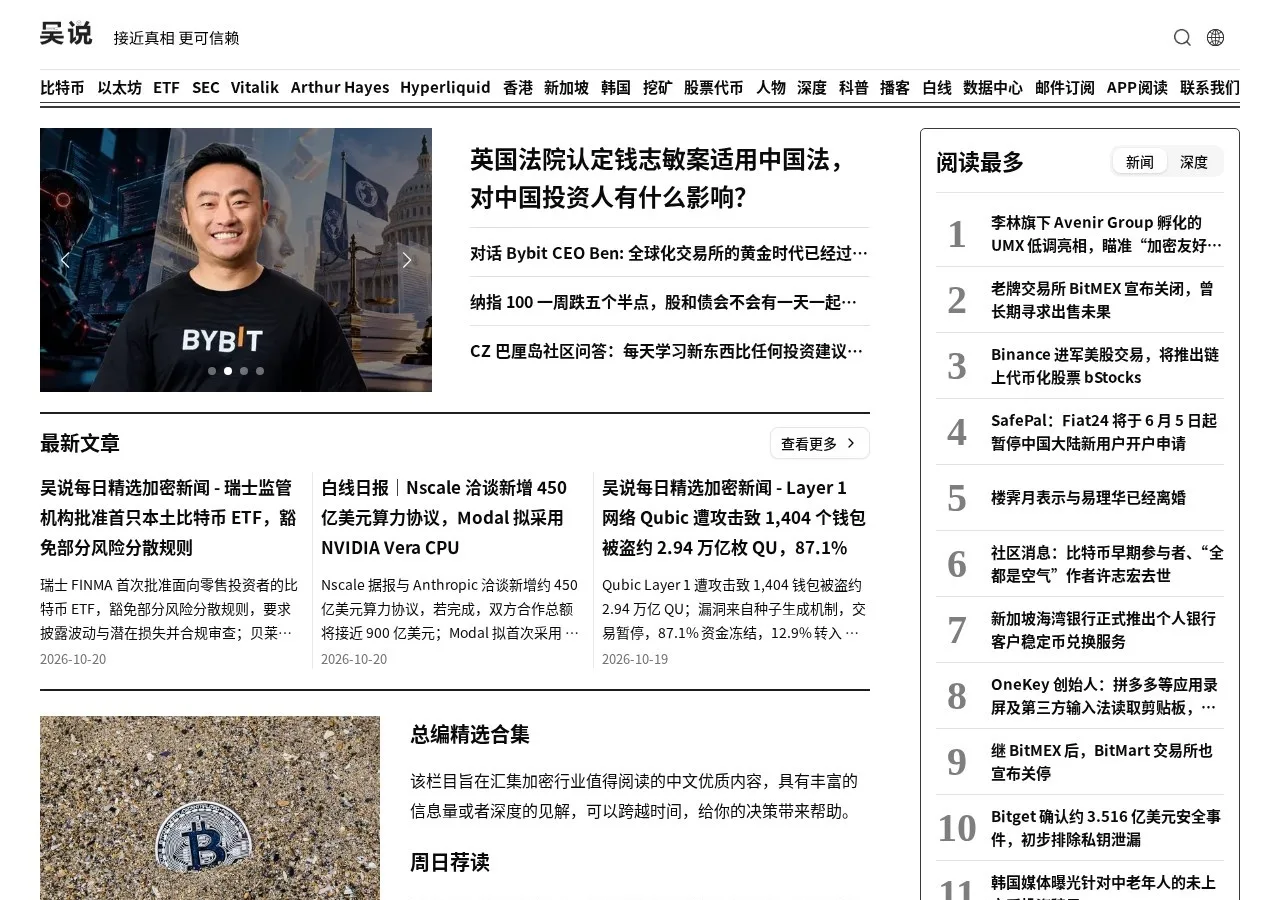
Wu Blockchain’s Chinese cryptocurrency news homepage with featured stories, latest articles, and a ranked reading list · Oct 20, 2026
What users say about Wu Blockchain
User commentary consists entirely of general market discussions, macroeconomic reactions, and technical debates triggered by reported news items. There are no direct assessments or feedback regarding Wu Blockchain as a platform or service.
Based on 152 X replies from the last 12 months, checked Oct 20, 2026. These are posts by users on other sites, not reviews submitted on CryptoReview.
User reviews
No user reviews yet. Have you used Wu Blockchain? Share your experience below.
FAQ
Who founded Wu Blockchain?
Wu Blockchain was founded in 2019 by crypto journalist Colin Wu. The publication is operated by Beijing Blue Seahorse Culture Communication Co., Ltd.
Does Wu Blockchain have a paywall?
No, Wu Blockchain's articles, newsletters, and news wire are freely accessible to readers. Content is available without a paid subscription across its website and Substack.
What languages does Wu Blockchain support?
Wu Blockchain offers content in Chinese, English, Japanese, Korean, and Russian.
Does Wu Blockchain have a native token?
No, Wu Blockchain does not issue or operate a cryptocurrency token. It functions strictly as an independent media and market news organization.
What topics does Wu Blockchain cover?
The outlet reports on crypto regulations, centralized exchanges, Bitcoin mining, macro markets, spot ETFs, and regional policies across Asia and North America. It also produces recurring monthly industry reviews covering venture capital and technology.
Binance 24H Net Outflows Fall to $3.29B From Earlier $7B Peak
According to DeFiLlama, Binance recorded about $3.29 billion in net outflows over the past 24 hours, down more than 50% from an earlier intraday peak of roughly $7 billion. DeFiLlama currently tracks about $127.78 billion in assets across Binance-linked on-chain wallets.
Brazil's Largest Crypto Exchange Mercado Bitcoin Confirms Cyberattack; Hypernative Estimates Over $40M in Suspected Losses
@MercadoBitcoin, Brazil's largest cryptocurrency exchange, confirmed on November 2 that one of its systems had suffered a cyberattack. The exchange said the incident was quickly contained, customers would not incur losses, and no customer data had been leaked. Deposits and withdrawals have been temporarily suspended as a precaution. According to preliminary analysis by blockchain security firm Hypernative, more than $40 million in suspicious transfers were identified across at least 10 blockchains, including Bitcoin, Ethereum, Solana, and Tron. The estimated losses have not been confirmed by the exchange, and the attack method remains unknown.
BitMine said it acquired 8,573 ETH over the past week, bringing total holdings to 6,060,506 ETH, or about 4.9% of Ethereum’s supply. The company has 5,227,037 ETH staked, while total crypto, cash, marketable securities and other investments stand at about $14.5 billion, including $498 million in cash and marketable securities.
Strategy Buys 811 BTC for $65.5M, Repurchases $208.2M in Preferred Stock
According to an SEC Form 8-K filed on November 2, Strategy purchased 811 BTC for approximately $65.5 million between October 26 and November 1, at an average price of $80,846 per BTC. As of November 1, the company held 849,327 BTC, acquired for a total of approximately $64.08 billion at an average cost of $75,451 per BTC. During the same period, Strategy sold approximately 1.18 million shares of MSTR common stock, generating $164 million in net proceeds, of which $65.5 million was used to purchase Bitcoin and $98.5 million was allocated to USD Cash. The company also repurchased approximately 2.09 million shares of its STRC preferred stock for $208.2 million.
ZachXBT: EU-Based Entity Suspected of Losing Over $106M in Crypto Theft
On-chain investigator ZachXBT reported on November 2 that an EU-based entity is suspected of losing more than $106 million from multiple centralized exchange accounts on November 1. The suspected attacker withdrew the funds in USDC and USDT and has since been actively swapping USDC for ETH, transferring assets through instant exchange services including WellWallet and Kyrrex, converting funds into privacy coin XMR via Wagyu, and bridging assets across multiple blockchains. The identity of the affected entity and the method of the suspected theft remain undisclosed. The reported losses have not yet been independently confirmed.
Binance Attacker Moved About $242 Million via Tron Within Two Days; Over $3 Billion in Stolen Assets Remain Largely Untouched
According to on-chain analyst SomaXBT, about two days after the Binance attack, the attacker transferred approximately $242 million through Tron-related paths. In the incident, roughly $628 million in assets on Tron were stolen. After Tether froze about 378.7 million USDT, the attacker moved funds via Relay, THORChain, Chainflip, Symbiosis and other channels. An additional approximately $41.7 million flowed through Bitget Wallet, with its destination still unconfirmed. About $7.5 million remains on Tron, while more than $3 billion in stolen assets held by the…
Issuer Objections to OKXICE Tokenized Stocks Expand to 50 Companies
The number of companies objecting to the tokenization of their shares on OKXICE TSV, a joint venture between OKX and NYSE parent ICE, has risen to 50, with Nvidia, Micron, Nike, Costco and Reddit among the latest additions. OKXICE had initially planned to offer tokenized trading in shares of 62 companies. Under the SEC’s temporary conditional exemption, issuers may submit a written objection within 30 calendar days of receiving notice to prevent tokenized versions of their shares, issued by an unaffiliated third party, from being traded on the venue. — link
China’s Communist Party Calls for Crackdown on Corruption Using Crypto and Blockchain
China’s Communist Party called for resolutely combating corruption committed via the internet, virtual currency, cross-border capital and blockchain, according to a resolution adopted at the Fifth Plenary Session of the 20th CPC Central Committee on October 29. The document also calls for stronger efforts to investigate cross-border corruption and recover illicit assets. — link
OneKey Founder: Some Older iPhones Have Unpatchable Chip Vulnerabilities, Posing Risks to Seed Phrase Storage
OneKey founder Yishi warned that factory-resetting an older iPhone, enabling airplane mode, and using it to store crypto wallet seed phrases offline may still be unsafe. He noted that iPhone 4S through iPhone X are affected by checkm8, while iPhone XS, XR, 11 series, and second-generation iPhone SE are affected by usbliter8, disclosed earlier this year. These BootROM-level vulnerabilities cannot be fixed through iOS updates. Attackers with physical access and specialized tools may exploit them via USB, even in airplane mode.
However, on models such as the XS and 11, these flaws…